




If you are studying Class 6 Social Science, Family and Community is one of the shortest chapters in the book and one of the easiest to score in. The 12-page PDF carries the Tiruvalluvar line on love and dharma, the Shalini and Tenzing stories, the Bhil halma tradition and the three end questions. This is the full printed chapter from Exploring Society: India and Beyond for the 2026-27 session, with nothing shortened or reworded.
- 12-page official file: Chapter 9 runs from printed page 137 to printed page 148 of the Class 6 textbook.
- Covers the three section heads Family, Roles and Responsibilities and Community.
- Carries 7 LET'S EXPLORE boxes, 1 THINK ABOUT IT box, 1 DON'T MISS OUT box, 3 real-life stories and 3 end questions.
This is the unedited NCERT chapter file for the 2026-27 print run, checked page by page against the official Exploring Society: India and Beyond release before it was put on this page.
Student Feedback
What 12,610 students told us about the Family and Community chapter, in a Collegedunia poll taken during the 2026-27 session.
- 68% of students said the Malayalam relationship words in Shalini's story were the part they got wrong in class tests.
- Most-mixed-up pair: Chittappa and Chitti, swapped by about 4 in 10 students surveyed.
- Students reported that drawing Shalini's family tree once fixed all seven names in a single sitting.
Source: 2026-27 Class 6 Social Science student poll. Sample of 12,610 students from CBSE schools across 17 states.
What the Family and Community Class 6 PDF Contains, Page by Page
The file is the printed chapter in full, not a summary sheet. It opens with a one-line quotation from Tiruvalluvar and closes with the three end questions on printed page 148. Use the table below to jump straight to the part you need.
| Section in the PDF | Printed pages | What is on these pages |
|---|---|---|
| Chapter opener | 137 | The Tiruvalluvar quotation on love and dharma, the two Big Questions, the Family section head and the photographs captioned 'Examples of joint families' |
| Family | 137 and 138 | Joint and nuclear families defined, the first LET'S EXPLORE box, the paragraph on Indian relationship words and the photographs captioned 'Examples of nuclear families' |
| Family relationship terms | 139 | A LET'S EXPLORE box with a three-column table, filled in with Rani and Sameer as worked examples |
| Roles and Responsibilities | 139 and 140 | Love, care, cooperation and interdependence, the six-question LET'S EXPLORE box, dharma and the four values the family teaches |
| Shalini's story | 140 and 141 | The Kerala family of seven, the Onam shopping trip, Acchamma's explanation and a LET'S EXPLORE box with the family-tree task |
| Tenzing's story | 141 and 142 | The Meghalaya household, the shared chores, what each grandparent does and the THINK ABOUT IT box |
| Family activities | 143 | A LET'S EXPLORE box asking for your own story, a class drama and the joint versus nuclear comparison |
| Community | 143 and 144 | What a community is, shared natural wealth, the unwritten rules and the duties that keep a community working smoothly |
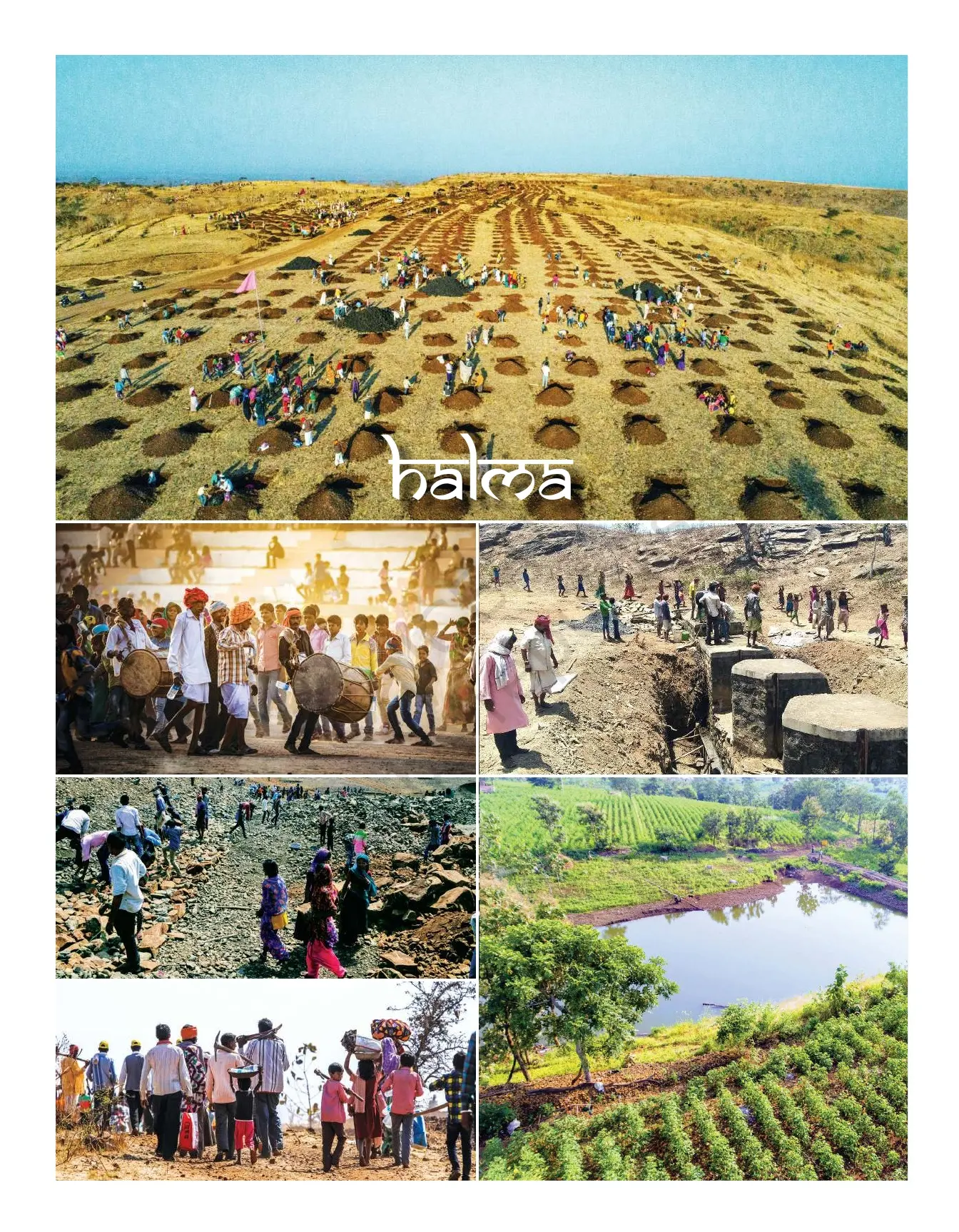
| The halma box | 144 | The DON'T MISS OUT box on Jhabua, the Bhil community, the Padma Shri award and the Chennai floods |
| The halma photo page | 145 | A full-page set of photographs of a halma gathering in Madhya Pradesh, captioned only with the word halma |
| Kamal Parmar's story | 146 and 147 | The Ahmedabad evening classes, the teacher's and the volunteer's quotations, and a four-question discussion set |
| New kinds of community | 147 and 148 | Residents' Welfare Associations, interdependence, jāti, the list of community examples and two more LET'S EXPLORE boxes |
| Before we move on and the questions | 148 | A three-point recap and 3 numbered questions, activities and projects |
Also Check:
The Tiruvalluvar Line and the Two Big Questions on Page 137 of the Family and Community Chapter
The chapter does not open with a definition. It opens with a single line from Tiruvalluvar: "Love and dharma are the flower and fruit of family life." Two Big Questions are printed just below it, and every section of the chapter answers one of them.
- Big Question 1: Why is the family unit important? Answered by the Family and Roles and Responsibilities sections.
- Big Question 2: What is a community and what is its role? Answered by the Community section from printed page 143 onwards.
- The chapter's own one-line answer to the first question sits in the opening paragraph: the family is the fundamental and most ancient unit of any society.
Learn the quotation and the two questions together. A one-mark question in a class test often asks who the opening line belongs to, and the answer is Tiruvalluvar, not the textbook.
Family, Values and Community Revised in One Sitting
Source: Magnet Brains on YouTube
Joint Families and Nuclear Families: The Two Types the Class 6 Chapter Defines
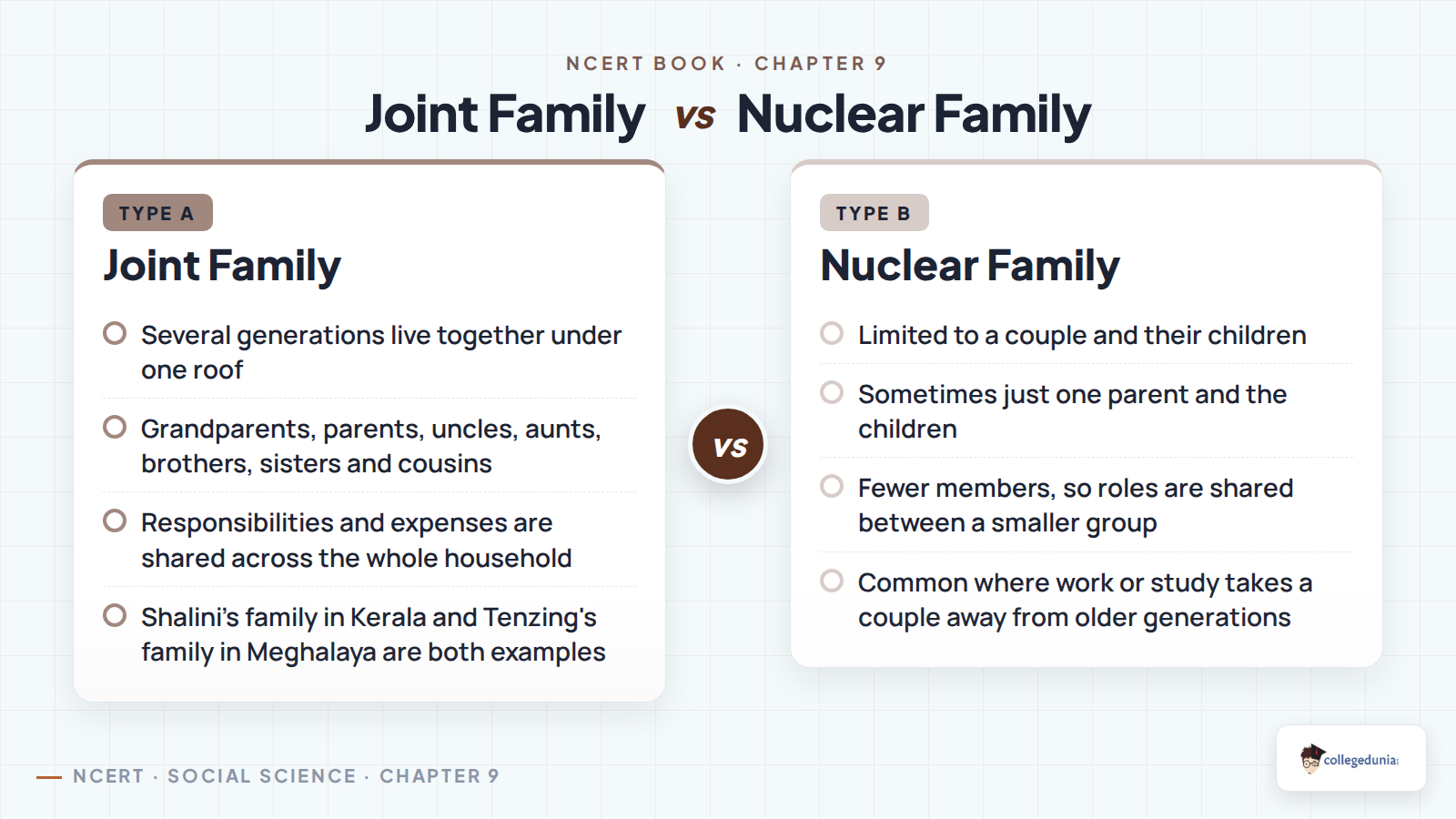
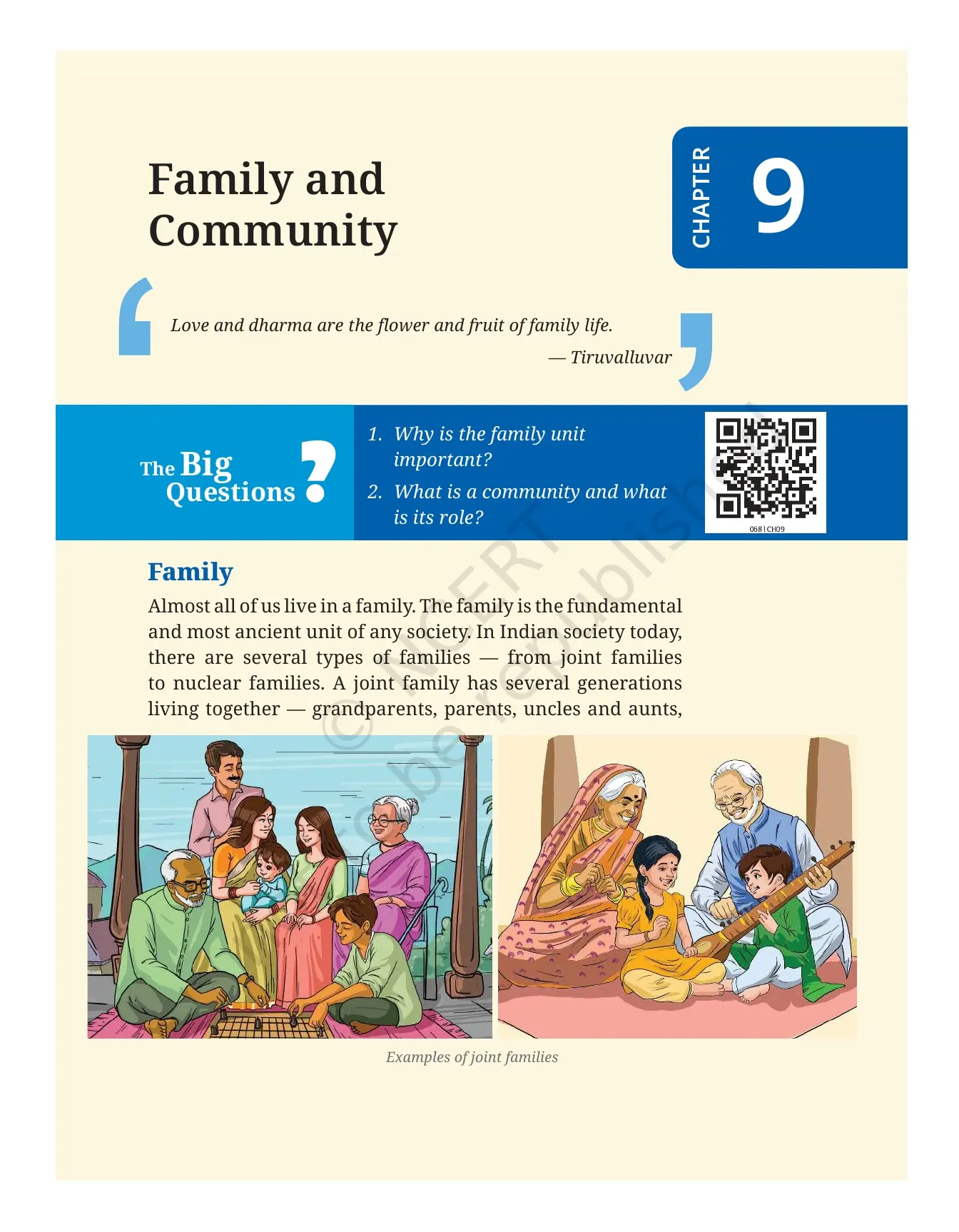
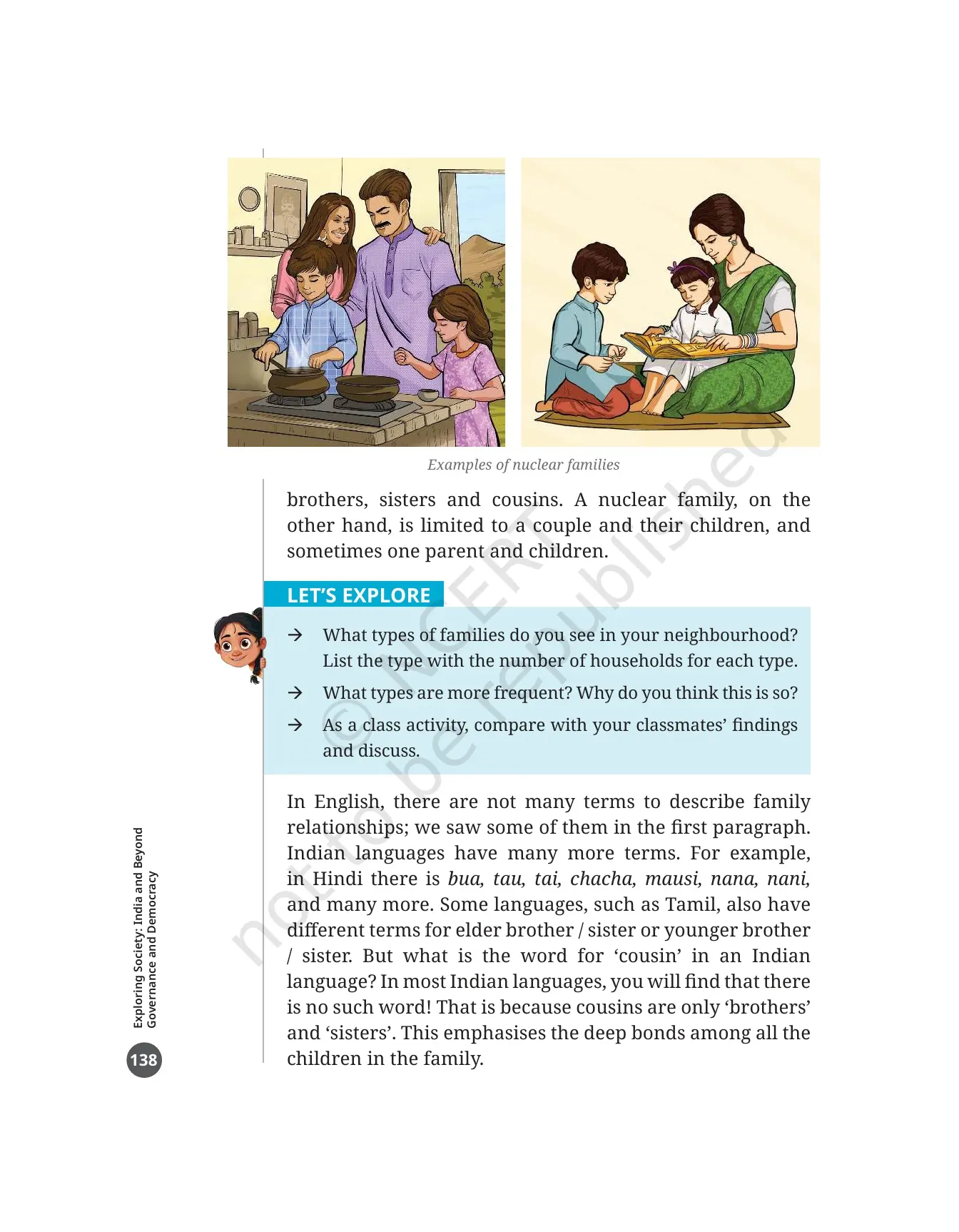
Almost all of us live in a family, and the chapter says Indian society today holds several types of them. It names two and defines both in a single sentence each. This is the most-asked pair in the whole chapter, so learn the definitions word for word.
| Type | What the chapter says | Who lives in it |
|---|---|---|
| Joint family | Has several generations living together | Grandparents, parents, uncles and aunts, brothers, sisters and cousins |
| Nuclear family | Is limited to a couple and their children | A couple and their children, and sometimes one parent and children |
| In the pictures | Printed page 137 is captioned 'Examples of joint families' and printed page 138 is captioned 'Examples of nuclear families' | Both photograph sets are unnumbered, so quote the printed page instead of a figure number |
The first LET'S EXPLORE box on printed page 138 turns the definitions into fieldwork. Count the types of families in your own neighbourhood, write the number of households against each type, say which type is more frequent and why, then compare your findings with your classmates in a class activity.
Why Indian Languages Have No Word for 'Cousin' and English Has So Few Relationship Terms
This is the most quoted paragraph in the chapter and the one that surprises students most. English has only a handful of words for family relationships. Indian languages have far more, and one common English word is missing from them altogether.
- Hindi terms the chapter names: bua, tau, tai, chacha, mausi, nana and nani, and it adds that there are many more.
- Tamil also has different terms for an elder brother or sister and a younger brother or sister.
- In most Indian languages there is no word for 'cousin', because cousins are only 'brothers' and 'sisters'.
- The chapter's reason: this emphasises the deep bonds among all the children in the family.
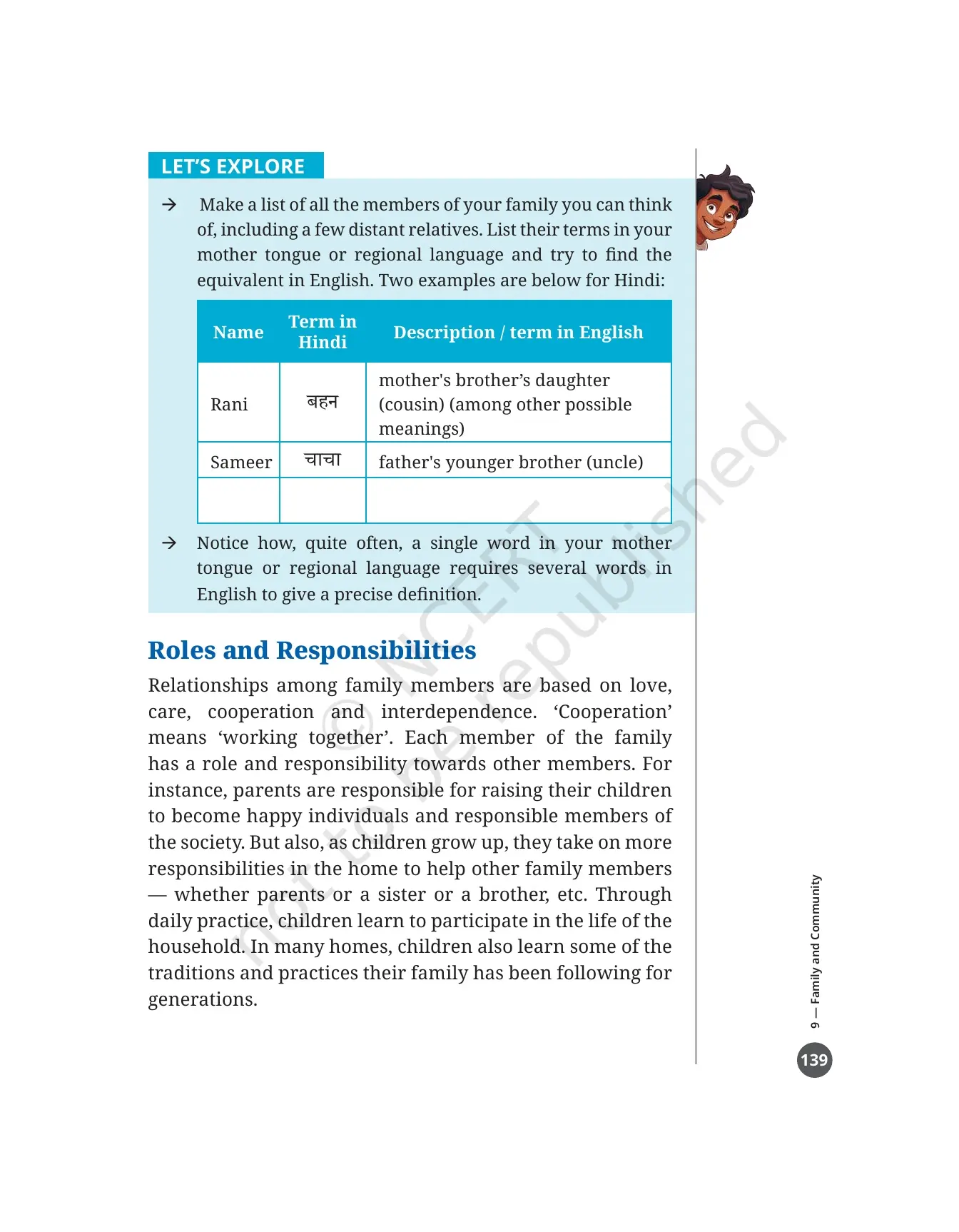
The LET'S EXPLORE box on printed page 139 asks you to list every family member you can think of, including a few distant relatives, write their term in your mother tongue or regional language and then find the English equivalent. Two rows are already filled in for you.
| Name | Term in Hindi | Description or term in English |
|---|---|---|
| Rani | बहन | Mother's brother's daughter (cousin), among other possible meanings |
| Sameer | चाचा | Father's younger brother (uncle) |
The box closes with the point the marker looks for: a single word in your mother tongue often needs several English words to give a precise definition.
Roles and Responsibilities: How the Family Works as a 'School' of Values
The second section head on printed page 139 explains what holds a family together. Relationships among family members are based on love, care, cooperation and interdependence, and the chapter stops to define one of those words: 'cooperation' means 'working together'.
- Each member of the family has a role and responsibility towards the other members.
- Parents are responsible for raising their children to become happy individuals and responsible members of the society.
- As children grow up, they take on more responsibilities in the home to help parents, a sister or a brother.
- Through daily practice, children learn to participate in the life of the household.
- In many homes, children also learn traditions and practices their family has been following for generations.
Then comes the line that carries the section. Following our dharma, or doing our duty, has been an important principle of Indian culture. The family is also a 'school', and the chapter names the four values it teaches.
| Value | What the chapter gives as its meaning |
|---|---|
| Ahimsa | Listed first among the values learnt in the family |
| Dāna | Giving |
| Sevā | Service |
| Tyāga | Sacrifice |
| Why they matter | Individuals in the family often give up their own needs to take care of the family's needs |
The LET'S EXPLORE box on printed page 140 asks six short questions about your own home and tells you to compare your answers with a few classmates: who decides what is to be bought from the market, who cooks the food, who is the oldest person in your family, who cleans the floor, who washes the utensils and who helps you with your homework.
Shalini's Onam Story from Kerala and What Her Family of Seven Teaches About Sharing
The chapter proves the four values with a story instead of a lecture. Shalini lives with her family in a town in Kerala. Her father runs a small business and her mother teaches in a nearby school. Seven people share the home, and the Malayalam relationship words are the part students most often get wrong.
| Member | Who they are |
|---|---|
| Shalini | The girl whose story this is |
| Her father | Runs a small business |
| Her mother | A teacher in a nearby school |
| Her younger brother | The fourth member of the household |
| Acchamma | Her grandmother, who is her father's mother |
| Chittappa | Her father's brother, that is her paternal uncle, who has just lost his job |
| Chitti | Her aunt, the uncle's wife, who is a homemaker |
| Chinni | Shalini's cousin, the daughter of Chittappa and Chitti |
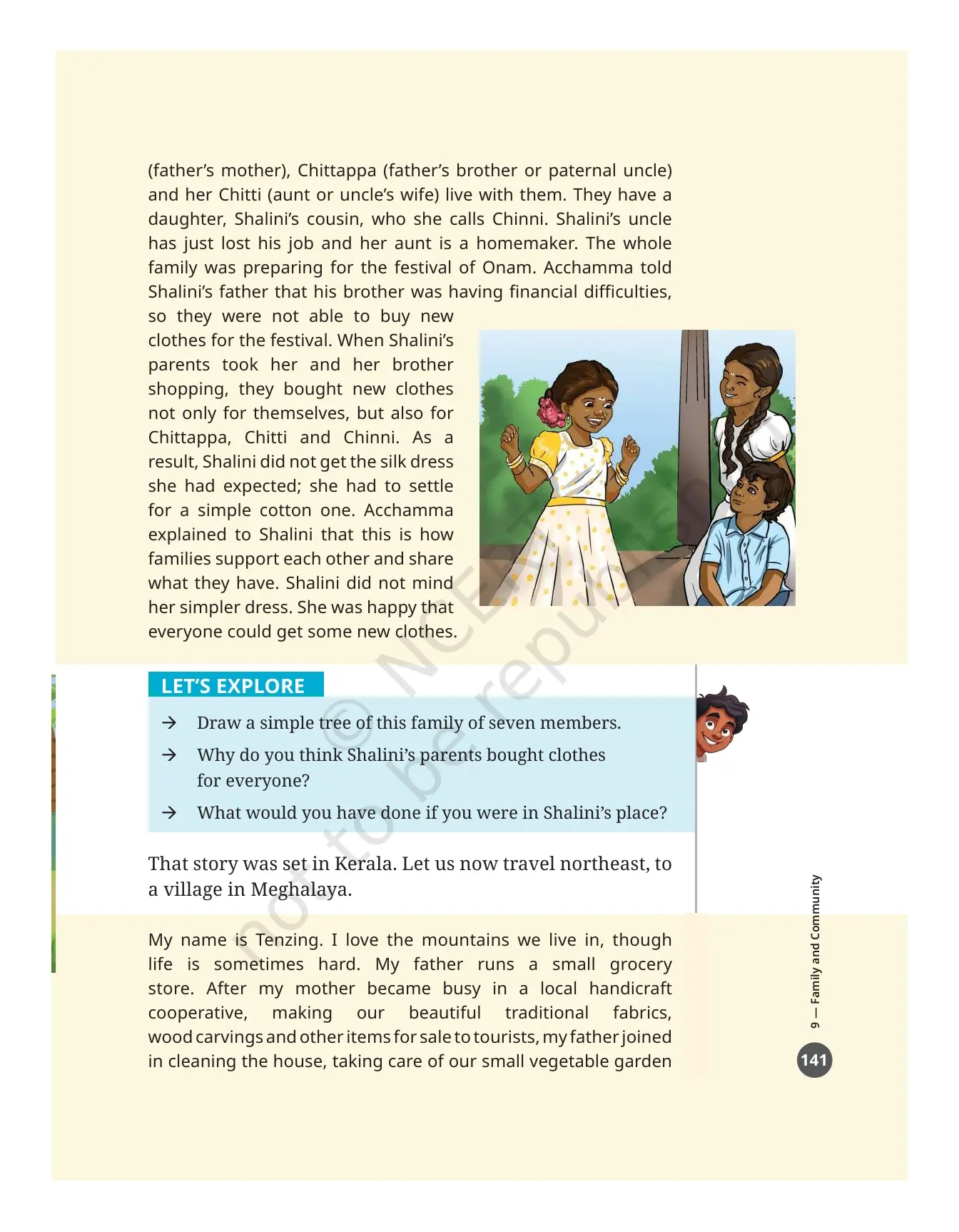
The whole family was preparing for the festival of Onam. Acchamma told Shalini's father that his brother was in financial difficulty and could not buy new clothes. So when Shalini's parents took her and her brother shopping, they bought new clothes for Chittappa, Chitti and Chinni as well.
Shalini did not get the silk dress she had expected and had to settle for a simple cotton one. Acchamma explained that this is how families support each other and share what they have, and Shalini did not mind. She was happy that everyone could get some new clothes. The LET'S EXPLORE box then asks three things.
- Draw a simple tree of this family of seven members.
- Why do you think Shalini's parents bought clothes for everyone?
- What would you have done if you were in Shalini's place?
Tenzing's Family in Meghalaya and the Household Chores Everyone Shares
The second story travels northeast, to a village in Meghalaya. Tenzing loves the mountains, though he says life is sometimes hard. This story is about who does what at home, and it is the one the examiner uses for the question on changing roles.
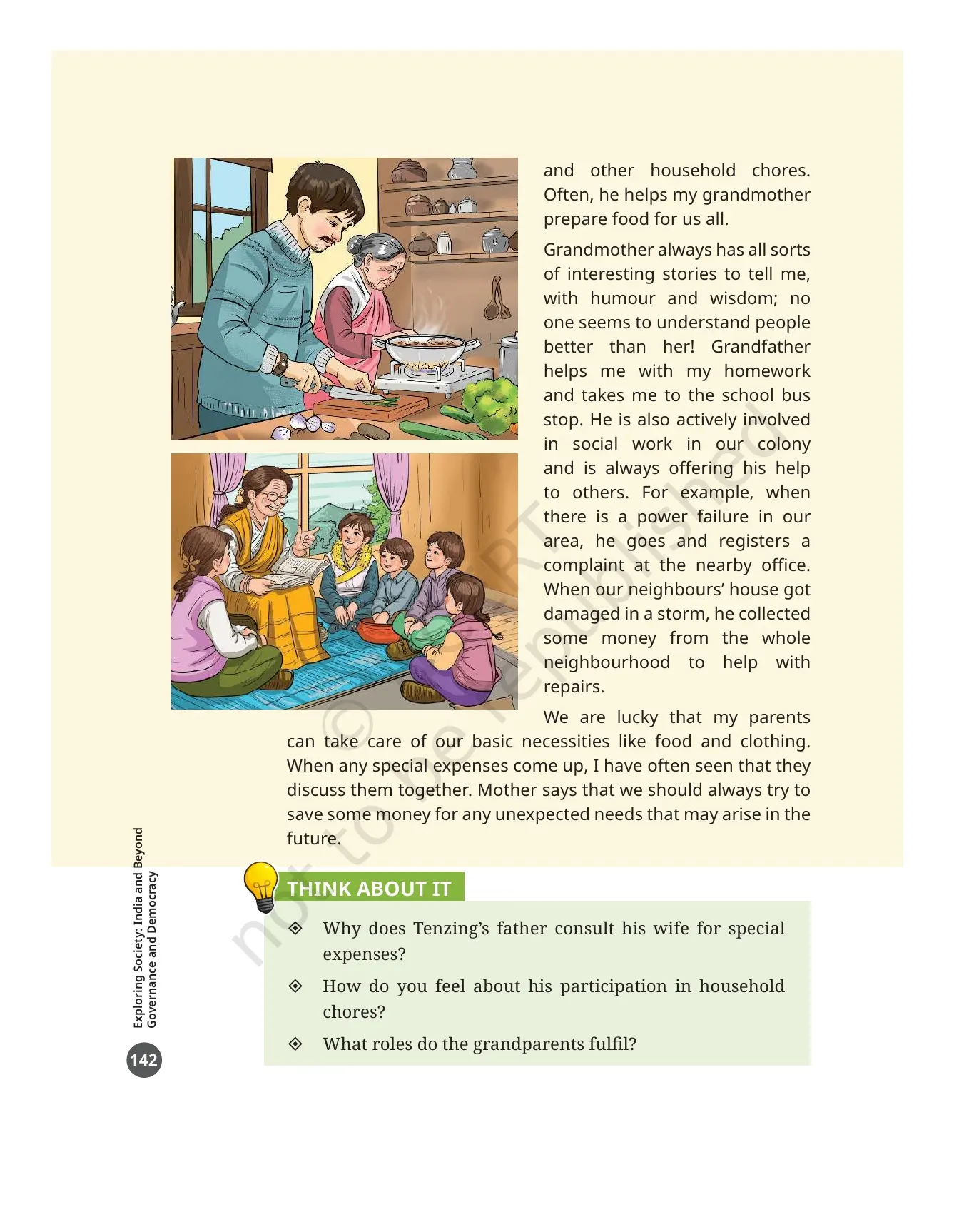
- Father: runs a small grocery store. After the mother got busy outside the home, he joined in cleaning the house, tending the small vegetable garden and doing other household chores, and he often helps the grandmother prepare food.
- Mother: works in a local handicraft cooperative, making traditional fabrics, wood carvings and other items for sale to tourists.
- Grandmother: always has interesting stories to tell, with humour and wisdom. Tenzing says no one seems to understand people better than her.
- Grandfather: helps Tenzing with his homework, takes him to the school bus stop and is actively involved in social work in the colony.
- Two examples of that social work: he registers a complaint at the nearby office when there is a power failure in the area, and he collected money from the whole neighbourhood when a neighbours' house was damaged in a storm.
- Money at home: the parents can take care of basic necessities like food and clothing, they discuss any special expenses together, and the mother says they should always save some money for unexpected future needs.
The THINK ABOUT IT box on printed page 142 asks three questions on exactly this: why Tenzing's father consults his wife for special expenses, how you feel about his taking part in household chores, and what roles the grandparents fulfil.
Printed page 143 closes the Family half with one more LET'S EXPLORE box. Create a story of a family somewhere in India where family values are practised and share it through writing or drawing, stage a small class drama around two or three families facing challenging situations, and then answer the big comparison: what aspects of modern living make some couples opt for a nuclear family, and what are the advantages and disadvantages of the two kinds of families?
Community: Shared Natural Wealth and the Rules That Were Rarely Written Down
The Community section starts from a simple observation. Families are connected not only within themselves but also with other families and the people around them, and such a group of connected people may be called a 'community'. The chapter adds a warning students should copy down: there are other meanings for the word, depending on the context.
- Why members come together: celebrating festivals, and organising feasts, weddings and other events.
- In some villages: people support each other with agricultural practices such as land preparation, sowing and harvesting.
- Shared natural wealth: over time communities agreed on practices for using water, grazing lands and forest produce.
- Where this is seen: in many tribal communities, and to some extent in village communities in rural India today.
- The rules: we may call these practices 'rules', though they were rarely written down. They gave communities secure access to resources.
- The catch: all families and individuals within the community have specific duties to perform, otherwise the community will not function smoothly.
That last point is the answer to Big Question 2. A community is not only a group that receives support. It is a group in which every member owes something back.
The Halma Tradition of the Bhils and the Chennai Floods in the DON'T MISS OUT Box
Printed page 144 carries the chapter's only DON'T MISS OUT box, and it holds two real examples of a community at work. Both are named in class tests, so keep the places and the words straight.
| Detail | What the chapter says |
|---|---|
| The place | The region around the town of Jhabua, in Madhya Pradesh, which suffered an acute water crisis year after year |
| The community | The Bhil community |
| Halma | Their tradition of coming together to support any individual or family in times of crisis |
| What they did | Planted thousands of trees in hundreds of villages, dug many trenches to conserve rainwater and created other water harvesting structures |
| What they were paid | Nothing. They did it as their duty towards their community and the environment. In the halma tradition the objective is to serve Mother Earth |
| The award | In 2019, Shri Mahesh Sharma of the Shivganga movement was honoured with the Padma Shri for his transformational work with the Bhil communities |
| The second example | During the Chennai floods of 2015, roads turned to rivers, almost all shops were closed and services were interrupted. Many private groups, in particular spiritual and religious organisations, cooked large quantities of food and distributed it to people who needed it |
The box ends by asking whether you have heard of any other examples of people doing something for the benefit of the community without expecting anything in return. Printed page 145 that follows is a full page of photographs of a halma gathering, captioned only with the word halma.
Kamal Parmar's Evening Classes in Ahmedabad and What the Volunteers Said They Learnt
The halma story shows community in a rural setting. The chapter then says community also exists in an urban setting, though it may work a little differently, and gives one more real-life story to prove it.
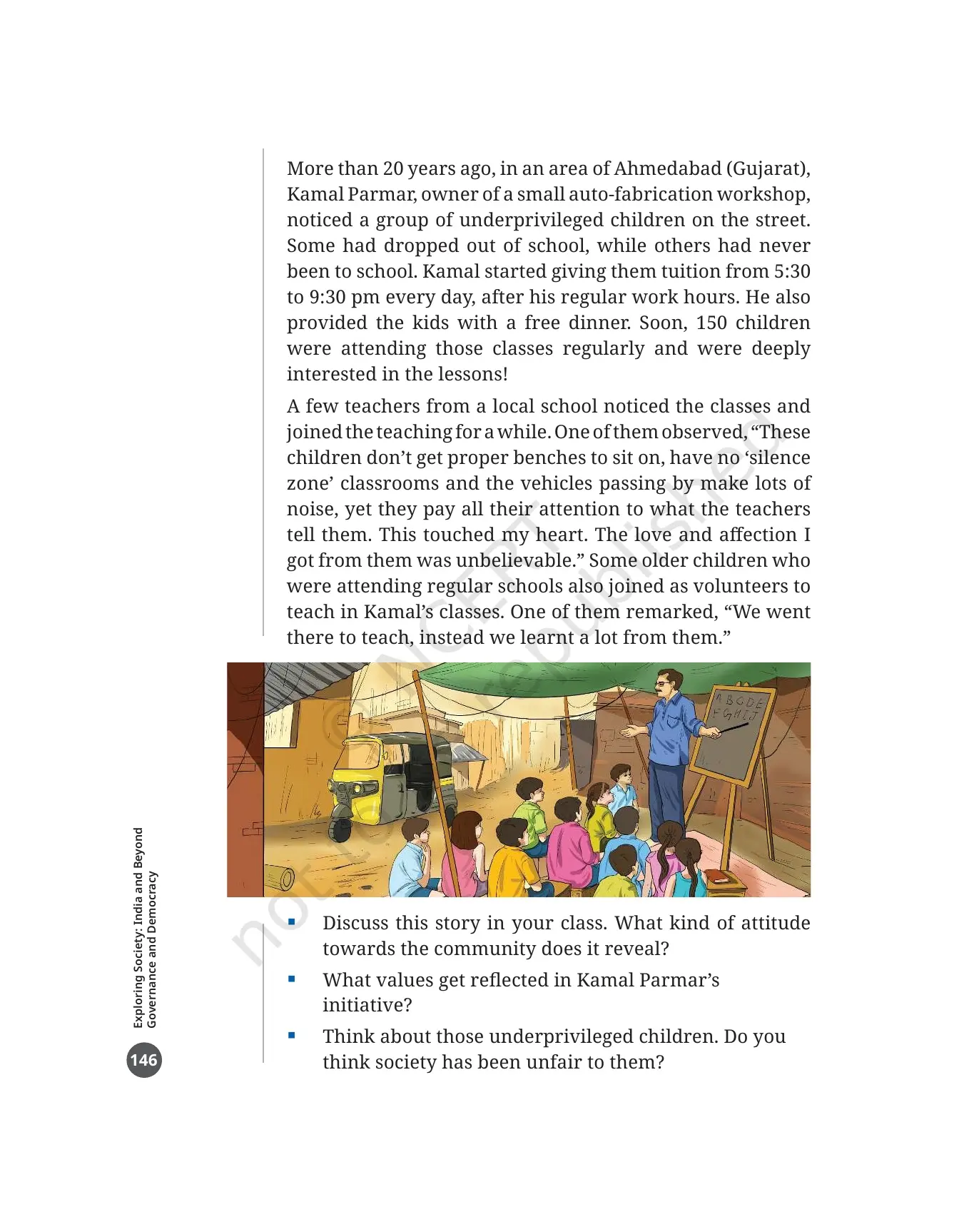
- When and where: more than 20 years ago, in an area of Ahmedabad, Gujarat.
- Who: Kamal Parmar, the owner of a small auto-fabrication workshop, who noticed a group of underprivileged children on the street. Some had dropped out of school and others had never been to school.
- What he did: gave them tuition from 5:30 to 9:30 pm every day, after his own work hours, and provided the children with a free dinner.
- How it grew: soon 150 children were attending those classes regularly and were deeply interested in the lessons.
- Who joined in: a few teachers from a local school taught there for a while, and some older children from regular schools joined as volunteers.
The chapter prints two quotations from the story. One teacher observed that the children had no proper benches and no 'silence zone' classrooms, and that passing vehicles made a lot of noise, yet the children paid full attention. She added: "This touched my heart. The love and affection I got from them was unbelievable." A volunteer put it more simply: "We went there to teach, instead we learnt a lot from them."
Four discussion questions follow across printed pages 146 and 147.
- Discuss this story in your class. What kind of attitude towards the community does it reveal?
- What values get reflected in Kamal Parmar's initiative?
- Think about those underprivileged children. Do you think society has been unfair to them?
- What should society do to make sure that all children get access to education?
Residents' Welfare Associations, Jāti and Why Communities Are Interdependent
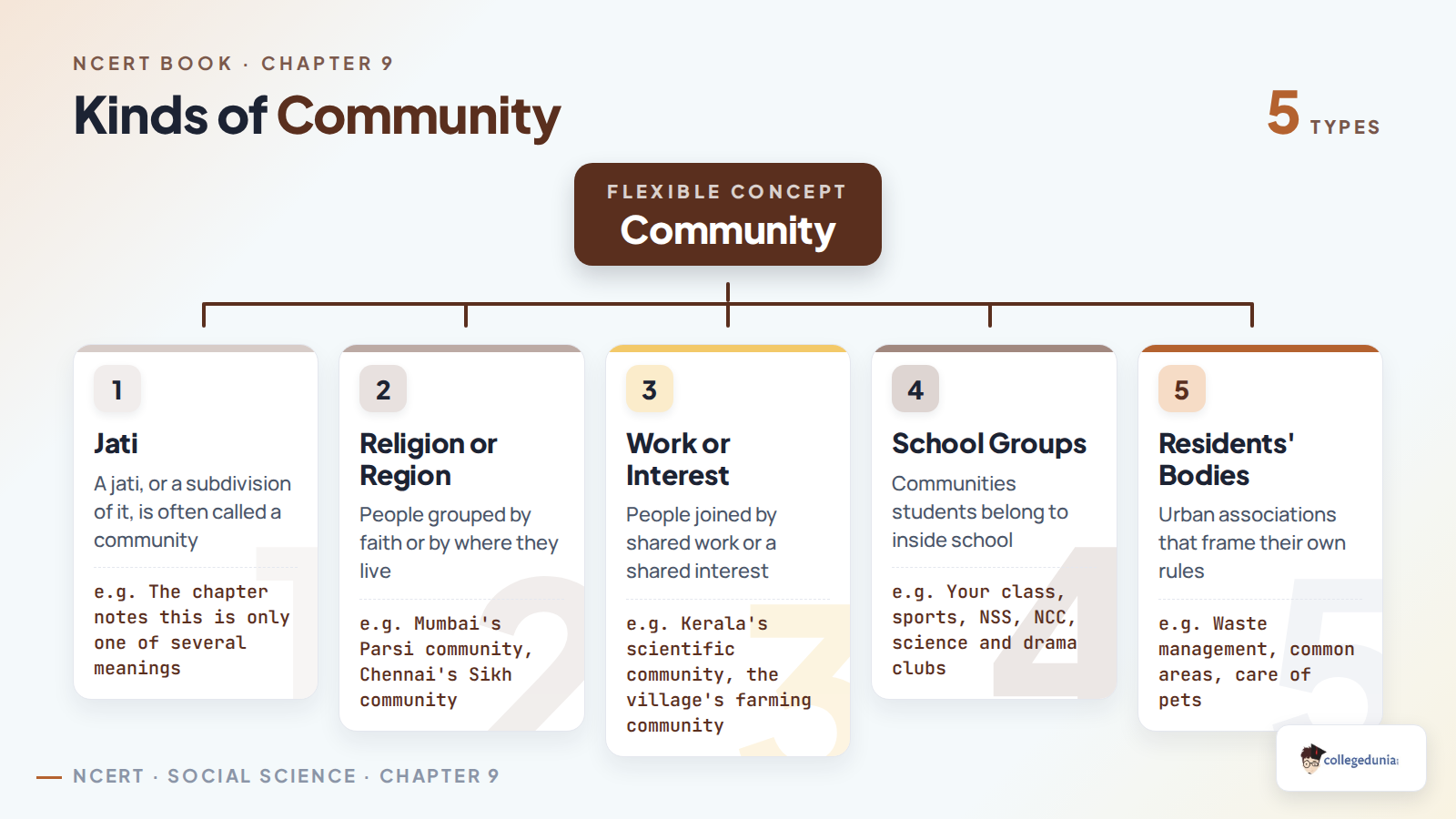
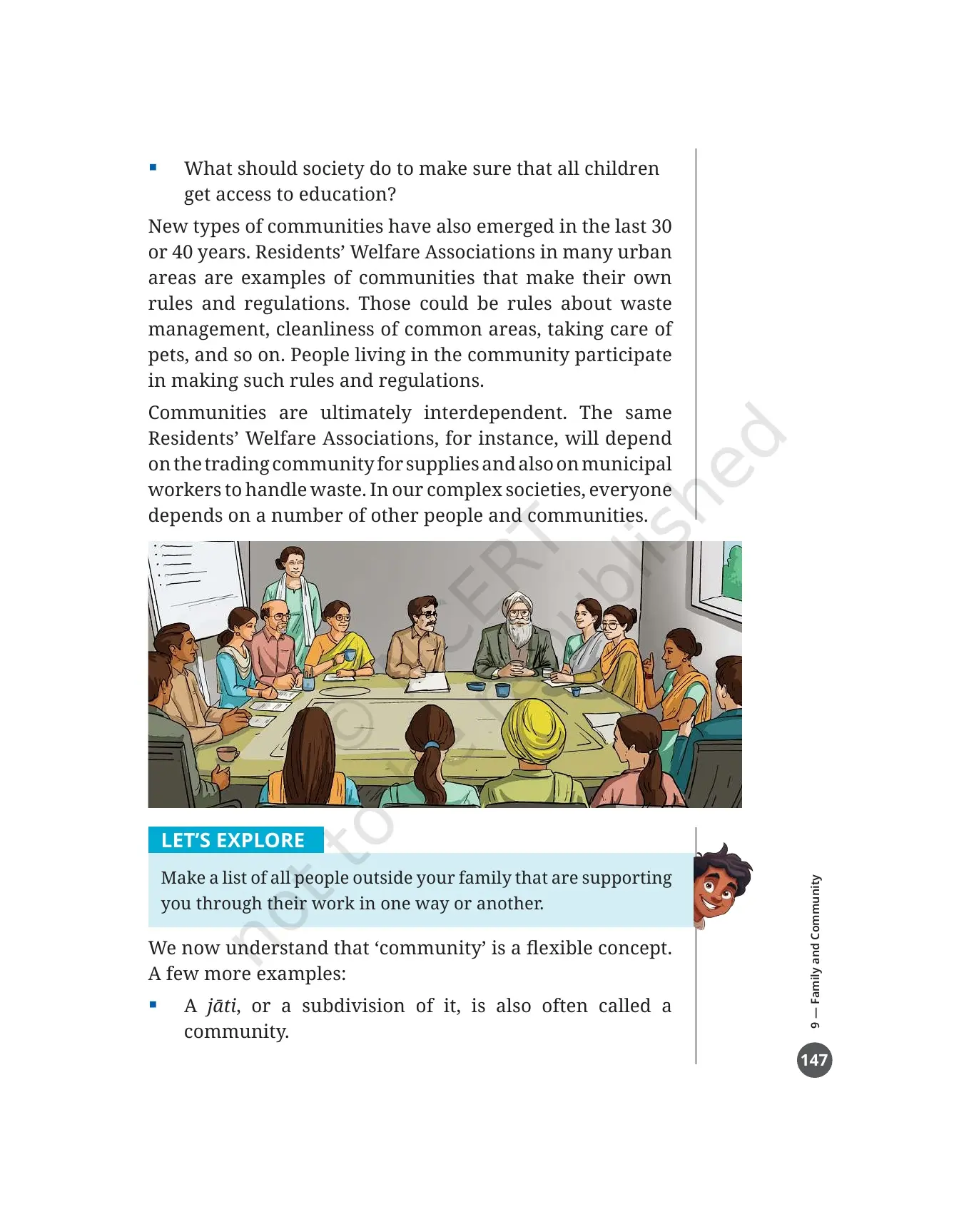
The last two printed pages widen the word 'community' until it covers a school club. Start with the newest kind. New types of communities have emerged in the last 30 or 40 years, and Residents' Welfare Associations in many urban areas are the example the chapter picks.
- What they do: make their own rules and regulations about waste management, cleanliness of common areas and taking care of pets.
- Who makes the rules: the people living in the community take part in making them.
- Why they are interdependent: the same association depends on the trading community for supplies and on municipal workers to handle waste.
- The closing idea: in our complex societies, everyone depends on a number of other people and communities.
A LET'S EXPLORE box on printed page 147 makes that concrete. List all the people outside your family who support you through their work in one way or another. The chapter then says 'community' is a flexible concept and gives a short list of the other things the word can mean.
| Sense of the word | Examples the chapter prints |
|---|---|
| A jāti | A jāti, or a subdivision of it, is also often called a community |
| A group by religion, region, work or interest | 'Mumbai's Parsi community', 'Chennai's Sikh community', 'America's Indian community', 'Kerala's scientific community', 'our school's art community' and 'the village's farming community'. The chapter says the list is endless |
| Communities inside your school | Your class, the sports community, the National Service Scheme, the National Cadet Corps, and a science or drama club |
The final LET'S EXPLORE box on printed page 148 asks what types of communities you are part of, and whether there is a club you belong to in school and how it functions.
Every Photograph, Activity Box and Story Inside the Family and Community PDF
Unlike Chapter 8, this chapter does not number its images, so there is no 'Fig. 9.1' to quote. Refer to the printed page instead. Ten activity boxes and three real-life stories carry the whole chapter, and the checklist below is the fastest way to make sure you have not skipped one.
| Box, photograph or story | Printed page | What it shows or asks |
|---|---|---|
| The opening quotation | 137 | Tiruvalluvar on love and dharma as the flower and fruit of family life |
| The Big Questions | 137 | Why the family unit is important, and what a community is and what its role is |
| 'Examples of joint families' | 137 | Two unnumbered photographs of three-generation households |
| 'Examples of nuclear families' | 138 | Unnumbered photographs of couples with their children |
| LET'S EXPLORE 1 | 138 | Types of families in your neighbourhood, the number of households for each type, which type is more frequent and why |
| LET'S EXPLORE 2 | 139 | The Name, Term in Hindi and English table, worked out for Rani and Sameer |
| LET'S EXPLORE 3 | 140 | Six questions on who does what in your own home, to be compared with a few classmates |
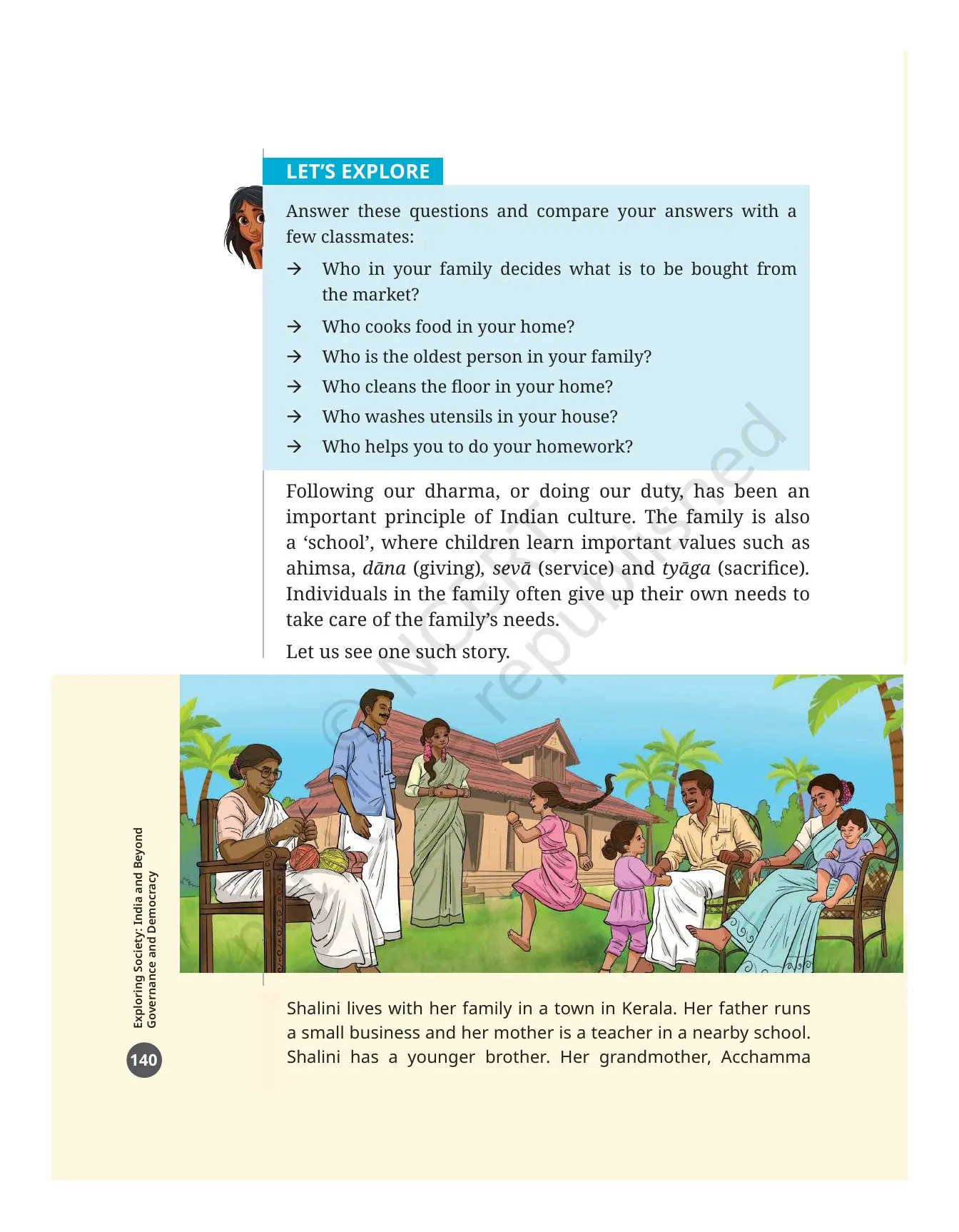
| Shalini's story and its picture | 140 and 141 | The Kerala family of seven and the Onam shopping trip, with an illustration of the family |
| LET'S EXPLORE 4 | 141 | Draw the family tree of seven members, say why the parents bought clothes for everyone and what you would have done |
| Tenzing's story and its picture | 141 and 142 | The Meghalaya household, the shared chores and the grandparents' roles, with an illustration of the family |
| THINK ABOUT IT | 142 | Why the father consults his wife on special expenses, how you feel about his share of the chores, and what roles the grandparents fulfil |
| LET'S EXPLORE 5 | 143 | Create a family story, stage a class drama, and compare joint and nuclear families |
| DON'T MISS OUT | 144 | The Bhil halma tradition at Jhabua, the Padma Shri in 2019, and the Chennai floods of 2015 |
| The halma photo page | 145 | A full page of photographs of a halma gathering, captioned only halma |
| Kamal Parmar's story and its picture | 146 | The Ahmedabad evening classes, with an illustration of the street classroom |
| Discussion set | 146 and 147 | Four questions on the attitude the story reveals, the values it shows, fairness to the children and access to education |
| LET'S EXPLORE 6 | 147 | List all the people outside your family who support you through their work |
| LET'S EXPLORE 7 | 148 | What types of communities you are part of, and the club you belong to in school |
| Before we move on ... | 148 | A three-point recap on the family as the foundation of society, community as a bigger unit, and interdependence |
Questions, Activities and Projects at the End of the Family and Community Chapter
Printed page 148 carries only 3 numbered items, the shortest end set in the book so far. There is no true or false set and no multiple-choice set in this chapter. Every question is open-ended, so the marks go to students who quote a detail from the chapter instead of writing a general answer.
- What are some of the rules you follow in your family and neighbourhood? Why are they important? Pair this with the community rules on printed page 144, the ones the chapter says were rarely written down.
- Do you think some rules are unfair to a few people in the family or community? Why? The Kamal Parmar discussion set on printed page 147 already asked a version of this about access to education.
- Describe several situations that you have observed where community support makes a difference. You can draw or write about these. The halma story and the Chennai floods relief work are the two models the chapter gives you.
Before the questions, the 'Before we move on ...' box gives you a three-point recap that works as a ready-made summary answer.
- Family is the foundation of human society. Ideally, members of a family support each other in their many duties and tasks.
- Community, a bigger unit, also implies that people do their best to support each other. 'Community' can be defined in several ways and there are many kinds of community.
- Ultimately, communities are interdependent.
Common Mistakes Students Make in the Family and Community Chapter
- Swapping the two family types. A joint family has several generations living together. A nuclear family is limited to a couple and their children, and sometimes one parent and children.
- Writing that English has more relationship words than Indian languages. The chapter says the opposite, and names bua, tau, tai, chacha, mausi, nana and nani as proof.
- Answering that Indian languages do have a word for 'cousin'. Most do not, because cousins are only 'brothers' and 'sisters'.
- Mixing up Shalini's relatives. Acchamma is her father's mother, Chittappa is her father's brother, Chitti is that uncle's wife and Chinni is the cousin.
- Placing Tenzing in the Himalayas or in Kerala. The chapter puts him in a village in Meghalaya, in the northeast.
- Calling halma a festival. It is a Bhil tradition of coming together to help anyone in a crisis, and its objective is to serve Mother Earth.
- Saying the community rules on shared resources were written down. The chapter says they were rarely written down, and that is why it puts the word 'rules' in quotation marks.
Related Links:
How to Read the Class 6 Family and Community PDF in One Sitting
This is a 12-page chapter with no numbered figures, no glossary words and only 3 end questions. It is one of the lightest chapters in the book, and one focused sitting of about 30 minutes is enough. Keep a rough sheet beside you for the names.
- Minutes 0 to 5: read printed pages 137 and 138, then write the Tiruvalluvar line, the two Big Questions and the joint and nuclear definitions.
- Minutes 5 to 10: copy the seven Hindi relationship words and the reason Indian languages have no word for 'cousin'.
- Minutes 10 to 15: read Roles and Responsibilities on printed pages 139 and 140 and list ahimsa, dāna, sevā and tyāga with their meanings.
- Minutes 15 to 21: read Shalini's story and draw the family tree of seven straight away, marking Acchamma, Chittappa, Chitti and Chinni.
- Minutes 21 to 26: read Tenzing's story and write one line each on what the father, mother, grandmother and grandfather do.
- Minutes 26 to 30: read the Community section from printed page 143, then note halma, Jhabua, the Bhils, the Chennai floods and Kamal Parmar's 150 children.
Come back the next day for the three end questions on printed page 148. Answering them after you know the names is what makes the chapter stick, because all three ask for something you have seen at home or in your own neighbourhood. That second pass turns a chapter you have read into a chapter you can answer.
More Family and Community Class 6 Resources
The book PDF gives you the printed chapter. These pages give you the answers, the revision layer and the last-day recap for the same chapter.
| Resource | What it gives you |
|---|---|
| Family and Community Class 6 NCERT Solutions | Step-by-step answers to all 3 end questions and every LET'S EXPLORE box, including the family-tree task and the joint versus nuclear comparison |
| Family and Community Class 6 Revision Notes | The two family types, the four values, Shalini's seven members, the halma story and the community senses in one short read |
| Family and Community Class 6 Handwritten Notes | A topper's handwritten pages with the names and the two definitions in colour-coded boxes for a last-day recap |
| Family and Community Class 6 NCERT Book PDF | This page. The official 2026-27 chapter file, printed pages 137 to 148 of Exploring Society: India and Beyond |
NCERT Book PDF for Class 6 Social Science: All 14 Chapters
Exploring Society: India and Beyond runs to 14 chapters across five themes. Download the ones your school has taught, or take the full set in one go.
| Chapter | Resource |
|---|---|
| Chapter 1 | Locating Places on the Earth NCERT Book PDF |
| Chapter 2 | Oceans and Continents NCERT Book PDF |
| Chapter 3 | Landforms and Life NCERT Book PDF |
| Chapter 4 | Timeline and Sources of History NCERT Book PDF |
| Chapter 5 | India, That Is Bharat NCERT Book PDF |
| Chapter 6 | The Beginnings of Indian Civilisation NCERT Book PDF |
| Chapter 7 | India's Cultural Roots NCERT Book PDF |
| Chapter 8 | Unity in Diversity, or 'Many in the One' NCERT Book PDF |
| Chapter 9 | Family and Community NCERT Book PDF (this page) |
| Chapter 10 | Grassroots Democracy Part 1: Governance NCERT Book PDF |
| Chapter 11 | Grassroots Democracy Part 2: Local Government in Rural Areas NCERT Book PDF |
| Chapter 12 | Grassroots Democracy Part 3: Local Government in Urban Areas NCERT Book PDF |
| Chapter 13 | The Value of Work NCERT Book PDF |
| Chapter 14 | Economic Activities Around Us NCERT Book PDF |
Family and Community Class 6 Social Science NCERT Book PDF FAQs
Common Questions on the Class 6 Social Science Chapter 9 File
Ques. Where can I download the NCERT Class 6 Social Science Chapter 9 Family and Community PDF?
Ans. You can download it directly from this page. It is the official NCERT chapter file for the 2026-27 print of Exploring Society: India and Beyond, and it is free.
Ques. How many pages is the Family and Community chapter PDF?
Ans. The file runs to 12 pages. It covers printed pages 137 to 148 of the textbook, from the Tiruvalluvar quotation to the three end questions.
Ques. What is a family, according to the Class 6 chapter?
Ans. The chapter calls the family the fundamental and most ancient unit of any society. It says almost all of us live in one, and that Indian society today has several types of families, from joint families to nuclear families.
Ques. What is the difference between a joint family and a nuclear family?
Ans. A joint family has several generations living together, such as grandparents, parents, uncles and aunts, brothers, sisters and cousins. A nuclear family is limited to a couple and their children, and sometimes to one parent and children.
Ques. Who wrote the quotation at the start of the Family and Community chapter?
Ans. Tiruvalluvar. The line printed on page 137 is "Love and dharma are the flower and fruit of family life."
Ques. Why is there no word for 'cousin' in most Indian languages?
Ans. Because cousins are only 'brothers' and 'sisters'. The chapter says this emphasises the deep bonds among all the children in the family. It also notes that Indian languages have many more relationship terms than English, such as bua, tau, tai, chacha, mausi, nana and nani in Hindi.
Ques. Which values does the chapter say children learn in the family?
Ans. The family is described as a 'school' where children learn ahimsa, dāna (giving), sevā (service) and tyāga (sacrifice). The chapter adds that following our dharma, or doing our duty, has been an important principle of Indian culture.
Ques. What is Shalini's story about, and who are the seven family members?
Ans. Shalini's family in Kerala buys new Onam clothes for her uncle's family after he loses his job, so Shalini settles for a simple cotton dress instead of the silk one she wanted. The seven members are Shalini, her father, her mother, her younger brother, Acchamma (her father's mother), Chittappa (her father's brother), Chitti (that uncle's wife) and their daughter Chinni.
Ques. What does Tenzing's story in Meghalaya show?
Ans. It shows how roles and chores are shared. The mother works in a local handicraft cooperative, the father runs a grocery store and also cleans the house, tends the vegetable garden and helps the grandmother cook. The grandmother tells stories, and the grandfather helps with homework and does social work in the colony.
Ques. What is a community in the Class 6 Social Science chapter?
Ans. A group of connected people, that is families linked with other families and the people around them. Members come together to celebrate festivals and organise feasts, weddings and other events, and in some villages to help with land preparation, sowing and harvesting.
Ques. What is the halma tradition of the Bhil community?
Ans. Halma is the Bhil tradition of coming together to support any individual or family in times of crisis. Around Jhabua in Madhya Pradesh, the Bhils planted thousands of trees in hundreds of villages, dug trenches to conserve rainwater and built other water harvesting structures, without being paid. The objective in the halma tradition is to serve Mother Earth.
Ques. Who received the Padma Shri for work with the Bhil communities?
Ans. Shri Mahesh Sharma of the Shivganga movement, honoured in 2019 for his transformational work with the Bhil communities.
Ques. What happened during the Chennai floods mentioned in the chapter?
Ans. During the Chennai floods of 2015, roads turned to rivers, almost all shops closed and services were interrupted. Many private groups, in particular spiritual and religious organisations, cooked large quantities of food and distributed it to people who needed it.
Ques. Who is Kamal Parmar and what did he do?
Ans. Kamal Parmar owns a small auto-fabrication workshop in Ahmedabad, Gujarat. More than 20 years ago he started teaching underprivileged street children from 5:30 to 9:30 pm every day after his work hours, and gave them a free dinner. Soon 150 children were attending regularly.
Ques. What are Residents' Welfare Associations, and why does the chapter call communities interdependent?
Ans. They are a new kind of urban community from the last 30 or 40 years that makes its own rules on waste management, cleanliness of common areas and pets. They are interdependent because they still depend on the trading community for supplies and on municipal workers for waste, and in complex societies everyone depends on other people and communities.
Ques. How many questions are there at the end of the Family and Community chapter?
Ans. Printed page 148 carries 3 numbered questions, activities and projects. There is no true or false set in this chapter. They ask about the rules you follow at home and in your neighbourhood, whether some rules are unfair, and situations where community support made a difference.
Ques. Do I need the NCERT Solutions if I already have the book PDF?
Ans. The book PDF carries the questions but not the answers. Use the Family and Community Class 6 NCERT Solutions to check all 3 end questions and every activity box.



Comments