




If you have finished the rural local government chapter, this is the file that completes the set. Chapter 12 takes the same idea into towns and cities, and names the three urban bodies, the ward committee and the services they run. This is the full printed chapter from Exploring Society: India and Beyond for the 2026-27 session, with nothing shortened or reworded.
- 10-page official file: Chapter 12 runs from printed page 173 to printed page 182 of the Class 6 textbook.
- Covers the two section heads Introduction and Urban Local Bodies.
- Carries 4 LET'S EXPLORE boxes, 1 THINK ABOUT IT box, 4 numbered figures, the Sameer and Anita dialogue and 5 end questions.


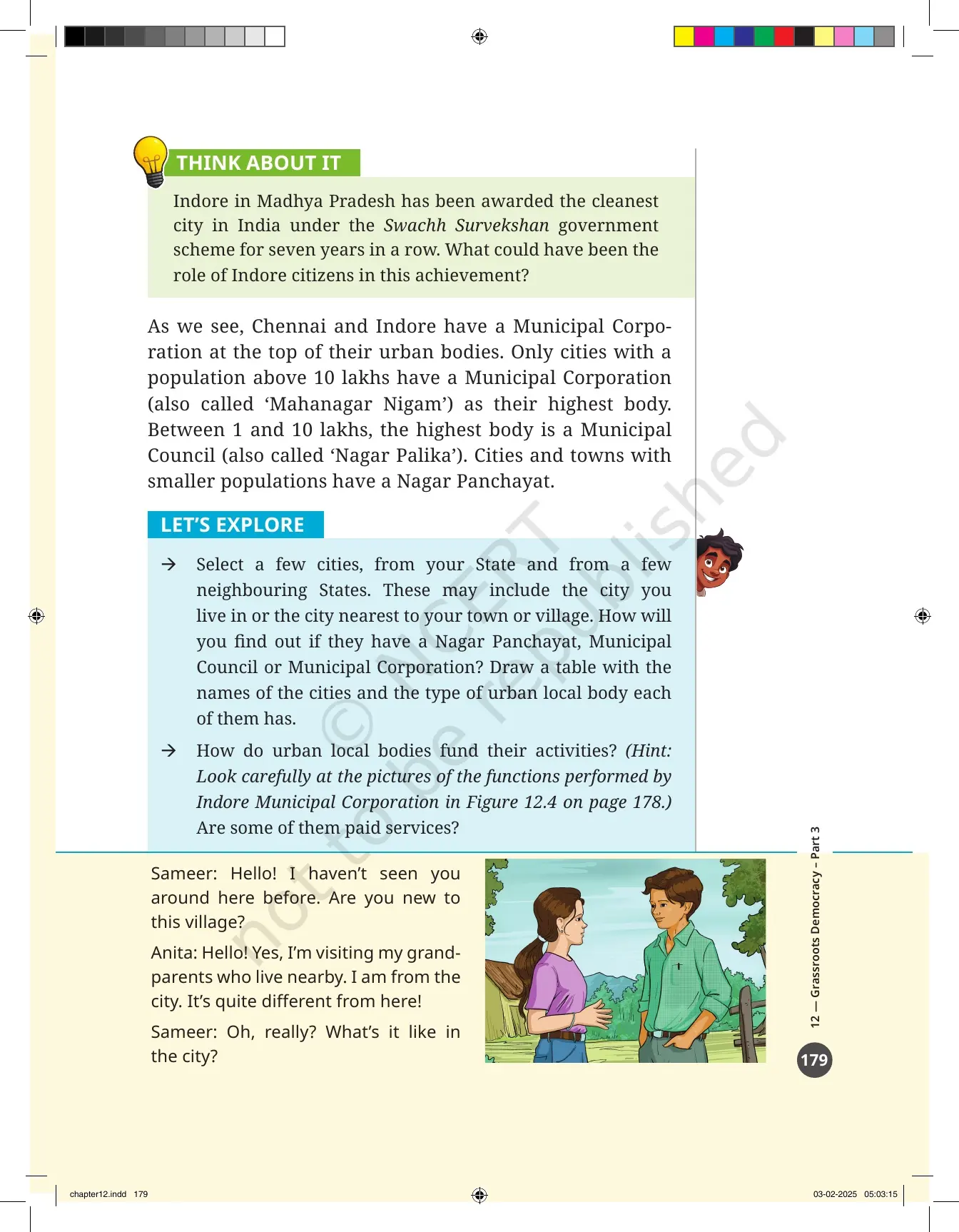

This is the unedited NCERT chapter file for the 2026-27 print run, checked page by page against the official Exploring Society: India and Beyond release before it was put on this page.
Student Feedback
What 13,480 students told us about the Local Government in Urban Areas chapter, in a Collegedunia poll taken during the 2026-27 session.
- 71% of students could not recall the population limits that separate a Municipal Corporation from a Municipal Council.
- Most-confused pair: Nagar Palika and Nagar Panchayat, swapped by about 5 in 10 students surveyed.
- Students reported that copying Fig. 12.2 once fixed both the rural and the urban side of the pyramid in one sitting.
Source: 2026-27 Class 6 Social Science student poll. Sample of 13,480 students from CBSE schools across 19 states.
What the Grassroots Democracy Part 3 Local Government in Urban Areas Class 6 PDF Contains, Page by Page
The file is the printed chapter in full, not a summary sheet. It opens with the Rustom K. Sidhwa quotation on printed page 173 and closes with the Noodles page on printed page 182. Use the table below to jump straight to the part you need.
| Section in the PDF | Printed pages | What is on these pages |
|---|---|---|
| Chapter opener | 173 | The Rustom K. Sidhwa quotation from the Constituent Assembly Debates, the two Big Questions, and Fig. 12.1 on the Municipal Corporation of Greater Mumbai |
| Introduction | 174 | Participatory democracy from the rural to the urban setting, why cities are more complex, and the first LET'S EXPLORE box |
| Fig. 12.2 and the start of Urban Local Bodies | 175 | The full governance pyramid from the ward to the Union Government, the second LET'S EXPLORE box, and the meaning of decentralised |
| Wards and functions | 176 | What a ward is, what ward committees do, and the list of functions urban local bodies carry out |
| Citizens' duties and the Madras Corporation | 177 | Waste segregation and reporting leaks, the third LET'S EXPLORE box, the 1688 Madras Corporation box and Fig. 12.3 |
| Fig. 12.4 | 178 | A full page of the services run by the Indore Municipal Corporation, including property tax, water charges and the CRM services |
| Indore, the three bodies and the dialogue | 179 | The THINK ABOUT IT box on Swachh Survekshan, the population rule for the three urban bodies, the fourth LET'S EXPLORE box and the start of the Sameer and Anita dialogue |
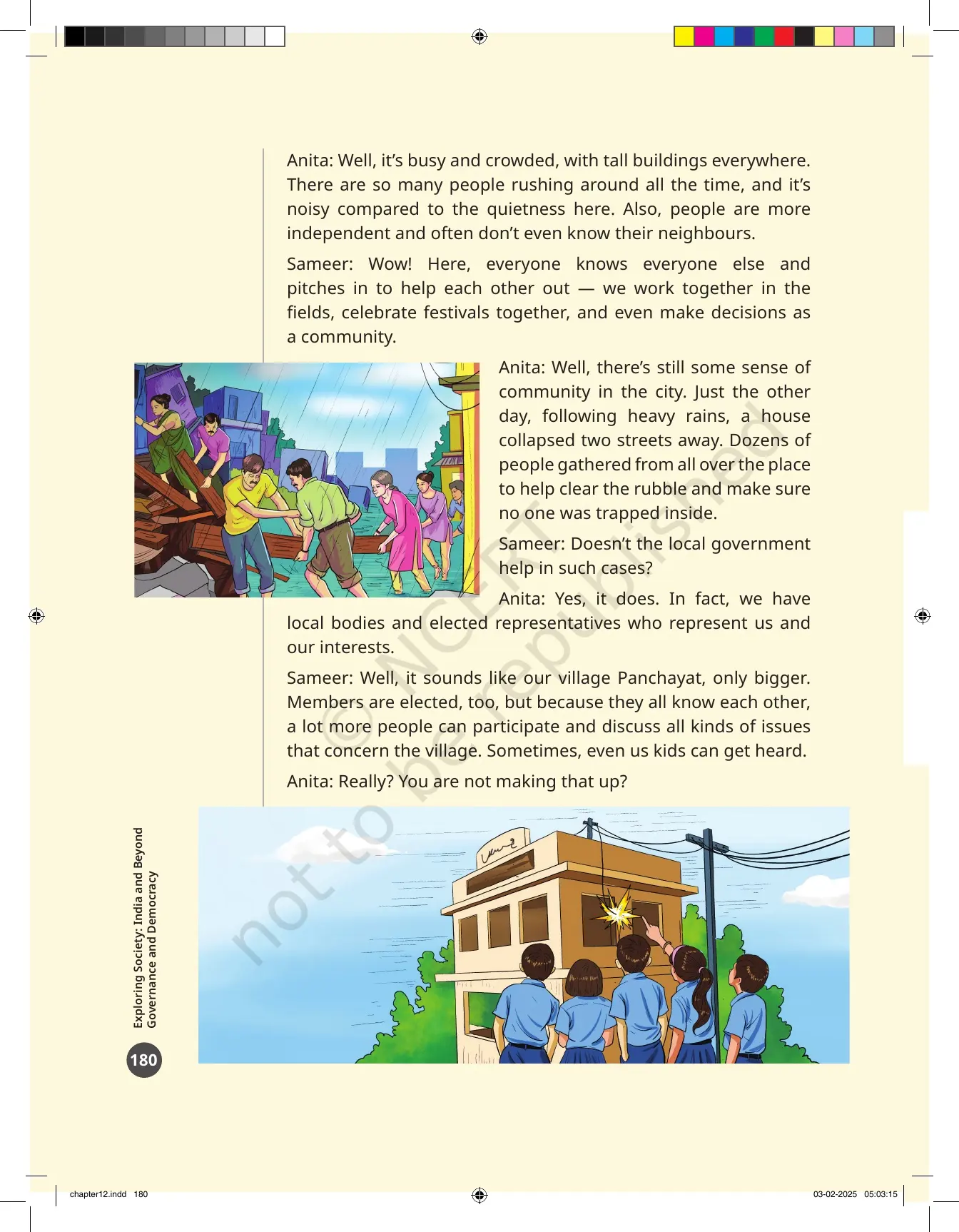
| Sameer and Anita | 180 | City life compared with village life, the collapsed house, and elected local representatives |
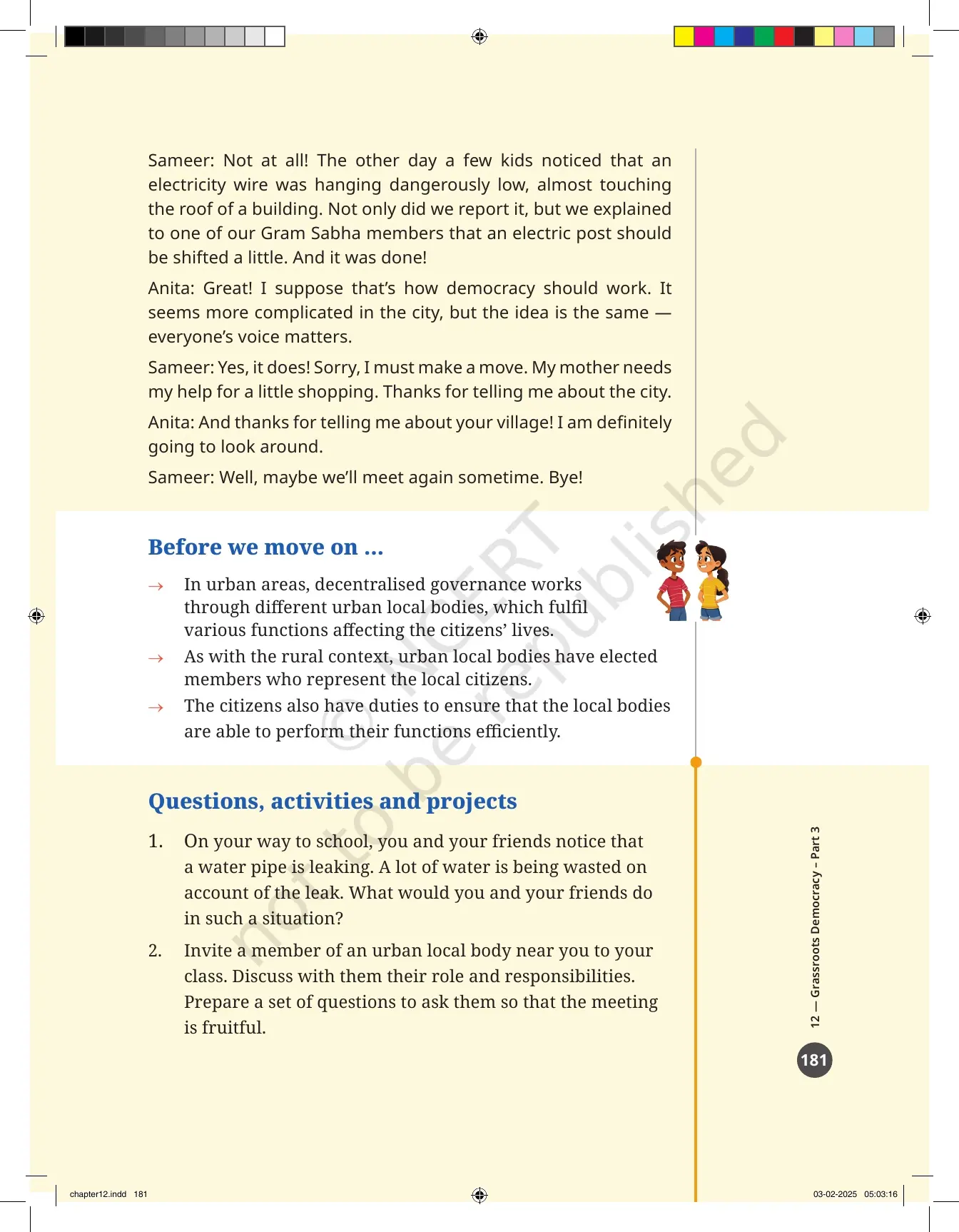
| Dialogue close, recap and questions | 181 | The hanging electricity wire, the 'Before we move on' recap and the first 2 numbered end items |
| Questions and Noodles | 182 | End items 3 to 5 and a blank Notes and Doodles page for your own rough work |
Also Check:
- Grassroots Democracy Part 3: Local Government in Urban Areas Class 6 NCERT Solutions
- Grassroots Democracy Part 3: Local Government in Urban Areas Class 6 Revision Notes
Urban Local Bodies and Municipal Functions Explained
Source: Magnet Brains on YouTube
The Rustom K. Sidhwa Quotation and the Two Big Questions on Page 173
This chapter opens with a line from the Constituent Assembly Debates, not with a definition. Two Big Questions are printed beside it. Both are answered inside the chapter, so learning them first gives you a map of the whole file.
- Who said it: Rustom K. Sidhwa, a Member of the Constituent Assembly, on 13 October 1949.
- What he asked for: that a full-fledged local body should be immediately formed, so that people may know what an administration is.
- Big Question 1: What are urban local bodies and what are their functions? Answered by the Urban Local Bodies section on printed pages 175 to 176.
- Big Question 2: Why are they important in governance and democracy? Answered by the 'Before we move on' recap on printed page 181.
Sidhwa names four things people should learn in their own town or village: the franchise, the powers, the rights and the privileges. Quote that list if a question asks why the Constituent Assembly wanted local bodies formed at once.
Fig. 12.1 and the Municipal Corporation of Greater Mumbai Created in 1865
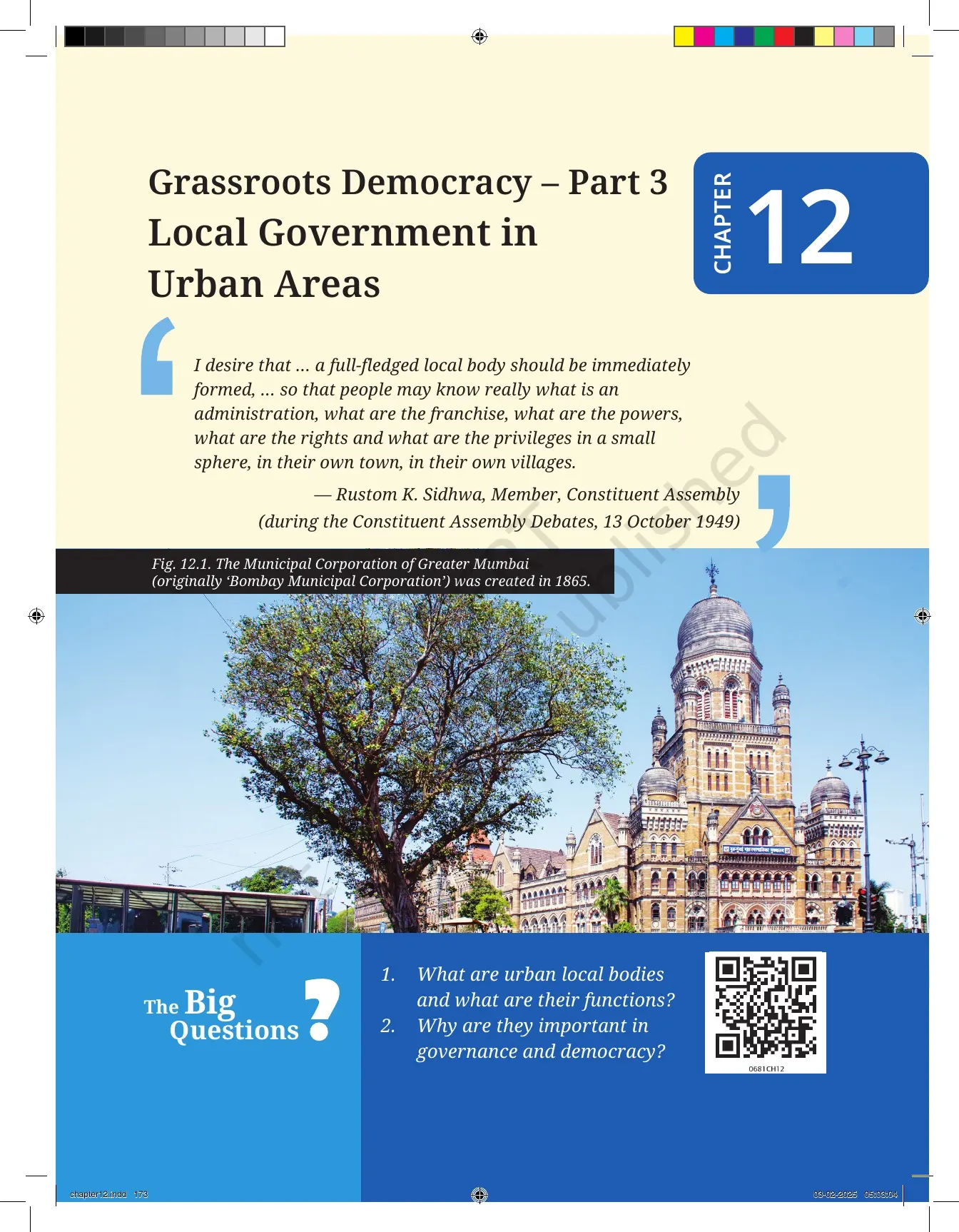
The photograph on the opening page is numbered, so it can be asked about. It shows the building of the Municipal Corporation of Greater Mumbai. The caption carries two facts that are easy one-mark answers.
- The old name: it was originally called the Bombay Municipal Corporation.
- The year: it was created in 1865.
Keep this year separate from the Madras Corporation date on printed page 177. Students often merge the two into one sentence and lose the mark. Mumbai is 1865, Madras is 1688.
Why Urban Governance Is More Complex Than Rural Governance
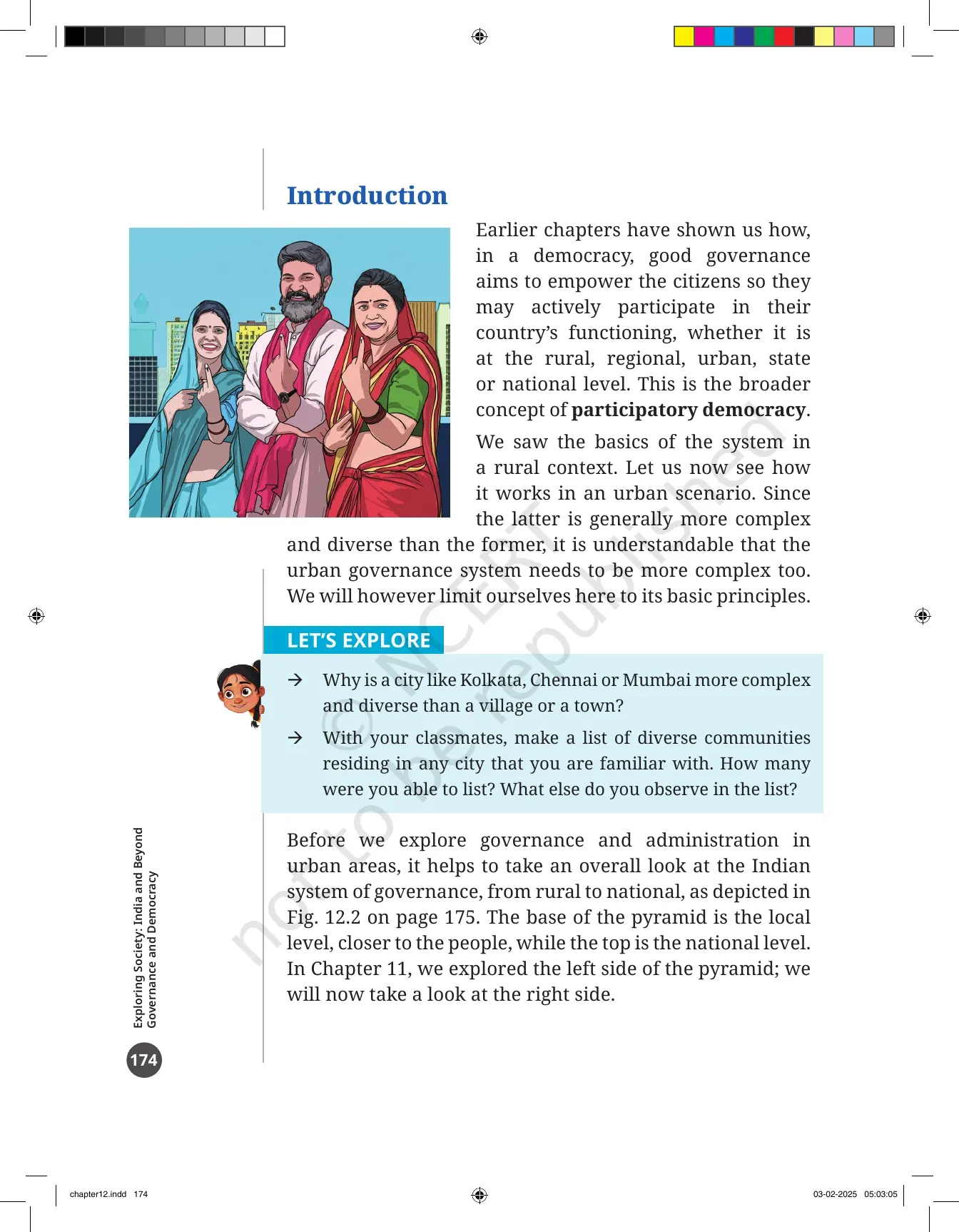
The Introduction on printed page 174 links this chapter to the two before it. Good governance in a democracy aims to empower the citizens so they can take an active part in how their country works. The chapter calls this the broader idea of participatory democracy.
That idea works at every level. The chapter lists them in one line: rural, regional, urban, State and national. Chapter 11 showed the system in a rural setting. This chapter shows the same system in a city.
- The reason cities are harder to run: an urban setting is generally more complex and diverse than a village or a town.
- The result: the urban governance system needs to be more complex too.
- What the chapter promises: it will limit itself to the basic principles of that system.
The first LET'S EXPLORE box sits under this paragraph. It asks why a city like Kolkata, Chennai or Mumbai is more complex and diverse than a village or a town. It then asks you to list, with your classmates, the diverse communities living in a city you know.
Reading Fig. 12.2: The Governance Pyramid From the Ward to the Union Government
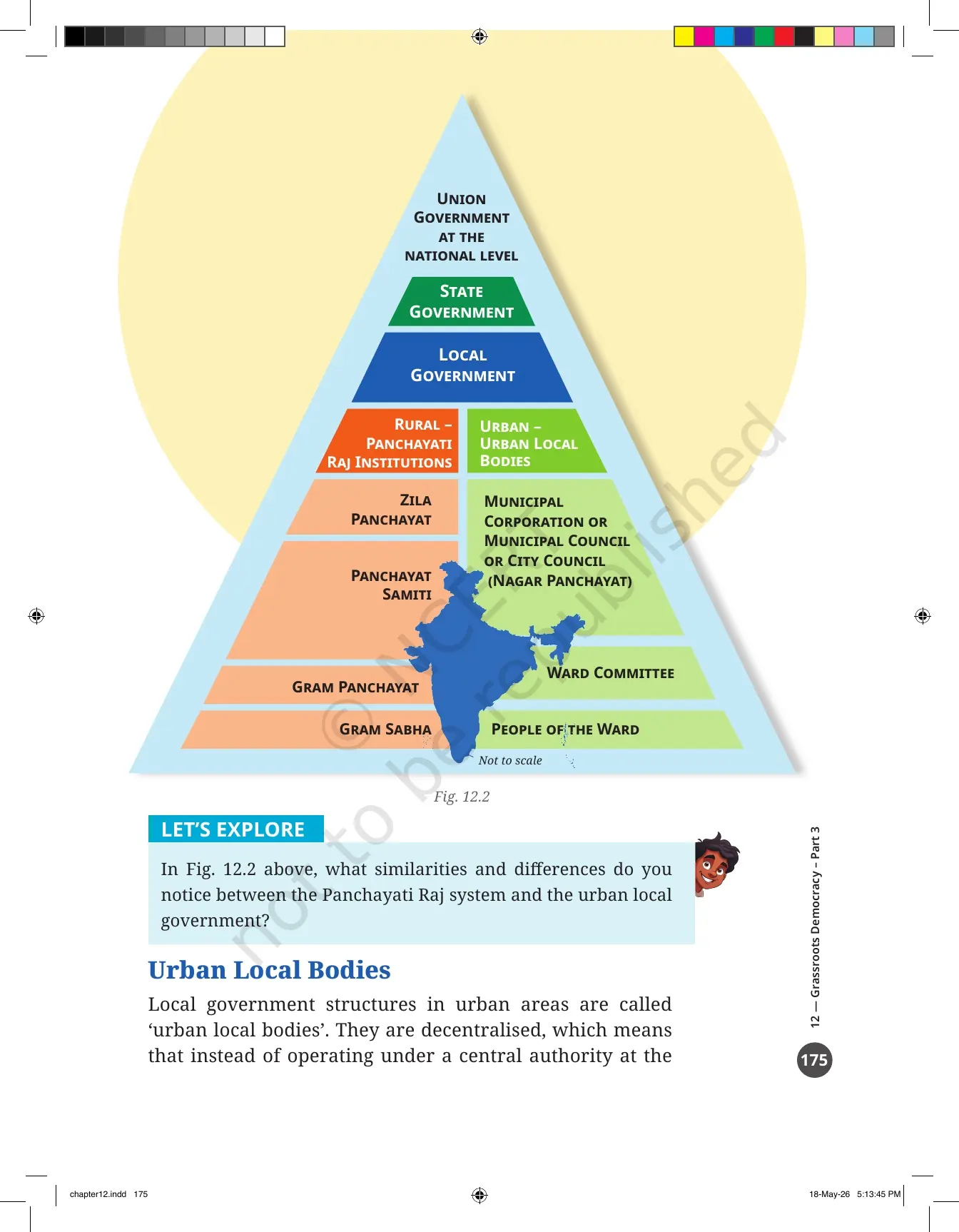
Fig. 12.2 on printed page 175 is the most useful diagram in the chapter. It is a pyramid with two sides. The left side is the rural system you learned in Chapter 11. The right side is the urban system this chapter teaches. Read it from the bottom up.
| Level in Fig. 12.2 | Rural side | Urban side |
|---|---|---|
| Base, closest to the people | Gram Sabha | People of the Ward |
| Second level | Gram Panchayat | Ward Committee |
| Third level | Panchayat Samiti | Municipal Corporation, Municipal Council or City Council, that is the Nagar Panchayat |
| Fourth level | Zila Panchayat | |
| Above local government | State Government | |
| Top of the pyramid | Union Government at the national level | |
The figure carries the note 'Not to scale'. Both sides sit under the same heading, Local Government, which is the point of the diagram. The rural side is called Panchayati Raj Institutions and the urban side is called Urban Local Bodies.
The second LET'S EXPLORE box asks what similarities and differences you notice between the two sides. A safe two-line answer: both are elected, decentralised and start at the level closest to the people, but the rural side has three tiers above the Sabha while the urban side works through wards and one main city body.
What Urban Local Bodies Are and Why They Are Called Decentralised
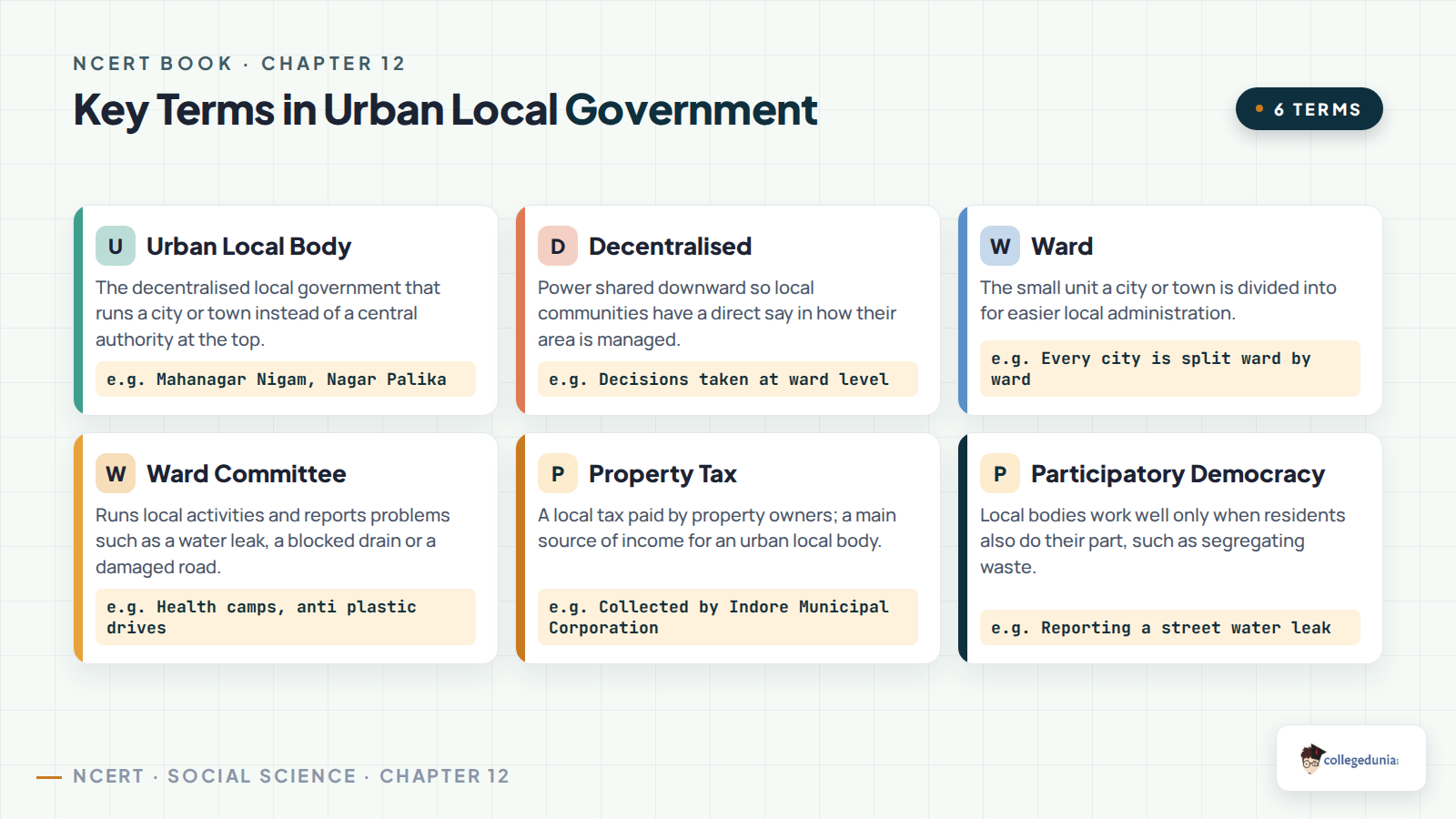
This is the definition the chapter builds everything else on. It is short, so learn it word for word. The word decentralised is the one students explain badly, and the book gives its meaning in the same sentence.
| Term | What the chapter says it is |
|---|---|
| Urban local bodies | The name for local government structures in urban areas |
| Decentralised | Instead of operating under a central authority at the top, the local communities have a direct say on how their areas are managed and on the issues they face |
| What it is for | A mechanism for citizens living in an area to come together and take decisions about what is best for them |
Notice the phrase direct say. It is the urban version of the direct participation you met in the Gram Sabha. That link is what makes this chapter part of the grassroots democracy set rather than a separate topic.
Wards and Ward Committees: The Smallest Unit of Urban Local Government
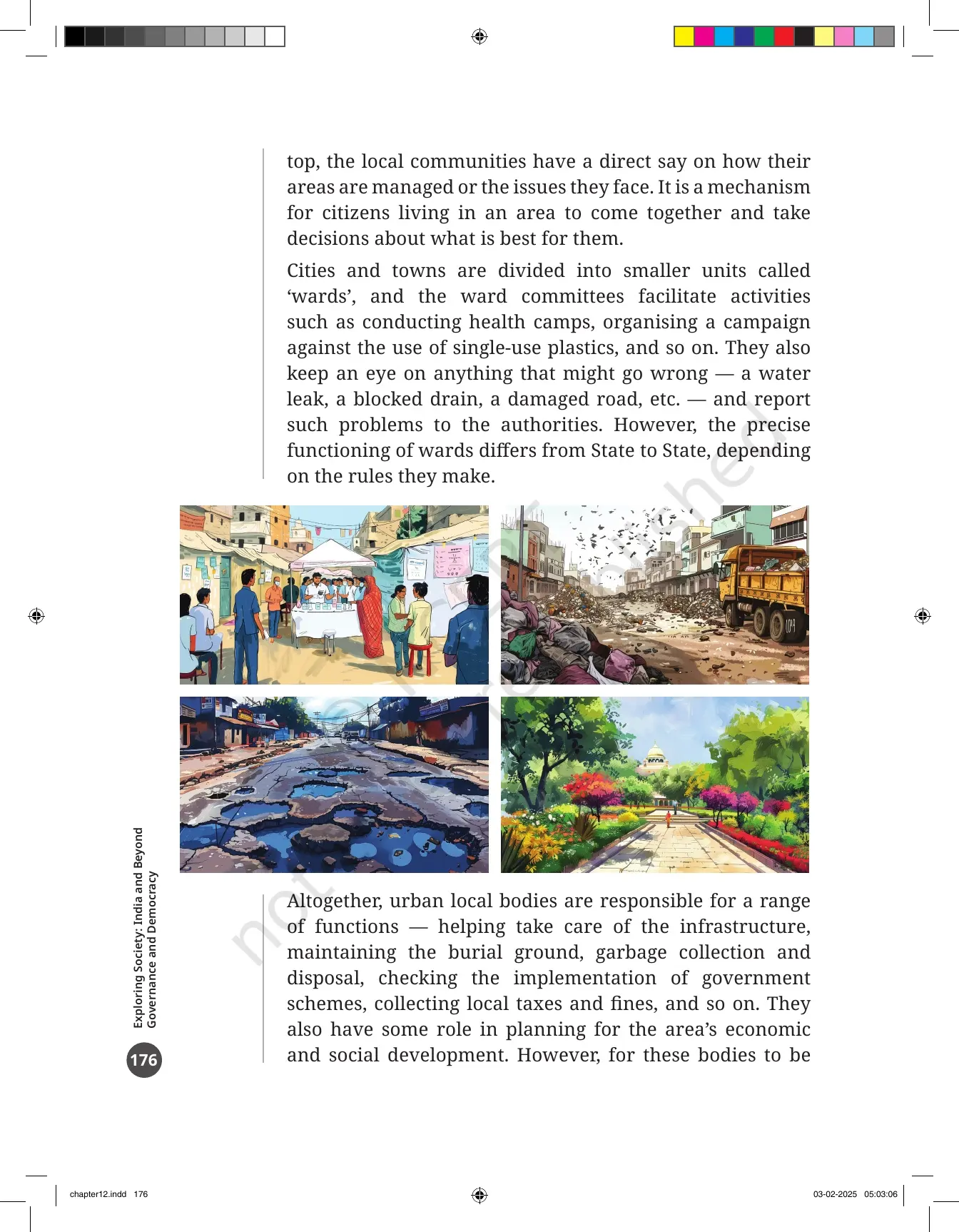
Cities and towns are divided into smaller units called wards. Each ward has a committee, and the chapter lists what those committees do. Two of the examples are named, so use them in your answer instead of writing something general.
- Health camps: ward committees help conduct them.
- Campaigns: one example given is a campaign against the use of single-use plastics.
- Keeping watch: they keep an eye on anything that might go wrong, such as a water leak, a blocked drain or a damaged road.
- Reporting: they report such problems to the authorities.
One line at the end of this paragraph is easy to miss and often carries a mark. The precise functioning of wards differs from State to State, because it depends on the rules each State makes. That is the same State authority idea you met in the rural chapter.
Every Function Urban Local Bodies Perform, From Garbage Collection to Local Taxes
Printed page 176 gives the function list in a single sentence. It is the direct answer to the first Big Question, so copy it as a list and learn all six items. The sentence ends with 'and so on', which means you may add sensible examples of your own.
- Helping take care of the infrastructure of the area.
- Maintaining the burial ground.
- Garbage collection and disposal.
- Checking the implementation of government schemes.
- Collecting local taxes and fines.
- Planning for the area's economic and social development, in which they have some role.
Write the sixth one carefully. The chapter says urban local bodies have some role in economic and social planning. It does not say they plan the city's economy on their own, and an answer that claims that is marked wrong.
What Citizens Must Do for Urban Local Bodies to Work
The chapter turns the argument around here. Bodies cannot work well on their own. People living in the city must also perform their duties, which means showing care and concern for their area. The book reminds you in brackets that this is a participatory democracy.
- Waste segregation: if people follow the instructions carefully, garbage collection becomes easier.
- Reporting leaks: noticing a water leakage in a street and reporting it promptly prevents further wastage of precious water.
The third LET'S EXPLORE box asks you to think of four or five more actions a responsible citizen could take. Good answers from the rest of the chapter: sorting waste at home, paying property tax on time, joining a ward health camp, avoiding single-use plastic, and reporting a blocked drain or a damaged road.
The Madras Corporation of 1688 and the Start of Municipal Administration in India
The box on printed page 177, with Fig. 12.3 beside it, is the chapter's history slot. It is dense with dates and numbers, and every one of them is a possible one-mark question. Take them one at a time.
| What the box says | The fact to learn |
|---|---|
| The oldest municipal institution in India | The Madras Corporation, now the Greater Chennai Corporation |
| Date it was established | 29 September 1688 |
| Who issued the charter, and when | The East India Company, the previous year |
| What the charter covered | The town of Fort St. George and all territories within 16 km of the Fort, formed into a corporation |
| When municipal administration properly began | With the Parliamentary Act of 1792, which gave the Madras Corporation power to levy municipal taxes in the city |
The trap here is the difference between two dates. 1688 is when the Corporation was established. 1792 is when it got the power to collect taxes, which is what the chapter calls the proper start of municipal administration.
Fig. 12.4: Services Under the Indore Municipal Corporation and How Urban Bodies Are Funded
Printed page 178 is given entirely to Fig. 12.4. It is a chart of the services the Indore Municipal Corporation offers, and the caption says the list has been simplified. The fourth LET'S EXPLORE box asks you to use this figure to work out how urban local bodies fund their activities.
| Group of services in Fig. 12.4 | What it includes |
|---|---|
| Money coming in | Property tax and water charges |
| Everyday city services | Solid waste management, and tree cutting and tree transportation |
| Licences and permissions | Business, hoardings and trade licences, plus CRM various licences |
| Certificates and safety | CRM marriage certificate and CRM fire services |
| Services on request | Water tanker, septic tanker, auditorium, funeral van, mobile toilet and ambulance |
| Complaints | CRM grievances, and CRM water tanker and debris clearance |
The chart carries a footnote you should be able to expand. CRM stands for Citizen Relationship Management. The funding answer follows from the first row and the last: urban local bodies raise money from property tax, water charges, licence fees and paid services such as a water tanker or an auditorium booking.
Municipal Corporation, Municipal Council and Nagar Panchayat: The Population Rule
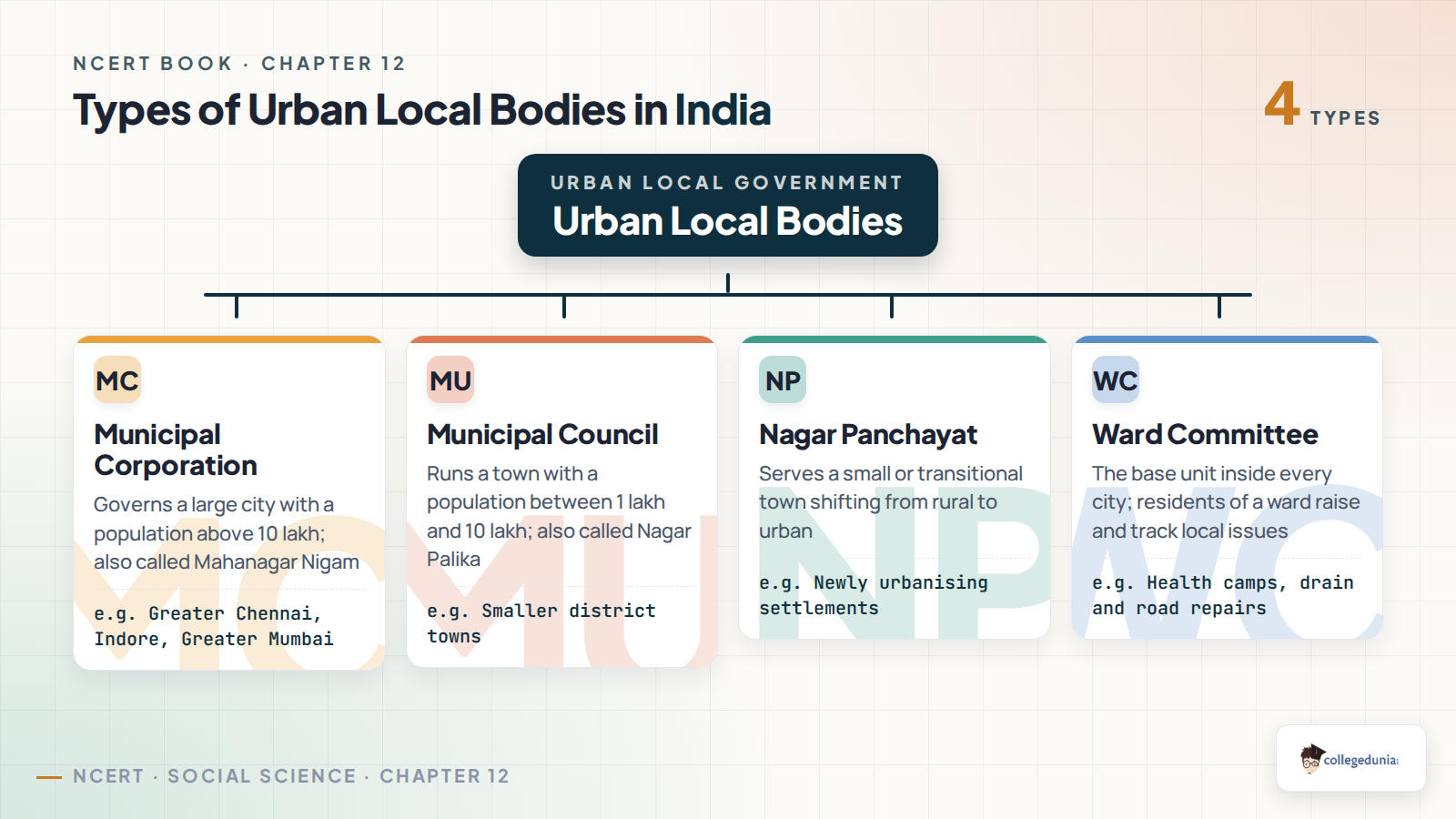
This is the paragraph our student poll found hardest, and it is the most likely question from the whole chapter. Three bodies, two names each, and a population limit that decides which one a place gets. Learn the numbers exactly as printed.
| Highest urban body | Other name given | Population of the city or town |
|---|---|---|
| Municipal Corporation | Mahanagar Nigam | Only cities with a population above 10 lakhs |
| Municipal Council | Nagar Palika | Between 1 and 10 lakhs |
| Nagar Panchayat | No second name is given in the chapter | Cities and towns with smaller populations |
Two examples are already in your hands. Chennai and Indore both have a Municipal Corporation at the top of their urban bodies, which is exactly how the chapter introduces this rule. Use one of them as your example and the answer stops sounding like a memorised list.
The fourth LET'S EXPLORE box builds on this. Pick a few cities from your State and from neighbouring States, find out which body each has, and draw a table of city names against body types. It then asks the funding question covered in the section above.
The Indore Swachh Survekshan THINK ABOUT IT Box on the Cleanest City in India
The only THINK ABOUT IT box in this chapter sits on printed page 179. It gives one striking fact and then asks you to explain it using the idea of participatory democracy you have just read about.
- The city: Indore, in Madhya Pradesh.
- The award: cleanest city in India under the Swachh Survekshan government scheme.
- How long: seven years in a row.
- The question: what could the role of Indore's citizens have been in this achievement?
The answer is already on printed page 177. Citizens segregated their waste, reported problems promptly and worked with the Corporation instead of leaving it to do everything alone. A body and its citizens working together is the point the chapter wants you to make.
The Sameer and Anita Dialogue: Village Life Compared With City Life
Printed pages 179 to 181 carry a conversation between two children. Anita is from the city and is visiting her grandparents. Sameer lives in the village. The dialogue is not decoration, because question 5 at the end asks for exactly the comparison it draws.
| What they compare | The city, as Anita describes it | The village, as Sameer describes it |
|---|---|---|
| Everyday feel | Busy and crowded, tall buildings everywhere, noisy, people rushing about | Quiet, and everyone knows everyone else |
| Sense of community | People are more independent and often do not know their neighbours | People pitch in to help each other, work together in the fields and celebrate festivals together |
| Taking decisions | Through local bodies and elected representatives | Members are elected too, but because they know each other, far more people can join the discussion |
| Example of people helping | After heavy rains a house collapsed two streets away, and dozens of people gathered to clear the rubble | Children spotted a low-hanging electricity wire, reported it, and got the electric post shifted |
The line to quote is Anita's closing one. City governance seems more complicated, but the idea is the same: everyone's voice matters. Sameer's example also shows that children can be heard, which links straight back to the Bal Panchayat pages of the rural chapter.
Every Figure, Activity Box and Special Page Inside the Urban Local Government PDF
This chapter numbers four figures, so a diagram question can come from any of them, not just the pyramid. Five activity boxes and three special pages carry the rest. The checklist below is the fastest way to make sure you have not skipped one.
| Figure, box or feature | Printed page | What it shows or asks |
|---|---|---|
| The opening quotation | 173 | Rustom K. Sidhwa in the Constituent Assembly Debates, 13 October 1949 |
| The Big Questions | 173 | Two questions on what urban local bodies are, what they do, and why they matter |
| Fig. 12.1 | 173 | The Municipal Corporation of Greater Mumbai, originally the Bombay Municipal Corporation, created in 1865 |
| LET'S EXPLORE 1 | 174 | Why Kolkata, Chennai or Mumbai is more complex than a village, and a class list of city communities |
| Fig. 12.2 | 175 | The governance pyramid, with Panchayati Raj Institutions on one side and Urban Local Bodies on the other |
| LET'S EXPLORE 2 | 175 | Similarities and differences between the Panchayati Raj system and the urban local government |
| LET'S EXPLORE 3 | 177 | Four or five more actions responsible citizens could take to help their area |
| The Madras Corporation box | 177 | The 1688 founding, the East India Company charter, Fort St. George and the Parliamentary Act of 1792 |
| Fig. 12.3 | 177 | The Madras Corporation |
| Fig. 12.4 | 178 | A full page of services under the Indore Municipal Corporation, from property tax to the CRM grievance desk |
| THINK ABOUT IT | 179 | Indore as the cleanest city in India for seven years, and the role of its citizens |
| LET'S EXPLORE 4 | 179 | A table of nearby cities against their type of urban local body, plus the funding question |
| Sameer and Anita | 179 to 181 | An illustrated dialogue comparing city life and village life, and how local government works in both |
| Before we move on ... | 181 | A three-point recap of decentralised urban governance, elected members and citizens' duties |
| Noodles | 182 | A page for Notes and Doodles, which is what the chapter says the word stands for |
Questions, Activities and Projects at the End of the Urban Local Government Chapter
Printed pages 181 and 182 carry 5 numbered items. There is no true or false set and no multiple-choice set in this chapter. Three of the five need you to talk to someone or make a list, so start them a day early.
- The leaking water pipe on the way to school. Say what you and your friends would do. Report it to the ward committee or the municipal helpline, and note that prompt reporting prevents further wastage, exactly as printed page 177 says.
- Invite a member of an urban local body to your class. Prepare a set of questions first so the meeting is useful, then discuss their role and responsibilities.
- Ask adults at home and in your neighbourhood what they expect from the urban local bodies, and make a list of those expectations.
- List the characteristics of a good urban local body. Build the list from the function list on printed page 176 and the Indore example.
- Compare the Panchayati Raj system with the urban local bodies. Use Fig. 12.2 for the structure and the Sameer and Anita dialogue for everyday life.
Before the questions, the 'Before we move on ...' box on printed page 181 gives a three-point recap that works as a ready-made summary answer.
- In urban areas, decentralised governance works through different urban local bodies, which fulfil various functions affecting citizens' lives.
- As in the rural setting, urban local bodies have elected members who represent the local citizens.
- The citizens also have duties, so that the local bodies are able to perform their functions efficiently.
Common Mistakes Students Make in the Local Government in Urban Areas Chapter
- Swapping Nagar Palika and Nagar Panchayat. Nagar Palika is the Municipal Council, for 1 to 10 lakhs. The Nagar Panchayat is for smaller towns.
- Getting the population limit wrong. A Municipal Corporation is only for cities above 10 lakhs, not above 1 lakh.
- Merging the two history dates. The Madras Corporation was established in 1688. The Parliamentary Act of 1792 gave it the power to levy taxes.
- Giving Fig. 12.1 the wrong city. Fig. 12.1 is Mumbai, created in 1865. Fig. 12.3 is the Madras Corporation.
- Reading Fig. 12.2 from the top. The base of the pyramid is the local level, closest to the people, and the top is the national level.
- Writing that the ward committee runs the whole city. A ward is a smaller unit of a city or town, and its committee reports problems to the authorities.
- Forgetting the citizens' half of the answer. Urban local bodies work efficiently only when people segregate waste and report problems.
Related Links:
- Grassroots Democracy Part 3: Local Government in Urban Areas Class 6 Handwritten Notes
- Grassroots Democracy Part 2: Local Government in Rural Areas Class 6 NCERT Book PDF
How to Read the Class 6 Urban Local Government PDF in One Sitting
This is a 10-page chapter with four figures, a short function list and only 5 end items. One focused sitting of about 30 minutes is enough. Keep a rough sheet beside you for the pyramid and the population table.
- Minutes 0 to 4: read printed page 173, then write the Sidhwa quotation, the two Big Questions and the Fig. 12.1 caption with the year 1865.
- Minutes 4 to 9: read printed page 174 and note why a city is more complex and diverse than a village.
- Minutes 9 to 15: read printed page 175 and copy the Fig. 12.2 pyramid with both sides, rural and urban, side by side.
- Minutes 15 to 20: read printed pages 176 and 177 and list the six functions, the ward committee tasks and the two citizens' duties.
- Minutes 20 to 25: read printed pages 177 and 178 and note the Madras Corporation dates and the Indore service groups.
- Minutes 25 to 30: read printed pages 179 to 181 and write the population table, the Indore award and the three recap points.
Come back the next day for the five end items. The question that makes the chapter stick is number 5, the comparison between the Panchayati Raj system and the urban local bodies, because you have to hold both chapters in your head at once. That second pass turns a chapter you have read into a chapter you can answer.
More Grassroots Democracy Part 3: Local Government in Urban Areas Class 6 Resources
The book PDF gives you the printed chapter. These pages give you the answers, the revision layer and the last-day recap for the same chapter.
| Resource | What it gives you |
|---|---|
| Grassroots Democracy Part 3: Local Government in Urban Areas Class 6 NCERT Solutions | Step-by-step answers to all 5 end items and every activity box, including the leaking water pipe and the rural versus urban comparison |
| Grassroots Democracy Part 3: Local Government in Urban Areas Class 6 Revision Notes | The Fig. 12.2 pyramid, the three urban bodies with their population limits, the function list and the Madras Corporation dates in one short read |
| Grassroots Democracy Part 3: Local Government in Urban Areas Class 6 Handwritten Notes | A topper's handwritten pages with the two-sided pyramid and the Corporation, Council and Nagar Panchayat split drawn out in colour-coded boxes |
| Grassroots Democracy Part 3: Local Government in Urban Areas Class 6 NCERT Book PDF | This page. The official 2026-27 chapter file, printed pages 173 to 182 of Exploring Society: India and Beyond |
NCERT Book PDF for Class 6 Social Science: All 14 Chapters
Exploring Society: India and Beyond runs to 14 chapters across five themes. Download the ones your school has taught, or take the full set in one go.
| Chapter | Resource |
|---|---|
| Chapter 1 | Locating Places on the Earth NCERT Book PDF |
| Chapter 2 | Oceans and Continents NCERT Book PDF |
| Chapter 3 | Landforms and Life NCERT Book PDF |
| Chapter 4 | Timeline and Sources of History NCERT Book PDF |
| Chapter 5 | India, That Is Bharat NCERT Book PDF |
| Chapter 6 | The Beginnings of Indian Civilisation NCERT Book PDF |
| Chapter 7 | India's Cultural Roots NCERT Book PDF |
| Chapter 8 | Unity in Diversity, or 'Many in the One' NCERT Book PDF |
| Chapter 9 | Family and Community NCERT Book PDF |
| Chapter 10 | Grassroots Democracy Part 1: Governance NCERT Book PDF |
| Chapter 11 | Grassroots Democracy Part 2: Local Government in Rural Areas NCERT Book PDF |
| Chapter 12 | Grassroots Democracy Part 3: Local Government in Urban Areas NCERT Book PDF (this page) |
| Chapter 13 | The Value of Work NCERT Book PDF |
| Chapter 14 | Economic Activities Around Us NCERT Book PDF |
Grassroots Democracy Part 3: Local Government in Urban Areas Class 6 Social Science NCERT Book PDF FAQs
Common Questions on the Class 6 Social Science Chapter 12 File
Ques. Where can I download the NCERT Class 6 Social Science Chapter 12 Grassroots Democracy Part 3 Local Government in Urban Areas PDF?
Ans. You can download it directly from this page. It is the official NCERT chapter file for the 2026-27 print of Exploring Society: India and Beyond, and it is free.
Ques. How many pages is the Local Government in Urban Areas chapter PDF?
Ans. The file runs to 10 pages. It covers printed pages 173 to 182 of the textbook, from the Rustom K. Sidhwa quotation to the Noodles page at the end.
Ques. What are urban local bodies?
Ans. Urban local bodies are the local government structures in urban areas. The chapter says they are decentralised, which means that instead of operating under a central authority at the top, the local communities have a direct say on how their areas are managed and on the issues they face.
Ques. What are the functions of urban local bodies?
Ans. Printed page 176 lists them: helping take care of the infrastructure, maintaining the burial ground, garbage collection and disposal, checking the implementation of government schemes, and collecting local taxes and fines. They also have some role in planning for the area's economic and social development.
Ques. What is a ward and what does a ward committee do?
Ans. Cities and towns are divided into smaller units called wards. Ward committees help conduct health camps and organise campaigns, such as one against single-use plastics. They also keep an eye on a water leak, a blocked drain or a damaged road, and report such problems to the authorities. Their precise functioning differs from State to State.
Ques. What is the difference between a Municipal Corporation, a Municipal Council and a Nagar Panchayat?
Ans. The difference is population. Only cities with a population above 10 lakhs have a Municipal Corporation, also called Mahanagar Nigam. Between 1 and 10 lakhs, the highest body is a Municipal Council, also called Nagar Palika. Cities and towns with smaller populations have a Nagar Panchayat.
Ques. What does Fig. 12.2 show?
Ans. It shows the whole Indian system of governance as a pyramid. The base is the local level, closest to the people, and the top is the Union Government at the national level. The left side carries the Panchayati Raj Institutions and the right side carries the urban local bodies, from the People of the Ward up to the Ward Committee and then the Municipal Corporation, Municipal Council or Nagar Panchayat.
Ques. Which is the oldest municipal institution in India?
Ans. The Madras Corporation, now the Greater Chennai Corporation, established on 29 September 1688. The East India Company had issued a charter the previous year forming the town of Fort St. George and all territories within 16 km of the Fort into a corporation.
Ques. When did municipal administration properly begin in India?
Ans. With the Parliamentary Act of 1792. That Act gave the Madras Corporation the power to levy municipal taxes in the city, which the chapter calls the proper start of municipal administration.
Ques. What does Fig. 12.1 show?
Ans. Fig. 12.1 shows the Municipal Corporation of Greater Mumbai, originally called the Bombay Municipal Corporation. The caption says it was created in 1865.
Ques. How do urban local bodies fund their activities?
Ans. Fig. 12.4 on printed page 178 gives the answer. The Indore Municipal Corporation collects property tax and water charges, issues business, hoarding and trade licences, and runs paid services on request such as a water tanker, a septic tanker, an auditorium and a mobile toilet. Urban local bodies also collect local taxes and fines.
Ques. What does CRM stand for in Fig. 12.4?
Ans. CRM stands for Citizen Relationship Management. In Fig. 12.4 the CRM groups cover marriage certificates, fire services, various licences, grievances, and services on request such as a water tanker, an ambulance or a funeral van.
Ques. Why is Indore mentioned in the chapter?
Ans. Indore in Madhya Pradesh has been awarded the cleanest city in India under the Swachh Survekshan government scheme for seven years in a row. The THINK ABOUT IT box on printed page 179 asks what the role of Indore's citizens could have been in this achievement.
Ques. What duties do citizens have towards urban local bodies?
Ans. The chapter says people living in the city must show care and concern for their area, because this is a participatory democracy. Two examples are given: following waste segregation instructions carefully so garbage collection becomes easier, and reporting a water leakage in a street promptly so that precious water is not wasted.
Ques. Who is quoted at the start of the Local Government in Urban Areas chapter?
Ans. Rustom K. Sidhwa, a Member of the Constituent Assembly, speaking during the Constituent Assembly Debates on 13 October 1949. He said a full-fledged local body should be immediately formed so that people may know what an administration is, and what the franchise, the powers, the rights and the privileges are in their own town or village.
Ques. Who are Sameer and Anita in the chapter?
Ans. They are the two children in the illustrated dialogue on printed pages 179 to 181. Anita is from the city and is visiting her grandparents in the village. Sameer lives in the village. They compare city life and village life, and how local government works in both.
Ques. How many questions are there at the end of the Local Government in Urban Areas chapter?
Ans. Printed pages 181 and 182 carry 5 numbered items. There is no true or false set in this chapter. They ask about a leaking water pipe, inviting a member of an urban local body to class, family expectations from urban local bodies, the characteristics of a good urban local body, and the comparison between the Panchayati Raj system and the urban local bodies.
Ques. What is the difference between the Panchayati Raj system and urban local bodies?
Ans. Both are decentralised local government with elected members, and both start at the level closest to the people. The rural side runs through the Gram Sabha, Gram Panchayat, Panchayat Samiti and Zila Panchayat. The urban side runs from the People of the Ward to the Ward Committee and then to a Municipal Corporation, Municipal Council or Nagar Panchayat, depending on population.
Ques. Do I need the NCERT Solutions if I already have the book PDF?
Ans. The book PDF carries the questions but not the answers. Use the Grassroots Democracy Part 3: Local Government in Urban Areas Class 6 NCERT Solutions to check all 5 end items and every activity box.



Comments