




The NCERT Class 6 Social Science Chapter 5 India, That Is Bharat PDF covers two questions the book asks on its opening page: how we define India, and what the ancient names for India were. Every name in it is traced back to one river and one Vedic word, so the whole chapter hangs together once you see that link. This is the full printed chapter from Exploring Society: India and Beyond for the 2026-27 session, with nothing shortened or reworded.
- 10-page official file: Chapter 5 runs from printed page 75 to printed page 84 of the Class 6 textbook.
- Covers Sapta Sindhava, Bhāratavarṣha, Jambudvīpa, Bhārata, Hind, Indoi, Yindu and Hindustān.
- Carries 5 numbered figures, 3 LET'S EXPLORE boxes, 2 THINK ABOUT IT boxes, 2 DON'T MISS OUT boxes and 4 end questions.
This is the unedited NCERT chapter file for the 2026-27 print run, checked page by page against the official Exploring Society: India and Beyond release before it was put on this page.
Student Feedback
What 15,290 students told us about the India, That Is Bharat chapter, in a Collegedunia poll taken during the 2026-27 session.
- 68% of students said the true or false set in question 2 was the part they got wrong most often.
- Most-skipped part: the Viṣhṇu Purāṇa verse on printed page 80, left out by about 5 in 10 students.
- Students reported that writing the Sindhu name chain once on a rough sheet fixed the Persian, Greek and Chinese order faster than re-reading the pages.
Source: 2026-27 Class 6 Social Science student poll. Sample of 15,290 students from CBSE schools across 21 states.
What the India, That Is Bharat Class 6 PDF Contains, Page by Page
The file is the printed chapter in full, not a summary sheet. It opens with a line from Sri Aurobindo about the spiritual and cultural unity of "this great surge of humanity between the Himalayas and the two seas", and closes with the four end questions on printed page 84. Use the table below to jump straight to the part you need.
| Section in the PDF | Printed pages | What is on these pages |
|---|---|---|
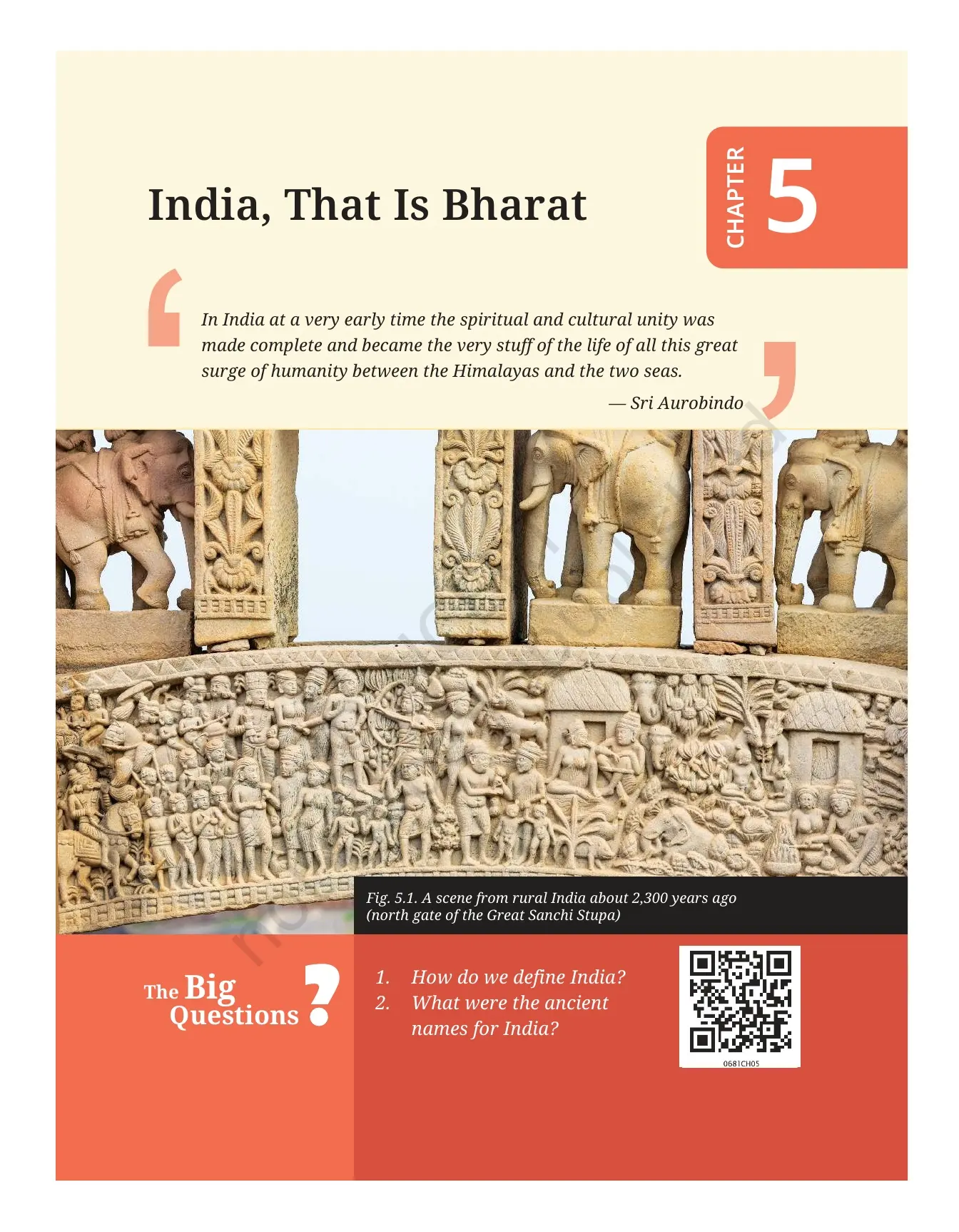
| Chapter opener | 75 | The Sri Aurobindo quotation, Fig. 5.1 from the north gate of the Great Sanchi Stupa, and the two Big Questions of the chapter |
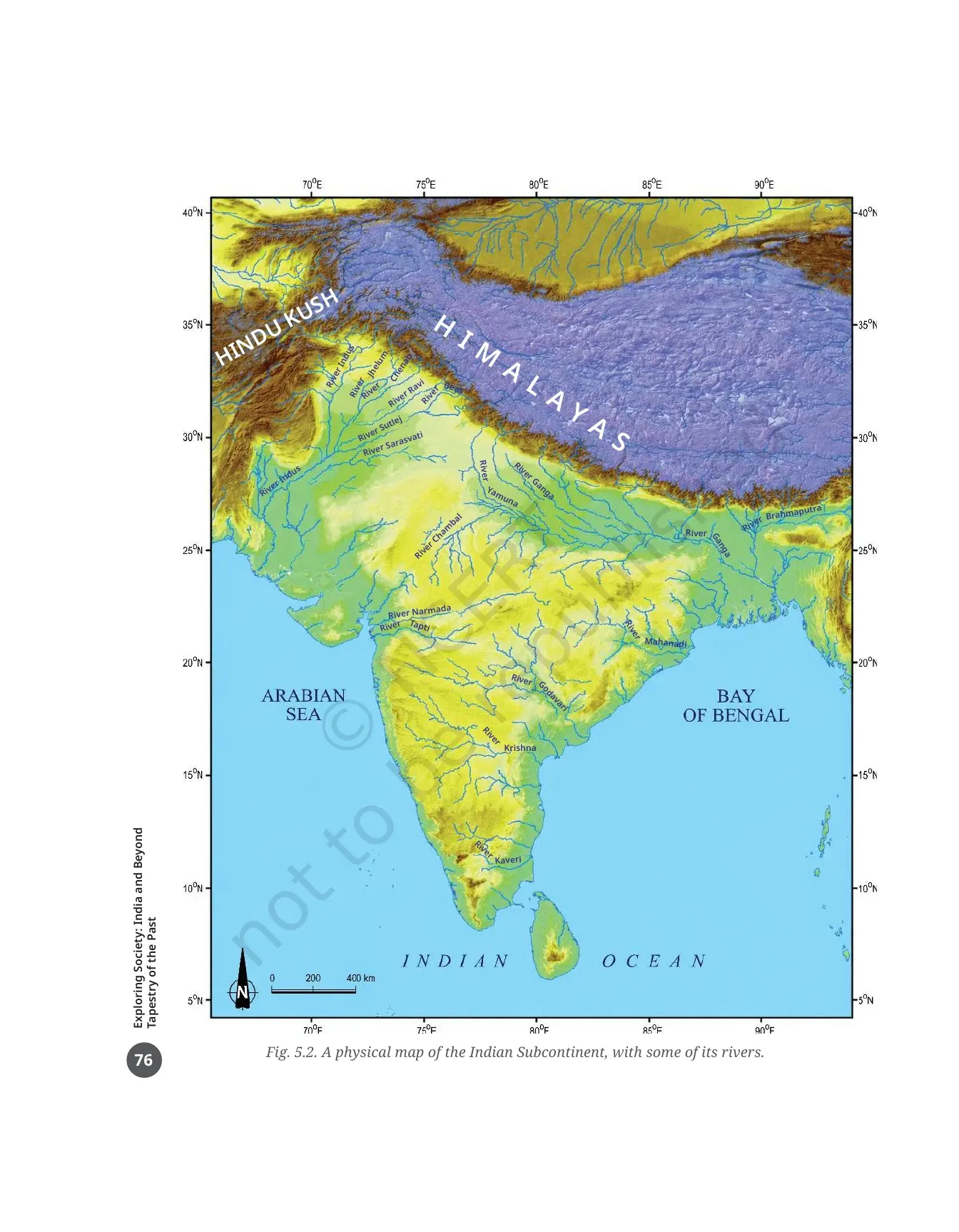
| Fig. 5.2, the rivers map | 76 | A full-page physical map of the Indian Subcontinent with the Indus, Jhelum, Chenab, Ravi, Beas, Sutlej, Sarasvati, Ganga, Yamuna, Chambal, Brahmaputra, Narmada, Tapti, Mahanadi, Godavari, Krishna and Kaveri |
| Opening text and THINK ABOUT IT | 77 | India 500, 2,000 and 5,000 years ago, the margin word Inhabitants, and the box on the natural boundaries of the Subcontinent |
| How Indians Named India | 77 | The Ṛig Veda, the name Sapta Sindhava, the word Sindhu, and Fig. 5.3 of the northwest region |
| The Mahābhārata names | 78 | Kāshmīra, Kurukṣhetra, Vanga, Prāgjyotiṣha, Kaccha and Kerala, then Bhāratavarṣha and Jambudvīpa, plus Aśhoka's inscription |
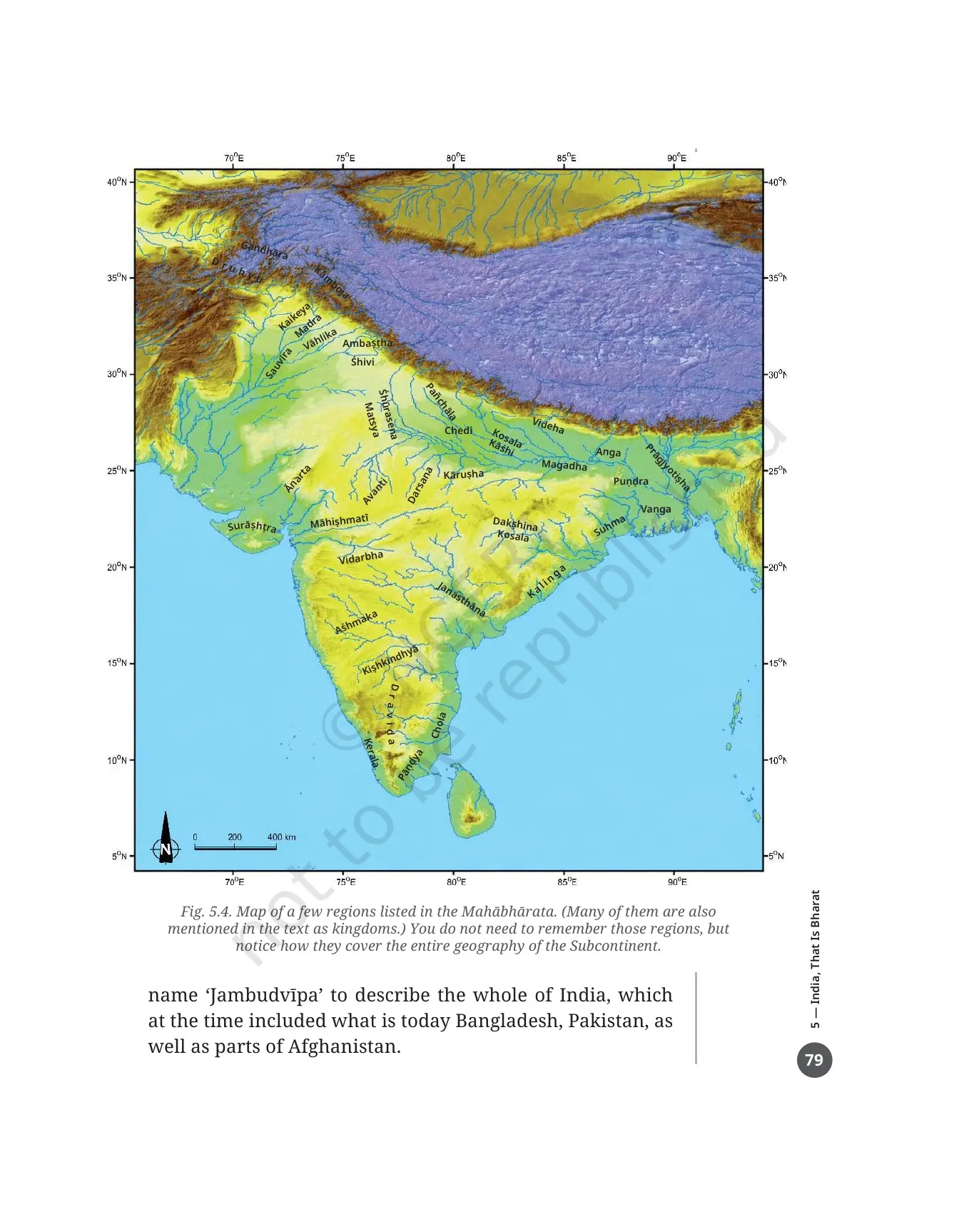
| Fig. 5.4, the regions map | 79 | A full-page map of regions listed in the Mahābhārata, from Gandhāra in the northwest to Pāṇḍya in the far south |
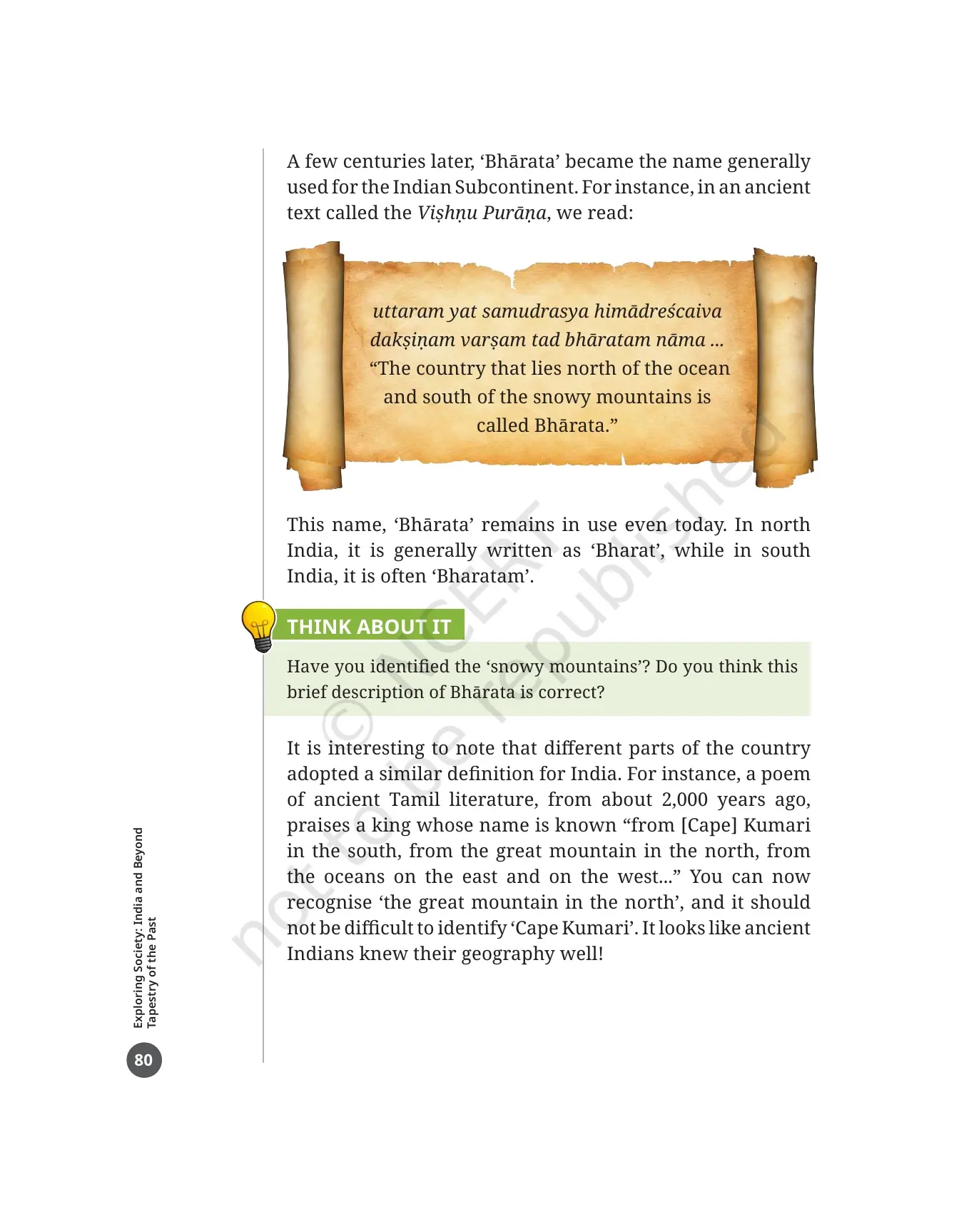
| The Viṣhṇu Purāṇa verse | 80 | The Sanskrit verse with its translation, the Bharat and Bharatam spellings, a THINK ABOUT IT box, and the ancient Tamil poem about Cape Kumari |
| The Constitution box | 81 | The DON'T MISS OUT box on "India, that is Bharat", the margin word Constitution, and the LET'S EXPLORE task pointing to Fig. 5.5 |
| How Foreigners Named India | 81 | The Persians, the 6th century BCE campaign, Hind and Hidu and Hindu, the Greek Indoi and Indike, and the Chinese Yintu and Yindu |
| Fig. 5.5, the Constitution page | 82 | A full-page reproduction of the first page of the original Constitution of India |
| Xuanzang and Hindustān | 83 | The DON'T MISS OUT box on Xuanzang, the word Tianzhu, the first use of Hindustān, and the LET'S EXPLORE table of names |
| Recap and end questions | 84 | The three-point Before we move on recap and 4 numbered questions, activities and projects |
Also Check:
The Many Names of India Explained in One Shot
Source: Magnet Brains on YouTube
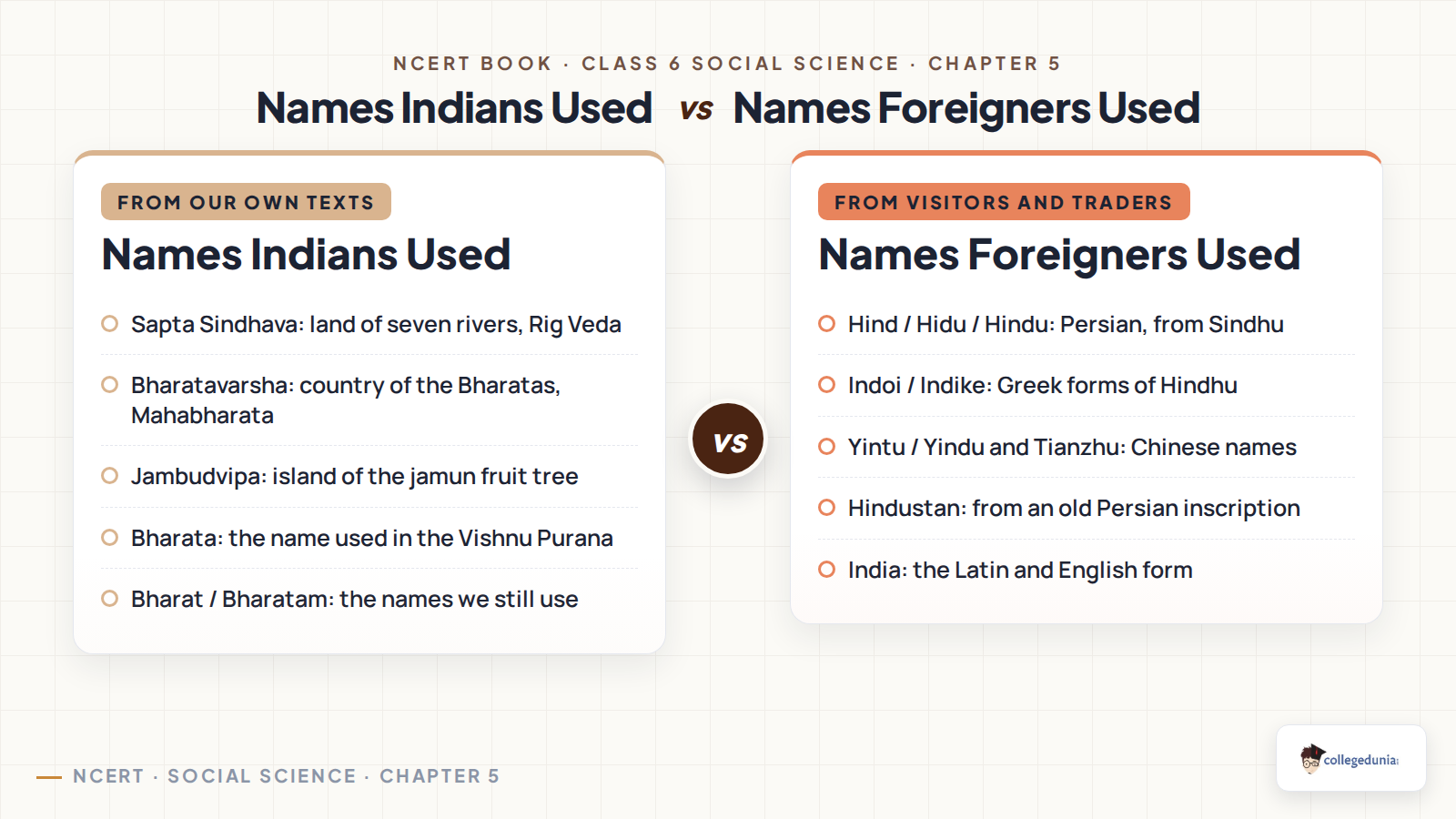
How Indians Named India: Sapta Sindhava and the Land of the Seven Rivers
The chapter starts with a comparison. The India we know today is a modern nation with defined borders, defined states and a known population. It was very different 500 years ago, 2,000 years ago or 5,000 years ago, when the region we now call the Indian Subcontinent had many different names and shifting boundaries.
The margin word on printed page 77 is inhabitants, which the book defines as people who live in a particular place. That word matters, because the chapter splits every name into two groups: names given by inhabitants, and names given by visitors from outside. Those names reach us from three kinds of records.
- Ancient texts, such as the Ṛig Veda, the Mahābhārata and the Viṣhṇu Purāṇa.
- Accounts of travellers and pilgrims, including the Chinese scholars who came to study here.
- Inscriptions, both Indian ones such as Aśhoka's and foreign ones such as the Persian stone records.
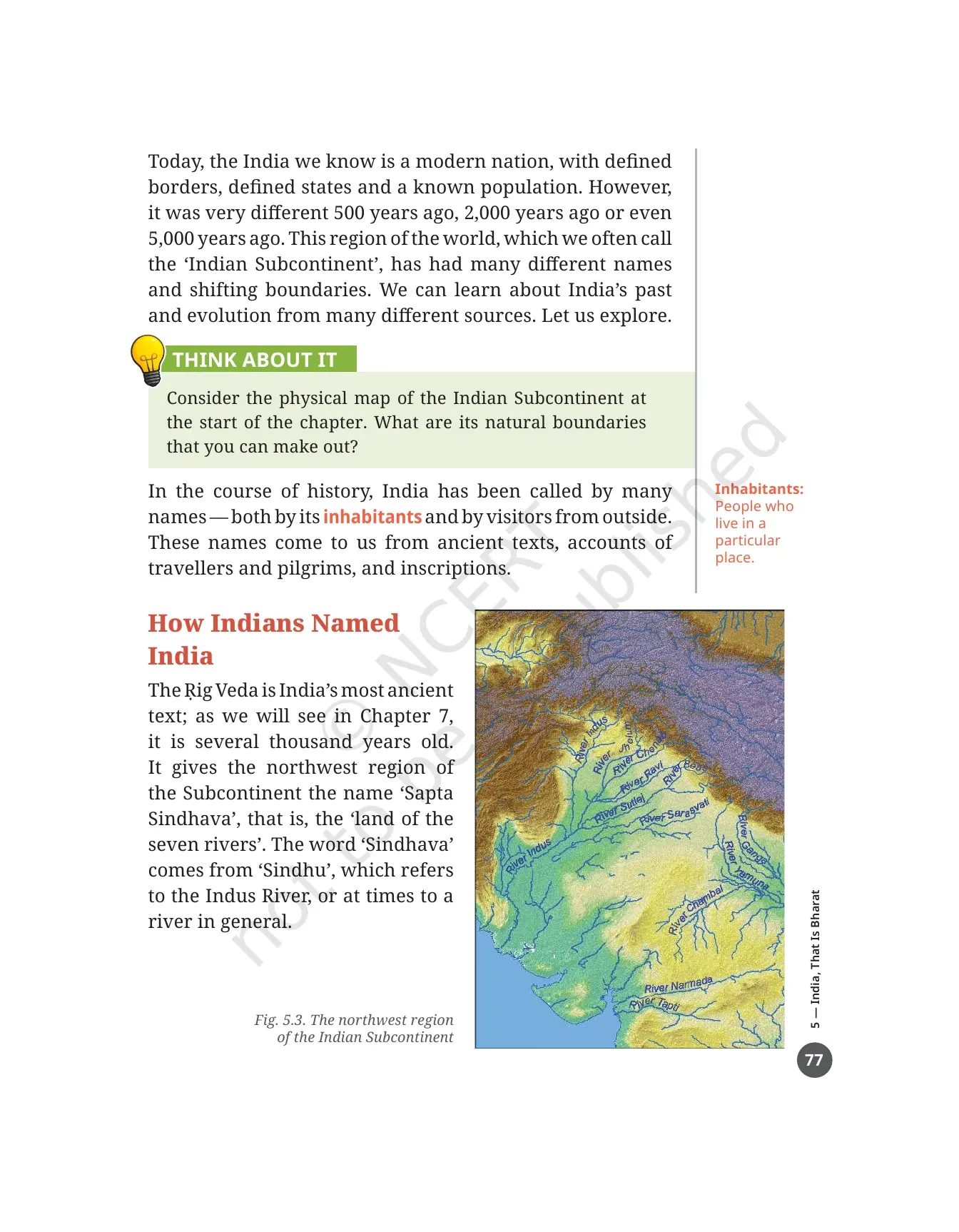
The first Indian name comes from India's most ancient text. The Ṛig Veda gives the northwest region of the Subcontinent the name Sapta Sindhava, which means the land of the seven rivers. The word Sindhava comes from Sindhu, which refers to the Indus River, and at times to a river in general. Fig. 5.3 on the same page shows that northwest region on a small map.
Bhāratavarṣha and Jambudvīpa: The Two Mahābhārata Names for the Whole Subcontinent
Moving on in time, names for other parts of India start appearing in the literature. The Mahābhārata lists many regions, and the book asks you to notice how familiar they still sound. Six of them are named in the text itself.
| Name in the Mahābhārata | What it matches today |
|---|---|
| Kāshmīra | More or less today's Kashmir |
| Kurukṣhetra | Parts of Haryana today |
| Vanga | Parts of Bengal |
| Prāgjyotiṣha | Roughly today's Assam |
| Kaccha | Today's Kutch |
| Kerala | More or less today's Kerala |
Then comes the harder question the chapter raises: when do we first meet a name for the entire Subcontinent? Because ancient Indian texts are difficult to date, the book says plainly that this is not an easy question to answer. The Mahābhārata, generally agreed to have been written from a few centuries BCE onward, supplies two such names.
- Bhāratavarṣha means "the country of the Bharatas". It clearly extends to the whole Subcontinent, and the text goes with it a long list of rivers and peoples. Bharata first appears in the Ṛig Veda as the name of one of the main Vedic groups of people, and several later kings are also named Bharata.
- Jambudvīpa means "the island of the fruit of the jamun tree", a tree native to India that is also called the jambul tree or the Malabar plum tree. In time this word came to mean the Indian Subcontinent.
The book then offers a dated clue. The emperor Aśhoka, whose date the chapter takes as about 250 BCE, used the same word Jambudvīpa in one of his inscriptions to describe the whole of India. At that time India included what is today Bangladesh, Pakistan and parts of Afghanistan.
The Viṣhṇu Purāṇa Verse That Defines Bhārata by Its Ocean and Its Mountains
A few centuries later, Bhārata became the name generally used for the Indian Subcontinent. The chapter proves it with one short verse from an ancient text called the Viṣhṇu Purāṇa, printed on page 80 in Sanskrit and in English. Learn the English line, because it is a favourite one-mark question.
- The verse begins uttaram yat samudrasya himādreścaiva dakṣiṇam, and its second line ends with the words tad bhāratam nāma.
- Translated, it reads: "The country that lies north of the ocean and south of the snowy mountains is called Bhārata."
- The THINK ABOUT IT box beside it asks you to identify those snowy mountains, and to judge whether the short description is correct.
- The name is still in use. In north India it is generally written Bharat, and in south India it is often Bharatam.
What makes the section interesting is that different parts of the country reached a similar definition on their own. A poem of ancient Tamil literature from about 2,000 years ago praises a king whose name was known "from [Cape] Kumari in the south, from the great mountain in the north, from the oceans on the east and on the west". The chapter's own comment is worth quoting in an answer: it looks like ancient Indians knew their geography well.
India, That Is Bharat in the Constitution of India and in Fig. 5.5
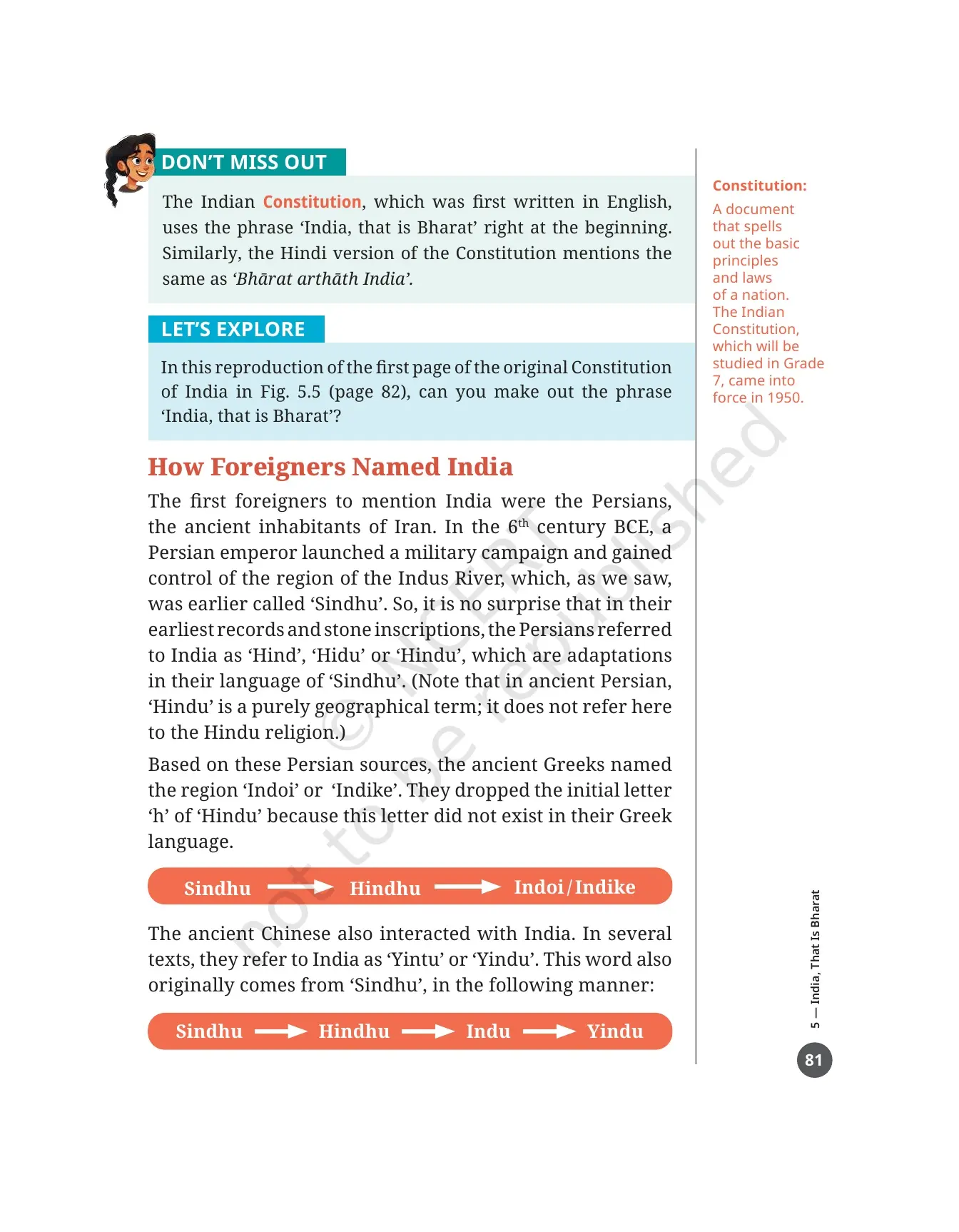
The chapter title comes straight out of a legal document, and the DON'T MISS OUT box on printed page 81 explains where. The Indian Constitution, which was first written in English, uses the phrase "India, that is Bharat" right at the beginning, and the Hindi version says the same as "Bhārat arthāth India".
The margin word here is Constitution, defined as a document that spells out the basic principles and laws of a nation. The book adds two facts about it that are easy to miss on a quick read.
- The Indian Constitution came into force in 1950.
- It will be studied properly in Grade 7, so Class 6 only needs the phrase and the date.
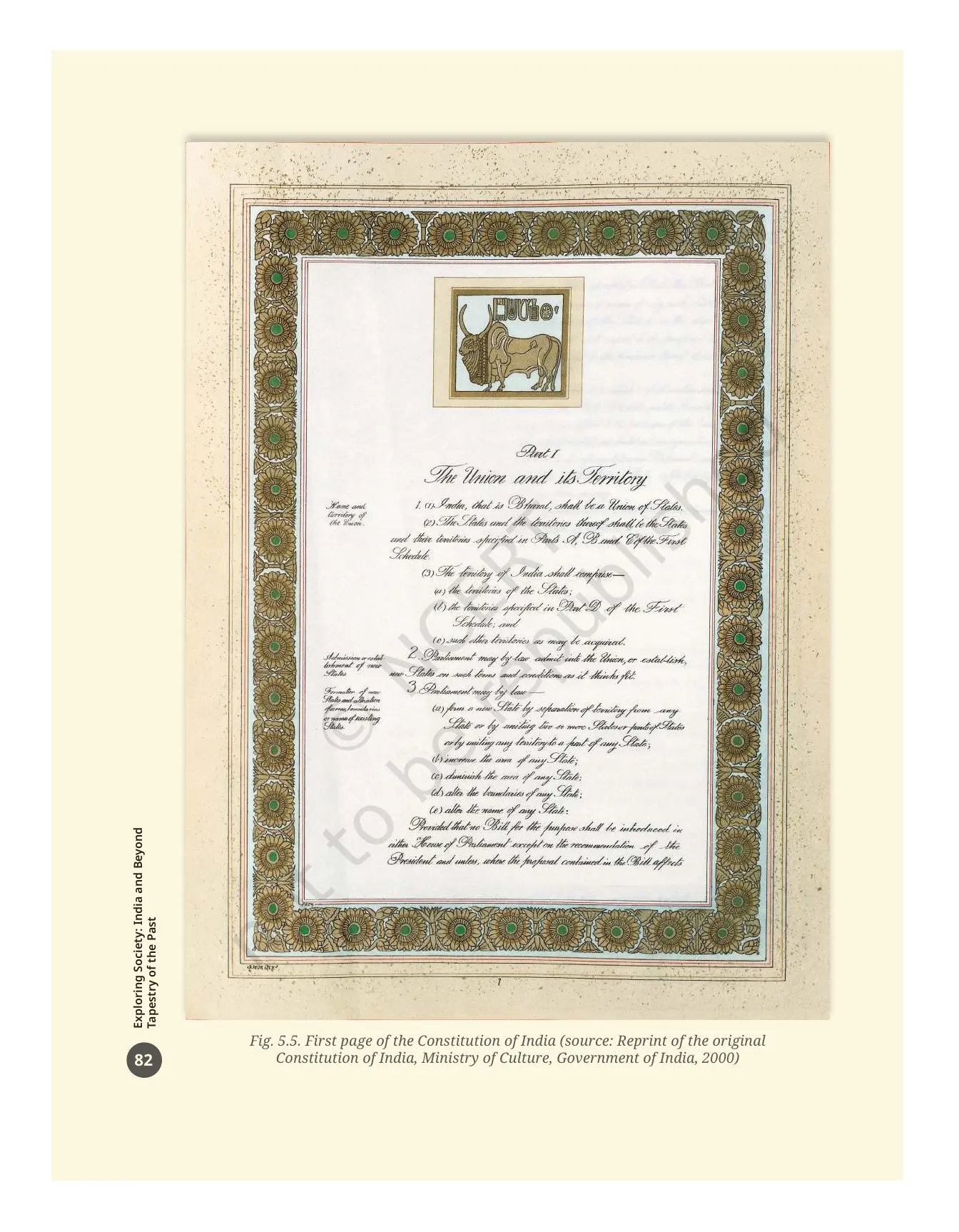
- The LET'S EXPLORE box sends you to Fig. 5.5 on printed page 82 to spot the phrase yourself.
Fig. 5.5 is a full-page reproduction of the first page of the original Constitution of India, taken from the reprint published by the Ministry of Culture, Government of India, in 2000. The page is decorated art, not plain type, so give yourself a minute to find the line. Finding it once makes the chapter title impossible to forget.
How Foreigners Named India: The Persian, Greek and Chinese Chain from Sindhu
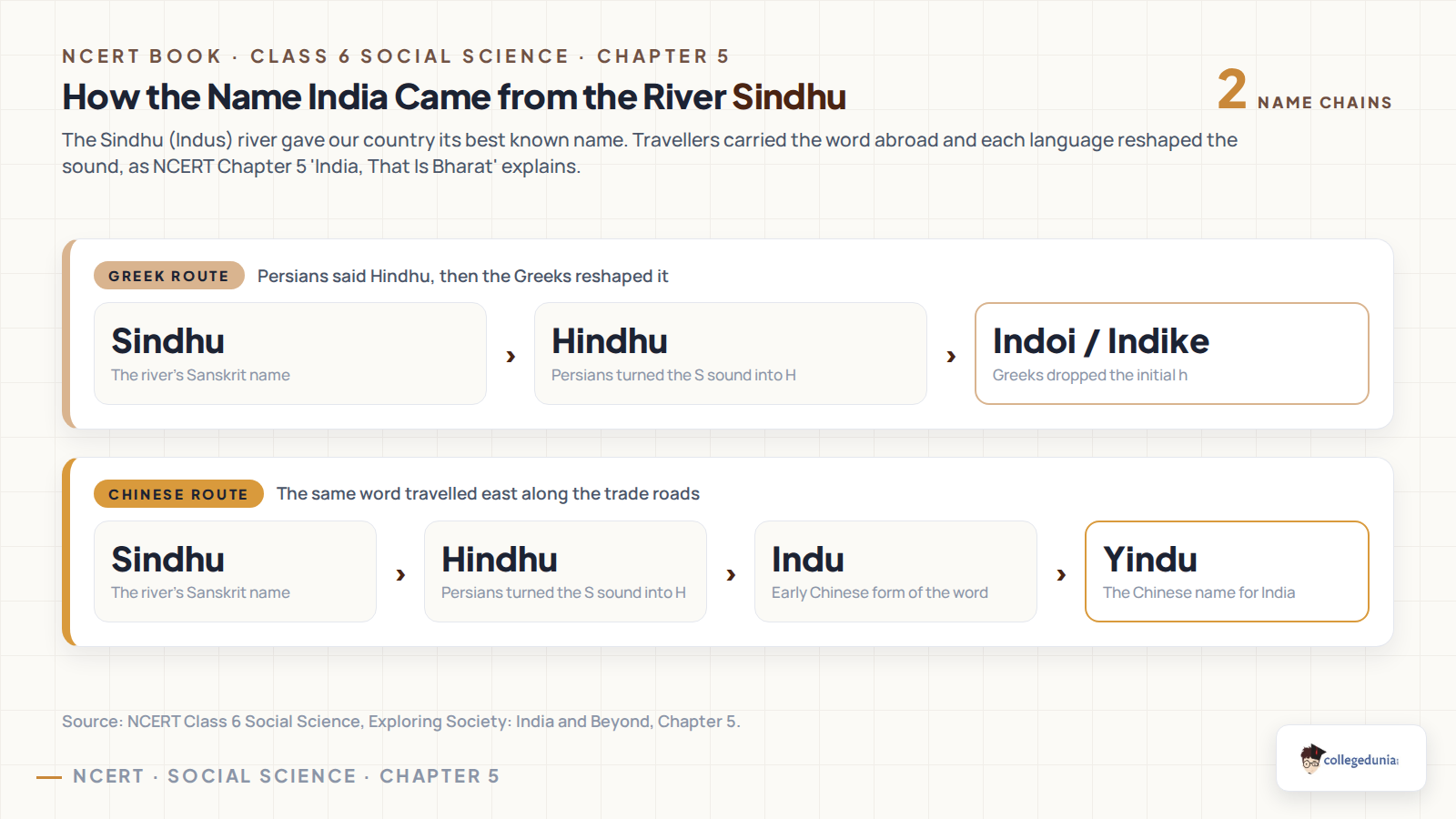
The second half of the chapter is one long chain reaction, and every link starts at the same word. Once you see that every foreign name for India is a version of Sindhu, this section takes ten minutes to learn instead of an hour.
- The first foreigners to mention India were the Persians, the ancient inhabitants of Iran. In the 6th century BCE a Persian emperor launched a military campaign and gained control of the region of the Indus River, which was earlier called Sindhu.
- In their earliest records and stone inscriptions the Persians called India Hind, Hidu or Hindu, all adaptations of Sindhu in their own language.
- The book adds a warning in brackets that examiners love. In ancient Persian, Hindu is a purely geographical term and does not refer to the Hindu religion.
- Working from those Persian sources, the ancient Greeks named the region Indoi or Indike. They dropped the initial letter h of Hindu because that letter did not exist in the Greek language. The book prints the chain as Sindhu to Hindhu to Indoi or Indike.
- The ancient Chinese also interacted with India and refer to it in several texts as Yintu or Yindu. That word comes from Sindhu too, and the book prints the longer chain as Sindhu to Hindhu to Indu to Yindu.
Write both chains out once with arrows and the section is done. The Greek chain has three steps and the Chinese chain has four, and the extra Indu step in the middle is the detail students most often drop when they reproduce the diagram in a test.
Xuanzang, Tianzhu and Hindustān: The Later Names in the Don't Miss Out Box
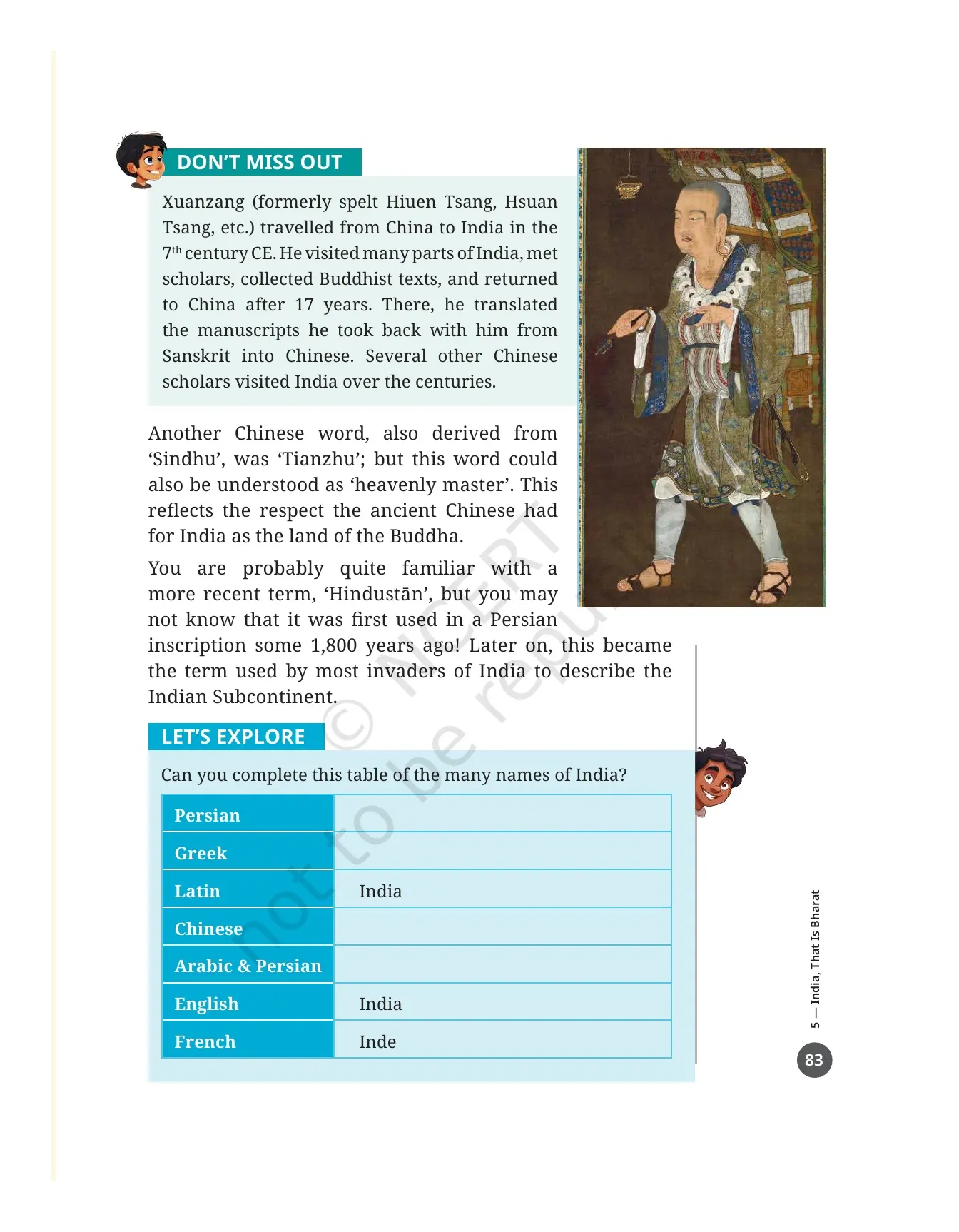
Printed page 83 adds the last two names and one traveller. The DON'T MISS OUT box introduces Xuanzang, whose name was formerly spelt Hiuen Tsang or Hsuan Tsang. He is the single most quotable person in the chapter, so learn his four facts as a set.
- He travelled from China to India in the 7th century CE.
- He visited many parts of India, met scholars and collected Buddhist texts.
- He returned to China after 17 years.
- Back home he translated the manuscripts from Sanskrit into Chinese. The book notes that several other Chinese scholars visited India over the centuries.
Two names close the section. Another Chinese word derived from Sindhu was Tianzhu, which could also be understood as "heavenly master", and the book reads that as a mark of the respect the ancient Chinese had for India as the land of the Buddha. The more familiar term Hindustān was first used in a Persian inscription some 1,800 years ago, and later became the term used by most invaders of India for the Subcontinent.
The LET'S EXPLORE box then hands you a blank table of the many names of India, with only three rows already filled in. Complete it from the chapter and you have a ready-made revision sheet.
| Language row in the book's table | Printed in the book | What the chapter lets you fill in |
|---|---|---|
| Persian | Blank | Hind, Hidu, Hindu |
| Greek | Blank | Indoi, Indike |
| Latin | India | Already given |
| Chinese | Blank | Yintu, Yindu, Tianzhu |
| Arabic and Persian | Blank | Hindustān |
| English | India | Already given |
| French | Inde | Already given |
Reading Fig. 5.2 and Fig. 5.4: The Rivers Map and the Mahābhārata Regions Map
Two full-page maps carry a lot of this chapter's marks, and both come with an instruction attached. Fig. 5.2 on printed page 76 is the physical map of the Indian Subcontinent with some of its rivers, and the THINK ABOUT IT box on the next page sends you back to it to work out the natural boundaries you can make out.
| Map | Printed page | What to look for |
|---|---|---|
| Fig. 5.2 | 76 | The Hindu Kush and the Himalaya across the top, and the rivers Indus, Jhelum, Chenab, Ravi, Beas, Sutlej and Sarasvati in the northwest |
| Fig. 5.2 | 76 | The Ganga, Yamuna, Chambal and Brahmaputra in the north and east, and the Narmada, Tapti, Mahanadi, Godavari, Krishna and Kaveri to the south |
| Fig. 5.4 | 79 | Regions listed in the Mahābhārata, including Gandhāra, Kāmboja, Matsya, Pañchāla, Chedi, Kosala, Magadha, Anga, Vanga, Avantī, Surāṣhṭra, Vidarbha, Kerala, Chola and Pāṇḍya |
The caption of Fig. 5.4 carries the exact instruction to follow. You do not need to remember those regions, but you should notice how they cover the entire geography of the Subcontinent. That single sentence is the whole point of the map, and it is also the reason the Mahābhārata name Bhāratavarṣha is treated as a name for the whole country. The LET'S EXPLORE box on printed page 78 only asks you to list the region names you have already heard of.
Every Figure, Activity Box and Margin Word Inside the India, That Is Bharat PDF
This chapter teaches through maps, boxes and two margin words as much as through paragraphs. Five numbered figures do the visual work and seven boxes turn the reading into tasks. Tick them off as you go.
| Figure or box | Printed page | What it shows or asks |
|---|---|---|
| Fig. 5.1 | 75 | A scene from rural India about 2,300 years ago, carved on the north gate of the Great Sanchi Stupa |
| Fig. 5.2 | 76 | A physical map of the Indian Subcontinent with some of its rivers |
| Fig. 5.3 | 77 | The northwest region of the Indian Subcontinent, the area the Ṛig Veda calls Sapta Sindhava |
| Fig. 5.4 | 79 | A map of a few regions listed in the Mahābhārata, many of them also mentioned as kingdoms |
| Fig. 5.5 | 82 | The first page of the Constitution of India, from the Ministry of Culture reprint of the original |
| THINK ABOUT IT boxes | 77 and 80 | The natural boundaries you can make out on the physical map, and whether the Viṣhṇu Purāṇa description of Bhārata is correct |
| LET'S EXPLORE boxes | 78, 81 and 83 | Listing the regions you recognise on Fig. 5.4, spotting "India, that is Bharat" in Fig. 5.5, and completing the table of the many names of India |
| DON'T MISS OUT boxes | 81 and 83 | The Constitution phrase in English and Hindi, and Xuanzang's 17-year journey from China |
| The Big Questions | 75 | How do we define India, and what were the ancient names for India |
| Before we move on ... | 84 | A three-point recap on India as an ancient land, the Indian names, and the foreign names built from Sindhu |
| Margin words | 77 and 81 | Inhabitants and Constitution |
Questions, Activities and Projects at the End of the India, That Is Bharat Chapter
Printed page 84 carries 4 numbered items, and the school test is usually built straight out of them. One is a discussion on the opening quotation, one is a seven-part true or false set, and two are imagination and reasoning questions with no single right answer.
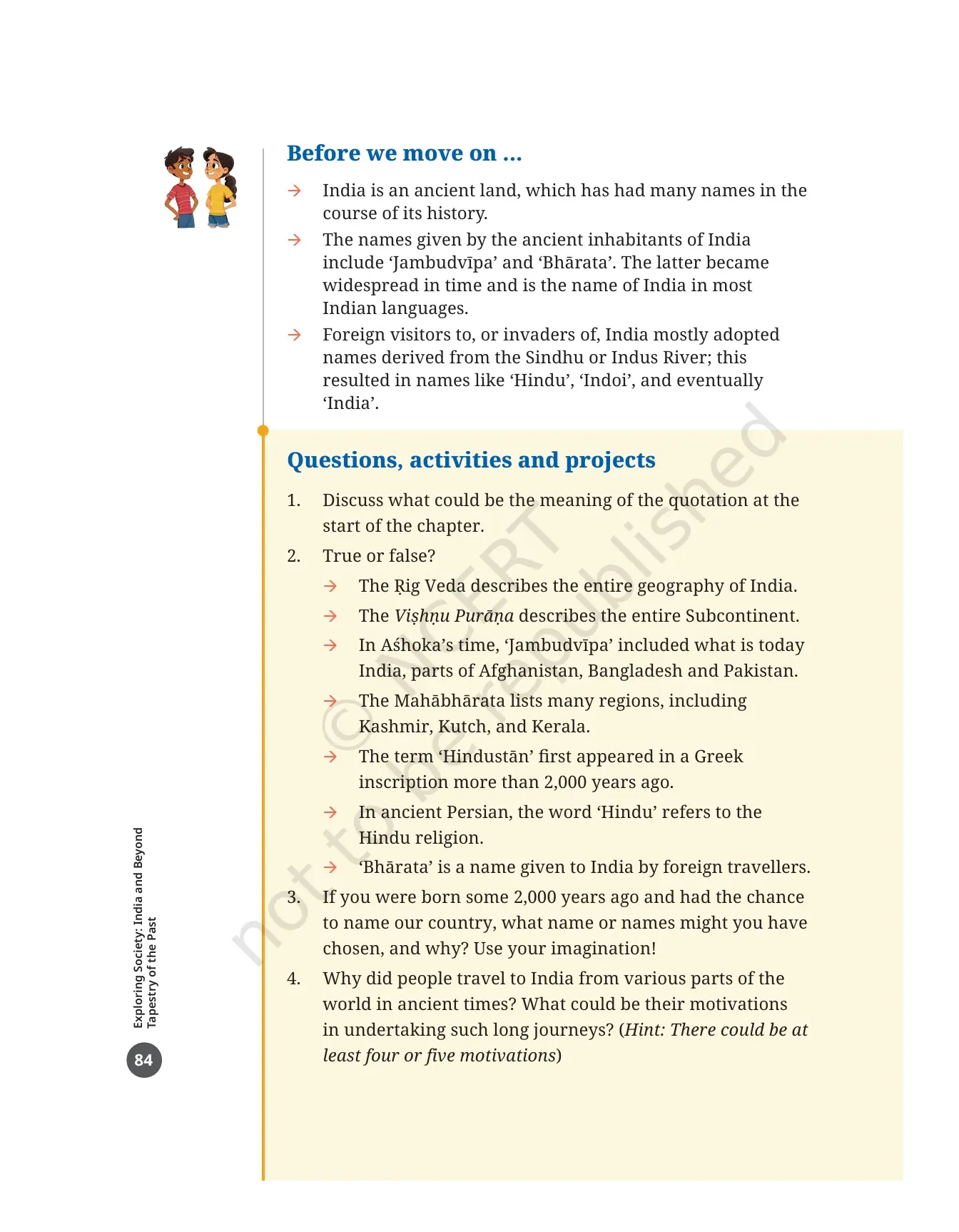
- Discuss the quotation. Work out what Sri Aurobindo's line at the start of the chapter could mean.
- True or false. Seven statements, listed separately below. This is the part that decides most of the marks.
- Name the country. If you were born some 2,000 years ago and could name our country, what name would you choose, and why? The book tells you to use your imagination.
- Why did people travel to India? Give the motivations behind such long journeys in ancient times. The printed hint says there could be at least four or five motivations.
Question 2 is the one to practise twice, because three of the seven statements are deliberate traps built on details from printed pages 77, 81 and 83.
- The Ṛig Veda describes the entire geography of India.
- The Viṣhṇu Purāṇa describes the entire Subcontinent.
- In Aśhoka's time, Jambudvīpa included what is today India, parts of Afghanistan, Bangladesh and Pakistan.
- The Mahābhārata lists many regions, including Kashmir, Kutch and Kerala.
- The term Hindustān first appeared in a Greek inscription more than 2,000 years ago.
- In ancient Persian, the word Hindu refers to the Hindu religion.
- Bhārata is a name given to India by foreign travellers.
Common Mistakes Students Make in the India, That Is Bharat Chapter
- Saying the Ṛig Veda names the whole of India. It names only the northwest region, as Sapta Sindhava. The names for the whole Subcontinent come from the Mahābhārata and the Viṣhṇu Purāṇa.
- Calling Hindustān a Greek word. It first appears in a Persian inscription about 1,800 years ago, not a Greek one.
- Reading the Persian Hindu as a religion. The chapter states in brackets that in ancient Persian it is a purely geographical term.
- Treating Bhārata as a foreign name. Bharata is a Vedic group name from the Ṛig Veda, so Bhāratavarṣha and Bhārata are names Indians gave themselves.
- Swapping Bhāratavarṣha and Jambudvīpa. Bhāratavarṣha is the country of the Bharatas. Jambudvīpa is the island of the jamun fruit tree.
Related Links:
- India, That Is Bharat Class 6 Handwritten Notes
- Timeline and Sources of History Class 6 NCERT Book PDF
How to Read the Class 6 India, That Is Bharat PDF in One 40-Minute Sitting
This is one of the shortest chapters in the book, so a single sitting is enough if you keep a rough sheet beside you for the name chains. Follow the order below and you will finish the reading, both maps and all seven boxes together.
- Minutes 0 to 5: read the Sri Aurobindo quotation and the two Big Questions on printed page 75, then look at Fig. 5.2 and answer the natural boundaries box.
- Minutes 5 to 15: read printed pages 77 and 78 and write down Sapta Sindhava, Bhāratavarṣha and Jambudvīpa with one line of meaning each.
- Minutes 15 to 22: read the Viṣhṇu Purāṇa verse on printed page 80 and copy the one-line English translation word for word.
- Minutes 22 to 30: read the Constitution box, then find "India, that is Bharat" on Fig. 5.5 before moving on.
- Minutes 30 to 40: read the foreigners section, draw both Sindhu chains with arrows, and fill the table of names from the last LET'S EXPLORE box.
Come back the next day for question 2, because the true or false statements need a second pass to catch the Greek inscription trap and the Persian religion trap. That second pass is what turns a chapter you have read into a chapter you can answer, and it is why students who keep the official PDF on their phone finish this theme faster than students working from guide books alone.
More India, That Is Bharat Class 6 Resources
The book PDF gives you the printed chapter. These pages give you the answers, the revision layer and the last-day recap for the same chapter.
| Resource | What it gives you |
|---|---|
| India, That Is Bharat Class 6 NCERT Solutions | Step-by-step answers to all 4 questions, activities and projects, including every part of the true or false set in question 2 |
| India, That Is Bharat Class 6 Revision Notes | The Indian names, the foreign names, the Sindhu chains and both maps in one short read |
| India, That Is Bharat Class 6 Handwritten Notes | A topper's handwritten pages with hand-drawn name chains and colour-coded sub-headings for a last-day recap |
| India, That Is Bharat Class 6 NCERT Book PDF | This page. The official 2026-27 chapter file, printed pages 75 to 84 of Exploring Society: India and Beyond |
NCERT Book PDF for Class 6 Social Science: All 14 Chapters
Exploring Society: India and Beyond runs to 14 chapters across five themes. Download the ones your school has taught, or take the full set in one go.
| Chapter | Resource |
|---|---|
| Chapter 1 | Locating Places on the Earth NCERT Book PDF |
| Chapter 2 | Oceans and Continents NCERT Book PDF |
| Chapter 3 | Landforms and Life NCERT Book PDF |
| Chapter 4 | Timeline and Sources of History NCERT Book PDF |
| Chapter 5 | India, That Is Bharat NCERT Book PDF (this page) |
| Chapter 6 | The Beginnings of Indian Civilisation NCERT Book PDF |
| Chapter 7 | India's Cultural Roots NCERT Book PDF |
| Chapter 8 | Unity in Diversity, or 'Many in the One' NCERT Book PDF |
| Chapter 9 | Family and Community NCERT Book PDF |
| Chapter 10 | Grassroots Democracy Part 1: Governance NCERT Book PDF |
| Chapter 11 | Grassroots Democracy Part 2: Local Government in Rural Areas NCERT Book PDF |
| Chapter 12 | Grassroots Democracy Part 3: Local Government in Urban Areas NCERT Book PDF |
| Chapter 13 | The Value of Work NCERT Book PDF |
| Chapter 14 | Economic Activities Around Us NCERT Book PDF |
India, That Is Bharat Class 6 Social Science NCERT Book PDF FAQs
Common Questions on the Class 6 Social Science Chapter 5 File
Ques. Where can I download the NCERT Class 6 Social Science Chapter 5 India, That Is Bharat PDF?
Ans. You can download it directly from this page. It is the official NCERT chapter file for the 2026-27 print of Exploring Society: India and Beyond, and it is free.
Ques. How many pages is the India, That Is Bharat chapter PDF?
Ans. The file runs to 10 pages. It covers printed pages 75 to 84 of the textbook, from the Sri Aurobindo quotation on the opening page to the four end questions on the last page.
Ques. Why is the chapter called India, That Is Bharat?
Ans. The phrase comes from the Constitution of India. The Constitution was first written in English and uses the words "India, that is Bharat" right at the beginning, while the Hindi version says "Bhārat arthāth India". The DON'T MISS OUT box on printed page 81 explains this, and Fig. 5.5 on page 82 shows the original page.
Ques. What does Sapta Sindhava mean?
Ans. Sapta Sindhava means the land of the seven rivers. The Ṛig Veda, India's most ancient text, uses it for the northwest region of the Subcontinent. The word Sindhava comes from Sindhu, which refers to the Indus River and at times to a river in general.
Ques. What is the meaning of Bhāratavarṣha?
Ans. Bhāratavarṣha means "the country of the Bharatas". The Mahābhārata uses it for the entire Subcontinent along with a long list of rivers and peoples. Bharata first appears in the Ṛig Veda as the name of one of the main Vedic groups of people, and several later kings were also named Bharata.
Ques. What does Jambudvīpa mean and who used the word?
Ans. Jambudvīpa means "the island of the fruit of the jamun tree", a tree native to India that is also called the jambul tree or the Malabar plum tree. The Mahābhārata uses it, and the emperor Aśhoka, whose date the chapter gives as about 250 BCE, used the same word in an inscription for the whole of India.
Ques. What does the Viṣhṇu Purāṇa say about Bhārata?
Ans. The verse on printed page 80 translates as "The country that lies north of the ocean and south of the snowy mountains is called Bhārata." The chapter then asks you to identify those snowy mountains and to judge whether the description is correct.
Ques. How did the name India come from the river Sindhu?
Ans. The Persians adapted Sindhu into Hind, Hidu or Hindu. The Greeks worked from those Persian records and made it Indoi or Indike, dropping the initial h because that letter did not exist in Greek. The chapter prints the chain as Sindhu to Hindhu to Indoi or Indike, and India in Latin and English comes from the same root.
Ques. What did the ancient Chinese call India?
Ans. Several Chinese texts call India Yintu or Yindu, which also comes from Sindhu through the chain Sindhu to Hindhu to Indu to Yindu. Another Chinese word derived from Sindhu was Tianzhu, which could also be understood as "heavenly master", reflecting the respect the ancient Chinese had for India as the land of the Buddha.
Ques. Who was Xuanzang and why does the chapter mention him?
Ans. Xuanzang, formerly spelt Hiuen Tsang or Hsuan Tsang, travelled from China to India in the 7th century CE. He visited many parts of India, met scholars, collected Buddhist texts and returned to China after 17 years, where he translated the manuscripts from Sanskrit into Chinese. He appears in the DON'T MISS OUT box on printed page 83.
Ques. When was the term Hindustān first used?
Ans. The chapter says Hindustān was first used in a Persian inscription some 1,800 years ago. Later it became the term used by most invaders of India to describe the Indian Subcontinent. It was not a Greek word, which is the trap set in the true or false question at the end of the chapter.
Ques. Which regions does the Mahābhārata list in this chapter?
Ans. The text names Kāshmīra for today's Kashmir, Kurukṣhetra for parts of Haryana, Vanga for parts of Bengal, Prāgjyotiṣha for roughly today's Assam, Kaccha for Kutch and Kerala for more or less today's Kerala. Fig. 5.4 on printed page 79 maps many more, and the caption says you do not need to remember them all.
Ques. How many questions are there at the end of the India, That Is Bharat chapter?
Ans. There are 4 numbered items under "Questions, activities and projects" on printed page 84. They cover a discussion on the opening quotation, a seven-part true or false set, an imagination task on naming the country 2,000 years ago, and a question on why people travelled to India in ancient times.
Ques. Do I need the NCERT Solutions if I already have the book PDF?
Ans. The book PDF carries the questions but not the answers. Use the India, That Is Bharat Class 6 NCERT Solutions to check each part of the true or false set and every activity box.



Comments