




The Class 11 Physics NCERT Solutions Chapter 10 Thermal Properties of Matter will help students prepare for Boards, JEE Main, JEE Advanced, NEET, CUET and NDA in 2026-27. Every back-exercise question is solved with full working, so students can check each temperature conversion, thermal-expansion calculation, calorimetry balance, and heat-transfer numerical step by step.
This chapter links heat with measurable change, and the skills built here are used again in Thermodynamics and Kinetic Theory.
- CBSE Weightage: 3 to 5 marks, usually one short answer plus one numerical on expansion, calorimetry or heat transfer.
- Questions solved: all Exercise 10.1 onward, covering temperature scales, thermal expansion, specific heat, latent heat, and conduction.
- Key formulas: linear and volume expansion, Q = mcΔT, Q = mL, conduction rate, Stefan's law and Wien's law.
Each solution in this Class 11 Physics NCERT Solutions Chapter 10 Thermal Properties of Matter compilation is curated by subject experts, based on the 2026-27 NCERT textbook, and refined against the last five years of CBSE Board, JEE Main and NEET papers.
Temperature, Heat and the Three Temperature Scales
The chapter starts by separating two ideas students often mix up. Heat is the energy that flows because of a temperature difference, while temperature tells how hot or cold a body is. Heat always flows from the hotter body to the colder one until both reach the same temperature. The NCERT questions here test this difference directly, so the solved answers state it in the first line.
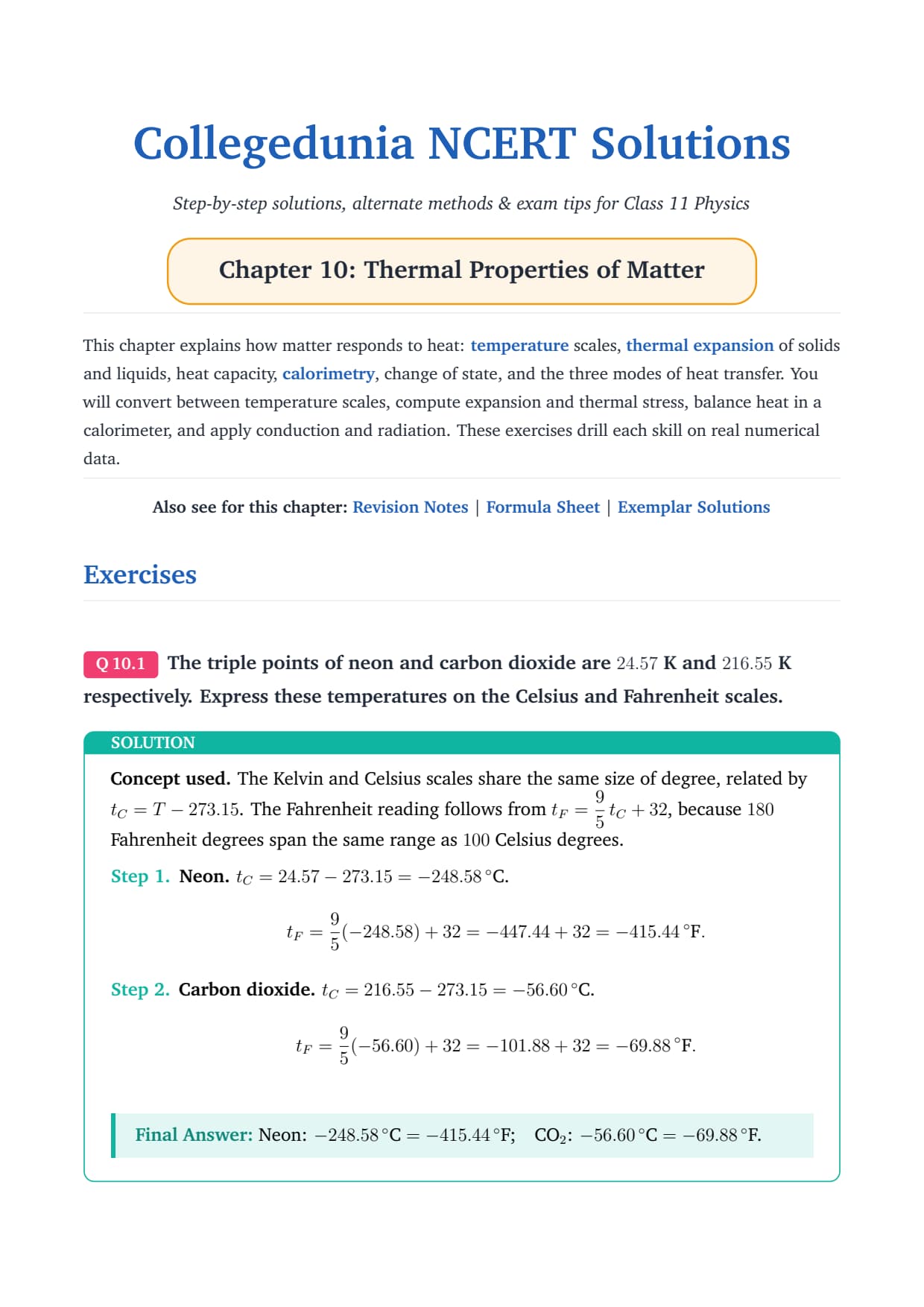
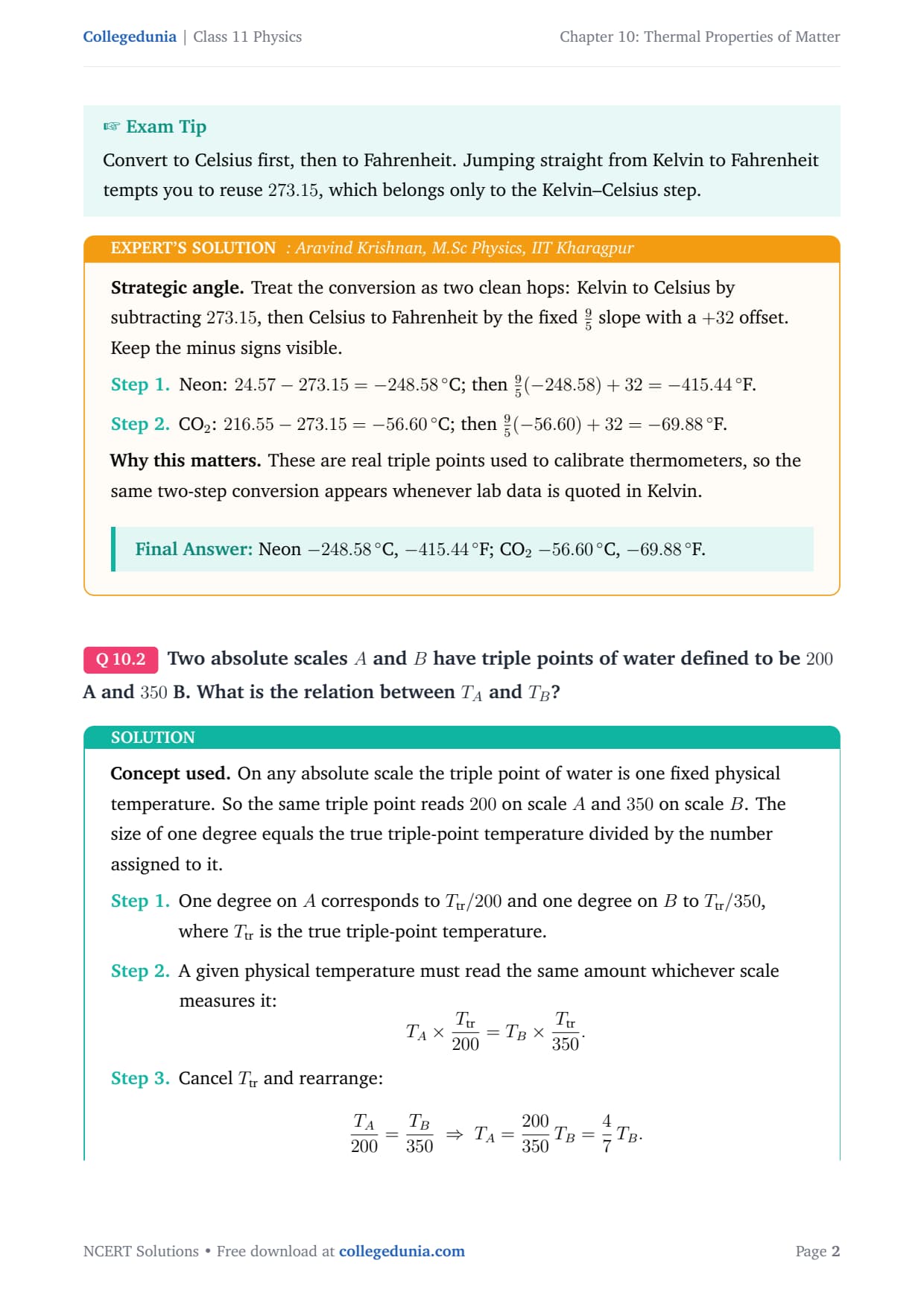
Three scales measure temperature, and the chapter asks students to convert between them. The Kelvin scale is the SI scale, and T(K) = t(°C) + 273.15. The Fahrenheit and Celsius scales are linked by a fixed relation.
| Scale | Ice point | Steam point | Conversion |
|---|---|---|---|
| Celsius (°C) | 0 | 100 | base scale |
| Fahrenheit (°F) | 32 | 212 | tF = (9/5)tC + 32 |
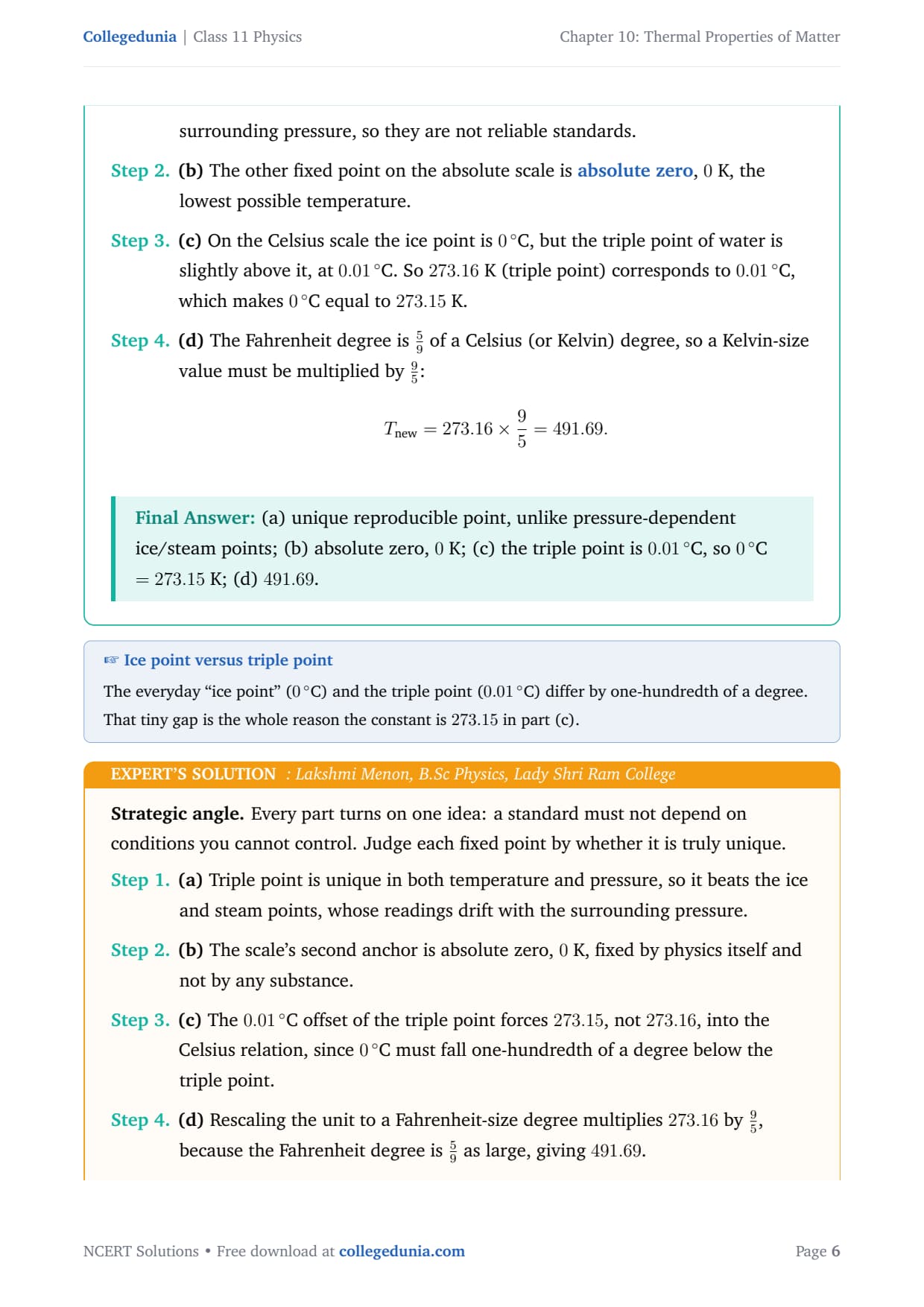
| Kelvin (K) | 273.15 | 373.15 | T = tC + 273.15 |
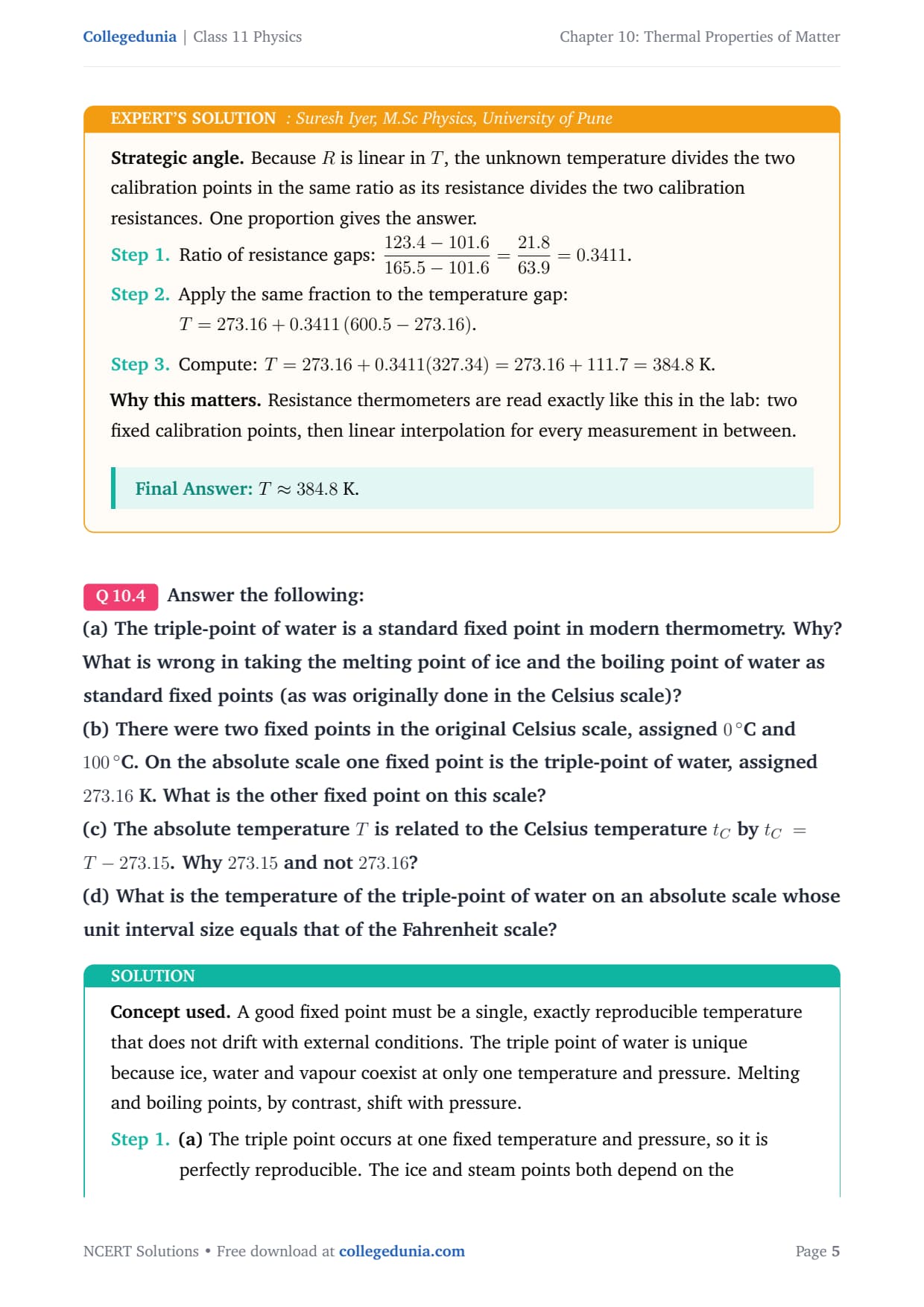
Numericals such as Exercise 10.1 give a temperature on one scale and ask for it on another. Substitute into the conversion formula and solve for the unknown scale. The solved answers keep the ice-point and steam-point values on their own line, so students see how the two-point calibration builds the relation.
Thermal Expansion: Linear, Area and Volume Change
Most solids and liquids grow larger when heated. The chapter measures this with three coefficients of expansion, and the NCERT solutions use all three. The coefficient tells how much a fixed length, area, or volume grows per degree rise in temperature.
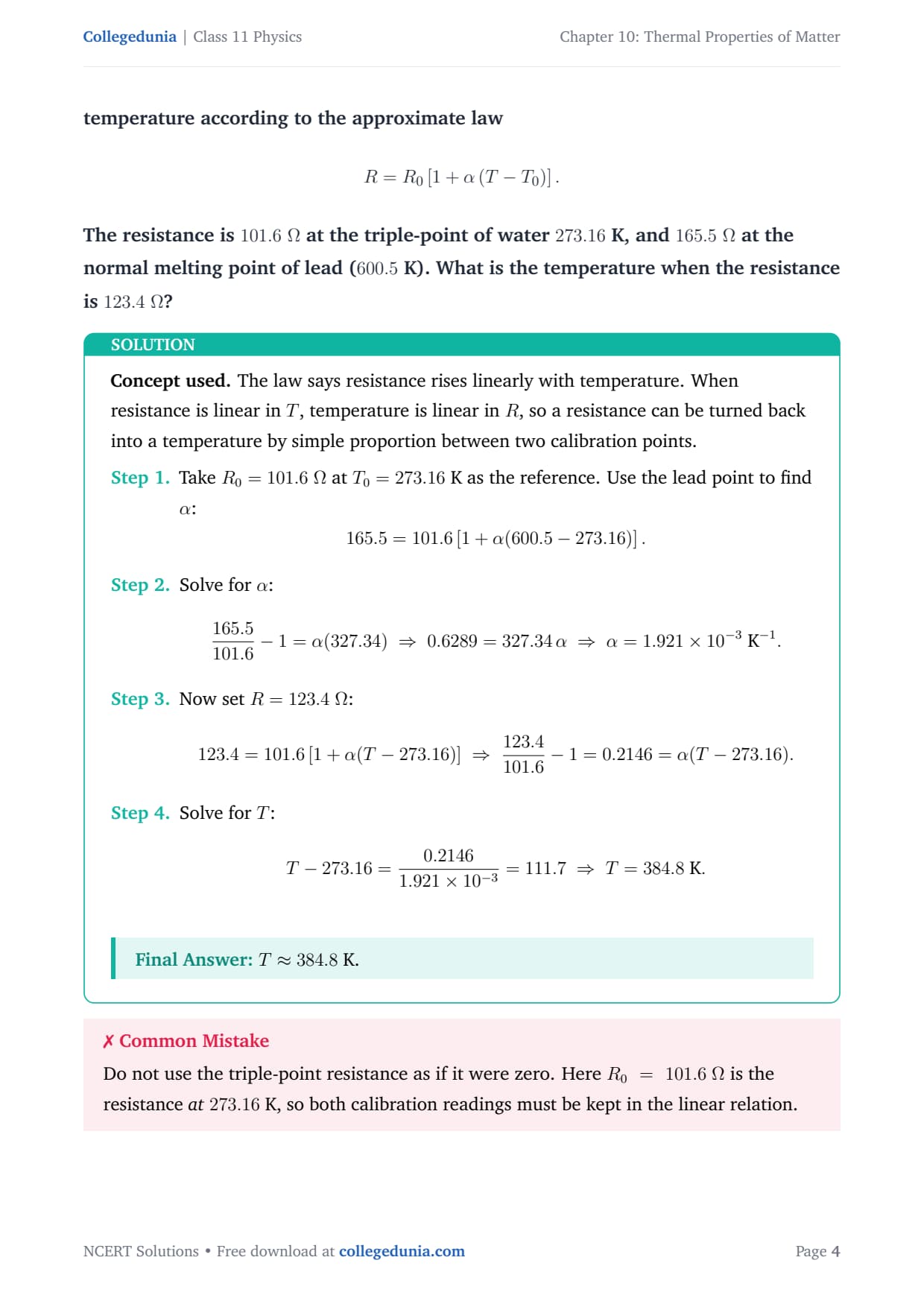
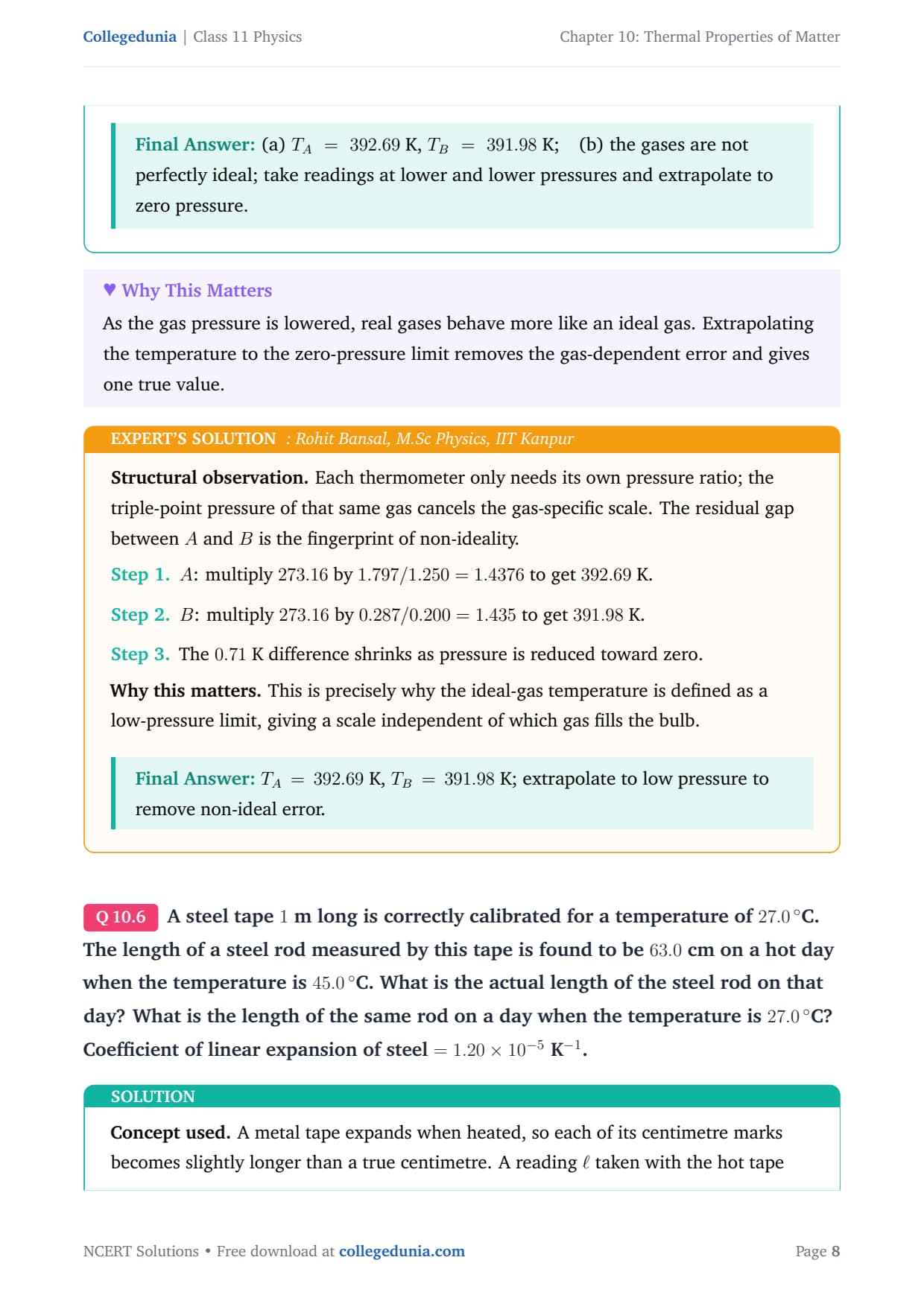
- Linear expansion: ΔL/L = α ΔT, where α is the coefficient of linear expansion.
- Area expansion: ΔA/A = β ΔT, with β = 2α.
- Volume expansion: ΔV/V = γ ΔT, with γ = 3α for an isotropic solid.
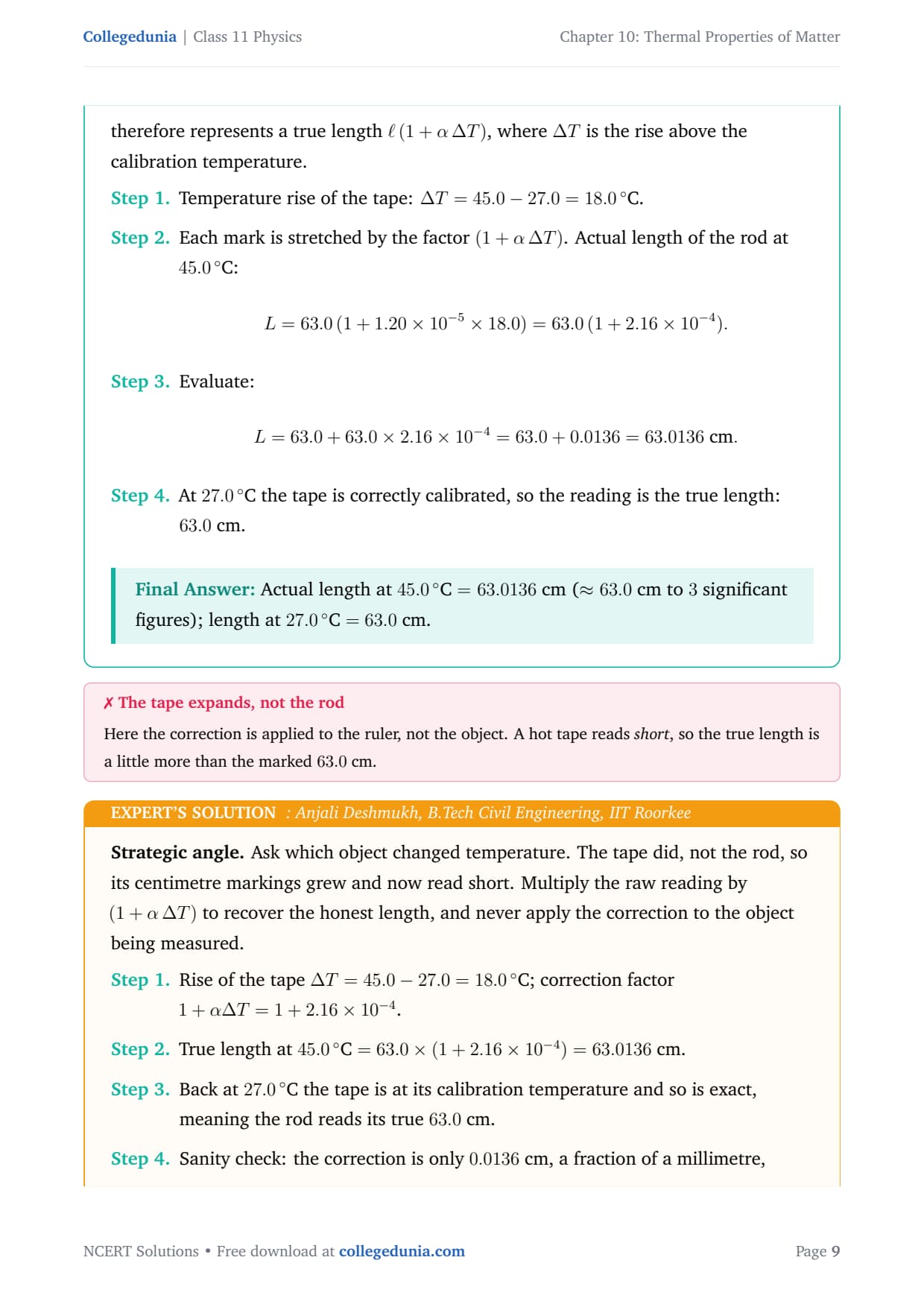
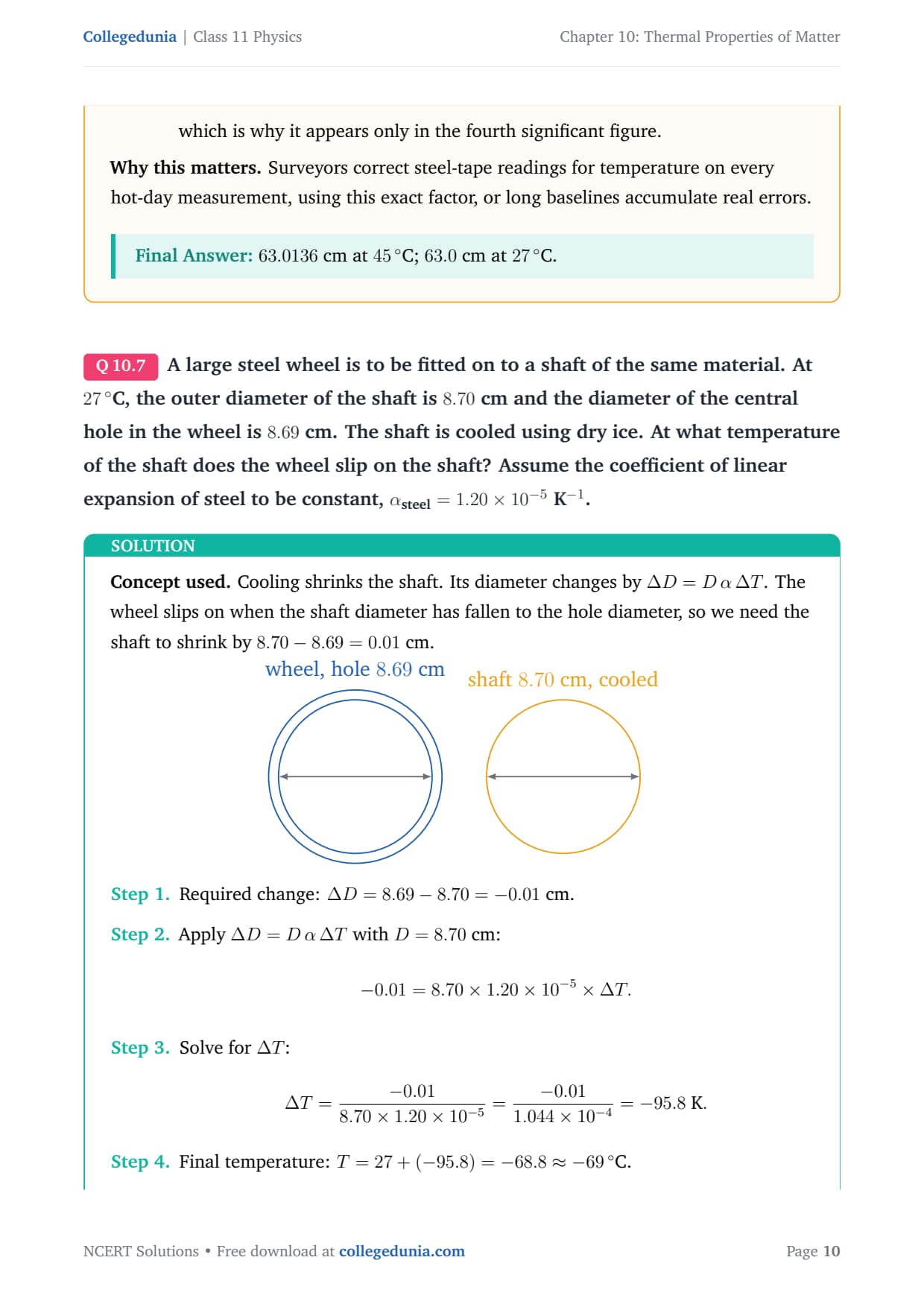
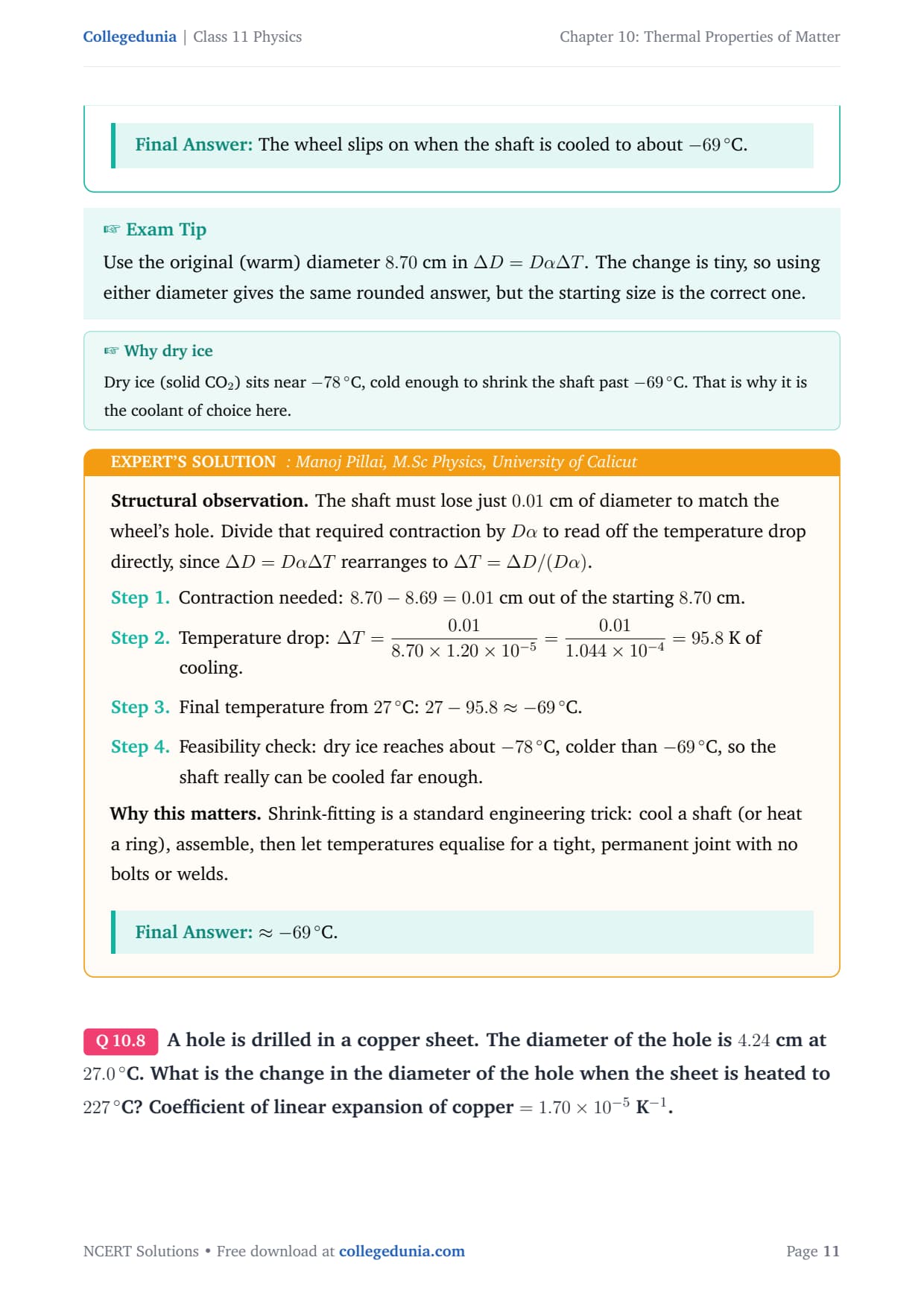
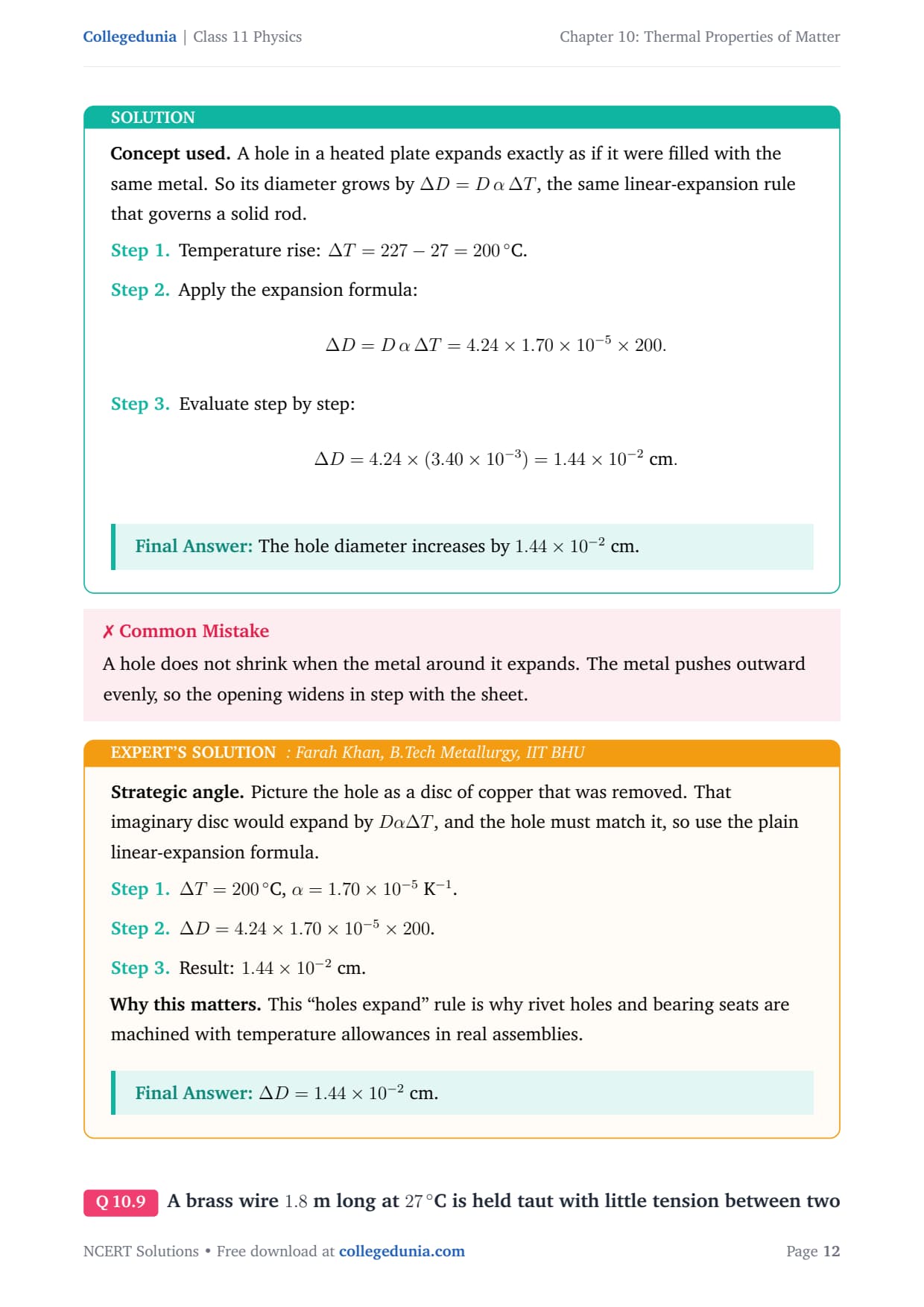
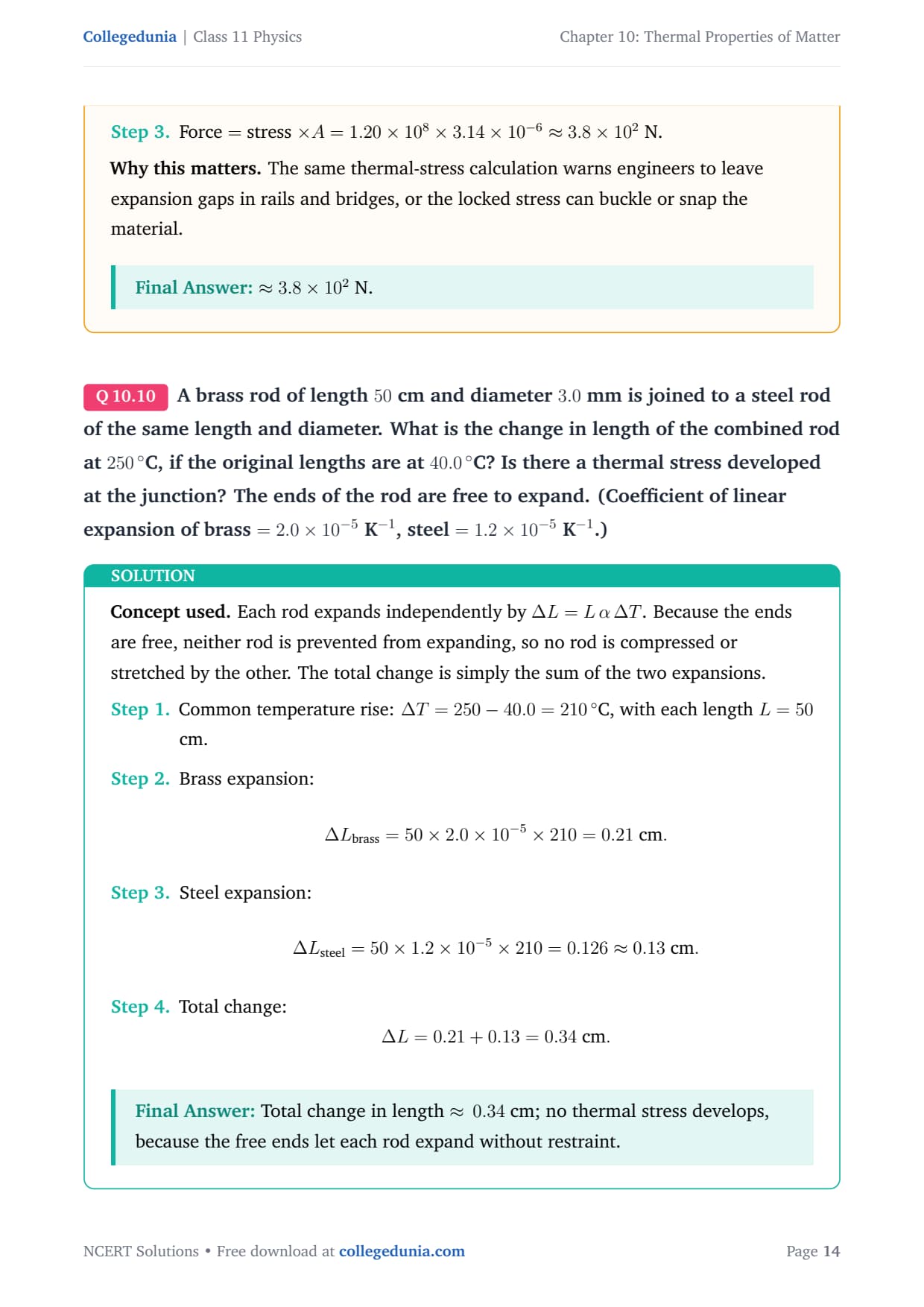
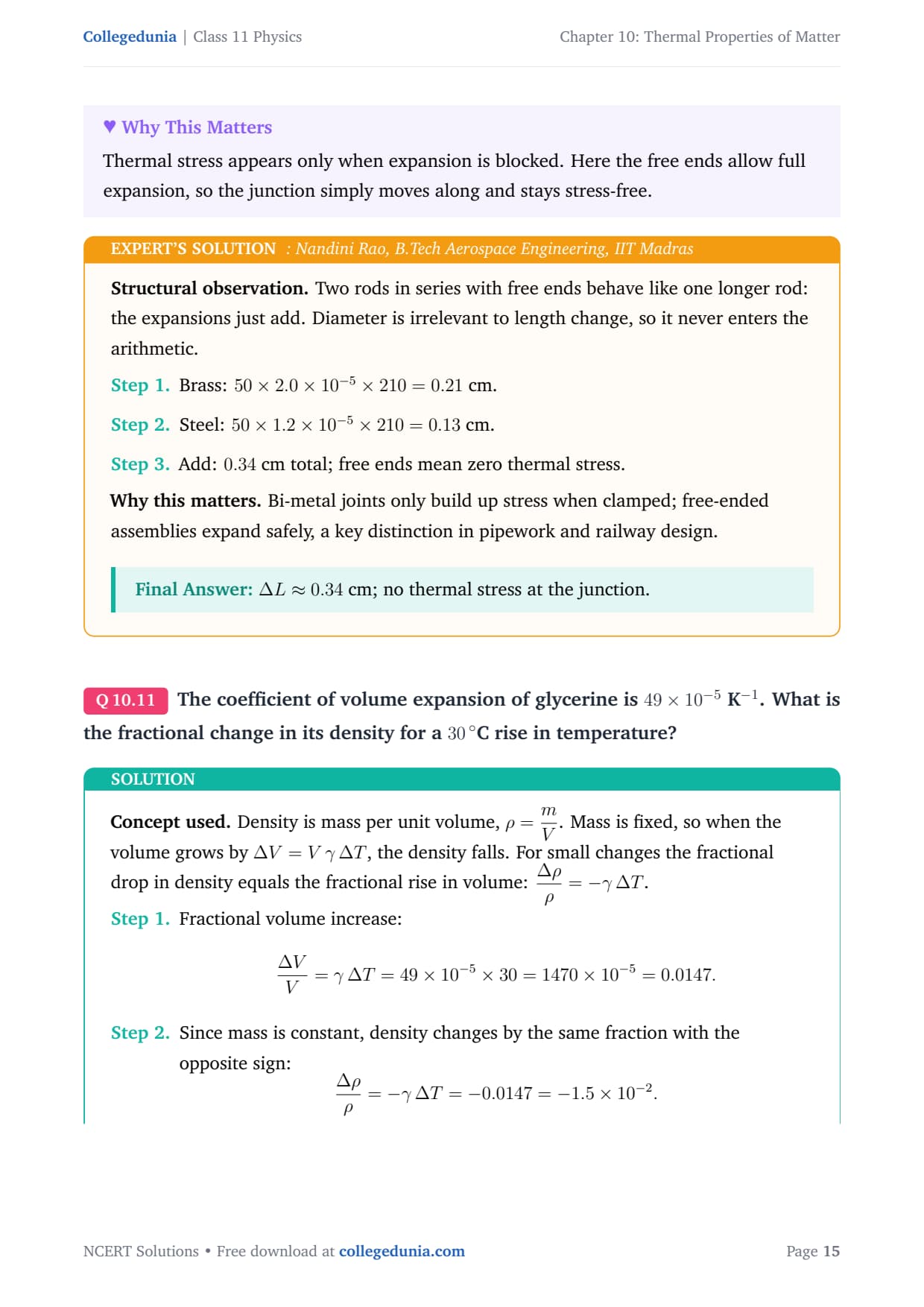
The link β = 2α and γ = 3α is one of the most tested facts in the chapter. Problems like Exercise 10.3 give the coefficient of linear expansion and ask for the change in length of a rod or the gap in a railway line. Convert every temperature change to the same unit, then multiply by the coefficient and the original size. The solutions also cover the special behaviour of water, which contracts between 0 °C and 4 °C, because this anomaly appears in short-answer questions.
Specific Heat Capacity and Calorimetry Problems
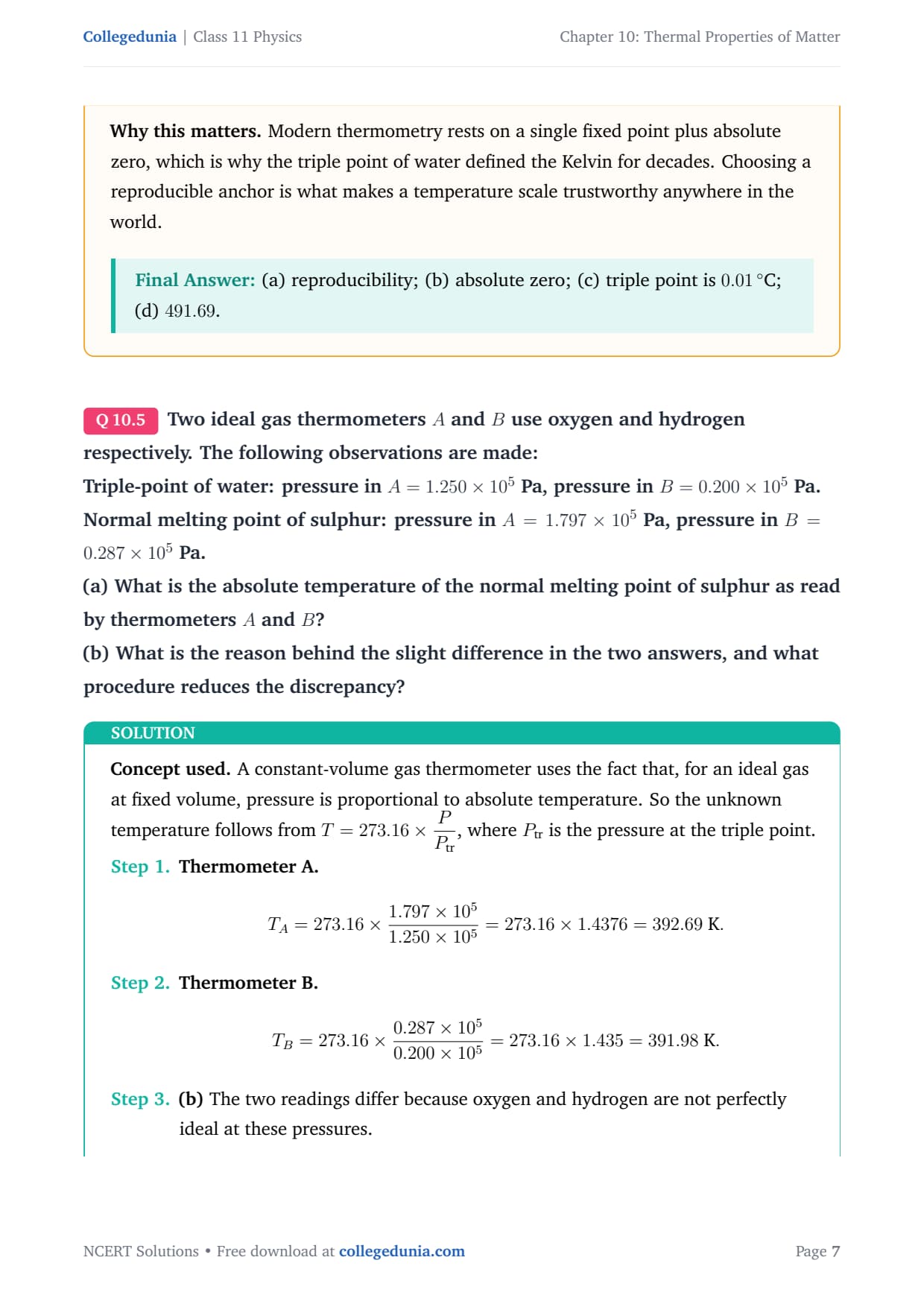
When heat is added to a body, its temperature rises by an amount that depends on the material. The specific heat capacity is the heat needed to raise the temperature of one kilogram of a substance by one kelvin. The core formula runs through every calorimetry numerical in the chapter.
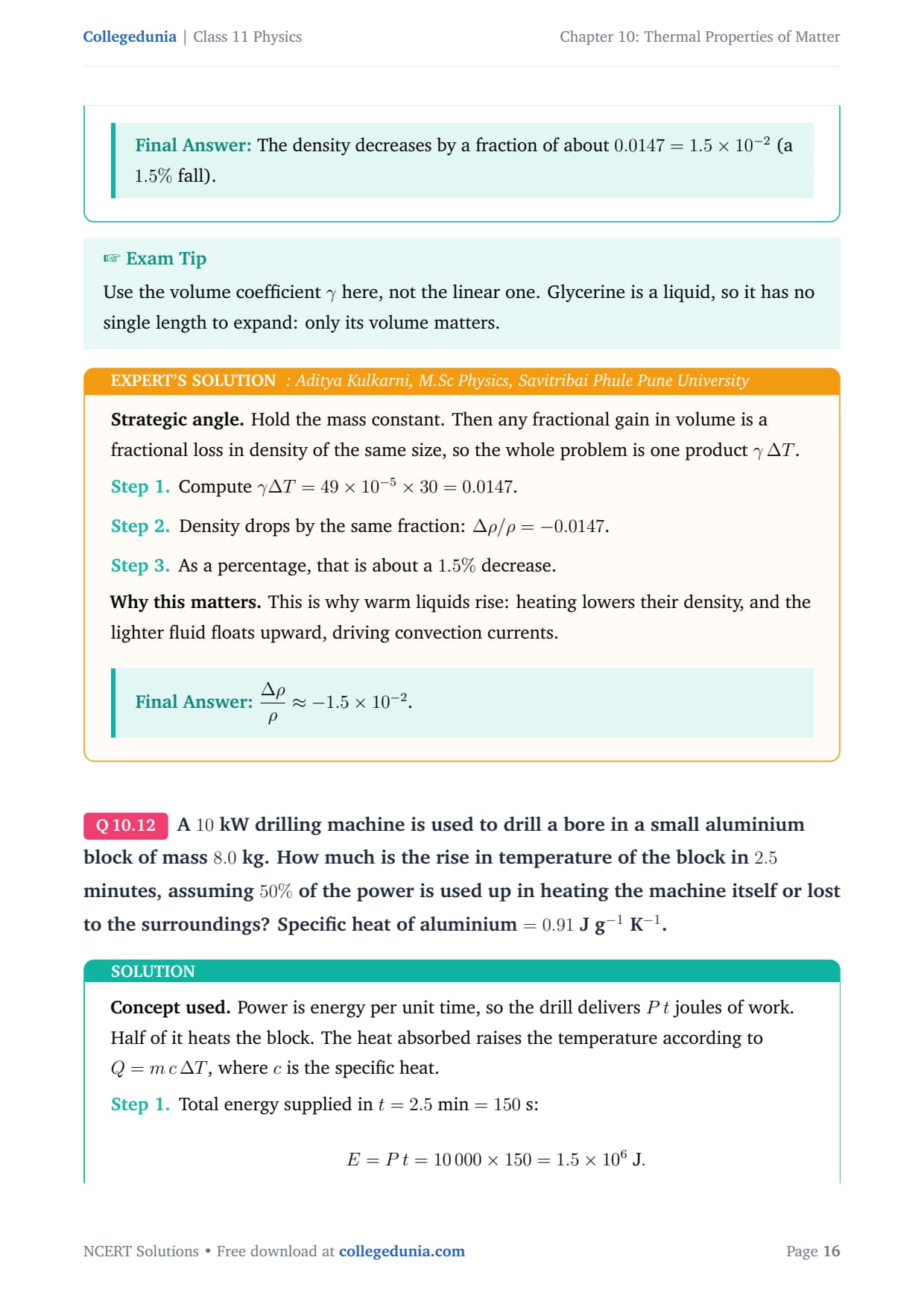
Q = m c ΔT, where Q is the heat supplied, m the mass, c the specific heat capacity, and ΔT the temperature change. Calorimetry problems use the principle of mixtures: in an insulated system, the heat lost by the hot body equals the heat gained by the cold body.
| Quantity | Formula | SI unit |
|---|---|---|
| Heat supplied | Q = m c ΔT | joule (J) |
| Heat capacity | S = m c | J K-1 |
| Molar specific heat | C = Q/(n ΔT) | J mol-1 K-1 |
In Exercise 10.5 and similar problems, students find the final temperature when two bodies at different temperatures are mixed. Write "heat lost = heat gained", put every term in SI units, and solve for the unknown. The solved answers show the water equivalent of the calorimeter on a separate line so no hidden heat term is dropped.
Change of State and Latent Heat of Fusion and Vaporisation
A substance can change from solid to liquid or liquid to gas without any change in temperature. During this change of state, the heat supplied breaks the bonds between particles instead of raising the temperature. The heat per unit mass for this is called the latent heat.
Q = m L, where L is the latent heat of fusion (melting) or vaporisation (boiling). The temperature stays fixed at the melting point or boiling point throughout the change. This is why a mixture of ice and water stays at 0 °C until all the ice has melted.
- Latent heat of fusion of ice: about 3.33 × 10⁵ J kg-1.
- Latent heat of vaporisation of water: about 22.6 × 10⁵ J kg-1.
- During the change of state, heat is absorbed or released with no temperature change.
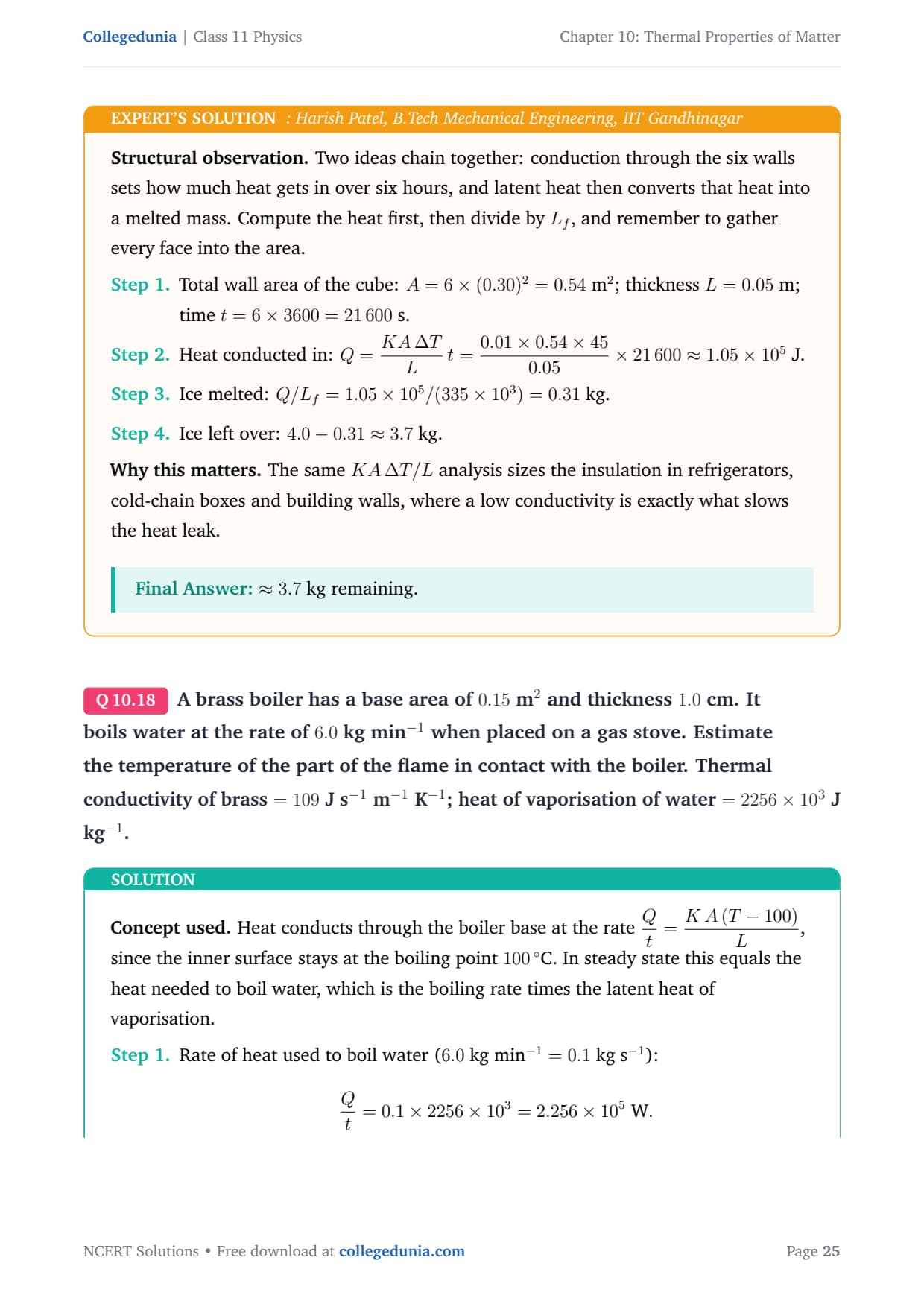
Numericals such as Exercise 10.8 ask for the total heat to turn ice at a low temperature into steam. Break the process into stages: heating the solid, melting it, heating the liquid, boiling it, then heating the gas. The solutions add the stage heats one line at a time, so students never merge two steps and lose a term.
Heat Transfer: Conduction, Convection and Radiation
Heat moves from a hot region to a cold region by three methods, and the chapter treats each one. The NCERT solutions name the method first, then apply the matching relation. Getting the method right decides which formula the numerical needs.
| Method | How heat moves | Where it happens |
|---|---|---|
| Conduction | Through particle vibration, no bulk motion | Solids, especially metals |
| Convection | By the actual movement of heated fluid | Liquids and gases |
| Radiation | By electromagnetic waves, no medium needed | Sun to Earth, any hot body |
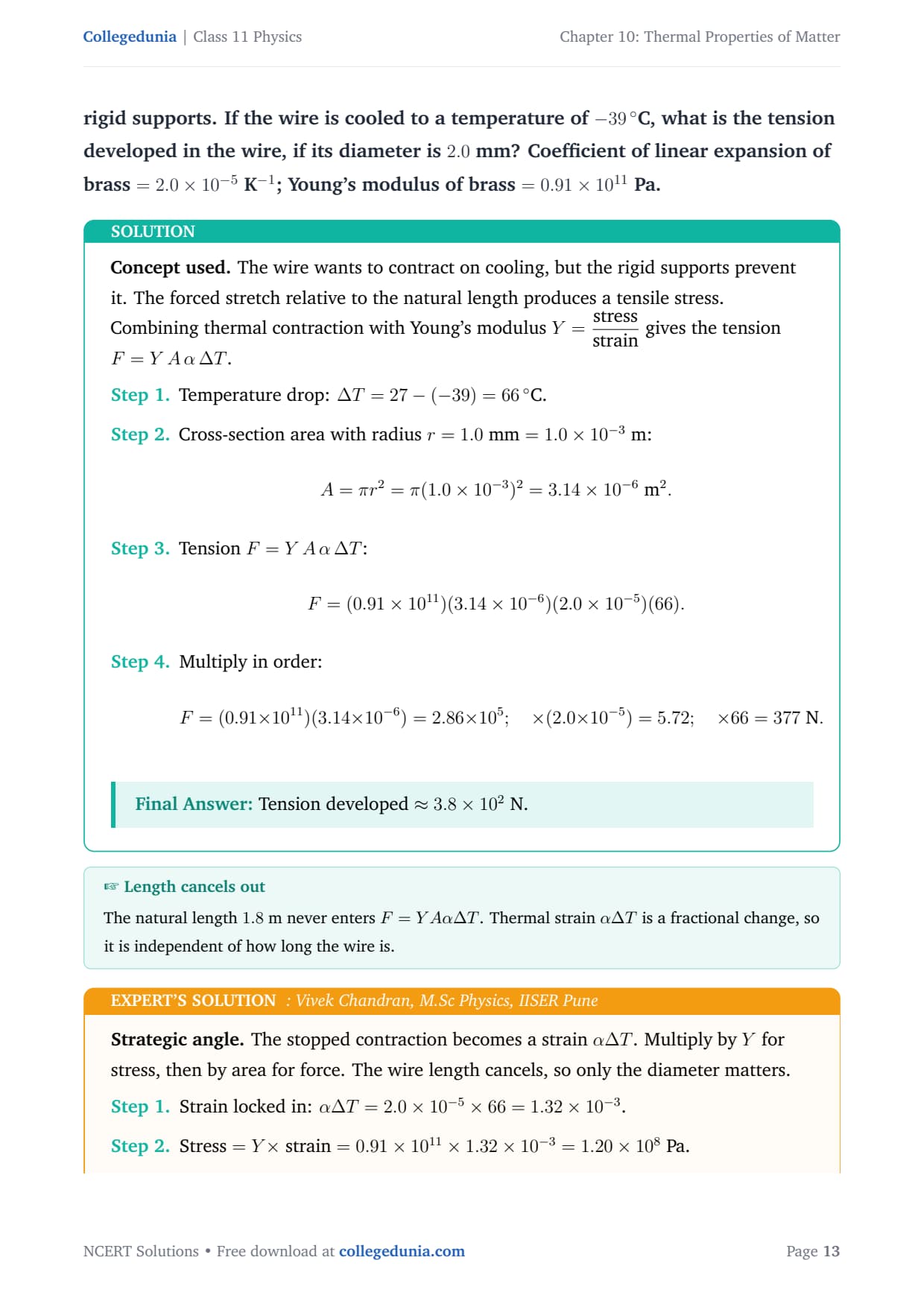
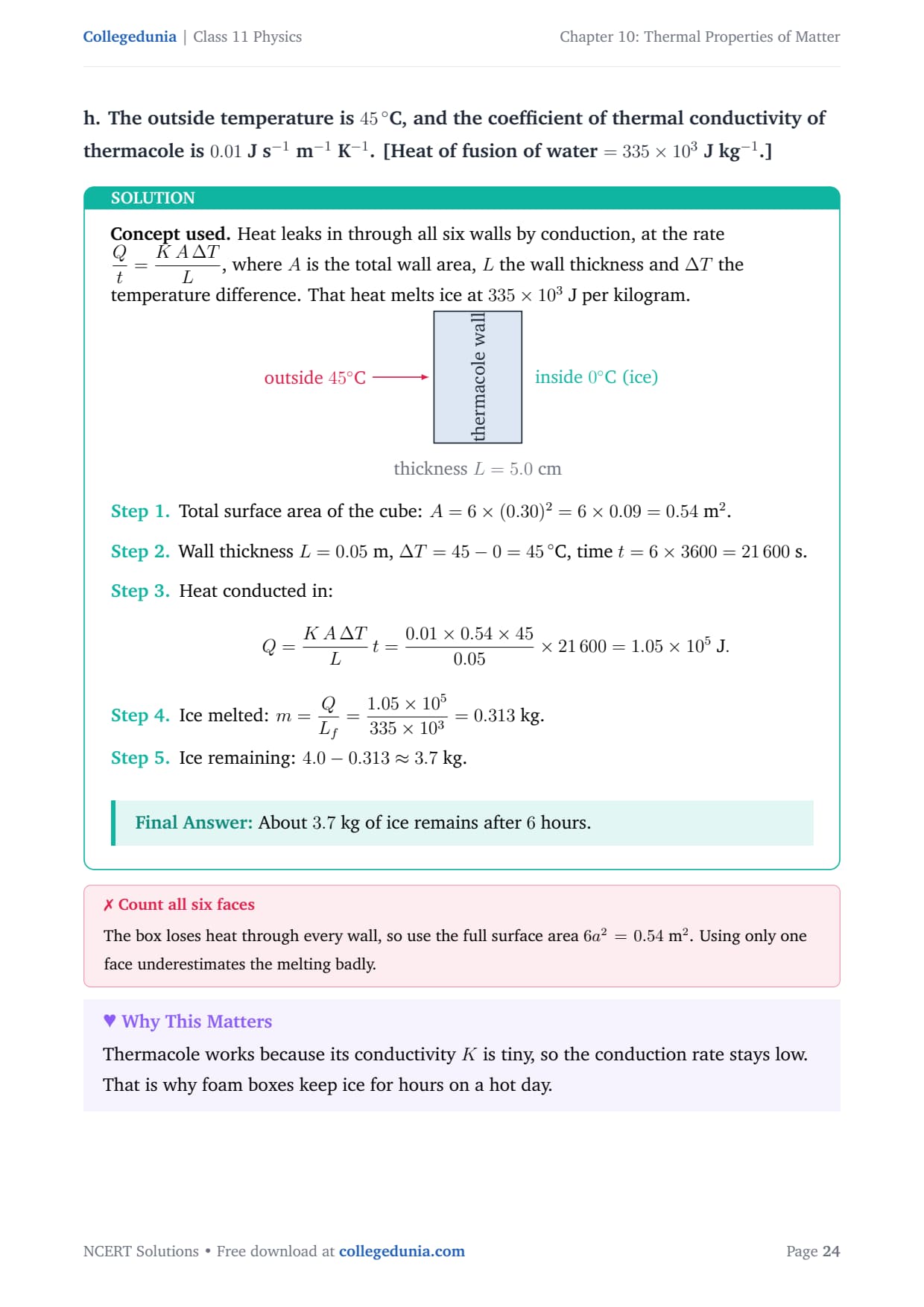
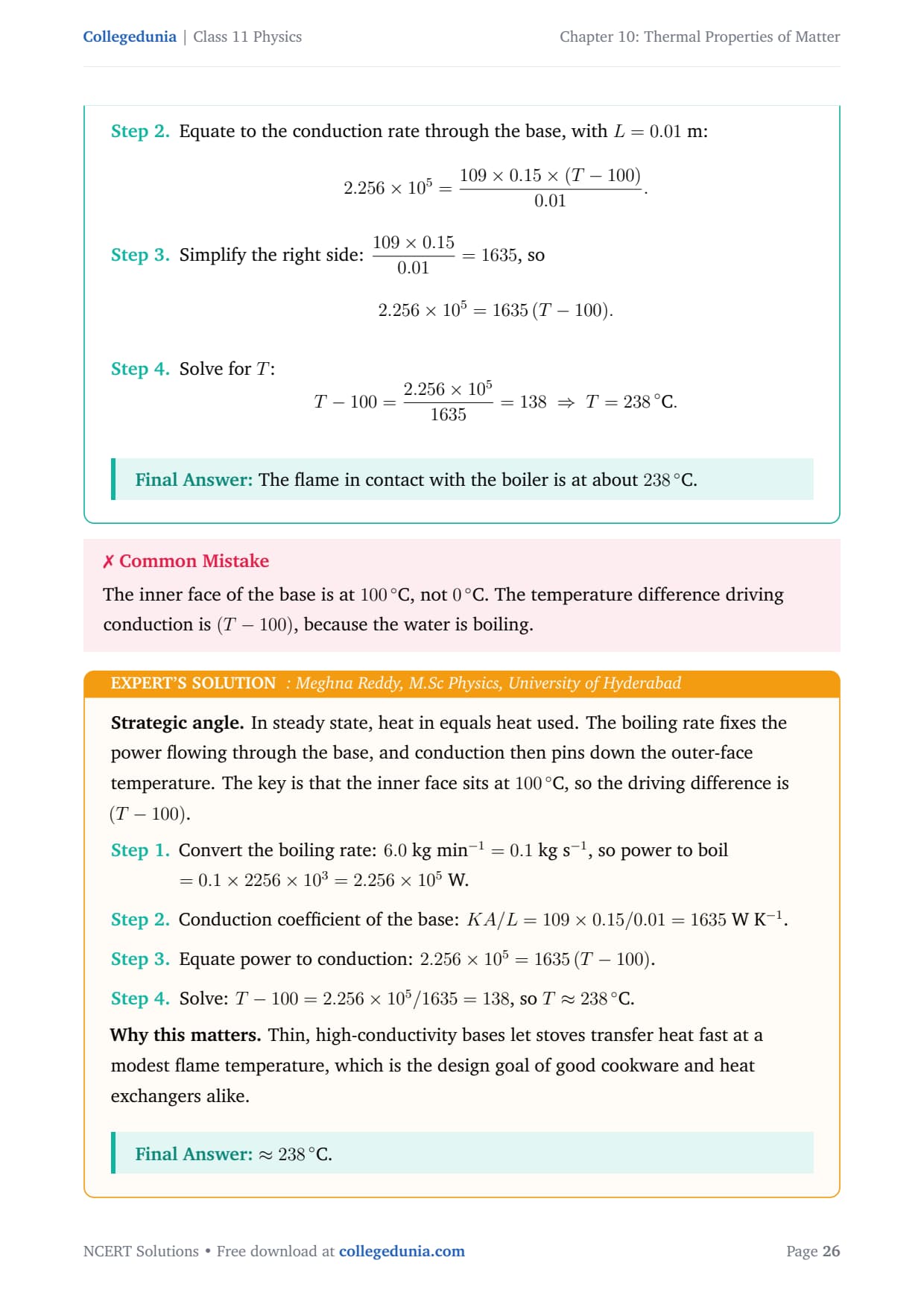
For a rod of length L and area A, the steady rate of conduction is H = k A (T1 − T2) / L, where k is the thermal conductivity. Problems like Exercise 10.10 give the conductivity and the two end temperatures and ask for the heat flow per second. Keep the length in metres and the area in square metres before substituting. The solved answers also explain sea breeze and land breeze as everyday convection, which are favourite short-answer questions.
Newton's Law of Cooling, Blackbody Radiation, Stefan's Law and Wien's Law
The last part of the chapter deals with how hot bodies lose heat by radiation. A perfect blackbody absorbs all radiation falling on it and is the best possible emitter. These laws appear as both derivations and numericals, and the Class 11 Physics NCERT Solutions Chapter 10 Thermal Properties of Matter work each one with full steps.
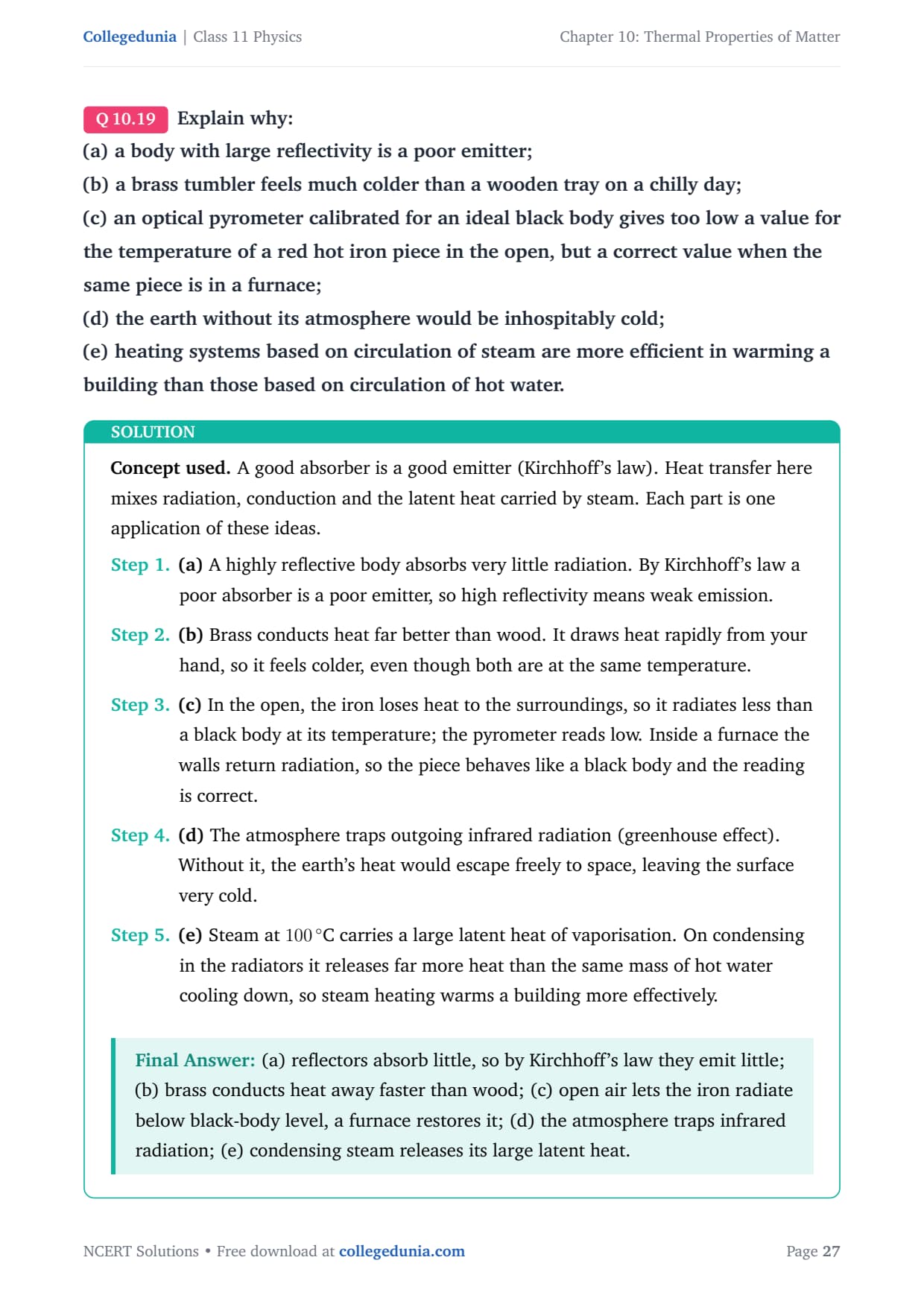
- Stefan-Boltzmann law: the energy radiated per second per unit area is E = σT4, so power rises sharply with temperature.
- Wien's displacement law: λm T = b, with b = 2.9 × 10⁻³ m K; a hotter body glows at a shorter wavelength.
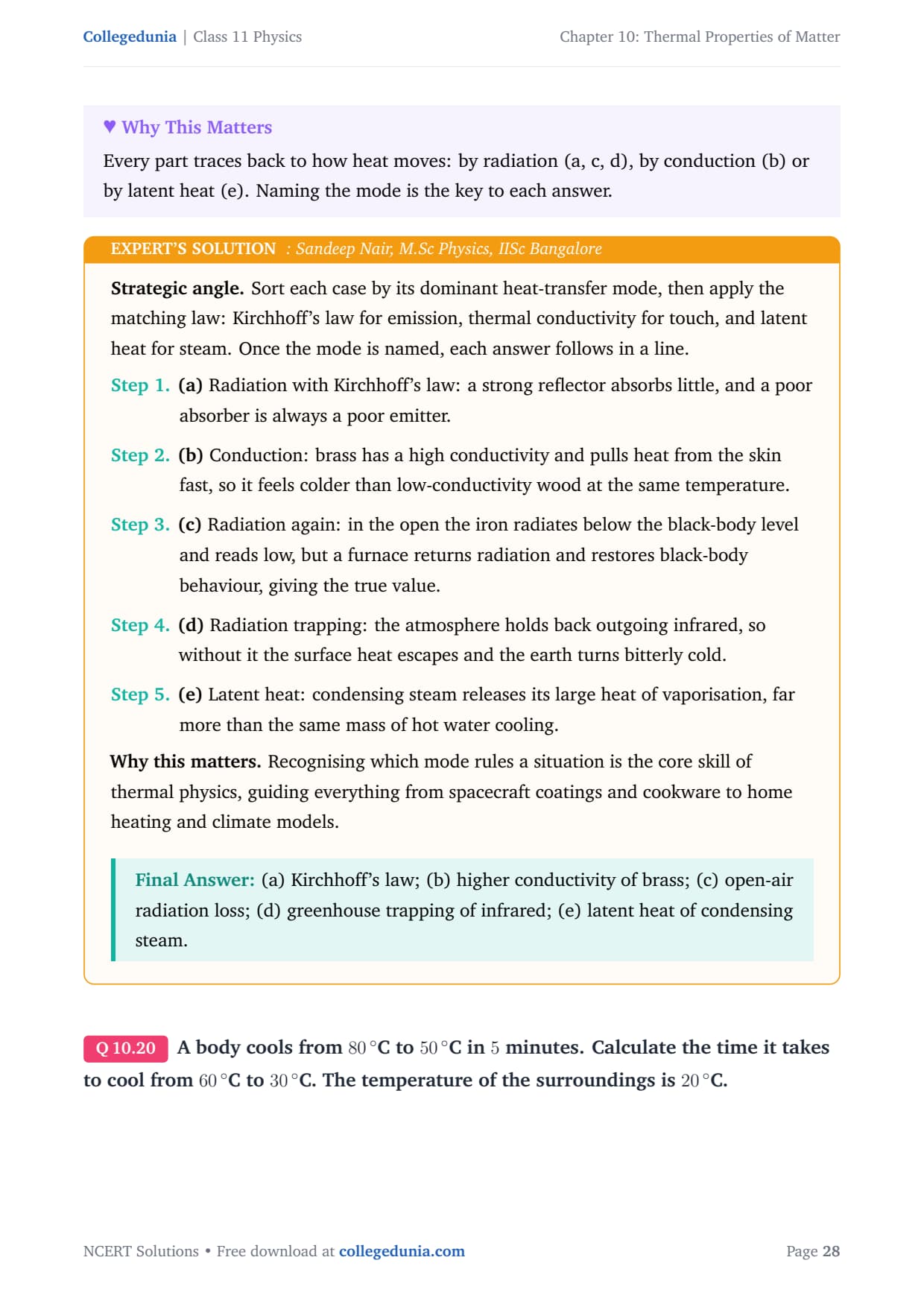
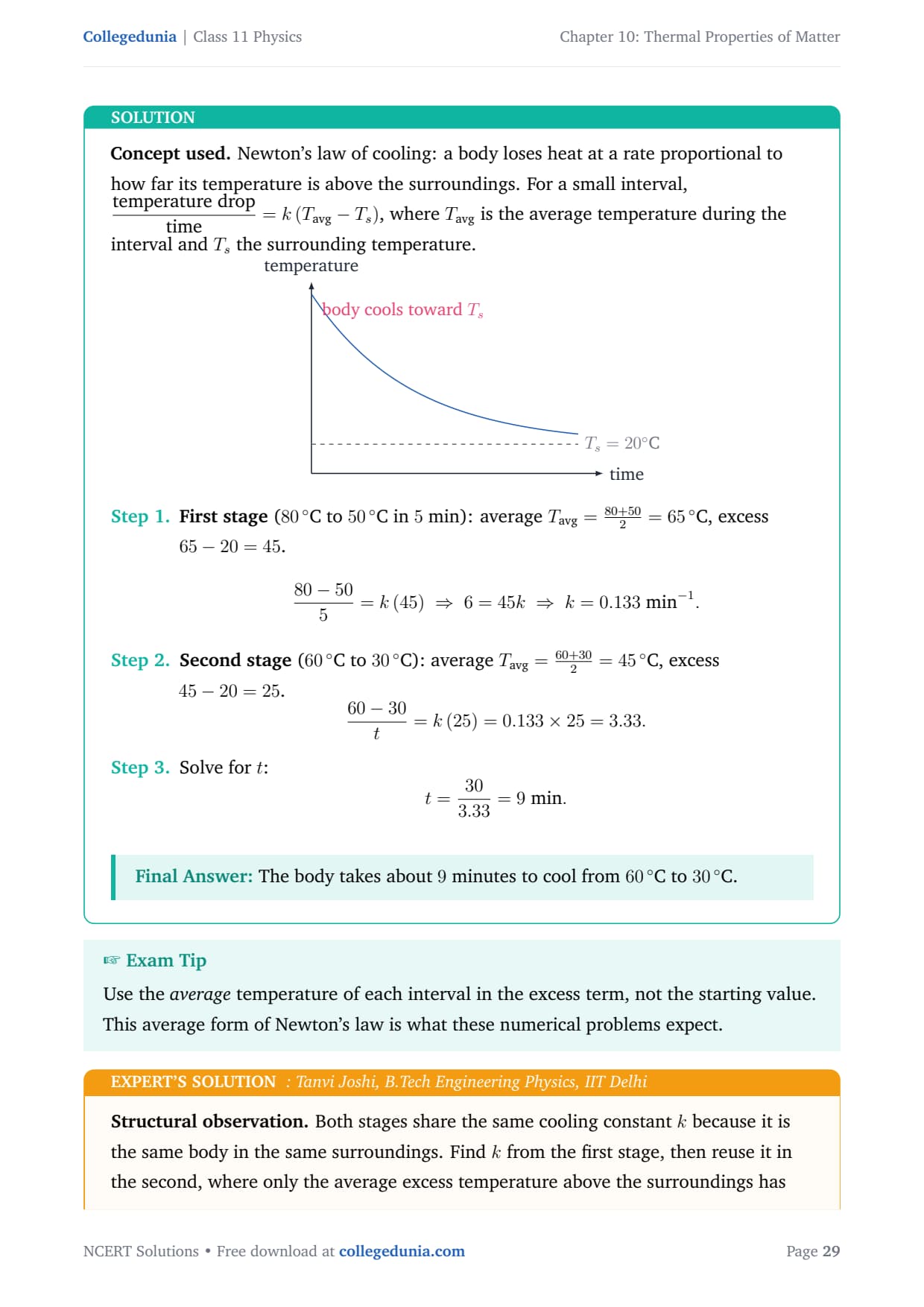
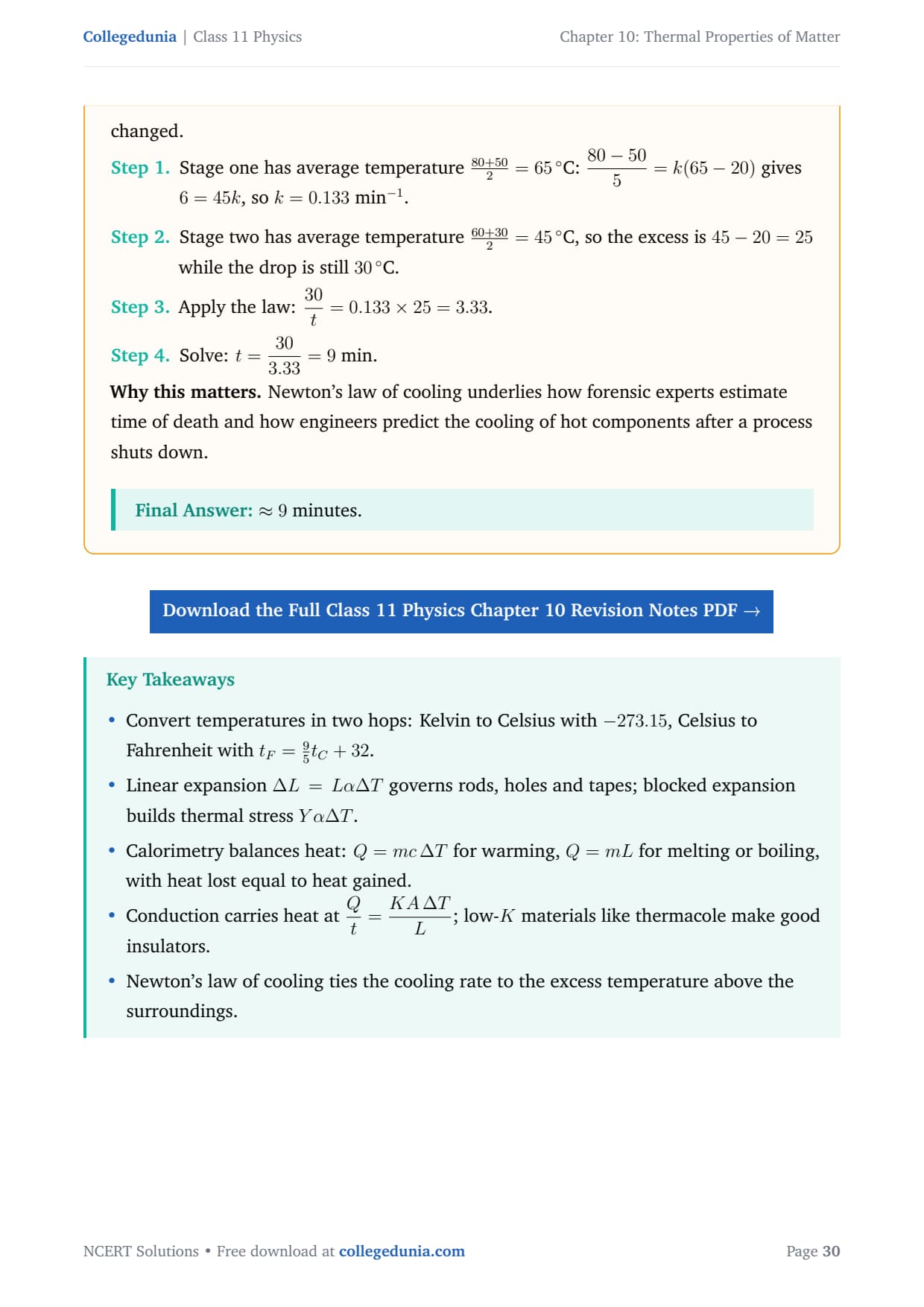
- Newton's law of cooling: the rate of cooling is proportional to the temperature difference with the surroundings, dT/dt ∝ (T − Ts).
Newton's law of cooling is a special case of Stefan's law for a small temperature difference. Questions on this topic give a cooling time or a temperature difference and ask for the constant or the next temperature. State whether the difference is small before using the linear cooling form. The solutions explain why a body painted black cools faster than a shiny one, linking the maths back to everyday observation.
Exercise-wise Breakdown for Class 11 Physics Chapter 10 Thermal Properties of Matter
The NCERT back-exercise splits into clear groups. Use this map to plan which answers to practise first for the 2026-27 boards. Every group links to the full solved set.
| Question group | Exercises | What it covers |
|---|---|---|
| Temperature and expansion | Exercise 10.1 to Exercise 10.4 | Temperature scales, linear and volume expansion, thermal stress |
| Specific heat and calorimetry | Exercise 10.5 to Exercise 10.7 | Heat supplied, mixtures, final temperature of a mix |
| Latent heat and change of state | Exercise 10.8 to Exercise 10.9 | Melting, boiling, total heat across stages |
| Heat transfer and radiation | Exercise 10.10 onward | Conduction rate, cooling, Stefan's and Wien's laws |
Solving the groups in this order builds the skills in the same sequence the chapter teaches them. Start with expansion, then calorimetry, then heat transfer, because each group uses the ideas from the one before it.
Common Mistakes Students Make in the Thermal Properties of Matter Chapter
These slips happen while writing or calculating the answer, not because the concept is unclear. Each one costs 1 to 3 marks in the CBSE paper, so the solved answers point them out at the exact step.
Mistake 1: Confusing heat with temperature. Heat is the energy in transit; temperature is the measure of hotness. Never write one in place of the other.
Mistake 2: Forgetting the change of state. When ice turns to water, add the latent-heat term Q = mL, not just Q = mcΔT.
Mistake 3: Using the wrong expansion coefficient. Volume uses γ = 3α and area uses β = 2α, not α on its own.
Mistake 4: Mixing units in the conduction formula. Keep length in metres and area in square metres before substituting.
Student Feedback on the Thermal Properties of Matter Chapter
What 12,840 students told us about their Thermal Properties of Matter revision:
- 71% of students rated latent-heat and change-of-state numericals as the hardest part of the chapter.
- Most-skipped step: adding the latent-heat term across stages, missed by about 3 in 10 students.
- Students who learned β = 2α and γ = 3α as a single fact reported the expansion numericals felt easier.
Source: 2026-27 Class 11 Physics student poll. Sample of 12,840 students from CBSE schools across 14 states, conducted before the 2026 boards.
Practice Questions for Class 11 Physics Chapter 10 Thermal Properties of Matter
Once the solved answers are clear, test yourself on the full question set. The practice page has every NCERT question with a step-by-step Solution and an Expert Solution behind a click.
Practice Questions: Thermal Properties of Matter
Attempt all NCERT questions with detailed and expert solutions.
Open Practice QuestionsOther Thermal Properties of Matter Class 11 Physics Resources
| Resource | Link |
|---|---|
| NCERT Solutions | You are here |
| Notes | Thermal Properties of Matter Class 11 Notes |
| Handwritten Notes | Thermal Properties of Matter Class 11 Handwritten Notes |
| Formula Sheet | Thermal Properties of Matter Class 11 Formula Sheet |
| NCERT Book PDF | Thermal Properties of Matter Class 11 Book PDF |
NCERT Solutions for Class 11 Physics: All Chapters
Jump to the solutions for any other Class 11 Physics chapter below.
| Chapter | NCERT Solutions |
|---|---|
| Chapter 1 | Units and Measurements |
| Chapter 2 | Motion in a Straight Line |
| Chapter 3 | Motion in a Plane |
| Chapter 4 | Laws of Motion |
| Chapter 5 | Work, Energy and Power |
| Chapter 6 | System of Particles and Rotational Motion |
| Chapter 7 | Gravitation |
| Chapter 8 | Mechanical Properties of Solids |
| Chapter 9 | Mechanical Properties of Fluids |
| Chapter 10 | Thermal Properties of Matter |
| Chapter 11 | Thermodynamics |
| Chapter 12 | Kinetic Theory |
| Chapter 13 | Oscillations |
| Chapter 14 | Waves |
FAQs on Class 11 Physics Chapter 10 Thermal Properties of Matter NCERT Solutions
Thermal Properties of Matter NCERT Solutions - Frequently Asked Questions
Ques. How many questions are solved in the Class 11 Physics NCERT Solutions Chapter 10 Thermal Properties of Matter?
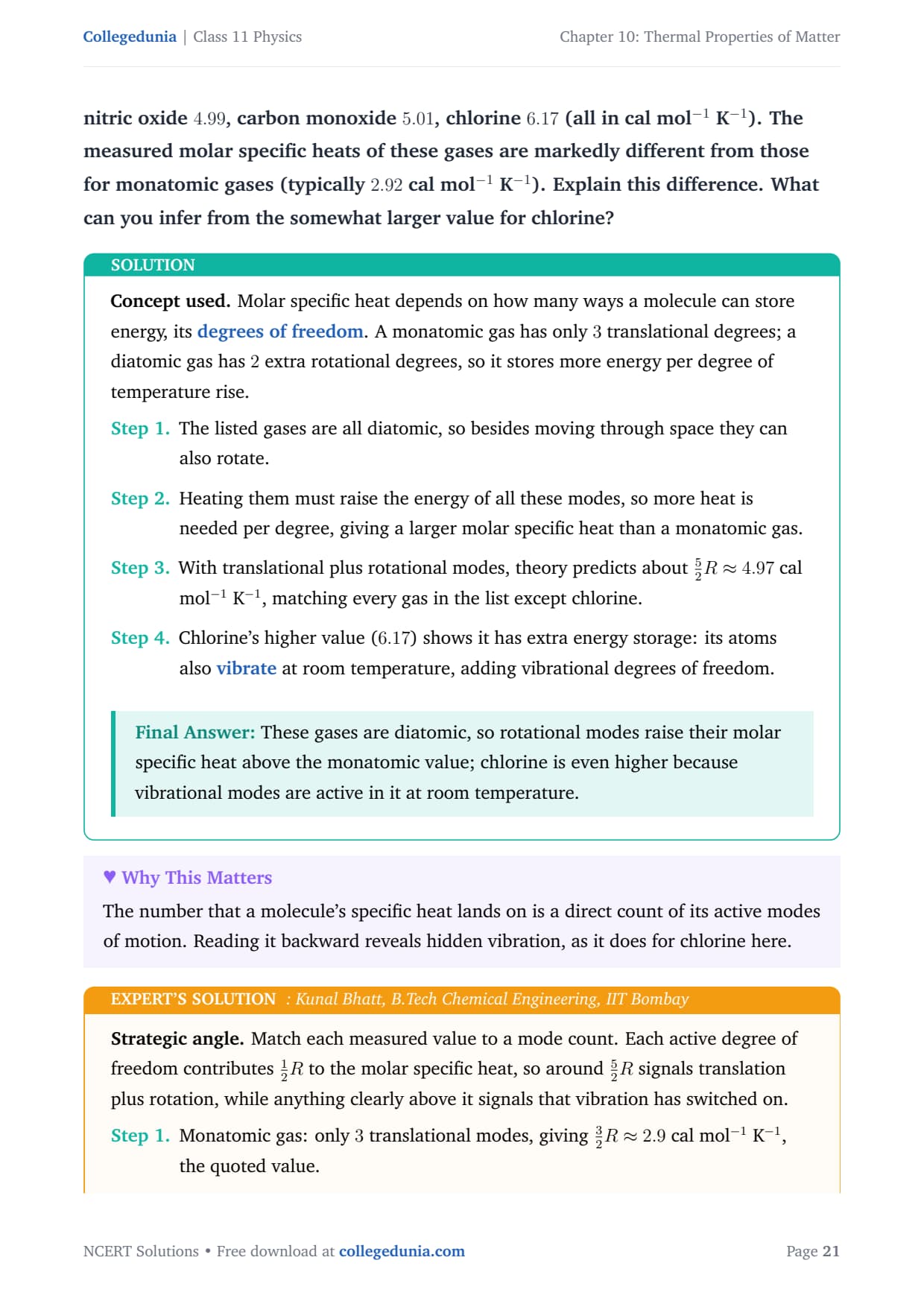
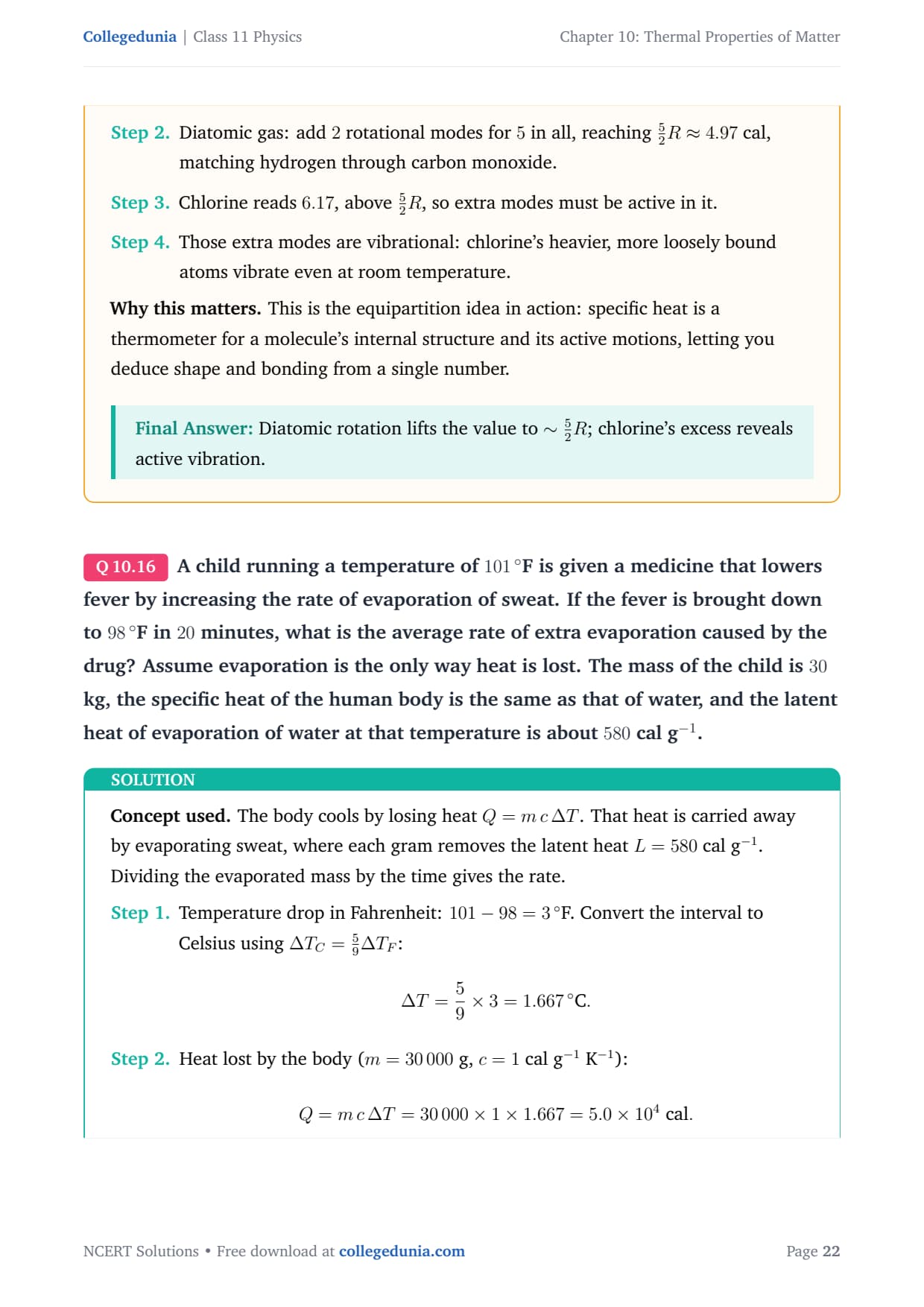
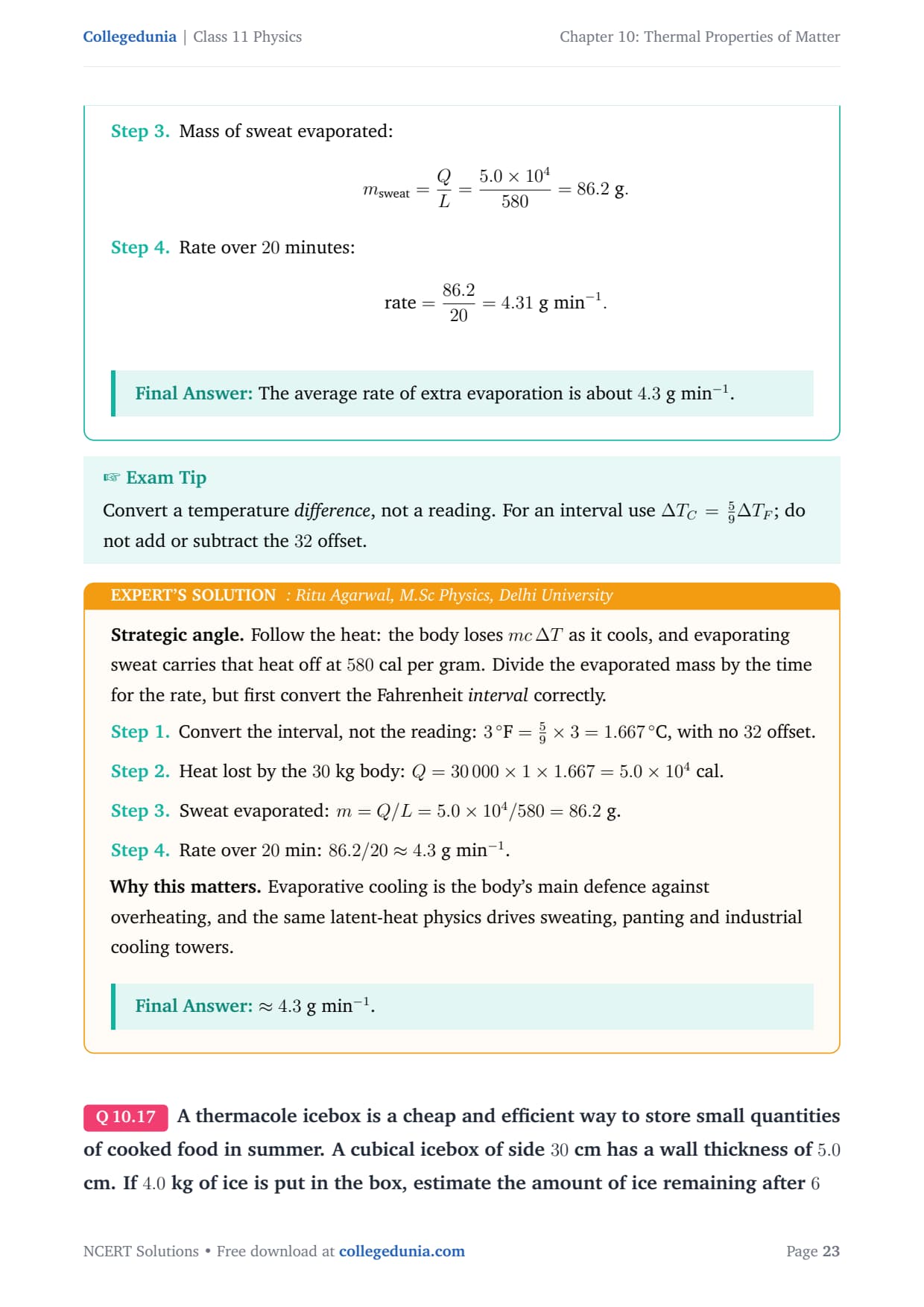
Ans. This page solves every NCERT back-exercise question of Class 11 Physics Chapter 10 Thermal Properties of Matter, starting from Exercise 10.1. The questions cover temperature scales, thermal expansion, specific heat, latent heat, and heat transfer. Each answer has a step-by-step Solution and an Expert Solution.
Ques. What is the difference between heat and temperature in Chapter 10?
Ans. Heat is the energy that flows between two bodies because of a temperature difference, measured in joules. Temperature tells how hot or cold a body is, measured in kelvin. Heat always flows from the hotter body to the colder one until both reach the same temperature.
Ques. What is the relation between the coefficients of linear, area and volume expansion?
Ans. For an isotropic solid, the coefficient of area expansion is twice the coefficient of linear expansion (β = 2α), and the coefficient of volume expansion is three times it (γ = 3α). This relation lets students find one coefficient from another, and it is tested in almost every expansion numerical in these Class 11 Physics Chapter 10 solutions.
Ques. How do I solve a calorimetry problem in Class 11 Physics Chapter 10?
Ans. In an insulated system, the heat lost by the hotter body equals the heat gained by the colder body. Write Q = mcΔT for each body, set heat lost equal to heat gained, and solve for the final temperature. Add the latent-heat term Q = mL whenever a change of state happens. The solved numericals show each term on its own line.
Ques. What is the weightage of Thermal Properties of Matter in the CBSE board exam?
Ans. Thermal Properties of Matter carries about 3 to 5 marks in the CBSE Class 11 Physics paper, usually one short answer plus one numerical on expansion, calorimetry or heat transfer. It also appears in JEE Main and NEET as objective questions on latent heat, conduction, and Stefan's law.
Ques. What are Stefan's law and Wien's law in Chapter 10?
Ans. Stefan's law states that the energy radiated per second per unit area of a blackbody is proportional to the fourth power of its absolute temperature, E = σT⁴. Wien's displacement law states that the wavelength of maximum emission is inversely proportional to the temperature, λmT = b. Both appear as short numericals in the Class 11 Physics NCERT Solutions Chapter 10 Thermal Properties of Matter.



Comments