




Reading Comprehension is the single most important topic in ATMA July 2026 Verbal Skills, carrying approximately 40% weightage, with around 10–12 questions per sub-section, based on previous year ATMA paper trends.
ATMA July 2026 is scheduled for Sunday, July 12, 2026. The exam features two dedicated Verbal Skills sub-sections (VS I and VS II), each with 30 questions to be answered in 30 minutes. Knowing the chapter-wise weightage for each topic allows you to direct preparation time toward the highest-scoring areas first and avoid negative marking traps.
- Verbal Skills total: 2 sub-sections × 30 questions = 60 questions
- Reading Comprehension: 40% weightage (approx. 10–12 questions per sub-section)
- Grammar and Sentence Correction: ~15% weightage
- Vocabulary (Synonyms, Antonyms, Analogies): ~15% weightage
- Sentence Completion and Para-jumbles: ~15% weightage
- Fill in the Blanks and Idioms: ~15% weightage
- Negative marking: −0.25 marks per wrong answer
| Direct Link to ATMA July 2026 Official Website: atmaaims.com |
Related Articles:
- ATMA Cutoff 2026 Available: Check Cutoff Marks for Welingkar, JBIMS, PUMBA, and top MBA Colleges
- Top Colleges in India accepting ATMA 2026 scores
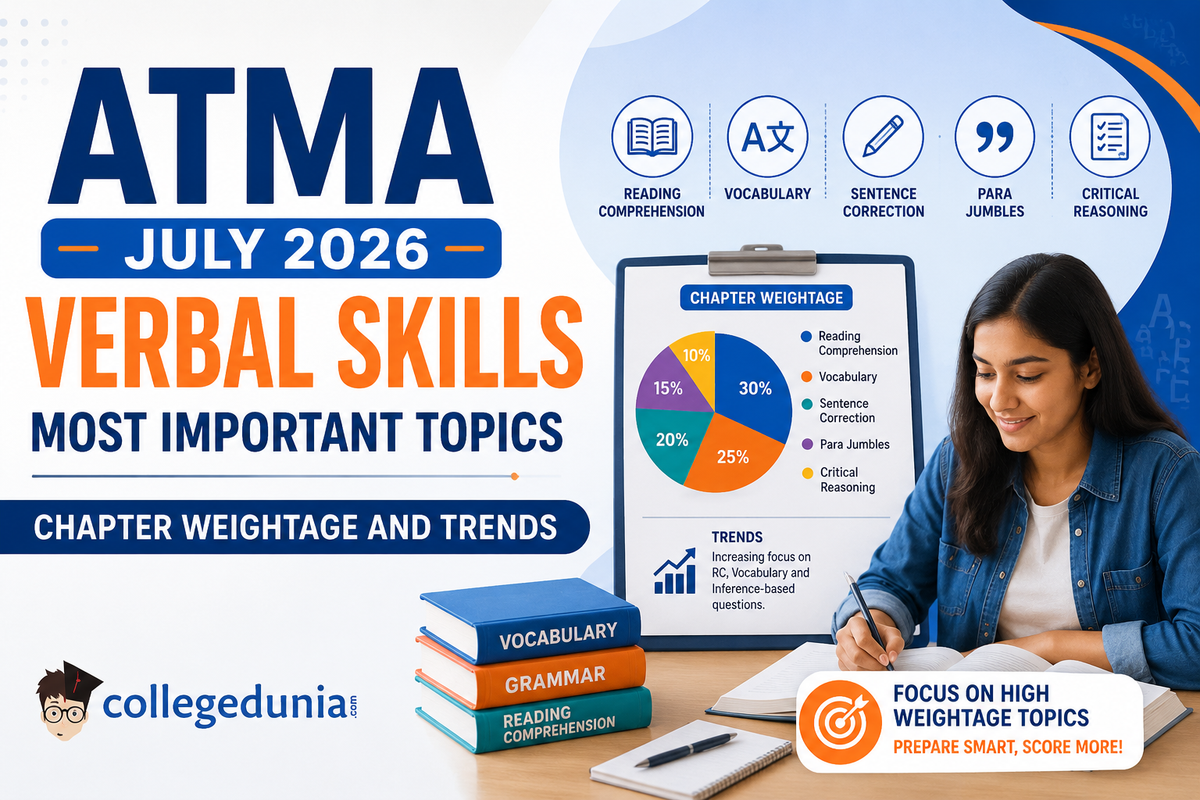
ATMA July 2026 Verbal Skills Section Overview
ATMA (AIMS Test for Management Admissions) is conducted by the Association of Indian Management Schools (AIMS). ATMA July 2026 is scheduled for July 9, 2026. The exam has six sections — two each of Analytical Reasoning Skills, Verbal Skills, and Quantitative Skills — with 30 questions per section and a 30-minute sectional time limit.
| Parameter | Details |
|---|---|
| Exam Date (July 2026) | July 12, 2026 |
| Conducting Body | AIMS (Association of Indian Management Schools) |
| Total Sections | 6 (VS I, VS II, QS I, QS II, ARS I, ARS II) |
| Verbal Skills Sub-sections | 2 (Verbal Skills I and Verbal Skills II) |
| Questions per Verbal Sub-section | 30 |
| Total Verbal Skills Questions | 60 |
| Time per Sub-section | 30 minutes |
| Marking Scheme | +1 correct, −0.25 wrong |
| Exam Mode | Computer-Based Test (CBT) |
Ques. Which is the most important topic in ATMA Verbal Skills?
Ans. Reading Comprehension is the most important topic in ATMA Verbal Skills, carrying approximately 40% weightage — around 10–12 questions per 30-question sub-section — based on previous year ATMA paper trends.
Check Out: ATMA Exam Pattern 2026
Chapter-wise Weightage in ATMA Verbal Skills: Previous Year Paper Trends
Reading Comprehension dominates the ATMA Verbal Skills section with around 40% weightage, while Grammar, Vocabulary, Sentence Completion, and Fill in the Blanks together account for the remaining 60%, based on previous year ATMA paper analysis. The table below shows the expected question distribution for each 30-question sub-section.

| Topic | Expected Questions (per sub-section of 30) | Weightage (%) | Difficulty Level |
|---|---|---|---|
| Reading Comprehension | 10–12 | ~40% | Moderate to High |
| Grammar and Sentence Correction | 4–5 | ~15% | Moderate |
| Vocabulary (Synonyms, Antonyms, Analogies) | 4–5 | ~15% | Moderate |
| Sentence Completion and Para-jumbles | 4–5 | ~15% | Moderate |
| Fill in the Blanks and Idioms | 4–5 | ~15% | Easy to Moderate |
Expected distribution based on previous year ATMA Verbal Skills paper trends. Actual question count per topic may vary slightly across editions.
Ques. When is ATMA July 2026?
Ans. ATMA July 2026 is scheduled for July 12, 2026. You can check the latest schedule, admit card, and exam updates on the official ATMA website at atmaaims.com.
Also Read: ATMA 2026 Syllabus
Reading Comprehension — Highest Weightage Topic
Reading Comprehension (RC) is the most score-critical topic in ATMA Verbal Skills, with approximately 10–12 questions per sub-section accounting for around 40% of your Verbal Skills score. Each sub-section typically features two to three passages of 350–500 words, followed by four to five questions per passage.
Key RC question types seen in previous year ATMA papers:
- Main idea and central theme of the passage
- Inference-based and implied meaning questions
- Author’s tone, purpose, and attitude
- Specific detail and fact-based questions
- Vocabulary in context — meaning of a highlighted word as used in the passage
ATMA RC passages cover business, economics, social sciences, and general current affairs. Practising two to three passages daily builds the reading speed and comprehension accuracy needed to score well within the 30-minute sub-section limit.
Ques. Does ATMA repeat Verbal Skills questions from previous years?
Ans. No, ATMA does not repeat exact questions from previous years. However, the question types, grammar rules, and vocabulary difficulty levels remain highly consistent.
Check Out: ATMA Paper Analysis
Grammar and Sentence Correction
Grammar and Sentence Correction contributes approximately 15% of each ATMA Verbal Skills sub-section — around four to five questions — testing your command over standard English usage and sentence structure.
High-frequency grammar topics based on previous year ATMA Verbal Skills papers:
- Subject-verb agreement — consistently one of the most tested concepts
- Tense consistency and sequence of tenses
- Active and passive voice transformations
- Articles (a, an, the) — correct usage in context
- Prepositions — appropriate choice based on meaning
- Parallel structure in sentences
- Dangling and misplaced modifiers
- Punctuation rules
Questions appear as error-spotting (identify the incorrect part of a sentence) or sentence improvement (choose the grammatically correct version from four options).
Ques. Which topic is the easiest to score in ATMA Verbal Skills?
Ans. Fill in the Blanks and Idioms are considered the easiest topics in the ATMA Verbal Skills exam. These questions are direct, do not require lengthy reading, and can be solved in under 30 seconds.
Also Read: ATMA Exam 2026 Preparation Tips
Vocabulary — Synonyms, Antonyms, and Analogies
Vocabulary questions carry approximately 15% weightage in each ATMA Verbal Skills sub-section — four to five questions — covering Synonyms, Antonyms, Word Analogies, and Contextual Vocabulary based on previous year patterns.
Sub-topics to focus on for ATMA Vocabulary:
- Synonyms and Antonyms — direct meaning questions using intermediate to advanced English words
- Word Analogies — identify the relationship between a word pair and select an equivalent relationship from the options
- Contextual Vocabulary — choose the word that best fits a sentence based on meaning and register
- Idioms and Phrases — identify the correct meaning or usage of common idiomatic expressions
Daily reading from quality English-language publications and systematic revision of word lists from previous ATMA Verbal Skills papers is the most effective vocabulary-building strategy before July 12.
Ques. How many Reading Comprehension passages are usually asked in the ATMA Verbal Skills?
Ans. Usually, 4 to 6 passages in total across the entire exam (typically 2 to 3 passages of 350–500 words per sub-section) are asked in the ATMA Verbal Skills exam.
Related Links: ATMA Previous Year’s Question Papers: Download PDF
Para-jumbles and Sentence Completion
Para-jumbles and Sentence Completion together account for approximately 15% of each ATMA Verbal Skills sub-section, about four to five questions, based on previous year paper analysis.
Para-jumbles present four to six sentences in jumbled order; you must arrange them into a coherent paragraph. Effective strategies:
- Identify the opening sentence first — it introduces the topic without a pronoun reference to an earlier idea
- Track transition words (however, therefore, in contrast, subsequently) to establish sequence
- Identify the concluding sentence — it typically summarises or concludes earlier points
Sentence Completion questions require you to choose the word or phrase that logically and grammatically completes a given sentence. Strong vocabulary and grammar awareness both improve accuracy in this type.
Check Out: ATMA Exam 2026 Results
Fill in the Blanks and Idioms
Fill in the Blanks and Idioms questions together make up approximately 15% of each ATMA Verbal Skills sub-section — four to five questions — testing grammar and vocabulary simultaneously.
- Single-blank: select the grammatically correct or contextually appropriate word from four options
- Double-blank: both blanks must be logically and grammatically consistent with each other and the rest of the sentence
- Idioms and Phrases: identify the correct meaning or usage of a common idiomatic expression in context
Because these question types draw on both grammar and vocabulary, consistent practice across both areas automatically strengthens performance here.
Ques. Are both Verbal Skills sections in ATMA identical in terms of difficulty?
Ans. No, the Verbal Skills sections in ATMA are not identical. Verbal Skills II is generally slightly tougher and more time-consuming than Verbal Skills I.
Related Links:
- ATMA 2026 Question Paper with Solutions (Available)- Download PDF
- ATMA Result 2026: Releasing Date, Details, Cut Off, and Selection
ATMA July 2026 Verbal Skills Preparation Tips
Targeting Reading Comprehension first — the highest-weightage topic at ~40% — gives you the greatest return on preparation time before ATMA July 2026.
- RC practice daily: Solve two passages daily and answer questions without re-reading the passage repeatedly. Build both speed and accuracy.
- Grammar drills: Revise subject-verb agreement, tense rules, and modifiers. Solve 10–15 grammar questions daily from standard MBA preparation resources.
- Vocabulary building: Read one editorial daily and note unfamiliar words with their meanings. Revise word lists from previous ATMA Verbal Skills papers regularly.
- Para-jumble strategy: Practise identifying the opening and concluding sentences first — this alone eliminates two to three wrong options immediately.
- Timed sub-section practice: Each Verbal Skills sub-section gives you 30 minutes for 30 questions — one minute per question. Practise under this constraint consistently.
- Manage negative marking: ATMA deducts 0.25 marks per wrong answer. Skip any question where you cannot eliminate at least two options with confidence.
Ques. What grammar topics are most important for ATMA Verbal Skills?
Ans. Subject-verb agreement, tense consistency, active and passive voice, articles, prepositions, parallel structure, and modifiers are the most frequently tested grammar topics in ATMA Verbal Skills based on previous year papers.
Also Check: ATMA 2026 Exam Dates: July Exam on July 12, Important Dates and Session-Wise Schedule
ATMA Verbal Skills — Quora Discussion
As per the Quora discussion on the Viswavijay Bhumihar page, below are the points to remember:
- ATMA is generally perceived as a moderate-level MBA entrance exam, making it accessible for candidates with consistent preparation across Quant, Logical Reasoning, and Verbal sections.
- Scoring 80+ percentile is commonly suggested as a competitive target for PUMBA, though actual admission depends on the year's cutoff and seat competition.
- The discussion emphasizes meeting college-specific cutoffs rather than just aiming for a high raw score, highlighting the importance of understanding admission criteria.

ATMA July 2026 Verbal Skills FAQs
Ques. Which is the most important topic in ATMA Verbal Skills?
Ans. Reading Comprehension is the most important topic in ATMA Verbal Skills, carrying approximately 40% weightage — around 10–12 questions per 30-question sub-section — based on previous year ATMA paper trends.
Ques. How many questions are there in ATMA Verbal Skills section?
Ans. ATMA has two Verbal Skills sub-sections — Verbal Skills I and Verbal Skills II — each with 30 questions, giving a total of 60 Verbal Skills questions out of 180 questions in the full exam.
Ques. Is there negative marking in the ATMA Verbal Skills section?
Ans. Yes. ATMA deducts 0.25 marks for every incorrect answer across all sections, including Verbal Skills. Avoid guessing when you cannot confidently eliminate at least two of the four options.
Ques. How much time is allowed for each ATMA Verbal Skills sub-section?
Ans. Each ATMA Verbal Skills sub-section has a sectional time limit of 30 minutes for 30 questions, which works out to one minute per question on average. Regular timed practice is essential to manage this pace.



Comments