




The JEE Advanced Syllabus 2027 covers advanced concepts from Physics, Chemistry, and Mathematics based on Class 11 and 12 topics. The JEE Adv. exam is conducted in 2 papers, of 3 hours each. Both papers contain the same 3 subjects. The final layout of questions varies each year.
- JEE Advanced Chemistry Syllabus 2027 covers 11 Physical, 10 Inorganic and 16 Organic sections with Organic carrying 39 to 45% of the paper.
- JEE Advanced Physics Syllabus 2027 gives Mechanics and Electricity & Magnetism around 30 to 33% each which together make up two-thirds of the marks.
- JEE Advanced Maths Syllabus 2027 covers 9 sections where Calculus may account for 27 to 33% of the Mathematics paper.
- In JEE Advanced Chemistry, Aldehydes, Ketones and Carboxylic Acids may account for 4 to 5 questions which makes it the largest single chapter.
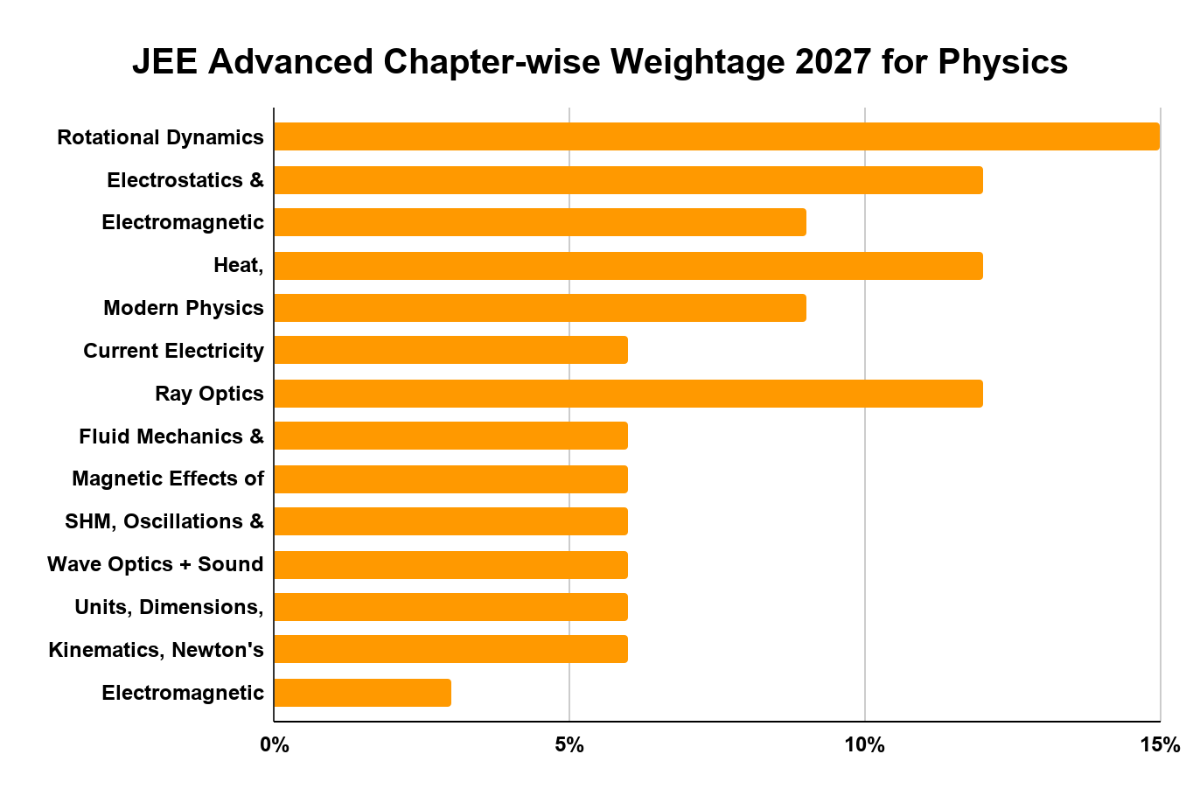
- Rotational Dynamics contributes 12 to 15% in the JEE Advanced Physics Syllabus 2027 with Ray Optics close behind at 9 to 12%.
- In JEE Advanced Maths, Coordinate Geometry and Algebra together contribute 27 to 33% with Conic Sections appearing in most papers.
- Practical Organic Chemistry, Qualitative Analysis and 10 named experiments are tested in JEE Advanced 2027 but not in the JEE Main paper.
Related Links:
- JEE Advanced Exam Pattern 2027: Paper 1 & 2 Structure, Marking Scheme, and Total Marks
- JEE Advanced Exam Paper Analysis: Paper 1&2 Difficulty Level and Students’ Reaction
- JEE Advanced Exam Mock Test: Download Free PDF
Key Summary
- Joint Admission Board sets the JEE Advanced Syllabus 2027 while NTA sets JEE Main, so the 2 documents differ in both scope and depth.
- JAB publishes no official chapter-wise weightage so every percentage in this article comes from JEE Advanced 2026 question paper analysis.
- Electromagnetic Waves is the 7th named Physics section in the official list rather than a part of Electricity and Magnetism.
- Waves and Simple Harmonic Motion sit inside Mechanics in the JEE Advanced Syllabus 2027 rather than as 2 standalone sections.
- Gauss's law is examinable in 3 cases only: an infinite straight wire, a uniformly charged infinite plane sheet and a thin spherical shell.
JEE Advanced Syllabus: Highlights
The JEE Advanced exam pattern combines a six-hour, two-paper format with 102 questions across Physics, Chemistry, and Mathematics.
-
2 papers are conducted consecutively. Both papers are compulsory, and each session tests all three subjects.
-
Questions test advanced applications of Class 11 and 12 concepts through objective and numerical-based formats.
-
Since negative marking applies to most sections, candidates must balance accuracy with speed and check the marking scheme for each question type.
| Parameter | Details |
|---|---|
| Conducting Body | IIT Delhi |
| Total Marks | 360 marks |
| Total Questions | 102 Questions |
| Total Duration | 6 hours total (Divided into two sessions: Paper 1 and Paper 2). |
| Syllabus Level | Advanced concepts beyond CBSE/NCERT Class 11 and 12 |
| Subjects Included | Physics, Chemistry, and Mathematics. |
| Subject Groups | All three subjects are tested in both Paper 1 and Paper 2. |
| Question Type | Objective & Numerical-based. Negative marking applies to most sections. |
| Language of Paper | English and Hindi (Candidates can switch between languages). |
Has the JEE Advanced Syllabus 2027 PDF been released?
No. The JEE Advanced Syllabus 2027 PDF has not been released. The organising IIT publishes it with the information brochure, usually in December. The latest official syllabus document states the syllabus was unchanged between two consecutive cycles, so candidates can prepare from it without waiting.
Also Check:
JEE Advanced Physics Syllabus 2027: Section-Wise Topics
Mechanics and Electricity & Magnetism together contribute 60 to 66% of the marks in the JEE Advanced Physics Syllabus 2027.
- The JEE Advanced Physics Syllabus 2027 follows the 2023 revision which removed Communication Systems and Semiconductor Electronics.
- Experimental skills such as Vernier, screw gauge, resonance column and metre bridge remain part of the JEE Advanced Physics syllabus.
| Section | Topics Covered |
|---|---|
| General | Units and dimensions, dimensional analysis, least count, significant figures, measurement methods, and error analysis in experiments. |
| Mechanics | Kinematics, laws of motion, friction, work, energy and power, momentum, collisions, centre of mass, rotational motion, rigid body dynamics, oscillations, gravitation, fluid mechanics, elasticity, surface tension, viscosity, and wave motion. |
| Thermal Physics | Thermal expansion, calorimetry, heat transfer, kinetic theory of gases, specific heats, thermodynamic processes, laws of thermodynamics, Carnot engine, and blackbody radiation. |
| Electricity and Magnetism | Electrostatics, electric field and potential, Gauss's law, capacitors, current electricity, resistance, electrical circuits, magnetic fields, magnetic forces, galvanometers, electromagnetic induction, inductance, and AC/DC circuits. |
| Electromagnetic Waves | Characteristics of electromagnetic waves, electromagnetic spectrum, and uses of radio waves, microwaves, infrared, visible light, ultraviolet, X-rays, and gamma rays. |
| Optics | Reflection, refraction, total internal reflection, prisms, lenses, mirrors, magnification, interference, diffraction, polarization, and Huygens' principle. |
| Modern Physics | Atomic nucleus, radioactive decay, half-life, mean life, binding energy, nuclear fission and fusion, photoelectric effect, Bohr's atomic model, X-rays, Moseley's law, and de Broglie wavelength. |
Also Check:
- Best Books for JEE Advanced
- JEE Advanced Exam Chemistry Preparation: Study Material, Tips and Best Books
JEE Advanced Physics Syllabus 2027: Chapter-wise Weightage
| Chapter / Topic | Approx. Weightage | Approx. No. of Questions |
|---|---|---|
| Rotational Dynamics & Rigid Body Motion | 12–15% | 4–5 |
| Electrostatics & Capacitance | 9–12% | 3–4 |
| Electromagnetic Induction & AC | 9% | 3 |
| Heat, Thermodynamics & Kinetic Theory | 9–12% | 3–4 |
| Modern Physics (Photoelectric, Bohr, Nuclear) | 6–9% | 2–3 |
| Current Electricity | 6% | 2 |
| Ray Optics (Geometrical Optics) | 9–12% | 3–4 |
| Fluid Mechanics & Surface Tension | 6% | 2 |
| Magnetic Effects of Current | 6% | 2 |
| SHM, Oscillations & Gravitation | 6% | 2 |
| Wave Optics & Sound Waves | 6% | 2 |
| Units, Dimensions, Errors & Experimental Skills | 6% | 2 |
| Kinematics, Newton's Laws, Work-Energy & Collisions | 6% | 2 |
| Electromagnetic Waves | 0–3% | 0–1 |
You can watch this video by Infinity Learn JEE by Sri Chaitanya to understand which chapters carry the heaviest load in the JEE Advanced Physics Syllabus 2027. The video ranks Geometrical Optics, Electrostatics, Rotational Motion and EMI as the top-weightage chapters and explains why Current Electricity matters less in Advanced than in JEE Main.
Ques. Which is the highest weightage section in the JEE Advanced Physics Syllabus 2027?
Ans. Mechanics and Electricity & Magnetism are the two highest-weightage sections, each contributing around 30 to 33% of the Physics marks. Rotational Dynamics is the single largest chapter at 12 to 15%, or 4 to 5 questions.
Also Check:
JEE Advanced Chemistry Syllabus 2027: Section-Wise Topics
JEE Advanced Organic Chemistry holds the highest weightage at 39-45% with Aldehydes, Ketones and Carboxylic Acids having 12 to 15% weightage.
- Physical Chemistry has 33% to 36% and comprises mainly of Solutions, Chemical Kinetics and Atomic Structure that appear almost every year in JEE Advanced.
- Inorganic Chemistry forms 27-33% weightage and Chemical Bonding forms almost 3-4 questions in the JEE Advanced Chemistry Paper.
- Electrochemistry, Thermodynamics and Chemical Equilibrium have appeared in nearly every JEE Advanced paper since 2017.
| Section | Topics Covered |
|---|---|
| Physical Chemistry | Mole concept and stoichiometry, states of matter, atomic structure, chemical bonding, chemical thermodynamics, chemical and ionic equilibrium, electrochemistry, chemical kinetics, solid state, solutions, and surface chemistry. |
| Inorganic Chemistry | Periodic classification and properties of elements, hydrogen, s-block and p-block elements, d-block and f-block elements, coordination compounds, extraction of metals, qualitative analysis, and environmental chemistry. |
| Organic Chemistry | Basic principles of organic chemistry, hydrocarbons, benzene and aromatic compounds, phenols, alkyl halides, alcohols, ethers, aldehydes and ketones, carboxylic acids, amines, haloarenes, biomolecules, polymers, chemistry in everyday life, and practical organic chemistry. |
JEE Advanced Chemistry Syllabus 2027: Chapter-wise Weightage
| Branch | Chapter / Topic | Approx. Weightage | Approx. No. of Questions |
|---|---|---|---|
| Organic | Aldehydes, Ketones & Carboxylic Acids | 12–15% | 4–5 |
| Basic Principles of Organic Chemistry | 9% | 3 | |
| Biomolecules, Polymers & Chemistry in Everyday Life | 6% | 2 | |
| Amines & Haloarenes | 6% | 2 | |
| Hydrocarbons, Alkyl Halides, Alcohols, Phenols & Ethers | 3–6% | 1–2 | |
| Practical Organic Chemistry | 3% | 1 | |
| Physical | Solutions & Colligative Properties | 6% | 2 |
| Chemical Kinetics | 6% | 2 | |
| Atomic Structure | 6% | 2 | |
| Chemical & Ionic Equilibrium | 3–6% | 1–2 | |
| Chemical Thermodynamics | 3% | 1 | |
| Electrochemistry | 3% | 1 | |
| States of Matter & Solid State | 3% | 1 | |
| Surface Chemistry | 3% | 1 | |
| Inorganic | Chemical Bonding & Molecular Structure | 9–12% | 3–4 |
| Coordination Compounds | 6% | 2 | |
| p-Block Elements | 6% | 2 | |
| d-Block & f-Block & Qualitative Analysis | 3–6% | 1–2 | |
| s-Block, Hydrogen, Periodicity, Metallurgy & Environmental Chemistry | 3% | 1 |

Also Check:
Ques. Which branch of Chemistry has the highest weightage in JEE Advanced 2027?
Ans. Organic Chemistry carries the highest weightage at 39 to 45% of the Chemistry section, followed by Physical Chemistry at 33 to 36% and Inorganic Chemistry at 27 to 33%.
According to a Reddit discussion, candidates preparing for JEE Advanced Chemistry were advised to study NCERT thoroughly for Inorganic Chemistry along with practising questions from books.
- The discussion recommended NCERT and personal notes for Organic Chemistry while Physical Chemistry should focus on understanding concepts and solving standard practice material.

Source: Reddit
JEE Advanced Maths Syllabus 2027: Section-Wise Topics
In JEE Advanced Maths syllabus 2027, Calculus forms 27-33% of the Maths section, thereby being the most important topic.
- Coordinate Geometry and Algebra together carry 27-33% weightage with Conic Sections and Complex Numbers appearing frequently in JEE Advanced papers.
| Section | Topics Covered |
|---|---|
| Algebra | Sets, relations and functions, complex numbers, quadratic equations, sequences and series, logarithms, permutations and combinations, and the binomial theorem. |
| Matrices and Determinants | Matrix operations, types of matrices, determinants, adjoint and inverse of matrices, and solutions of simultaneous linear equations. |
| Probability and Statistics | Probability rules, conditional probability, independent events, total probability, Bayes’ theorem, random variables, mean, variance, standard deviation, and measures of central tendency and dispersion. |
| Trigonometry | Trigonometric functions, identities, compound and multiple angles, trigonometric equations, and inverse trigonometric functions. |
| Analytical Geometry (2D) | Straight lines, circles, conic sections (parabola, ellipse and hyperbola), tangents, normals, eccentricity, and locus problems. |
| Three-Dimensional Geometry | Direction cosines and ratios, equations of lines and planes, angles between lines and planes, shortest distance between skew lines, and coplanarity. |
| Differential Calculus | Limits, continuity, differentiability, derivatives, differentiation rules, Rolle’s theorem, Lagrange’s mean value theorem, and applications of derivatives, including maxima and minima. |
| Integral Calculus and Differential Equations | Indefinite and definite integrals, methods of integration, properties of definite integrals, area under curves, and differential equations. |
| Vectors | Vector addition, dot and cross products, scalar and vector triple products, projections, and geometrical applications involving areas and volumes. |
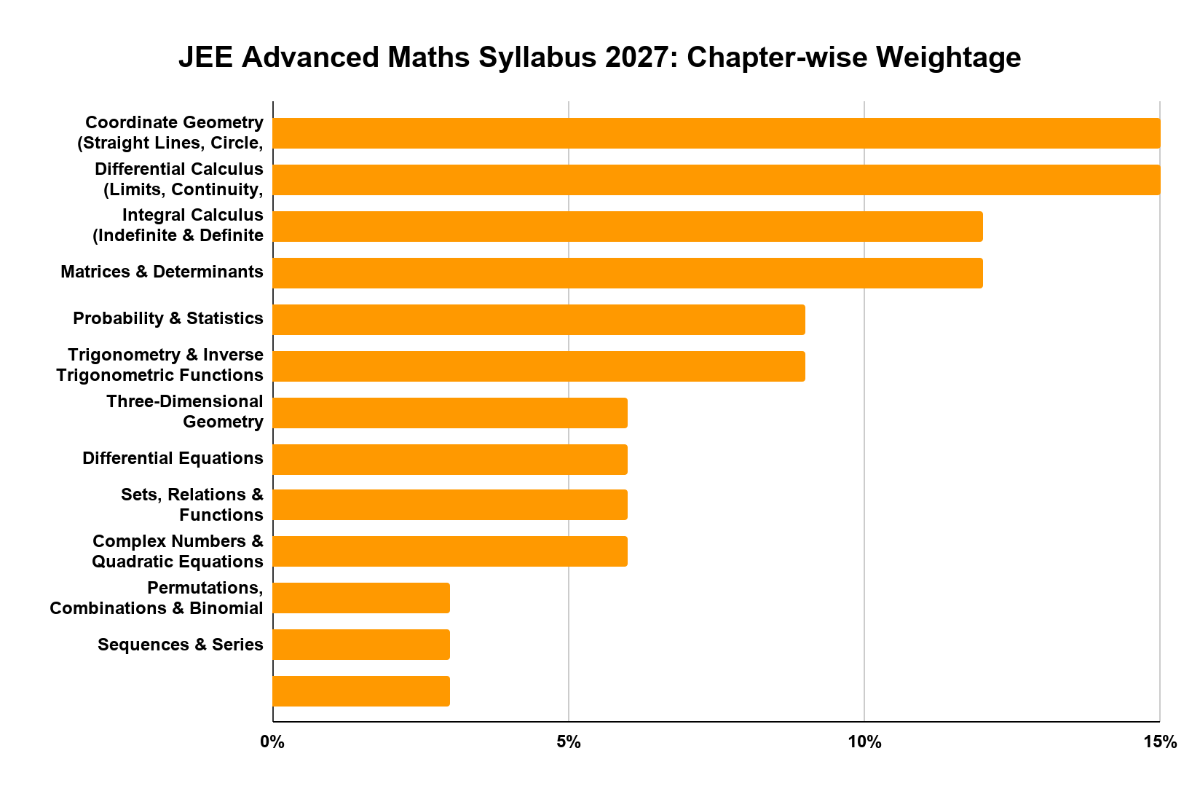
JEE Advanced Maths Syllabus 2027: Chapter-wise Weightage
| Chapter / Topic | Approx. Weightage (%) | Approx. No. of Questions |
|---|---|---|
| Coordinate Geometry (Straight Lines, Circle, Conic Sections) | 12–15% | 4–5 |
| Differential Calculus (Limits, Continuity, Differentiability, AoD) | 12–15% | 4–5 |
| Integral Calculus (Indefinite & Definite Integrals, Area under Curves) | 9–12% | 3–4 |
| Matrices & Determinants | 9–12% | 3–4 |
| Probability & Statistics | 9% | 3 |
| Trigonometry & Inverse Trigonometric Functions | 9% | 3 |
| Three-Dimensional Geometry | 6% | 2 |
| Differential Equations | 6% | 2 |
| Sets, Relations & Functions | 6% | 2 |
| Complex Numbers & Quadratic Equations | 3–6% | 1–2 |
| Permutations & Combinations & Binomial Theorem | 3% | 1 |
| Sequences & Series | 3% | 1 |
| Vectors | 3% | 1 |
Also Check:
- JEE Advanced Exam Previous Year Question Papers[2025-2007]
- JEE Advanced Exam 2026 Question Paper- Download Paper 1 and Paper 2 Question Paper with Answer Key
Ques. Are Sets and Statistics part of the JEE Advanced Maths Syllabus 2027?
Ans. Yes, Sets and Statistics are included in the latest JEE Advanced Mathematics syllabus. Sets are covered under Sets, Relations and Functions, while Statistics is included under Probability and Statistics.
Topics Outside the JEE Advanced Syllabus 2027
JEE Advanced Syllabus 2027 excludes 4 chapter level topics which appear in the JEE Main syllabus but carry 0 questions in the Advanced paper.
- Semiconductor Electronics and Communication Systems are the 2 Physics chapters left out of the JEE Advanced Syllabus 2027 along with diodes and logic gates.
- Solution of Triangles and Harmonic Progression are the 2 Mathematics topics missing from the JEE Advanced Syllabus 2027 which candidates can drop from revision.
| Subject | Topic / Chapter | Status / Notes |
|---|---|---|
| Physics | Communication Systems | Entire chapter removed |
| Semiconductor Electronics and Devices | Entire chapter removed (diodes, transistors, logic gates, etc.) | |
| Mathematics | Solution of Triangles | Removed (since 2023) |
| Harmonic Progression | Removed (since 2023) |
JEE Advanced Question Papers:
Ques. Is Semiconductor Electronics part of the JEE Advanced Syllabus 2027?
Ans. No. Semiconductor Electronics is not in the JEE Advanced Syllabus 2027. The official Modern Physics section ends at nuclear physics, the photoelectric effect, Bohr's theory, X-rays and de Broglie wavelength. Diodes, transistors and logic gates are JEE Main material only.
Best Books for the JEE Advanced Syllabus 2027
Candidates can check the best books for the JEE Advanced Syllabus 2027 given below:
-
Start with H.C. Verma, NCERT Chemistry, and Cengage Mathematics to strengthen fundamentals before attempting advanced problems.
-
Practice Advanced Questions: Use I.E. Irodov, M.S. Chauhan, Narendra Awasthi, and I.A. Maron selectively for challenging, subject-specific practice.
-
Solve chapter-wise JEE Advanced previous year questions to understand question patterns, marking schemes, and multi-concept applications.
| Subject | Book Name | Author / Publisher | Best For |
|---|---|---|---|
| Physics | Concepts of Physics (Vol 1 & 2) | H.C. Verma | Conceptual foundation + graded problems |
| Understanding Physics (Series) | D.C. Pandey (Arihant) | Topic-wise practice & exam-oriented problems | |
| Problems in General Physics | I.E. Irodov | High-difficulty multi-concept problems | |
| Fundamentals of Physics | Halliday, Resnick & Walker | Deep theory (especially Electricity, Magnetism, Optics) | |
| Chemistry | NCERT | Must-do foundation (especially Inorganic) | |
| Problems in Physical Chemistry | Narendra Awasthi / R.C. Mukherjee | Physical Chemistry numericals | |
| Organic Chemistry | M.S. Chauhan / O.P. Tandon / Morrison & Boyd | Mechanisms & named reactions | |
| Concise Inorganic Chemistry | J.D. Lee | Coordination Compounds, d/f-block & advanced Inorganic | |
| Mathematics | Cengage Mathematics Series (G. Tewani) | G. Tewani (Cengage) | Comprehensive theory + extensive practice |
| Problems in Calculus of One Variable | I.A. Maron | Advanced Calculus (definite integrals, applications) | |
| Coordinate Geometry / Plane Trigonometry | S.L. Loney | Conic sections, straight lines, trigonometry | |
| Algebra for JEE Advanced | S.K. Goyal (Arihant) | Complex Numbers, P&C, Binomial Theorem, Matrices | |
| All Subjects | Previous Years’ Solved Papers (Chapter-wise) | Arihant / Disha / MTG | Pattern familiarity & real exam questions |
Also Check:
- JEE Advanced Exam 2024 AAT Question Paper with Answer Key PDF
- JEE Advanced Exam 2024 PCM May 26 Paper 2 Question Paper Pdf - Check Solutions with Answer Key Pdf
Ques. Is NCERT enough for the JEE Advanced Syllabus 2027?
Ans. No. NCERT is not sufficient for the JEE Advanced Syllabus 2027. It does not cover Advanced-only areas such as qualitative salt analysis, practical organic chemistry and error propagation. NCERT works as a base for Inorganic Chemistry, with dedicated problem books layered above it.
JEE Advanced Exam Previous Years’ Papers
| Year | Paper | PDF Link |
|---|---|---|
| JEE Advanced 2025 | Paper 1 | Download PDF |
| Paper 2 | Download PDF | |
| JEE Advanced 2024 | Paper 1 | Download PDF |
| Paper 2 | Download PDF | |
| JEE Advanced 2023 | Paper 1 | Download PDF |
| Paper 2 | Download PDF | |
| JEE Advanced 2022 | Paper 1 | Download PDF |
| Paper 2 | Download PDF |
JEE Advanced Syllabus 2027: Frequently Asked Questions
Ques. Will the JEE Advanced syllabus change in 2027?
Ans. The official JEE Advanced 2027 syllabus has not been released yet. Candidates should follow the latest official syllabus until the 2027 syllabus is announced.
Ques. Which IIT will conduct JEE Advanced in 2027?
Ans. IIT Delhi is expected to conduct JEE Advanced 2027 based on the established rotation among the seven organising IITs. The official announcement is yet to be made.
Ques. Which IIT at 13000 rank?
Ans. With an AIR around 13,000, candidates may get seats in some newer IITs or less competitive branches, depending on the category and counselling year. Branch availability changes every year according to JoSAA cutoffs.
Ques. Which year was JEE Advanced toughest?
Ans. JEE Advanced 2022 is often considered one of the toughest recent papers, particularly because of its challenging Mathematics section. A decade-long analysis also identified 2022 as the toughest JEE Advanced Mathematics paper in that period.
Ques. Can I crack JEE Advanced in 1 month?
Ans. Yes, but cracking JEE Advanced in one month is difficult and depends heavily on the candidate's existing preparation. Candidates with strong fundamentals should focus on PYQs, mock tests, revision and high-weightage topics.
Ques. Is IIT tougher than CA?
Ans. IIT admission through JEE Advanced and the CA qualification are difficult in different ways, so there is no objective way to rank one as tougher. JEE Advanced focuses heavily on advanced problem-solving, while CA involves multiple stages and extensive study of accounting, taxation, law and related subjects.



Comments