




JEE Advanced Chemistry preparation 2027 should start with the JEE Advanced syllabus. Revise core theory, derivations, assumptions, and exceptions before attempting multi-concept problems.
Solve 10-15 years of JEE Advanced PYQs chapter-wise to learn question patterns and traps. Revise reactions, colours, and periodic trends from short notes every week.
- From Physical Chemistry, focus on Ionic Equilibrium, Electrochemistry, Thermodynamics and Chemical Kinetics, with regular multi-step numericals.
- From Organic Chemistry, master General Organic Chemistry (GOC), reaction mechanisms, stereochemistry and carbonyl compounds rather than memorising reactions.
- From Inorganic Chemistry, read NCERT line by line and prioritise Chemical Bonding, Coordination Compounds and Salt Analysis.
- Choose limited, reliable books: NCERT for foundation, N. Avasthi for Physical Chemistry, M.S. Chouhan for Organic Chemistry and V.K. Jaiswal for Inorganic Chemistry.
- In the final month, take full JEE Advanced mock tests under exam conditions and analyse every error.
Related Links:
- JEE Advanced Exam Pattern 2027: Paper 1 & 2 Structure, Marking Scheme, Subject-Wise Weightage
- JEE Advanced Syllabus 2027: Section-Wise Physics, Chemistry & Maths Syllabus and PDF Download
- Download JEE Advanced 2007-2026 Question Paper with Solutions in PDF Format For Exam Preparation

JEE Advanced Chemistry Preparation 2027: Highlights
JEE Advanced Chemistry preparation 2027 depends on three sections of roughly equal weight. Chemistry is often the most scoring subject in JEE Advanced because it blends concepts, structural memory and calculation.
- Organic Chemistry carries the approximate weightage of 33-40%.
- Physical Chemistry produces most of the numerical and integer-type questions, with an expected weightage of 30-35%
- Inorganic Chemistry rewards NCERT accuracy and structural reasoning with a weightage of about 25-33%.
| Section | Approx. Weightage | High-Priority Chapters |
|---|---|---|
| Physical Chemistry | 30–35% | Chemical and Ionic Equilibrium, Thermodynamics, Electrochemistry, Chemical Kinetics, Atomic Structure, Solutions, Mole Concept |
| Organic Chemistry | 33–40% | GOC, Reaction Mechanisms (SN1/SN2, E1/E2, addition), Carbonyl Compounds, Amines, Hydrocarbons, Phenols |
| Inorganic Chemistry | 25–33% | Chemical Bonding, Coordination Compounds, p-Block, d- and f-Block, Salt Analysis |

Ques. What is the weightage of Chemistry sections in JEE Advanced?
Ans. Physical Chemistry carries about 30–35%, Organic about 33–40% and Inorganic about 25–33%. Weightage changes every year, so prepare the full JEE Advanced Chemistry syllabus.
Check Out:
Important Chemistry Chapters for JEE Advanced
Focus on the high-yield chapters first for JEE Advanced Chemistry preparation 2027. Then cover the easier chapters, which take little time and give guaranteed marks.
- Ionic Equilibrium: One of the toughest areas, with simultaneous equilibria, buffers and Ksp. It is often merged with Electrochemistry or Qualitative Analysis.
- Electrochemistry: Scoring but conceptually intense. Focus on the Nernst equation, conductance, Faraday's laws and concentration cells.
- Carbonyl Compounds: The most important Organic chapter. Focus on Aldol, Cannizzaro, Perkin and Iodoform.
- Salt Analysis: Tests reagent colours, precipitate solubility and gas evolution. It is often clubbed with d-block and p-block reactions.
- Coordination Compounds: Heavily tested through matrix-match and integer-type questions.
- Easier scoring chapters: Surface Chemistry, Atomic Structure and Metallurgy have predictable patterns. Do not skip them.
| Subject | Chapter | Key Topics |
|---|---|---|
| Physical | Ionic and Chemical Equilibrium | Simultaneous equilibria, buffers, solubility product (Ksp) |
| Electrochemistry | Nernst equation, conductance, Faraday's laws, concentration cells | |
| Thermodynamics and Thermochemistry | Entropy, Gibbs free energy, reversible and irreversible processes, spontaneity | |
| Surface Chemistry | Freundlich isotherm, Tyndall effect, coagulation, Hardy–Schulze rule | |
| Atomic Structure | Quantum mechanical model, radial and angular nodes, Bohr transitions | |
| Organic | GOC and Isomerism | Intermediate stability, acidity/basicity, tautomerism, optical isomerism |
| Aldehydes, Ketones and Carboxylic Acids | Aldol, Cannizzaro, Perkin, Iodoform, multistep conversions | |
| Inorganic | Coordination Compounds | Isomerism, Crystal Field Theory, magnetic properties, electronic configurations |
| Salt Analysis | Reagent colours, precipitate solubility, gas evolution | |
| Metallurgy | Extraction principles, Ellingham diagrams, Mond and Van Arkel processes, zone refining |
Ques. Which are the most important chapters in JEE Advanced Chemistry?
Ans. Ionic Equilibrium, Electrochemistry, Carbonyl Compounds, Coordination Compounds and Salt Analysis are the most important chapters.
Check Out:
- JEE Advanced 2024 Question Paper (Available)- Download Paper 1 and Paper 2 Question Paper with Answers and Solution PDF
- JEE Advanced 2023 Question Paper Available: Download Paper 1 and Paper 2 Question Paper with Answer Key and Solution PDF
- JEE Advanced 2022 Question Papers: Download Paper and Answer Key PDFs
JEE Advanced Chemistry Preparation Tips and Practice Strategy
Master NCERT, especially Inorganic. Build GOC and Chemical Bonding early, as they underpin other chapters. Solve the last 10-15 years chapter-wise. Treat them as mock tests to learn the phrasing and traps.
- Multi-correct questions decide ranks. One wrong option can cost marks, so conceptual clarity is vital.
- Study about 2–2.5 hours daily in the peak phase. Balance numericals (Physical), mechanisms (Organic) and revision (Inorganic).
- Take a mixed test every week and maintain an error notebook.
- Use formula sheets, reaction maps and periodic trend charts. Revise Inorganic NCERT fully every month.
| Timeline Phase | Main Resource Focus | Daily Practice Target |
|---|---|---|
| Phase 1 (Foundation) | NCERT + Basic Class Notes | 15–20 Conceptual Single-Corrects |
| Phase 2 (Depth) | N. Awasthi / M.S. Chouhan / V.K. Jaiswal | 25–30 Mixed Pattern Questions (Multi-correct / Numerical) |
| Phase 3 (Integration) | Coaching Module Exercise-2 & Micro-Notes | 20 Multi-Step Complex Roadmaps / Paragraphs |
| Phase 4 (Testing) | 15-Year Advanced PYQs & Mock Booklets | 2 Full Papers per week (6 Hours total check) |
Ques. How to prepare for JEE Advanced Chemistry?
Ans. Master NCERT, build GOC and Bonding early, solve 10-15 years of PYQs chapter-wise, and keep an error notebook.
This video by the channel “RDS Vlogs [IIT Guwahati]” shares a 35-day study plan for JEE Advanced 2027 based on analyses of previous trends and data. It highlights the importance of solving previous years’ questions (PYQs) and provides specific preparation strategies for Physical, Organic, and Inorganic Chemistry.
JEE Advanced Question Paper with Solution PDF
| Paper Name | Question Paper Link | Solutions Link |
|---|---|---|
| JEE Advanced 2026 Question Paper – Paper 1 | Download PDF | Check Solutions |
| JEE Advanced 2026 Question Paper – Paper 2 | Download PDF | Check Solutions |
| JEE Advanced 2025 Question Paper – Paper 1 | Download PDF | Check Solutions |
| JEE Advanced 2025 Question Paper – Paper 2 | Download PDF | Check Solutions |
| JEE Advanced Question Paper 2024 – Paper 1 | Download PDF | Check Solutions |
| JEE Advanced Question Paper 2024 – Paper 2 | Download PDF | Check Solutions |
| JEE Advanced 2024 AAT Question Paper | Download PDF | Check Solutions |
How to Prepare Physical Chemistry for JEE Advanced
Physical Chemistry for JEE produces many numerical and integer-type questions. It needs conceptual depth and calculation accuracy.
- Prioritize numerical-based chapters such as Thermodynamics, Equilibrium, Electrochemistry, Chemical Kinetics and Mole Concept.
- Learn the logic behind thermodynamic derivations, kinetic variables and electrochemical pathways instead of memorising final results.
- Practise multi-step calculations without a calculator to build speed and reduce errors.
| Preparation Aspect | Strategy and Key Focus Areas |
|---|---|
| High-Priority Chapters | Prioritize Chemical and Ionic Equilibrium, Electrochemistry, Chemical Kinetics, Thermodynamics, and Mole Concept. |
| Conceptual Understanding | Focus on thermodynamic derivations, kinetic variables, and electrochemical pathways instead of memorising formulas. |
| Numerical Practice | Solve multi-step, numerical and integer-type questions to improve accuracy and application of concepts. |
| Calculation Precision | Practise without a calculator to improve speed and reduce calculation errors in lengthy problems. |
| Logarithms and Approximations | Practise natural logarithms, non-integer powers (e.g., 10-4.74), and log approximations to handle complex calculations efficiently. |
| Application-Based Questions | Apply concepts to unfamiliar problem settings and practise questions that combine multiple topics. |
Ques. How to prepare Physical Chemistry for JEE Advanced?
Ans. Understand derivations, solve multi-step numericals by hand, learn log approximations, and practise Equilibrium, Electrochemistry, Kinetics and Thermodynamics.
Ques. Which is the best book for Physical Chemistry for JEE Advanced?
Ans. N. Avasthi's Physical Chemistry for JEE. Start with Level 2 and Level 3 exercises after finishing your module.
Also Check:
How to Prepare Organic Chemistry for JEE Advanced
Rote learning doesn’t help in Organic Chemistry. JEE Advanced Organic questions use multi-step sequences, paragraphs, and matrix-match.
- Prioritise chapters: GOC, Stereochemistry, Carbonyl Compounds (Aldehydes & Ketones), Hydrocarbons and Amines.
- Build command over GOC, reaction intermediates (carbocations, carbanions, free radicals), and electronic effects. Map how functional groups convert, such as alcohol to aldehyde to carboxylic acid.
- Whenever a carbocation forms, check for 1,2-hydride, 1,2-methyl, or ring-expansion shifts before drawing the product. For alkenes and cyclic systems, use wedge-dash, Fischer or Newman projections.
- Memorise reagents and named reactions only after understanding the mechanism.
| Preparation Aspect | Strategy and Key Focus Areas |
|---|---|
| Master Core Mechanisms |
|
| Reaction Roadmaps |
|
| High-Priority Chapters |
|
| Rearrangement Reactions |
|
| Stereochemistry and Optical Isomerism |
|
| Reaction-Based Practice |
|
| Named Reactions and Reagents |
|
Ques. How to prepare Organic Chemistry for JEE Advanced?
Ans. Strengthen GOC and mechanisms first, practise multistep roadmaps, check carbocation rearrangements and draw structures in 3D.
Ques. Is M.S. Chouhan Organic Chemistry enough for JEE Advanced?
Ans. It is the main problem book for multistep conversions and stereochemistry. Pair it with NCERT, theory notes and JEE Advanced PYQs.
Check Out:
How to Prepare Inorganic Chemistry for JEE Advanced
Inorganic Chemistry for JEE rewards structural logic as much as memory. Study it daily rather than in the last two months.
- Read NCERT line by line: Note exceptions, anomalous behaviour and industrial uses.
- Draw structures and link Coordination concepts. Connect CFSE (Δo vs Δt), strong and weak field ligands, pairing energy, inner and outer orbital complexes and Jahn–Teller distortion.
- Keep a Salt Analysis notebook: Group observations by gas evolution (NO2 is brown, SO2 turns acidified K2Cr2O7 green), precipitate colour (Fe(OH)3 reddish-brown, CuS black, AgI yellow), flame tests and borax bead tests.
| Preparation Area | Focus Areas & Strategy |
|---|---|
| NCERT Line-by-Line Reading | Study block chemistry thoroughly, focusing on exceptions, anomalous behaviour, reactions, and industrial uses. |
| Chemical Bonding | Practice identifying hybridisation, molecular geometry, magnetic properties, and bond characteristics through structural reasoning. |
| Coordination Compounds | Master crystal field splitting, strong/weak field ligands, pairing energy, inner/outer orbital complexes, and Jahn–Teller distortion for matrix-match questions. |
| Structural Chemistry | Draw structures of oxoacids, silicates, and cyclic compounds; count bridging oxygens, P–O–P bonds, and lone pairs. |
| Qualitative Analysis | Maintain a revision notebook for gas evolution, precipitate colours, reagent reactions, flame tests, and borax bead tests. |
| Metallurgy & Practical Chemistry | Revise extraction principles, ores, reagents, and qualitative analysis reactions according to the prescribed JEE Advanced syllabus. |
| Daily Revision | Dedicate around 1 hour daily to inorganic chemistry, combining NCERT revision, reaction recall, and topic-wise PYQs. |
Ques. How to prepare Inorganic Chemistry for JEE Advanced?
Ans. Read NCERT line by line, draw structures instead of reading properties, maintain a Salt Analysis notebook and revise daily.
Ques. Which is the best book for Inorganic Chemistry for JEE Advanced?
Ans. NCERT for facts, V.K. Jaiswal for practice, and J.D. Lee (Sudarsan Guha adaptation) selectively for trends and structures.
How to Revise Chemistry for JEE Advanced After JEE Main?
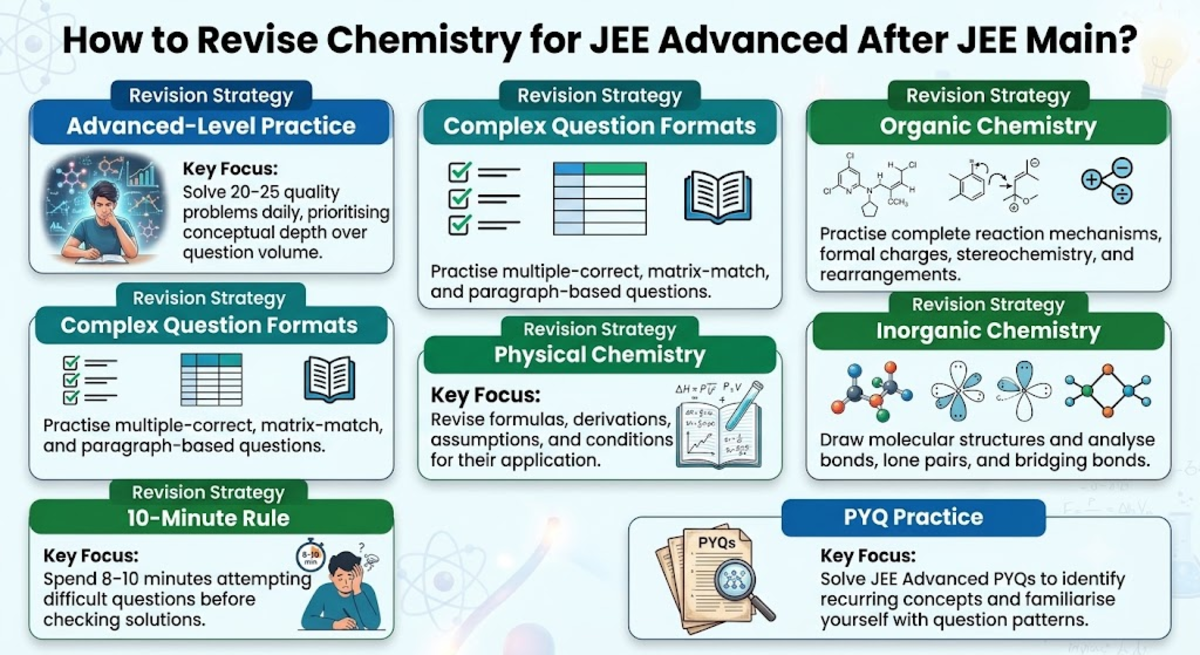
JEE Main tests speed and recall. JEE Advanced tests conceptual depth and multi-concept integration. After JEE Main, change how you revise for JEE Advanced Chemistry preparation 2027.
- Solve 20–25 high-quality Advanced-level problems instead of 100 easy ones.
- Prioritise Multiple Correct, Matrix Match and Comprehension Paragraph formats.
- Try solving a hard question for 8–10 minutes before checking the solution.
| Revision Strategy | Key Focus |
|---|---|
| Advanced-Level Practice | Solve 20–25 quality problems daily, prioritising conceptual depth over question volume. |
| Complex Question Formats | Practise multiple-correct, matrix-match, and paragraph-based questions. |
| 10-Minute Rule | Spend 8–10 minutes attempting difficult questions before checking solutions. |
| Physical Chemistry | Revise formulas, derivations, assumptions, and conditions for their application. |
| Organic Chemistry | Practise complete reaction mechanisms, formal charges, stereochemistry, and rearrangements. |
| Inorganic Chemistry | Draw molecular structures and analyse bonds, lone pairs, and bridging bonds. |
| PYQ Practice | Solve JEE Advanced PYQs to identify recurring concepts and familiarise yourself with question patterns. |
Ques. How to revise Chemistry for JEE Advanced after JEE Main?
Ans. Solve fewer but harder problems, rewrite full mechanisms, revisit equation conditions and draw inorganic structures.
Best Books for JEE Advanced Chemistry 2027
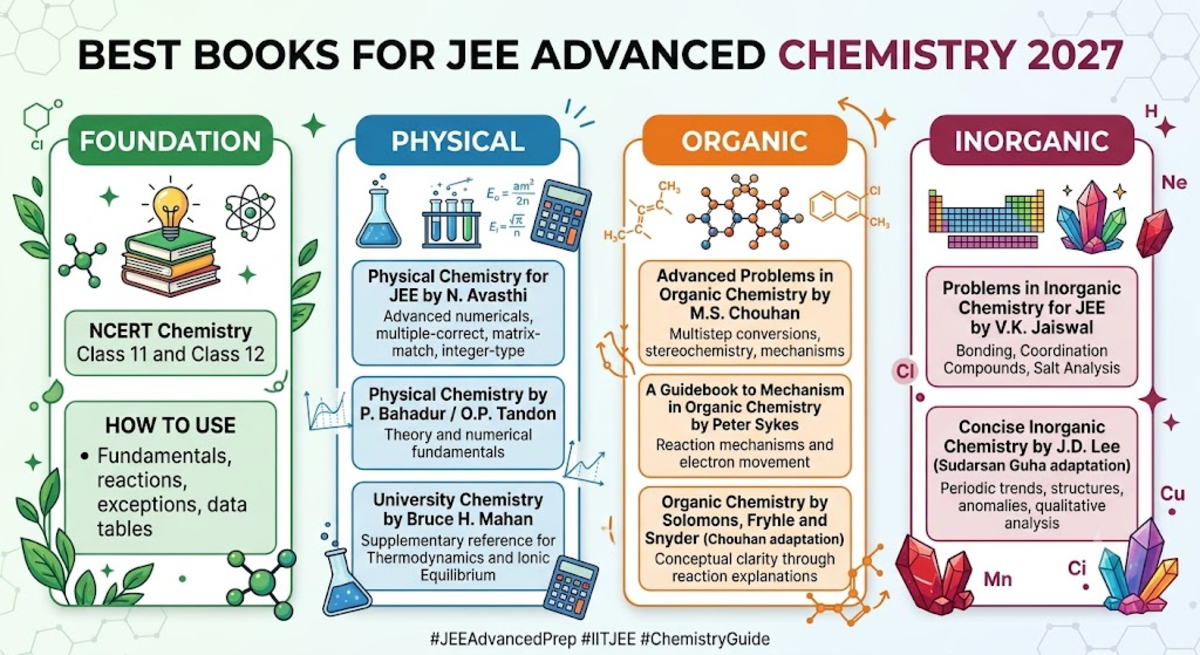
The best books for JEE Advanced Chemistry are NCERT plus one problem book per section. Use these Chemistry books for JEE Advanced selectively and do not try to finish every title.
- NCERT (Class 11 and 12): Treat it as the primary roadmap. Facts, exceptions and data tables for Inorganic and Physical chapters are often lifted from it.
- N. Avasthi (Physical): Go to Level 2 and Level 3. It has Multiple Correct, Matrix Match and integer-type questions in the IIT layout.
- M.S. Chouhan (Organic): Multistep roadmaps and stereochemistry problems build logic.
- V.K. Jaiswal (Inorganic): Questions are graded by level and cover Bonding, Coordination Compounds and Salt Analysis.
| Section | Book and Author | How to Use |
|---|---|---|
| Foundation | NCERT Chemistry Class 11 and Class 12 | Fundamentals, reactions, exceptions, data tables |
| Physical | Physical Chemistry for JEE by N. Avasthi | Advanced numericals, multiple-correct, matrix-match, integer-type |
| Physical Chemistry by P. Bahadur / O.P. Tandon | Theory and numerical fundamentals | |
| University Chemistry by Bruce H. Mahan | Supplementary reference for Thermodynamics and Ionic Equilibrium | |
| Organic | Advanced Problems in Organic Chemistry by M.S. Chouhan | Multistep conversions, stereochemistry, mechanisms |
| A Guidebook to Mechanism in Organic Chemistry by Peter Sykes | Reaction mechanisms and electron movement | |
| Organic Chemistry by Solomons, Fryhle and Snyder (Chouhan adaptation) | Conceptual clarity through reaction explanations | |
| Inorganic | Problems in Inorganic Chemistry for JEE by V.K. Jaiswal | Bonding, Coordination Compounds, Salt Analysis |
| Concise Inorganic Chemistry by J.D. Lee (Sudarsan Guha adaptation) | Periodic trends, structures, anomalies, qualitative analysis |
As per a Reddit discussion where a JEE Advanced exam aspirant is asking for Chemistry preparation tips, below are some tips to apply in your preparation:
1. Inorganic Chemistry: Read NCERT line-by-line thoroughly. This alone covers 60–70% of the Inorganic Chemistry section.
2. Organic Chemistry: Stick to NCERT and thoroughly revise your teacher's/coaching class notes. Solve M.S. Chouhan (MS Chouhan) after your JEE Main first attempt.
3. Physical Chemistry: Focus heavily on deep conceptual understanding rather than rote application. Make sure you fully comprehend the underlying principles of each numerical problem you attempt.

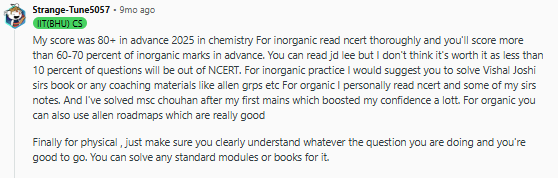
Source: Reddit
Ques. Which are the best books for JEE Advanced Chemistry?
Ans. NCERT, N. Avasthi for Physical, M.S. Chouhan for Organic and V.K. Jaiswal for Inorganic.
Ques. Are JEE Mains preparation books enough for JEE Advanced Chemistry?
Ans. No. They cover single-concept questions. Add the problem books above and JEE Advanced PYQs for multi-concept practice.
JEE Advanced Chemistry Mock Tests and Revision Strategy
In JEE Advanced Chemistry preparation 2027, spend double the test time on analysis.
- Take one part-test or single-paper mock every week. Track weak chapters, not speed.
- Once a week, attempt both papers back-to-back, every three hours with the official break between them, to train for late-afternoon fatigue.
- Filter multiple-correct questions carefully. Mark only options you can prove, and follow the partial marking rules in that year's instructions.
- Solve chapter-wise JEE Advanced PYQs after finishing each topic.
- Review unsolved questions, note recurring patterns, and revisit weak concepts.
| Strategy Block | Frequency | Metric to Track |
|---|---|---|
| Dual Paper Mock Test | Once a week (6 hours total) | Net accuracy and multi-correct selection efficiency |
| Error Log Review | Daily, 30–45 minutes | Drop in repeated errors over 3 weeks |
| Formula and Map Sprint | Alternate days, rotating sections | Speed of drawing structural transitions manually |
Ques. How many mock tests should I take for JEE Advanced Chemistry?
Ans. One part-test or paper weekly, a full two-paper mock once a week in the final phase, and double the test time for analysis.
Check Out: JEE Advanced Preparation 2027: Toppers' Tips, Study Plan, Books and Subject-wise Strategy
Common Mistakes to Avoid in JEE Advanced Chemistry Preparation
Most errors in JEE Advanced Chemistry preparation 2027 come from habits, not gaps in the syllabus. Fix these early.
- Leaving Inorganic Chemistry for the last two months. JEE Advanced rarely asks direct facts. It tests structures, trends and reasoning.
- Studying Organic Chemistry in isolated chapters. Expect questions that combine GOC, Stereochemistry, Carbonyl Compounds and Biomolecules.
- Skipping the carbocation rearrangement and spatial orientation check before finalising a product.
- Guessing in multi-correct questions and using a calculator during practice.
- Skipping Paper 2 practice due to fatigue, or checking answers midway.
- Glancing at a solution and assuming "I already knew that."
- Careless errors in calculations, units, signs and the exact quantity asked.
- Switching between multiple resources instead of using concise notes or coaching modules.

Ques. What is the biggest mistake in JEE Advanced Chemistry preparation?
Ans. Treating Inorganic as pure memorisation and leaving it for the end.
FAQs on JEE Advanced Chemistry Preparation
Ques. How to start JEE Advanced Chemistry preparation 2027?
Ans. Go through the JEE Advanced Chemistry syllabus, classify chapters as weak, moderate or strong, finish NCERT, and then move to problem books and PYQs.
Ques. How to prepare for JEE Advanced Chemistry in the last month?
Ans. Revise NCERT Inorganic, review your error notebook, solve topic-wise PYQs and take full JEE Advanced mock tests under exam conditions.
Ques. How to crack JEE Advanced Chemistry?
Ans. Build concepts first, solve 10-15 years of PYQs, practise multi-correct questions, keep an error log and revise Inorganic daily.
Ques. Is NCERT enough for JEE Advanced Chemistry?
Ans. NCERT is enough for Inorganic facts and exceptions, but Physical and Organic need problem books such as N. Avasthi and M.S. Chouhan.
Ques. Which is the best book for IIT JEE Chemistry?
Ans. NCERT is the base. Add N. Avasthi, M.S. Chouhan and V.K. Jaiswal for Physical, Organic and Inorganic practice.
Ques. Which book is best for JEE Advanced Chemistry?
Ans. There is no single book. Use NCERT plus one problem book for each section.



Comments