



Inside the NCERT notes for Class 8 Mathematics Part 1 Chapter 5 Number Play, you will find parity rules, divisibility checks, and letter-digit puzzles. These notes explain the main ideas from the 2026-27 Ganita Prakash textbook with short examples and clear reasoning.
- Core idea: Use remainders and parity to explain number patterns.
- Quick checks: Test divisibility by 3, 9, and 11 without long division.
- Puzzle focus: Replace letters with digits while keeping each statement true.
Chapter5NumberPlayNotes.pdf?page=1&dpi=150)
Chapter5NumberPlayNotes.pdf?page=2&dpi=150)
Chapter5NumberPlayNotes.pdf?page=3&dpi=150)
Chapter5NumberPlayNotes.pdf?page=4&dpi=150)
Chapter5NumberPlayNotes.pdf?page=5&dpi=150)
Chapter5NumberPlayNotes.pdf?page=6&dpi=150)
Chapter5NumberPlayNotes.pdf?page=7&dpi=150)
Chapter5NumberPlayNotes.pdf?page=8&dpi=150)
Chapter5NumberPlayNotes.pdf?page=9&dpi=150)
Chapter5NumberPlayNotes.pdf?page=10&dpi=150)
Chapter5NumberPlayNotes.pdf?page=11&dpi=150)
Chapter5NumberPlayNotes.pdf?page=12&dpi=150)
Chapter5NumberPlayNotes.pdf?page=13&dpi=150)
Chapter5NumberPlayNotes.pdf?page=14&dpi=150)
Chapter5NumberPlayNotes.pdf?page=15&dpi=150)
Chapter5NumberPlayNotes.pdf?page=16&dpi=150)
Chapter5NumberPlayNotes.pdf?page=17&dpi=150)
Chapter5NumberPlayNotes.pdf?page=18&dpi=150)
Chapter5NumberPlayNotes.pdf?page=19&dpi=150)
Chapter5NumberPlayNotes.pdf?page=20&dpi=150)
Chapter5NumberPlayNotes.pdf?page=21&dpi=150)
Chapter5NumberPlayNotes.pdf?page=22&dpi=150)
Chapter5NumberPlayNotes.pdf?page=23&dpi=150)
Chapter5NumberPlayNotes.pdf?page=24&dpi=150)
Chapter5NumberPlayNotes.pdf?page=25&dpi=150)
Chapter5NumberPlayNotes.pdf?page=26&dpi=150)
Chapter5NumberPlayNotes_flat_MobileCard.pdf?page=1&dpi=150)
Chapter5NumberPlayNotes_flat_MobileCard.pdf?page=2&dpi=150)
Chapter5NumberPlayNotes_flat_MobileCard.pdf?page=3&dpi=150)
Chapter5NumberPlayNotes_flat_MobileCard.pdf?page=4&dpi=150)
Chapter5NumberPlayNotes_flat_MobileCard.pdf?page=5&dpi=150)
Chapter5NumberPlayNotes_flat_MobileCard.pdf?page=6&dpi=150)
Chapter5NumberPlayNotes_flat_MobileCard.pdf?page=7&dpi=150)
Chapter5NumberPlayNotes_flat_MobileCard.pdf?page=8&dpi=150)
Chapter5NumberPlayNotes_flat_MobileCard.pdf?page=9&dpi=150)
Chapter5NumberPlayNotes_flat_MobileCard.pdf?page=10&dpi=150)
Chapter5NumberPlayNotes_flat_MobileCard.pdf?page=11&dpi=150)
Chapter5NumberPlayNotes_flat_MobileCard.pdf?page=12&dpi=150)
Chapter5NumberPlayNotes_flat_MobileCard.pdf?page=13&dpi=150)
Chapter5NumberPlayNotes_flat_MobileCard.pdf?page=14&dpi=150)
Chapter5NumberPlayNotes_flat_MobileCard.pdf?page=15&dpi=150)
Chapter5NumberPlayNotes_flat_MobileCard.pdf?page=16&dpi=150)
Chapter5NumberPlayNotes_flat_MobileCard.pdf?page=17&dpi=150)
Chapter5NumberPlayNotes_flat_MobileCard.pdf?page=18&dpi=150)
Chapter5NumberPlayNotes_flat_MobileCard.pdf?page=19&dpi=150)
Chapter5NumberPlayNotes_flat_MobileCard.pdf?page=20&dpi=150)
Chapter5NumberPlayNotes_flat_MobileCard.pdf?page=21&dpi=150)
Chapter5NumberPlayNotes_flat_MobileCard.pdf?page=22&dpi=150)
Chapter5NumberPlayNotes_flat_MobileCard.pdf?page=23&dpi=150)
Chapter5NumberPlayNotes_flat_MobileCard.pdf?page=24&dpi=150)
Chapter5NumberPlayNotes_flat_MobileCard.pdf?page=25&dpi=150)
Chapter5NumberPlayNotes_flat_MobileCard.pdf?page=26&dpi=150)
Chapter5NumberPlayNotes_flat_MobileCard.pdf?page=27&dpi=150)
These Number Play notes follow the 2026-27 Ganita Prakash chapter and explain each rule through examples, patterns, and proofs.
Number Play Topic-by-Topic Notes for Class 8 Mathematics
Number Play studies patterns that stay true across many examples. The chapter asks you to test a claim and then explain why it works.
Consecutive Numbers and Their Sums
Consecutive numbers come one after another, such as 4, 5, 6, and 7. Their sums often reveal factors and useful patterns.
- Two consecutive numbers always have different parity.
- Three consecutive numbers include one multiple of 3.
- A product of two consecutive numbers is always even.
- A product of three consecutive numbers is always divisible by 6.
Parity of Expressions with Plus and Minus Signs
Parity tells whether an integer is odd or even. Changing a plus sign to minus changes an expression by twice a number.
- Odd plus odd and odd minus odd both give even results.
- Even plus even and even minus even both give even results.
- Odd combined with even gives an odd result.
- Switching one sign changes the value by an even amount.
Numbers that differ by an even amount have the same parity. This fact explains why a whole family of expressions can stay odd or stay even.
Remainders, Multiples and General Claims
A remainder describes what is left after division. For division by 4, the possible remainders are 0, 1, 2, and 3.
- A multiple leaves remainder 0 after division by its factor.
- Even numbers leave remainder 0 or 2 after division by 4.
- Two matching remainders can help prove a divisibility claim.
- One counterexample is enough to disprove an always-true claim.
Fast Divisibility Checks and Why They Work
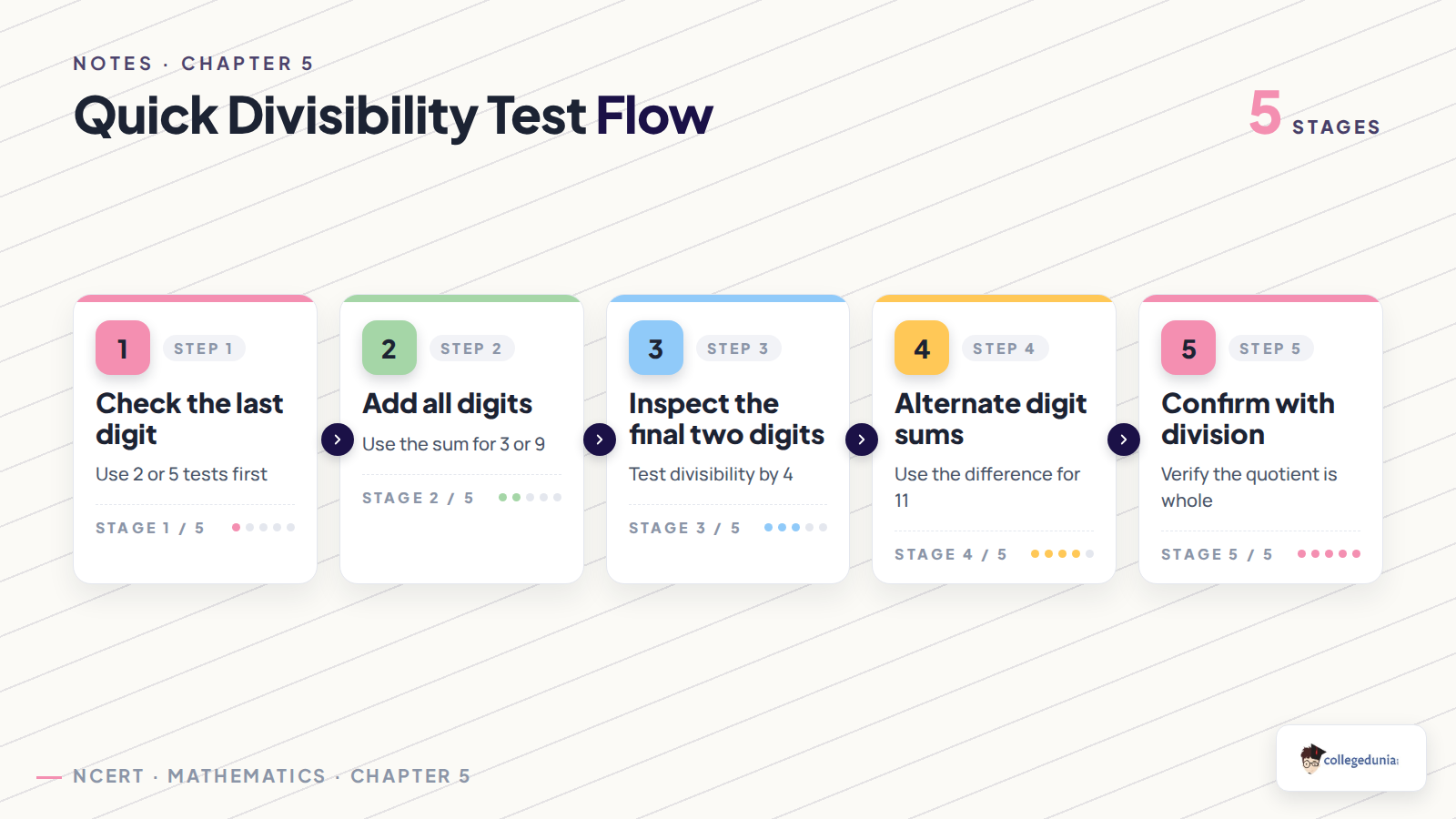
Divisibility shortcuts save time, but the chapter also explains their logic. Place value turns a large number into smaller, easier parts.
| Divisor | Quick check | Reason to remember |
|---|---|---|
| 3 | Add all digits; the sum must be divisible by 3. | Powers of 10 leave remainder 1 upon division by 3. |
| 9 | Add all digits; the sum must be divisible by 9. | Powers of 10 leave remainder 1 upon division by 9. |
| 11 | Find the difference between alternating digit sums. | The difference must be 0 or a multiple of 11. |
| 6 | Check divisibility by both 2 and 3. | The factors 2 and 3 share no common factor. |
Digits in Disguise and Letter-Digit Puzzles
In a cryptarithm, each letter stands for one digit. The same letter keeps the same digit throughout the puzzle.
- Start at the units column and note any carry.
- Use the same digit whenever a letter repeats.
- Do not give two letters the same digit.
- Check the completed addition or multiplication from the start.
A leading letter cannot represent zero. Otherwise, the written number would have fewer digits than the puzzle shows.
Number Play Chapter Overview
Source: Magnet Brains on YouTube
Number Play Important Rules at a Glance for 2026-27
This table joins the chapter's main claims with a quick checking method. Use it before solving the Figure it Out questions.
| Rule | Fast reasoning | Useful example |
|---|---|---|
| Two consecutive numbers have an even product | One number must be even | 8 x 9 is divisible by 2 |
| Three consecutive numbers have a product divisible by 6 | They include a factor 2 and a factor 3 | 5 x 6 x 7 is divisible by 6 |
| Digit sum checks divisibility by 3 and 9 | Each place value has remainder 1 | 4 + 5 + 9 = 18 |
| Alternating sum checks divisibility by 11 | Successive place values alternate remainders | 121 gives 1 - 2 + 1 = 0 |
Number Play Concepts Students Often Mix Up
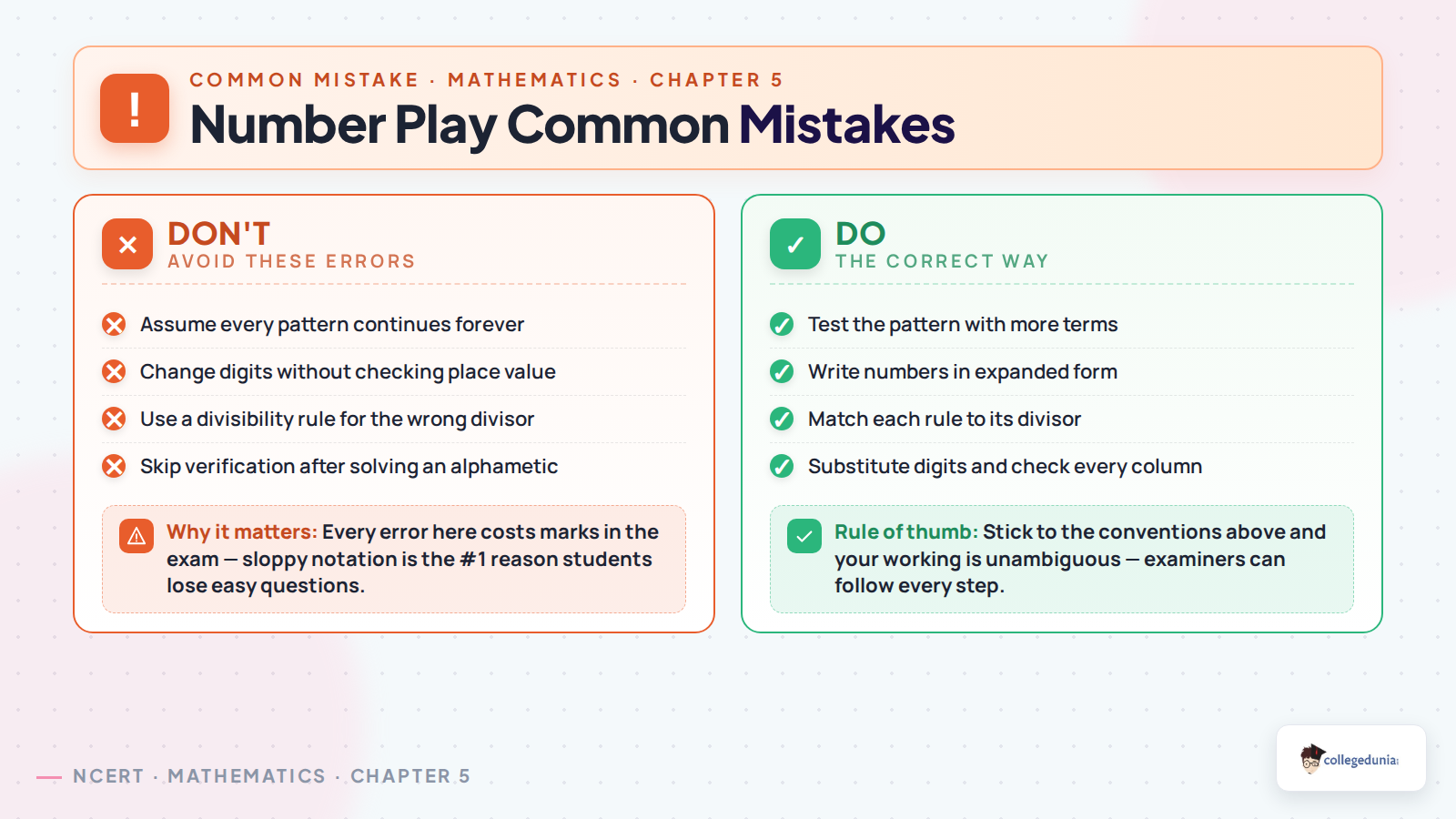
Most errors come from using a correct rule without checking its full condition. Keep these distinctions clear while solving a claim.
- Factor vs multiple: A factor divides a number; a multiple is produced by multiplication.
- Example vs proof: Examples support a pattern, but algebra or remainder reasoning proves it.
- Divisible by 6: A number must pass both the 2 test and the 3 test.
- Divisible by 24: Checking 4 and 6 is not enough because their factors overlap.
Never treat several successful examples as a complete proof. Write a general reason that covers every allowed number.
Number Play Student Feedback from Class 8 Learners
What 10,620 students told Collegedunia about Number Play
In a Collegedunia poll before the 2026 exams, most students preferred testing a pattern before writing its algebraic proof.
Source: 2026-27 Class 8 Mathematics student poll. Sample of 10,620 students.
More Number Play Class 8 Mathematics Resources
Use the matching chapter resources below for textbook answers, quick revision, and the official chapter reading.
| Resource | What it helps with |
|---|---|
| Number Play Class 8 NCERT Solutions | Step-by-step textbook answers |
| Number Play Class 8 NCERT Book | Official chapter reading |
| Number Play Class 8 Handwritten Notes | Fast visual revision |
| Number Play Class 8 Exemplar Solutions | Extra number-pattern practice |
NCERT Notes for Class 8 Mathematics Part 1: All Chapters
The table links nearby Ganita Prakash Part 1 notes for the 2026-27 book.
| Chapter | Resource |
|---|---|
| Chapter 2 | Power Play Notes |
| Chapter 3 | A Story of Numbers Notes |
| Chapter 4 | Quadrilaterals Notes |
| Chapter 5 | Number Play Notes |
| Chapter 6 | We Distribute, Yet Things Multiply Notes |
| Chapter 7 | Proportional Reasoning-1 Notes |
Number Play Class 8 Mathematics Notes FAQs
Ques. Where can I download Number Play Class 8 Mathematics notes?
Ans. Download the Number Play notes PDF from the PDF card on this page. It follows the 2026-27 Ganita Prakash chapter.
Ques. What does parity mean in Number Play?
Ans. Parity tells whether an integer is odd or even. Numbers with the same parity differ by an even number.
Ques. How do I check divisibility by 9?
Ans. Add the digits. The original number is divisible by 9 when this digit sum is divisible by 9.
Ques. What is the divisibility rule for 11?
Ans. Find the difference between the sums of alternating digits. It must be zero or a multiple of 11.
Ques. Why is the product of three consecutive numbers divisible by 6?
Ans. Among three consecutive numbers, one is even and one is divisible by 3. Their product contains factors 2 and 3.
Ques. What is a cryptarithm?
Ans. A cryptarithm is a number puzzle where letters stand for digits. Each letter keeps one digit throughout the puzzle.
Ques. How can I prove a number pattern?
Ans. Write the numbers in a general algebraic form or compare their possible remainders. A few examples alone do not prove the pattern.



Comments