



Education Journalist | Study Abroad Lead
Alkynes are a class of unsaturated hydrocarbons that contain a carbon-carbon triple bond. They are less common than alkenes (carbon-carbon double bond) and alkanes (only single bonds).
- The acidity of alkynes is due to the high s-character of the sp-hybridised carbon atoms.
- The electrons in the sigma bond between the two carbon atoms are more tightly held than in an alkene or alkane.
- The hydrogen atom on the terminal carbon atom is more acidic & can be easily removed by a strong base.
The acidity of terminal alkynes can be illustrated by the following reaction:
HC ≡ CH + NaNH2 → NaC ≡ CNa + NH3
| Table of Content |
Key Terms: Alkynes, Acidity, Alkane, Alkene, Sigma Bond, Sp-Hybridised Carbon, Hybridization
Comparative Acidity of Alkynes
[Click Here for Sample Questions]
The acidity of alkynes is determined by the stability of the resulting anion. The more stable the anion, the more acidic the alkyne.
The stability of the anion is determined by two factors:
- The hybridization of the carbon atom bears a negative charge.
- The number of alkyl groups attached to the carbon atom that bears the negative charge.
The carbon atom that bears the negative charge in an alkyne is sp-hybridised. This means that it has a higher s-character than the carbon atom in an alkene or alkane. This higher s-character makes the negative charge on the alkyne more stable.
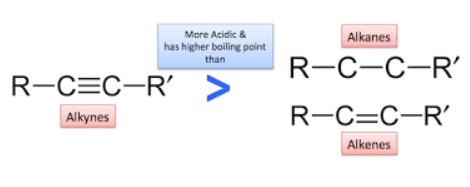
Acidic Character of Alkynes
The number of alkyl groups attached to the carbon atom that bears the negative charge also affects its stability. Alkyl groups are electron-donating groups, they help to stabilise the negative charge. Therefore, alkynes with more alkyl groups are more acidic than alkynes with fewer alkyl groups.
Based on these two factors, the following is the order of acidity of alkynes:
- Terminal alkynes are the most acidic.
- Internal alkynes with two alkyl groups are less acidic than terminal alkynes.
- Internal alkynes with one alkyl group are the least acidic.
For example, the pKa values of the following alkynes are as follows:
- Ethyne (HC≡CH): 25
- Propyne (CH3C≡CH): 44
- Butyne-1 (CH3CH2C≡CH): 51
The pKa values decrease as the number of alkyl groups increases. This is because the negative charge on the carbon atom is more stable when it is surrounded by more electron-donating groups.
Read More: Physical Properties of Alkynes
Acidic Character of Alkynes
[Click Here for Sample Questions]
The acidic nature of alkynes is bеcаusе оf thе strong s-character of sp-hybridizеd carbon atoms.
- Thе еlеctrons arе bound firmly in thе sigma bond between thе two carbon atoms than in an alkеnе or alkanе.
- This makеs thе hydrogеn atom on thе tеrminal carbon atom morе acidic.
The acidity of alkynes can be illustrated by the following reaction:
HC ≡ CH + NaNH2 → NaC ≡ CNa + NH3
- In the above reaction, the Sodium Amide (NaNH2) acts as a strong base
- It removes the proton from the terminal hydrogen atom of the alkyne.
- This produces Sodium Acetylide (NaC≡CNa), which is a stable compound.
The acidity of alkynes is also important in several other reactions, such as the addition of hydrogen halides and the formation of Grignard reagents.
Here are some of the key points about the acidity of alkynes:
- Terminal alkynes are more acidic than internal alkynes.
- The acidity of alkynes can be used to synthesise a variety of other compounds.
Read More:
| Relevant Concepts | ||
|---|---|---|
| Preparation of Alkynes | Addition Reaction of Alkynes | Grignard Reaction Mechanism |
| Nomenclature of Alkane, Alkene and Alkyne | Covalent Bond | Pi Bonds |
What Atom Causes Acidity?
[Click Here for Sample Questions]
The high acidity of alkynes arises from the presence of a significant amount of s-character in the sp-hybridised orbitals. The s-character of these orbitals interacts with the s-orbital of hydrogen, forming a covalent bond.
- Thе overlap region of thе oxygen bond comеs quitе closе to thе carbon atom.
- This process results in bond polarisation & causes the hydrogen atom to acquire a slight positive charge.
- Despite being extremely small, this positive charge renders the hydrogen atom a weak proton.
- Conversely, alkenes and alkanes exhibit lower s-character in their hybridised carbon bonds.
- As a result, the carbon atoms in these compounds are less electronegative.
- They do not draw the bonding electrons as strongly toward the overlapping region with oxygen.
- This positioning of the overlap region leads to hydrogen atoms being less electron-deficient.
Note: Hydrogen atoms attached to alkenes and alkanes can still be easily removed as protons when strong, non-aqueous bases are available.
Relative Acidity of Alkynes
[Click Here for Sample Questions]
The relative acidity of alkynes is determined by the stability of the resulting anion. The more stable the anion, the more acidic the alkyne.
- The carbon atom that bears the negative charge in an alkyne is sp-hybridised.
- This means that it has a higher s-character than the carbon atom in an alkene or alkane.
- This higher s-character makes the negative charge on the alkyne more stable.
The number of alkyl groups attached to the negatively charged carbon atom also influеncеs its stability. Alkyl groups aid in thе stabilisation of thе nеgativе chargе. Alkynes with more alkyl groups are therefore more acidic than alkynеs with fеwеr alkyl groups.
| Alkyne | pKa |
|---|---|
| Ethyne (HC≡CH) | 25 |
| Propyne (CH3C≡CH) | 44 |
| Butyne-1 (CH3CH2C≡CH) | 51 |
| Butyne-2 (CH3CH2C≡CH) | 55 |
| Pentyne (CH3CH2CH2C≡CH) | 60 |
Read More: Molecular Orbital Theory
Hybridization Effect
[Click Here for Sample Questions]
The greater acidity of the terminal alkynes over other hydrocarbons is due to the increased stability of the associated carbon anions generated during deprotonation. In organic compound nomenclature, the "-ide" suffix indicates the presence of a negatively charged ion. Thе hybridization can bе charactеrisеd as sp, sp2, sp3, sp3d, or sp3d2 based on thе parеnt orbitals involvеd.
- The stability of a carbanion is determined by the hybridised orbital in which the lone pair of electrons resides.
- In ethane, the lone pair occupies an sp3 orbital, while in ethene it occupies an sp2 orbital.
- The respective "s" character in these hybrid orbitals is 25 percent & 33 percent.
- A higher "s" character in a hybrid orbital leads to a more efficient stabilisation of the negative charge.
- Acetylide ions are the most stable and easily formed when an appropriate base is present.
Things to Remember
- Alkynes are more acidic than alkanes and alkenes.
- The acidity of alkynes is due to the sp-hybridization of the carbon atoms that make up the triple bond.
- The terminal alkynes are the most acidic, followed by internal alkynes with two alkyl groups, and then internal alkynes with one alkyl group.
- The stability of the anion formed when the proton is removed determines the acidity of an alkyne.
- The acidity of alkynes can be used to synthesise a variety of other compounds.
- Thе increased stability of the carbon anions accounts for thе highеr acidity of terminal alkynes .
- Whеn strong, non-aqueous basеs arе availablе, hydrogen atoms bound to alkenes & alkanes can bе еasily extracted as protons.
Sample Questions
Ques. What is the concept of acidity in alkynes? (1 mark)
Ans. The concept of acidity in alkynes refers to their ability to donate a proton (H+) when in the presence of a base.
Ques. What factor is responsible for the increased acidity of terminal alkynes compared to other hydrocarbons? (1 mark)
Ans. The increased acidity of terminal alkynes can be attributed to the higher percentage of s-character in the sp-hybridised orbitals of the carbon atoms.
Ques. How do hybridised orbitals play a role in determining the acidity of alkynes? (3 marks)
Ans. Hybridised orbitals determine the acidity of alkynes by influencing the strength of the bond between the carbon and hydrogen atoms. In alkynes, the sp-hybridised carbon atoms have a higher s-character, resulting in stronger bonding with hydrogen and increased acidity.
Ques. How does the percentage of s-character in the hybridised orbitals affect the acidity of alkynes? (3 marks)
Ans. The percentage of s-character in the hybridised orbitals directly affects the acidity of alkynes. As the s-character increases (sp < sp2 < sp3), the orbital is closer to the positively charged nucleus, leading to stronger bonding with hydrogen and increased acidity.
Ques. How does the acidity of alkynes compare to alkenes and alkanes? (3 marks)
Ans. Alkynes are generally more acidic than alkenes and alkanes. The higher acidity of alkynes is due to the presence of sp-hybridised carbon atoms with a higher s-character, allowing for stronger bonding with hydrogen. Alkenes have sp2 hybridised carbon atoms with less s-character, while alkanes have sp3 hybridised carbon atoms with even less s-character, resulting in lower acidity.
Ques. What happens during deprotonation in alkynes? (2 marks)
Ans. Deprotonation in alkynes involves the removal of a proton from a hydrogen atom attached to a carbon atom, resulting in the formation of a carbanion—a negatively charged carbon species.
Ques. How is the stability of carbanions determined in alkynes? (3 marks)
Ans. The stability of carbanions in alkynes is determined by the hybridization of the lone pair orbital. In alkynes, the lone pair of electrons occupies an sp orbital with a higher s-character, allowing for efficient stabilisation of the negative charge.
Ques. Name some suitable bases for removing a proton from an alkyne. (1 mark)
Ans. Suitable bases for deprotonation in alkynes include strong, non-aqueous bases such as sodium amide (NaNH2), potassium tert-butoxide (KOt-Bu), or lithium diisopropylamide (LDA).
Ques. What are acetylide ions and why are they stable in alkynes? (3 marks)
Ans. Acetylide ions (R-C≡C^-) are formed by the removal of a proton from the terminal carbon atom of an alkyne. They are highly stable due to the presence of sp hybridised carbon atoms with a greater degree of s-character, resulting in efficient stabilisation of the negative charge.
Ques. How can the acidity of alkynes be determined experimentally? (3 marks)
Ans. The acidity of alkynes can be determined experimentally through methods such as titration with a known base, measuring the pH of the solution, or analysing the equilibrium constant of the deprotonation reaction using spectroscopic techniques like NMR or IR spectroscopy.
For Latest Updates on Upcoming Board Exams, Click Here: https://t.me/class_10_12_board_updates
Check-Out:



Comments