



Content Writer-SME
Decomposition reaction is a chemical process in which a single reactant breaks up into two or more products. The general equation of this reaction is given as AB → A + B. The three types of decomposition reaction are Thermal Decomposition Reaction, Electrolytic Decomposition Reaction, and Photo Decomposition Reaction.
The decomposition reaction is the reverse of a combination reaction. The real life example of these reaction is electrolysis of water (H2O) in which water molecule breaks into hydrogen (H2) and oxygen (O2).
What is Decomposition Reaction?
[Click Here for Sample Questions]
In chemistry, the definition of decomposition Reaction can be given as:
| “The reactions in which a chemical reactant breaks up into two or more products are termed decomposition reactions.” |
- The process of decomposition reaction requires energy input which is provided in the form of heat and light energy.
- One of its major applications comprises the extraction of metals for obtaining ores.
- A general equation for the break-down process of a reactant into two or more products can be expressed as, AB → A + B.
- The decomposition of carbonic acid in soft drinks is an example of a decomposition reaction.
Examples of Decomposition Reaction
[Click Here for Sample Questions]
Energy input in the form of heat, light, or electricity is typically necessary for decomposition reactions. Here are some of the important examples in chemistry where decomposition takes place:
- Carbonic Acid Decomposition: The decomposition of carbonic acid in soft drinks is an example of a decomposition reaction. Its equation can be represented as:
| H2CO3 → H2O + CO2 |
- Electrolysis of Water: Water, H2O, undergoes hydrolysis to break down into hydrogen and oxygen. The equation for the same can be represented as:
| H2O → 2H + O2 |
- Potassium Chlorate Decomposition: The decomposition of potassium chlorate (KClO3) by heat is done for producing oxygen gas in the laboratory. The chemical reaction of the same can be given as:
| 2KClO3 (s) → 2KCl (s) + 3O2 (g) |

Read More:
| Combustion Reaction | Chemical Change | Balanced Chemical Equation |
| Displacement Reaction | Precipitation Reaction | Oxidation and Reduction |
Types of Decomposition Reaction
[Click Here for Sample Questions]
When a single component decomposes into two or more simpler substances, this is known as a decomposition reaction. There are three types of decomposition reaction which are mentioned below in detail:
- Thermal Decomposition Reaction
- Electrolytic Decomposition Reaction
- Photochemical Decomposition Reaction
1. Thermal Decomposition Reaction
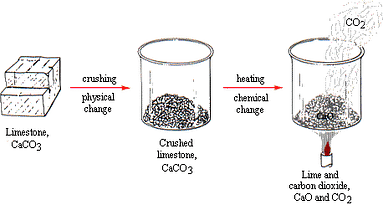
Thermal decomposition reaction of a chemical substance can be defined as an endothermic reaction. The energy in the form of heat is required to break the chemical bonds of an element or a chemical compound undergoing decomposition. There exist few compounds that easily break down into multiple reactants when exposed to heat or when heated.
For example, the decomposition of calcium carbonates to form calcium oxide and carbon dioxide on heating. The reaction for the same can be represented as:
| CaCO3(s) + heat → CaO(s) + CO2(g) |
2. Electrolytic Decomposition Reaction
In this type of decomposition reaction, the activation energy needed for the process of breakdown is given in the form of electrical energy. Through an aqueous solution of a chemical compound in the electrolytic decomposition reaction, an electric current is transferred.
For example, the decomposition of hydrogen and oxygen within the presence of electric current. Its reaction is expressed as:
| 2H2O (l) + 2H2 (g)+ O2 (g) |
3. Photochemical Decomposition Reaction
Photochemical decomposition reaction takes place in the presence of photons of light which means that the reactant is broken down into its constituent by absorbing energy from the photons. This sort of decomposition reaction can also be termed a photolysis reaction as light energy is required to break the bonds in the reactant.
For example, the decomposition of silver chloride in the presence of sunlight forms silver and chloride. Its chemical reaction can be represented as:
| 2AgCl (s) + sunlight → 2Ag (s)+ Cl2 (g) |

Decomposition of Silver Chloride in the Presence of Sunlight
Read More:
Applications of Decomposition Reaction
[Click Here for Sample Questions]
Here are some of the major applications of decomposition reaction mentioned below which can also be seen in real life:
- Extracting metals from their ores is an example of a decomposition reaction.For example, NaCl can be decomposed to get Na.
- The applications of reaction can be seen used in industries such as in manufacturing cement.
- Decomposition reactions are used in the process of thermal welding.
Applications of Decomposition Reaction in Daily Life
|
Check More PYQ Examples:
Double Decomposition Reaction
[Click Here for Sample Questions]
When two reactants undergo a chemical change to form new products by interchanging their positive and negative ions, the reaction is known as a double displacement reaction.
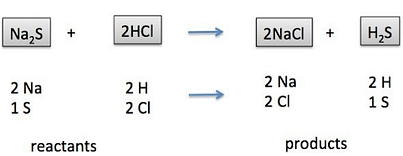
Double displacement reaction between Na2S and HCl
Double Decomposition Reaction Examples
|
Things to Remember
[Click Here for Sample Questions]
- Decomposition reaction are the reactions in which a chemical reactant breaks up into two or more products.
- The decomposition of carbonic acid in soft drinks is an example of a decomposition reaction.
- In thermal decomposition, energy in the form of heat is required to break the chemical bonds of an element.
- In an electrolytic decomposition reaction, the activation energy needed for the process of breakdown is given in the form of electricity.
- In photolytic decomposition, the reactants break down in the presence of photons of light.
- Decomposition Reactions are used to extract metals from their ores.
- In double decomposition reactions, two reactants interchange the positive and negative ions to form new compounds.
Read More:
| Lead (ii) Nitrate Formula | Magnesium Bromide | Magnesium Oxide |
| Chemical Equation | Chemical Reactions Important Questions | Redox Reactions |
Sample Questions
Ques. What are decomposition reactions? Give an example. (2 marks)
Ans. Decomposition reactions are the processes in which a single chemical element breaks up into multiple products. Example - Decomposition of carbonic acid in soft drinks.
Ques. Why are decomposition reactions sometimes called endothermic reactions? (2 marks)
Ans. An endothermic reaction is a chemical reaction in which the reactants absorb the energy in form of heat, electric current, or sunlight from the environment. Therefore, most of the decomposition reactions are called endothermic reactions as they require some sort of energy to break the bonds of the more complex molecule.
Ques. Give the reaction for the hydrolysis of water. (2 marks)
Ans. Water undergoes hydrolysis to break down into hydrogen and oxygen.
H2O → 2H + O2
Ques. What is the reaction for the molten sodium chloride decomposition? (2 marks)
Ans. The decomposition of molten sodium chloride is done to obtain molten sodium and chlorine gas. This is one of the examples of electrolytic decomposition. The decomposition reaction can be given as:
2NaCl(l) → 2Na(l) + Cl2(g)
Ques. What are thermal decomposition reactions? Give a few examples of the same. (3 marks)
Ans. In thermal decomposition, energy in the form of heat is needed to destroy the bonds between the chemical compounds. The examples of thermal decomposition include:
- The decomposition of potassium chlorate to form potassium chloride and oxygen gas when hated
2KClO3(s)+heat→2KCl(s)+3O2(g)
- The decomposition of ferric dioxide into ferric oxide and water on heating.
2Fe(OH)3+heat→Fe2O3+3H2O
Ques. What are the uses of decomposition reactions? (3 marks)
Ans. The uses of decomposition reactions include:
- Extraction of metals in different ways
- Manufacturing of calcium oxide or cement.
- The relief from acid indigestion
- Thermite welding.
Ques. What are the characteristics of chemical reactions? (3 marks)
Ans. The important characteristics of a chemical reaction are mentioned below:
- Evolution of gas
- Formation of precipitate
- Change in color
- Change in temperature
Ques. What is the opposite of a Decomposition Reaction? (1 mark)
Ans. The opposite of a Decomposition Reaction is the Combination Reaction. In the method of Combination reaction, one single product is formed from two or more reactants.
Ques. Define Double Decomposition Reaction. (1 mark)
Ans. A double decomposition reaction can be defined as a type of decomposition reaction wherein two reactants are seen to interchange positive and negative ions in order to create two new compounds.
Ques. Give an example of a Photochemical Decomposition Reaction. (1 mark)
Ans. An example of a Photochemical Decomposition Reaction is when the decomposition of silver chloride occurs in the presence of sunlight to form silver and chloride.
Thus, 2AgCl (s) + sunlight → 2Ag (s)+ Cl2 (g)
Read More:
| Types of Redox Reactions | Oxidizing Agent | Reducing Agent |
| Ammonium Oxalate | Ammonium Sulphate | Galvanic Corrosion |
| Hydrogen Sulphate | Potassium Ferrocyanide | Potassium Iodide |
Chemistry Study Guides:



Comments