



Education Journalist | Study Abroad Lead
Binary Fission is an asexual mode of reproduction in which the organism separates itself into two daughter organisms. Reproduction is a very important process involved in the life cycle of organisms which allows them to sustain their species. There are two main types of reproduction- Sexual reproduction and Asexual reproduction. Unicellular organisms can undergo both sexual and asexual reproduction. At the core level, reproduction is the chemical replication of genes from the parent. For unicellular organisms, reproduction is the same as cell reproduction where the cell copies its elements and divides into two different species. Binary fission and Budding are the types of asexual reproduction mainly found in unicellular organisms.
Table of Contents
| Table of Content |
Key Terms: Amoeba, Binary Fission, Yeast, Budding, Asexual Reproduction, Sexual Reproduction, Multiple Fission, Cell Division, Unicellular Organisms, Chromosomes, Gametes, Pseudopodia
Introduction to Asexual Reproduction
[Click Here for Sample Questions]
In this type of reproduction, the new organism is produced without the involvement of gametes or a change in the number of chromosomes. It is the primary form of reproduction among single-celled organisms like an amoeba, paramecium, etc. Some types of asexual reproduction are:
- Fission
- Budding
- Vegetative propagation
- Spore formation
- Fragmentation
- Agamogenesis
What is Amoeba?
[Click Here for Sample Questions]
Amoeba (pronounced as “Ameba” ) is one of the microscopic unicellular organisms. It is found mainly in the bottom of freshwater vegetation like ponds and streams. They have the ability to form temporary extensions in their body called pseudopodia. This is responsible for the movement of amoeba. This is one of the most basic forms of locomotion and is called amoeboid movement. Amoeba consists of small jelly-like cytoplasm which is surrounded by the outer plasma membrane, a layer of stiff, clear ectoplasm within the plasma membrane with a central granular endoplasm. Oxygen diffuses into the cell from the water around it and similarly, the metabolic waste diffuses from its body to outside. Amoeba has no fixed shape and it changes its shape in accordance with the environment.
Amoeba can be classified as:
- Kingdom: Protozoa
- Class: Tubulinea
- Family: Amoebidae
- Order: TubulinIndia
- Genus: Amoeba
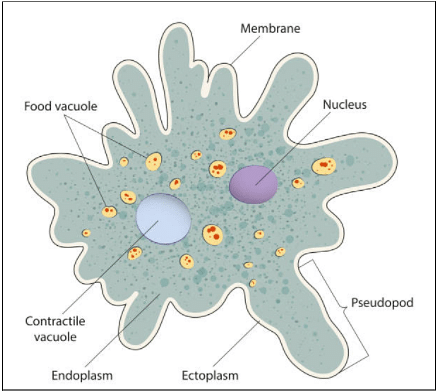
Structure of an Amoeba
Amoeba can undergo multiple types of reproduction like binary fission, spore formation, and sometimes sexually also. The most common type of reproduction among amoeba is binary fission.
Also Read: Difference between Locomotion and Movement
Binary Fission in Amoeba
[Click Here for Sample Questions]
In binary fission, the genetic material is copied from the parent through mitotic division, then the cell divides into two daughter cells. Both contain the same genetic information, therefore the daughter cells are identical to each other and the parent. The process of division of parent nucleus into two daughter nuclei is called Karyokinesis. After the division of the nucleus is completed then the cytoplasm starts to divide to form the daughter nuclei, this is called Cytokinesis. Binary fission is the primitive reproduction process in prokaryotes.
Also Read: Difference Between Karyokinesis and Cytokinesis
Stages of Binary Fission in Amoeba
The various stages of binary fission in amoeba are as follows:
- DNA Replication: In this stage, the parent cell replicates its chromosomes and other genetic materials.
- Growth of Cell: After the replication process, the cell starts to divide the cytoplasm into two parts in order to form the two daughter cell. The two strands start to move towards opposite poles.
- Segregation of DNA: When the two cells divide the same number of chromosomes are transferred to both the side and the cell elongates creating a furrow in the middle.
- Splitting of Cells: When the cell divides itself from the middle, the cell wall starts to form around both cells.
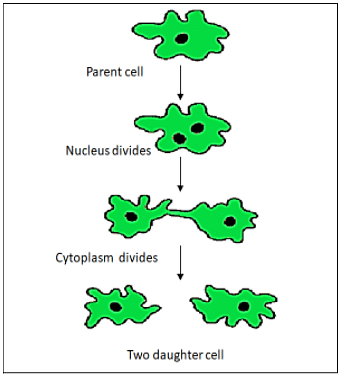
Binary Fission in Amoeba
Microscopic View of Amoeba
When amoeba is viewed under a microscope it looks like an asymmetric colourless jelly-like substance moving through the water slowly. Its shape changes as it moves forward. They have a finger-like projection in their body which is called pseudopodia.
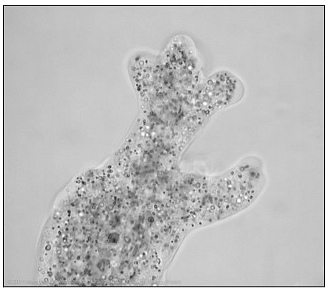
Microscopic View of Amoeba
What is Yeast?
[Click Here for Sample Questions]
Yeast is a single-celled organism that relies on food, warmth and moisture for survival. It is extensively used in the fermentation process where it converts sugar and starch into carbon dioxide and alcohol. It is the carbon dioxide that raises the baked food.
Fun Fact: It takes twenty billion yeast cells to weigh just one gram!

Yeast
Budding in Yeast
[Click Here for Sample Questions]
Budding is another type of asexual reproduction. In this process, the parent organism develops a bud due to cell division at one part of its body. In yeast, it forms a small bud-like projection coming out of its body. This is called a bud. Because this is an asexual reproduction the daughter organism lacks any mutation and is genetically identical to its parent. Many organisms such as hydra and yeast reproduce through this method.
In yeast, a bud develops at one part of its body by repetitive cell division. These buds get all the necessary genetic materials through cell division. These buds develop into tiny organisms and then separate into individuals as they mature. Because it is an asexual mode of reproduction, there is no mutation and the daughter individual is identical to the parent.
Stages of Budding in Yeast
The various stages of budding in yeast are as follows:
- Formation of Bud: Bud starts to develop on the parent’s body due to repetitive cell division.
- Division of Cytoplasm: Cytoplasm equally divides into the parent to its daughter cells.
- Termination of Bud: When the genetic material is transferred to the bud then the bud starts to detach from the parent’s body.

Budding in Yeast
Check More
Things to Remember
[Click Here for Sample Questions]
- Reproduction is a very important process involved in the life cycle of organisms which allows them to sustain their species
- Unicellular organisms can undergo both sexual and asexual reproduction.
- Amoeba is found mainly in the bottom of freshwater vegetation like ponds and streams
- At the core level, reproduction is the chemical replication of genes from the parent
- In binary fission, the genetic material is copied from the parent through mitotic division, then the cell divides into two daughter cells.
- The process of division of parent nucleus into two daughter nuclei is called Karyokinesis
- After the division of the nucleus is completed then the cytoplasm starts to divide to form the daughter nuclei, this is called Cytokinesis.
- Yeast is a single-celled organism that relies on food, warmth and moisture for survival
- In budding, the parent organism develops a bud due to cell division at one part of its body.
Sample Questions
Ques. What is budding? (3 Marks)
Ans. Budding is an asexual reproduction process in which repetitive cell division takes place at one site on the parent’s body. It forms a bud at the site which is a tiny individual attached to the parent. When all the genetic materials are transferred to the bud, it separates from the parent. The daughter is identical to the parent and no mutation can be observed.
Ques. Distinguish between binary fission and multiple fission? (3 Marks)
Ans. The difference between binary fission and multiple fission is as follows:
- Binary fission
- It can only occur during favourable conditions.
- This process takes place only once.
- There is a pattern in cell division.
- Multiple fission
- It can occur at any time irrespective of environmental conditions.
- There is no pattern in cell division.
- This process takes place repeatedly.
Ques. What is binary fission? (3 Marks)
Ans. Binary fission is an asexual process of reproduction that doesn’t involve the formation of the gametes. In this process, the parent cell divides into two daughter cells through cell division. In this process, the daughter nucleus is identical to the parent. Binary Fission is a mode of reproduction in Ameoba.
Ques. Why do organisms produced by sexual reproduction have a better chance of survival? (3 Marks)
Ans. Organisms reproducing by the sexual process have a better chance of survival. Because during sexual reproduction genetic materials from two parents are involved in the production of offspring. The offspring is found to have the genes of both parents. This type of genetic diversity allows the organisms to adapt to the changing environment.
Ques. Why budding and binary fission falls under asexual reproduction? (3 Marks)
Ans. Budding and binary fission, both of these process involves one parent only in the production of offspring. Formation of zygote, fertilization etc does not occur in these processes. Chromosomes of only one parent are replicated to the daughter cells.
Ques. Write the different stages of budding in yeast. (3 Marks)
Ans. The stages of budding in yeast are:
- Formation of bud: Bud starts to develop on the parent’s body due to repetitive cell division.
- Division of cytoplasm: Cytoplasm equally divides into the parent to its daughter cells.
- Termination of bud: When the genetic material is transferred to the bud then the bud starts to detach from the parent’s body.
Ques. Write a short note on Amoeba. (5 Marks)
Ans. Amoeba is a microscopic unicellular organism. It is found mainly in the bottom of freshwater vegetation like ponds and streams. The shape of the amoeba is not fixed and it changes with respect to the environment. They have the ability to form temporary extensions in their body called pseudopodia. This is responsible for the movement of amoeba. This is one of the most basic forms of locomotion and is called amoeboid movement.
Oxygen diffuses into the cell from the water around it and similarly, the metabolic waste diffuses from its body to outside. Amoeba can reproduce through a variety of processes such as binary fission, spore formation and sometimes sexually also.



Comments