



Content Curator
Flora and fauna are plants and animals encompassing all of the life on Earth. The flora, fauna, microorganisms, and other forms of life in any region are collectively termed biota. There are two types of flora: Normal Flora and Transient Flora. They make up a significant part of the ecosystem. Flora and fauna are important for human survival because they regulate the amount of oxygen and carbon dioxide in the air. They also provide us with a wide range of food, drink, and medicines. All living species, including plants, animals, and bacteria, are considered biotic components. Abiotic components, on the other hand, are non-living substances that are necessary for life to survive, such as soil, water, and climate.
Read More: Biodiversity Hotspot
| Table of Content |
Key Terms: Abiotic, Biotic, Key, Ecosystem, Fungi, Algae, Weeds, Cryptofauna
What is Flora?
[Click Here for Sample Questions]
Flora refers to the population of plant life, and natural vegetation, which includes fungi, algae, and indigenous plants, in a specific geographical place or time. Flora, also known as the "Goddess of Flowers," represents the entire plant kingdom.

Flora
It can be divided into many categories based on a variety of variables. The flora includes desert plants, water plants, and plants found in steep areas, among other things. Cactus, a desert plant, is prevalent in deserts and has adaptations including modified leaves and prickles for water conservation and predator protection.
Flowers are also classified as Flora; men produce agricultural and ornamental flowers, which is referred to as Horticulture. The Scientific name of a plant contains a wealth of information, including literature references, habitats, geographical distribution, flowering seasons, images, and much more.
Learn More About:
| Concepts Related to Flora and Fauna | ||
|---|---|---|
| Predators | Bird and Insect Life Cycle | Megafauna |
| Genus | Carnivores and Herbivores | Terrestrial Ecosystem |
What is Fauna?
[Click Here for Sample Questions]
Fauna is the population of animal life in a certain location or time. Fauna is known as the 'Goddess of Fertility,' and it includes a wide range of animal life. Taxonomy of the animal kingdom is widely available, with categories such as birds, fish, microbes, and cryptofauna (undiscovered species) among the most common.
Birds are referred to as Avifauna, whereas fish are referred to as Piscifauna. Microfauna is a term used to describe microscopic organisms such as Archaea and bacteria. Fauna includes all of creatures that live in a certain area. All interconnected species, from pheasants to vultures, mammals from mice to bison, worms to reptiles, insects, soil and water fauna, and so on, fall under the category of fauna.
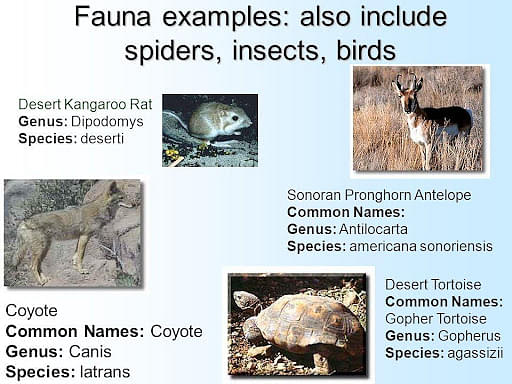
Fauna Examples
Classification of Flora
[Click Here for Sample Questions]
Flora is classified according to areas, periods, climates, and specific conditions. The native and indigenous flora of a location, such as gum trees (eucalypts) and English oak in the United Kingdom, is an important aspect of the Australian natural environment.
Plants that are intentionally grown by humans for a specific purpose, such as agricultural plants. Weed flora is a term that refers to any flora category that is considered to be unwanted.
Animal kingdom has been divided into divisions and subdivisions by scientists.
- Phylum is the first division. These are divided into "classes,".
- Classes are divided into orders
- From orders come families
- From families the genera
- There are species in each genus. Individual groups of animals with similar features that may breed together, known as true-breeding, are referred to as species.
The marine biome is an environmental zone formed by naturally developing vegetation and animals in water bodies, mainly oceans and seas. The euphotic, disphotic, and aphotic layers can be split into three categories.
The euphotic zone is the part of the body where sunshine can get through. As a result, this zone is home to the majority of marine species. There is no sunshine in the disphotic zone. It's gloomy, and there's some marine life here, but it's limited. Only those creatures and plants that have gained the ability to exist in extreme and harsh conditions are found in the third zone, the aphotic zone.
Carnivores like the Great White Shark and Tiger Shark can be found in the marine biomes, as can herbivores like Green Sea Turtles, Parrotfish, and hermit crabs, to mention a few. Dead Man's Fingers Green Feather Halimeda Leafy Flat-Blade is one of the many plants found in the marine biome. This list, however, is by no means complete.
Importance of Flora and Fauna
[Click Here for Sample Questions]
Our existence is made possible by the importance of flora or plants on land or in the oceans. Plants are the natural mechanism that produces oxygen and absorbs carbon dioxide, without which life would be impossible. Plants are also an important source of nutrition for humans. The Amazon jungles not only provide oxygen but also provide food for the region.
Every plant and animal on the earth contributes something to the environment on which other plants and animals, including humans, rely. This generates a life balance that allows the life cycle to continue.

Flora and Fauna of India
The earth's plants create the oxygen that the fauna breathes, and the fauna, in turn, exhales the carbon dioxide that the flora requires to survive. One cannot exist without the other, and humans cannot exist without either.
The existence of one species is contingent on the existence of the other, as in the case of pandas and bamboo plants. Bamboo stalks are the Panda's only source of nutrition. The panda has been threatened by the removal of bamboo forests in China, which has resulted in malnutrition and habitat loss.
Furthermore, flora and fauna are medicinally essential to humanity since they may be used to extract a variety of medicines and herbs. The Fauna population is made up of all animals from a specific location or habitat, and it is this population that contributes the most to the development of pharmaceuticals and therapies to cure human illnesses. Similarly, medications and herbs that aid human well-being can be made from plants found in nature.
Flora and Fauna in India
[Click Here for Sample Questions]
India has a variety of fauna, numbering 92,037 species, of which insects alone include 61,375 species. India posesses a tremendous diversity of climate and physical conditions. Nearly two times that number of species still remain to be discovered in India alone.
- Four out of the 36 Biodiversity Hotspots in the world are found in India: the Western Ghats, the Himalayas, the Indo-Burma region, and the Sundaland.
- There are around 18,000 species of flowering plants in India. These constitute 6-7% of the total plant species in the world.
- Madhya Pradesh is rich and diverse in forest resources. It is a reservoir of biodiversity.
Things to Remember
- There are two types of flora: normal flora and transient flora.
- Flora is the plant life found in a particular region. It occurs naturally.
- Fauna is described based on systematic groups; for example bird species (avifauna) or reptiles and amphibians (herpetofauna).
- India's flora and fauna are diverse, with an estimated 81,000 species of animals and 47.000 types of flora.
- There are 500 different species of mammals in India, as well as 30K different insects and a variety of amphibians, reptiles, and fish.
Learn More About:
Sample Questions
Ques 1. List the prominent flora and fauna of India. (3 Marks)
Ans. India's flora and fauna feature a diverse spectrum of plant and animal species, the majority of which are unique to the world. Junipers, pines, and deodars, as well as lotus, milkworts, Assam catkin yew, spiderwort, and other flora, are prominent examples. The Bengal tiger, Asian elephant, snow leopard, Indian rhino, Indian sloth bear, and other animals found in India are examples of fauna.
Ques 2. How do we Describe the Flora and Fauna Meaning? (2 Marks)
Ans. Flora refers to a plant population (including flower cultivation) in a specific place or period, whereas fauna refers to the animal kingdom, which includes microorganisms and cryptofauna (undiscovered animals). Flora and fauna are mutually reliant, as many animals rely on plants for their survival. Because they rely on each other for growth, the environment is in balance.
Ques 3. What are the Benefits of Flora and Fauna to the Economy? (3 Marks)
Ans. The rich flora and wildlife preserved in biological parks, botanical gardens, national parks, woods, sanctuaries, and other places can greatly boost tourism. Forests in the Amazon, Indonesia, the Caribbean, and Panama are only a few of the well-known instances that have contributed significantly to the inflow of funds. At the locations of wildlife and flora collections, enthusiasts, scientists, explorers, aspirants, naturalists, zoologists, and botanists from all over the world meet.
Ques 4. How are Flora and Fauna Dependent on Each Other? (2 Marks)
Ans. A major portion of the fauna, or animal kingdom, relies on flora for their daily dietary needs. On the other hand, fauna is responsible for pollinating plants, which helps to increase the population and growth of flora. As a result, it is understandable that fauna and flora are mutually dependent. This is also in charge of preserving ecological balance.
Ques 5. Who is a Botanist? (2 Marks)
Ans. Botanists are scientists who study plants and observe or research the diversity of flora in various environments. He or she is particularly interested in learning about the characteristics of each flower or plant species and studying them for future research and results. Botanists are fascinated by the amazing beauty of plants as well as their significance.
Ques 6. What is the difference between flora and fauna? (2 Marks)
Ans. All plant life is referred to as flora, and all animal life is referred to as fauna. Because fauna cannot prepare their food, they must rely on the flora. The term flora refers to the total number of plant species that are healthy in a certain location. The fauna refers to the total number of animal species found in that area, while the vegetation is a broader phrase that refers to a larger area than an ecosystem.
Ques 7. What is the importance of flora and fauna? (3 Marks)
Ans. Flora and fauna are both parts of the ecosystem, and their survival is dependent on one another. Furthermore, if there are any negative consequences on flora and fauna, such as the extinction of a species, the ecosystem becomes unbalanced. Flora and animals are critical to human survival. The flora releases oxygen, which the fauna uses for respiratory activity. The flora consumes carbon dioxide, which the fauna liberates for photosynthesis. Flora and fauna provide enormous benefits to humanity in the form of medicinal and food offerings.
Ques 8. For which purpose animals are not useful to plants? (2 Marks)
Ans. Animals can't make their energy, so they have to eat other animals or plants to stay alive. - Photosynthesis is the process through which plants obtain energy from the sun to survive. Chlorophyll is a green pigment found in plant cells that allows for photosynthesis. It is one of the defining characteristics of plants.
Ques 9. What are flora and keys? (3 Marks)
Ans. "A flora is a systematic account of plants in a particular geographic area that includes keys and descriptions to aid in plant identification." Identification of species is aided by primary flora. It also includes information such as a plant's local or vernacular name, distribution, botanical name, and description. Typically, a key will ask questions based on easily recognised characteristics of an organism. Dichotomous keys ask questions with just two possible answers. They might be presented as a table of questions or as a question tree with branches.
Ques 10. Why does India possess a great variety of flora and fauna? (3 Marks) [CBSE 2015]
Ans. Climatic Conditions: Different climatic conditions prevail in India. At some places, the temperature is 55°C and at others, it is about – 45°C. Some places experience rainfall of more than 1000 cm, and some receive only 50 cm. This also helps in growing different types of plants.
Sunlight: Sunlight is one of the important factors responsible for the growth of vegetation. With the help of a longer duration of sunlight, trees grow faster in most parts of India.
Precipitation: Precipitation plays an important role in the growth of different types of vegetation. Tropical rainforests are found in the Western Ghats due to heavy rainfall.
Ques 11. Give any three steps taken by the government of India to protect the flora and fauna. (2 Marks) [CBSE March 2011, 2012]
Ans. Here are the steps that the Government of India has taken to save the flora and fauna of India:
- Nearly 100 national parks, 515 wildlife sanctuaries, and 35 zoological gardens have been set up.
- Biosphere reserves have been set up. For example, the Nilgiri in Karnataka, Tamil Nadu, and Kerala, Nanda Devi in Uttarakhand, etc.
- More than 100 national parks, 515 wildlife sanctuaries, and 35 zoological gardens have been set up.
Ques 12. How do the land and soil affect natural vegetation directly and indirectly? Give examples. (1 Mark)
Ans. Examples of how land and soil affect natural vegetation:
- The sandy soil of the desert support cactus and thorny bushes.
- Wet, marshy, and deltaic soil supports mangroves.
Ques 13. What is natural vegetation or virgin vegetation? (1 Mark)
Ans. Natural vegetation refers to a plant community that has grown naturally without human aid and has been left undisturbed by human beings for a long time.
Ques 14. On the basis of the availability of water, tropical deciduous forests are divided into two parts. What are these two Categories? (1 Mark)
Ans. Dry deciduous and Moist deciduous are the two categories of tropical deciduous forests.
Ques 15. Where are the thorn and the scrub forests formed? (1 Mark)
Ans. Thorn and scrub forests are formed in Punjab plains, Northern Madhya Pradesh, and South-West Uttar Pradesh, (Bundelkhand plateau).
Also Check:



Comments