



Content Curator
Buoyancy is the force acting upwards on the body immersed in a fluid partially or completely. This is also called upthrust, buoyant force, or simply buoyancy.
- A body immersed in a fluid experiences a vertical buoyant force equal to the weight of the fluid it displaces.
- Its SI Unit is Newton as it is a kind of force.
- The line of action of the buoyant force passes through the centre of the volume of the displaced body.
- The Buoyancy force is equal to "hρga" where h is the height up to which the body is immersed, is the density of the object, g is the acceleration due to gravity, and ‘a’ is the area of cross-section of the object.
Read Also: Venturimeter
Key Terms: Buoyancy, Buoyant Force, Upthrust, Upward force, Buoyancy formula, Relative Density, Archimedes Principle
What is Buoyancy?
[Click Here for Sample Questions]
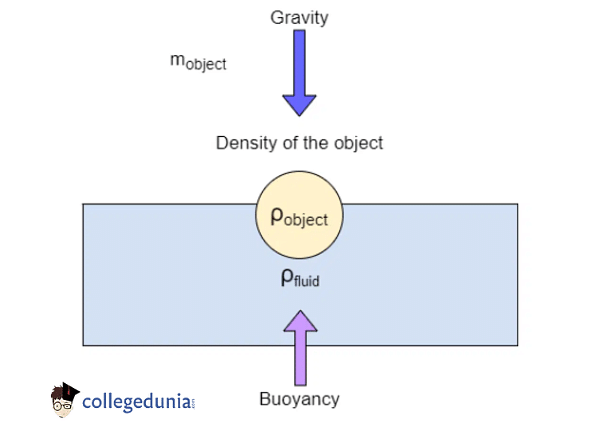
A body, when immersed in a fluid, partially or wholly displaces the fluid due to which the fluid tries to regain its original position and exerts an upward force on the body known as Buoyant force or simply Buoyancy.
The pressure exerted on the bottom of the object in a fluid is greater than the pressure at the top of the object leading to a pressure difference. The pressure difference between the top and the bottom of the object results in a net upward force or buoyant force.
- The process of acting buoyant force on the object is called Buoyancy.
- It is the upward force acting on the body immersed in the fluid. It is also called upthrust because the force acts in an upward direction.
- The buoyant force acts to prevent the object from sinking.
- The buoyant force acts at the centre of the object.
Buoyancy Meaning
- For a solid body of uniform density, the centre of gravity coincides with the centre of buoyancy.
- The SI unit of Buoyant Force is ‘Newton’ expressed by ‘N’.
- The CGS unit for Buoyant Force is ‘dyne’.
- The dimensional formula for Buoyant force is the same as of Force [MLT -2].
Check More: Density Vs Specific Gravity
Buoyancy Formula
[Click Here for Previous Year Questions]
This Buoyant Force acting on the object immersed in the fluid is equal to the product of the Pressure difference between the top and the bottom of the object immersed in the fluid and the Base Area of the object.
The pressure difference depends on the vertical distance ‘h’ between the top and bottom of the object, mass density of the fluid 'ρ’, and acceleration due to gravity ‘g’.
Buoyant Force = Pressure difference × Area of base of the body
Thus,
Buoyant Force = hρgA
Read more: Mechanical Properties of Fluids
Buoyancy Formula Derivation
[Click Here for Sample Questions]
Consider a fluid of density ‘ρ' at rest in a container. Let's assume a cylindrical element of fluid having an area of base ‘A’ and height ‘h’. The resultant horizontal force gets eliminated and the resultant vertical forces should balance the weight of the element.
The force acting in the vertical direction is due to the difference in the force acting on the top and the bottom of the cylindrical element.
Hence,
Net Force on the Element=Weight of the Cylindrical Element
Pressure Difference × Base Area=Weight of the Cylindrical Element
→ (P2 – P1) A = mg
→( P2 – P1) A = (ρv)g
→(P2 – P1)A = ρAhg
→ (P2 – P1) = hρg
Buoyant Force=Pressure difference × Base Area
Buoyant Force = hρgA
Where, m = mass of the element
Read More: Fluid Mechanics Formula
Archimedes' Principle of Buoyancy
[Click Here for Previous Year Questions]
Archimedes' Principle of Buoyancy reveals the idea of the apparent weight of the body immersed in the liquid. The principle is described as “when a body is immersed partly or wholly in a liquid at rest, it losses some of its weight and is buoyed up by a force equal to the weight of the liquid displaced by the immersed part of the body”.
Apparent Immersed Weight =Weight – Weight of Displaced Liquid
Apparent Immersed Weight (W') = W (1 – \(\frac{ρ }{σ}\))
Or,
Apparent Immersed Weight W' = W (1- \(\frac{1}{Relative Density}\) )
Where, 'ρ' is the density of liquid, 'σ' is the density of the object immersed, and ‘W’ is the True Weight of the Object.
The video below explains this:
Archimedes Principle Detailed Video Explanation:
Read More:
| Important Concepts Related to Buoyant Force | ||
|---|---|---|
| Viscosity | Barometer | Poisson’s Ratio |
| Bernoulli’s Principle | Density of Water | Surface Tension |
Applications of Archimedes Principle
[Click Here for Sample Questions]
Archimedes' principle is applied in many day-to-day activities. Some of the best examples has been curated below.
Helium balloon
A helium balloon in a moving car experiences buoyant force by the air mass moving in the opposite direction to the car’s acceleration. For the same reason, as the car goes around a curve, the balloon will drift toward the inside of the curve.
Submarine and Ships
Submarines and ships are designed so that it can displace the fluid equal to the weight of the ship or submarine.
Fish
A fish can regulate its density by expanding or contracting an inbuilt air sac that changes its volume. The fish can move upward by increasing its volume leading to a decrease in its density and can move downward by contracting its volume leading to an increase in its density. Hence, The fish moves up and down in the water with the variation of its relative density.
Air Vessels
A dirigible, if displaces more amount of air, it rises; if it displaces less, it falls; and If it displaces exactly its weight, it hovers at a constant altitude.
Relative Density
[Click Here for Previous Year Questions]
Relative Density is the ratio of the density of a substance to the ratio of the density of another reference material. Relative density is also the specific gravity when measured with respect to water at its densest which is 40 C.
Relative Density= \(\frac{ Density of the Substance }{Density of the reference material}\)
Or,
Relative Density= \(\frac{ Density of the Substance }{Density of water at 4℃}\)
Read More: Hydrostatic Paradox
Law of Floatation
[Click Here for Sample Questions]
The three Law of floatation explains why a body when immersed in the liquid tends to flow or tends to sink.
The Body will Sink
In the case when the average density of the object is greater than that of the fluid, its relative density becomes greater than 1 and the object tends to sink.
If, σ > ρ, \(\frac{σ}{ρ }\) >1, The body will sink
The Body will Float
In the case when the average density of the object is less than that of the fluid, its relative density becomes less than 1 and the object tends to float.
If, σ < ρ, \(\frac{σ}{ρ }\) <1, The body will Float
The Body will Float in Equilibrium State
In the case when the average density of the object is equal to that of the fluid, its relative density becomes equal to 1 and the object tends to will keep floating fully submerged in an equilibrium state.
If, σ= ρ, \(\frac{σ}{ρ }\) =1, The body will Float in equilibrium state.
Check Out:
Things to Remember
- The buoyant force acts at the centre of the object.
- The principle of floatation says that a body displaces a weight of liquid equal to its weight.
- Archimedes' principle can be expressed in terms of volume i.e. ρgV
- Buoyancy force = weight of an object in space − the weight of an object immersed in the fluid.
- Relative Density, also known as specific gravity, plays an important role in floating a body.
- The density of the fluid, the volume of the object, and acceleration due to gravity are the factors that affect the buoyant force.
Previous Year Questions
- The cylindrical tube of a spray pump has radius… (NEET 2015)
- Water rises to a height h in capillary tube… (NEET 2015)
- A ball whose density is 0.4×10³kg/m3 falls into water …. (BITSAT 2007)
- A small sphere of radius ′r′ falls from rest in a viscous liquid...(NEET 2018)
- A rectangular film of liquid is extended from...(NEET 2016)
- A boat with scrap iron in it is floating in a small tank of water… (JIPMER 1998)
- A certain number of spherical drops of a liquid of radius… (NEET 2014)
- A fluid is in streamline flow across a horizontal pipe of….(NEET 2013)
Sample Questions
Ques. What basic principle is involved in the up and down motion of a fish in water? (1 Mark)
Ans. A fish can regulate its density by expanding or contracting an inbuilt air sac that changes its volume. The fish can move upward by increasing its volume leading to a decrease in its density and can move downward by contracting its volume leading to an increase in its density.
Ques. What is the pressure on a swimmer 10m below the surface of the lake? Given, g = 10 m/s2 and atmospheric pressure = 1.01 105 Pa. (2 Marks)
Sol. Here, h = 10 m, Atmospheric Pressure (Pa) = 1.01 x 10⁵ Pa
Hence, Total Pressure (P) = Pa + hρg
P = 1.01 x 10⁵ + 1000 x 10 x 10
P = 2.01 x 10⁵ Pa
Or,
P = 2 atm
Ques. Does Archimede’s principle hold in a vessel in free fall? (1 Mark)
Ans. As the vessel in free fall is in a condition of weightlessness, so the buoyant force accounting for Archimedes' principle does not exist. Hence, Archimedes' principle does not hold well in this situation.
Ques. A wooden ball of density is immersed in water of density to depth h and then released. Find the height H above the surface of the water up to which the ball jumps out of the water. (5 Marks)
Ans. Let V = volume of the ball
So, the Weight of the ball = V
ρgUpward thrust on the ball = V
σgUpward acceleration, a = V
ρg - Vσg / vρ = (σ – ρ / ρ)gLet v be the velocity of the ball while reaching the surface of the water, after being released at depth h in water.
Then
V2 = 2as = 2 x (σ – ρ / ρ) gh
For the motion of the ball outside the water, K.E. at the surface of water = P.E. at height H
\(\frac{1}{2}\)mV2 = mgH
H =( \(\frac{ρ }{σ}\) – 1 )h
Ques. A block of wood floats in a bucket of water in a lift. Will the block sink more or less if the lift starts accelerating up? (2 Marks)
Ans. When the lift starts accelerating up the block of wood will float at the same level in a bucket of water in a lift. It is so because the equilibrium of the floating body is unaffected by variation in acceleration due to gravity ‘g’. However, the thrust of liquid and weight of body bot depends on ‘g’ and will increase equally.
Ques. A body floats in a liquid contained in a beaker. The whole system falls freely under gravity. What is the upthrust on the body due to the fluid? (2 Marks)
Ans. As per the principle of free fall when the system falls freely under gravity the apparent weight of the body becomes zero. So the upthrust on the body due to the liquid becomes zero.
Apparent Immersed Weight (W') = W (1 – \(\frac{ρ }{σ}\))
Ques. A boat carrying a number of large stones is floating in the water tank. What will happen to the water level, if the stones are unloaded into the water? (1 Mark)
Ans. When the stones are unloaded into the water, the volume of the water displaced by stones in the water will be less than the volume of water displaced when stones are in the boat. Hence in this case the water level will fall.
Ques. What are buoyancy and the center of buoyancy? (1 Mark)
Ans. The upward thrust acting on the body immersed in a liquid is called the buoyant force or simply buoyancy. The center of buoyancy is the center of gravity of the displaced liquid by the body when immersed in a liquid. The line of action of the buoyant force passes through the center of the volume of the displaced body.
Ques. Why a small iron needle sinks in the water while a large iron ship floats? (1 Mark)
Ans. In the case of the iron needle, the weight of water displaced by the needle is much less than the weight of the needle. Hence, the iron needle sinks into the water. A large ship displaces the weight of the liquid equal to the weight of immersed part of the body in liquid. Hence, it floats.
Ques. A balloon filled with helium does not rise in the air indefinitely but halts after a certain height. (1 Mark)
Ans. The density of air and the value of acceleration due to gravity decreases with height. Due to it, the weight of air decreases at a greater height. The balloon halts at such a height that the weight of the air displaced is just equal to the weight of helium gas and the balloon.
Ques. A piece of pure gold of density 19.3 g cm-3 is suspected to be hollow inside. It weighs 38.250 g in air and 33.865 g in water. Calculate the volume of the hollow portion of the gold. (4 Marks)
Ans. Given,
The density of pure gold (ρ) = 19.3 g cm-3
Mass of gold piece (M) = 38.250 g
The volume of the gold piece (V) = M/V = 38.25 / 19.3 = 1.982 cm-3
Mass of gold piece in water = 33.865 g
Therefore, the apparent loss in weight of the gold piece in water = 38.250 – 33.865 = 4.385 g
As the density of water is 1 g cm-3,
Therefore the volume of displaced water = 4.385/1 = 4.385 cm3.
Hence, the Volume of the hollow portion of the gold = 4.385 – 1982 = 2.403 cm3.
For Latest Updates on Upcoming Board Exams, Click Here: https://t.me/class_10_12_board_updates
Also Read:



Comments