



Content Curator
Butane is a saturated hydrocarbon that contains 4 carbons. It has an unbranched structure. Butane is an organic compound. The formula for Butane is C4H10. Butane is a commonly used product with it primarily being used as a gasoline mixture. Its is also known as Methylethylmethane or n-Butane
What is Butane?
[Click Here for Sample Questions]
Butane (C4H10) is a member of the paraffinic hydrocarbons series. It is an organic compound which is a colourless, highly flammable gas at room temperature and atmospheric pressure. It has an odour similar to gasoline. It is a gas that can be easily liquefied to vaporize at room temperature. Butane has a molecular weight of 58.12g/mol and a boiling point of -1 °C.

Butane
A British chemist Edward Frankland discovered Butane in 1849. Edmund Ronald's, an English industrial chemist who described its properties, found it dissolved in crude petroleum in the year 1864.
What are Isomers?
[Click Here for Previous Year Questions]
Isomers are compounds that contain precisely the same number of atoms, i.e., they have exactly the same empirical formula but differ from each other by how the atoms are arranged. This phenomenon is called isomerism. Isomers may have different chemical and physical properties also due to their different structures.
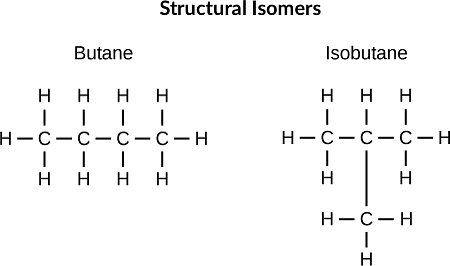
Structural Isomers
There are four carbon atoms in the given molecular formula. So these four carbon atoms can arrange in two different manners. They can be either placed in the straight chain of four carbon atoms or form a chain of 3 carbon atoms with one side chain.
Also Read:
| Related Articles | ||
|---|---|---|
| Isomerism in Coordination Compounds | Optical isomerism | Conformational isomers |
| Cis Trans Isomerism | Alliphatic Hydrocarbons | Saturated solution |
Butane has two isomers:
- Butane
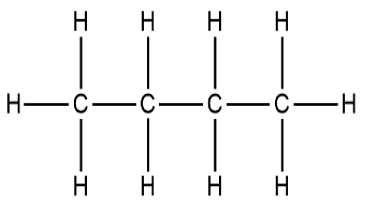
- Iso-butane

Production of Butane
[Click Here for Sample Questions]
Crude Oil Distillation: Butane is a highly liquefied petroleum gas that occurs naturally in crude oil and natural gas. It is, therefore, a by-product of crude oil distillation (in refineries during cracking) and natural gas.
Removal of Oil and Condensate: In this process, the gas is separated from the oil using types of equipment near the well or source of the gas pocket where it is dissolved.
Removal of Water: Similar to petroleum, gases also have to be separated from Water using a variety of machines at the surface. This is done using the dehydration process either by absorption(using silicate or granules) or adsorption(binding of gas on the surface of another solid or liquid in a condensed layer for further process.

Production of Butane
Uses of Butane
[Click Here for Previous Year Questions]
- It is used as cooking gas, cigarette lighters, and portable stoves.
- It is used in fridges after its combination with gasoline and aerosols.
- Butane can be combined with propane and other substances to form L.P.G., a liquid petroleum gas.
Butane is often referred to as n-butane or regular Butane.
Butane Structure
[Click Here for Sample Questions]
Butane’s molecular formula is c4h10. The prefix 'but' refers to 4 carbon atoms and the suffix ‘Ane’ signifies that it is a member of the alkane series. Butane is an IUPAC name. Butane can be put in the general formula of alkanes which is CnH2n+2, where n = any positive integer or the number of carbon atoms present.
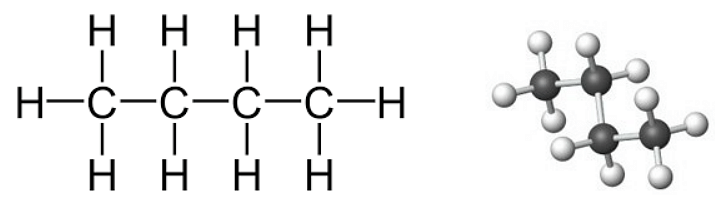
Butane Structure
For Butane,
n = 4, on putting the value of ‘n’ in the general formula C4H2*4+2 = C4H10.
| IUPAC name | Butane |
|---|---|
| Molecular formula | C4H10 or CH3CH2CH2CH3 |
| Isomers | N-butane, Iso-butane |
| Molecular weight | 58.12mol/g |
| colour | colourless |
| Odour | Gasoline like |
| Boiling point | -1 °C |
| Melting point | -138 °C |
| Solubility In Water | 61 mg/L (at 20 °C (68 °F)) |
| Density | 573 kg/m³ |
| Corrosivity | No corrosivity action on metals |
Chemical Properties of Butane
[Click Here for Previous Year Questions]
Reaction with oxygen:
2C4H10 + 13O2 = 8CO2 + 10H2O
Butane reacts with oxygen to give out carbon dioxide and Water
Reaction with chlorine:
2C4H10 + Cl2 = C4H9Cl + HCl
Butane reacts with chlorine and forms butyl chloride and hydrochloric acid.
Reaction with iodine:
2C4H10 + I2 = C4H9I + HI
Butane reacts with iodine and forms 2-iodobutane and hydrogen iodide.
Butane: Disadvantages and Precautions
[Click Here for Sample Questions]
- Increased usage within a short period of time can lead to depressed breathing and loss of consciousness. In this case, a person using Butane is at risk of choking if they vomit.
- Butane is a widely abused dangerous gas with a gasoline-like odour that can cause death by suffocation or ventricular arrhythmia.
- Butane is highly flammable, so there is a high risk of burns or explosions, particularly in smokers.
- Butane is a central nervous system depressant that slows down the brain's activity, affecting physical and mental responses.
- Exposure or point of Butane on skin or the eyes can cause frostbite or freeze burn.
Measures to be taken while handling Butane:
- One should avoid using plastic masks while handling Butane.
- Keep the Butane filled container upright without tilting it.
- Do not mix it with alcohol or any prescribed medicines.
- Avoid smoking or lighting cigarettes near Butane.
- Butane should be stored in an area of ventilation away from direct sunlight.
Butane: Important Facts
- In 1911, Snelling and the United States Bureau of Mining discovered a way to convert gas butane into liquid form.
- For nearly 100 years, Butane has been the source of heating buildings and as a source of power.
- Butane is used in portable hair straighteners.
- Butane is one of the most widely available gases in the world as a derivative of natural gas.
Things to Remember
- Butane is an unsaturated hydrocarbon of the alkane series.
- C4H10 is the molecular formula of Butane.
- Butane has two isomers, namely N-butane and Iso-butane.
- Butane is produced using methods like crude oil distillation, water removal, oil removal, and condensate.
- Butane is a colourless, highly flammable gas with a gasoline-like odour.
Previous Year Questions
- Which of the following releases maximum energy on combustion….[AMUEEE 2011]
- In the following reaction, major product obtained is [AMUEEE 2010]
- For an electrophilic aromatic substitution reaction [JKCET 2012]
- 2-Hexyne gives trans-2-hexene on treatment with [JEE Advanced 2004]
- 2-phenyl propene on acidic hydration, gives [JEE Advanced 2004]
- Ethylene can be converted into alcohol by treatment of [JKCET 2014]
- Which of the following is aromatic compounds? [AMUEEE 2016]
- Which one of the following mono-enes does not exhibit geometric isomerism? [JKCET 2008]
- Which one of the following is not aromatic? [JKCET 2011]
- Which one of the following is aromatic? [JKCET 2009]
- Which one of the following has the smallest heat…..[JEE Advanced 1993]
- Which one among the following is most reactive towards electrophilic substitution reaction? [JKCET 2011]
- Which of the following will decolourise alkaline KMnO4 solution? [JEE Advanced 1980]
- Which of the following reactions is used for producing symmetrical…..[JKCET 2019]
- Which of the following groups is ortho and para directing? [JKCET 2013]
- Among the alkenes which one produces tertiary butyl alcohol on acid hydration [WBJEE 2011]
Sample Questions
Ques. Find out the molecular weight of Butane. (3 marks)
Ans. The Chemical formula of Butane is C4H10.So, its molecular weight will be,
= 4×12.0107+10×1.00794=58.1222 gm. /mole.
Anatomic weight of C=12.0107 H =1.00794.
Therefore, the Molecular weight of Butane is 58.1222 grams per mole.
Ques. Give different isomers of C4H10 with their I.U.P.A.C. names. (2 marks)
Ans. Some different isomers of C4H10 with their I.U.P.A.C. names are:
- CH3-CH(CH3)CH3 2-isobutane or methyl propane
- CH3-CH2-CH2-CH3 n-butane
Ques. Are commercial LP-gas fuels always either propane or Butane? (2 marks)
Ans. Ordinary commercial LP-gas may be essentially propane or Butane, or it may be a mixture of these gases. Usually, minor amounts of other similar petroleum products are also present.
Ques. Explain Wurtz reaction? (2 marks)
Ans. Wurtz's reaction is an organic chemical coupling reaction wherein sodium metal is reacted with two alkyl halides in the environment provided by a solution of dry ether in order to form a higher alkane and a compound containing sodium and the halogen.
Ques. Name the four types of Alkanes? (2 marks)
Ans. The four types of alkenes are:
- Methane
- Propane
- Ethane
- Butane
Ques. What are the harmful effects of using Butane? (3 marks)
Ans. Some harmful effects of butane use are:
- It can cause frostbite or freeze burn if exposed to skin or eyes.
- Its odour can cause suffocation or ventricular arrhythmia.
- Butane can cause direct toxicity to the brain.
Ques. What are the properties of Butane? (4 marks)
Ans. The main properties of butane are:
- It forms gas at room temperature or atmospheric pressure.
- It is colourless and has an odour like gasoline.
- It is a highly flammable gas and hence acts as a good fuel.
- It is a member of the paraffinic series of hydrocarbons.
Ques. Write the chemical reaction for the combustion of Butane? (2 marks)
Ans. The combustion of Butane is between Butane and oxygen gas that produces carbon dioxide gas and Water.
2C4H10(g) + 13O2(g) → 8CO2(g) + 10H2O(g).
Ques. Is the combustion of Butane endothermic or exothermic? (3 marks)
Ans. The combustion reaction produces heat energy, and hence it is an exothermic reaction. Combustion reactions break the bonds of hydrocarbon molecules, and the water and carbon dioxide bonds always release more energy than was used to break the existing hydrocarbon bonds. Hence, materials mainly made up of hydrocarbons produce energy and are therefore exothermic.
Do Check Out:



Comments