



Education Content Expert
Cartesian Plane a two-dimensional coordinate plane formed by the intersection of two perpendicular lines namely the x-axis and y-axis.
- Cartesian plane is commonly referred to as the Coordinate Plane.
- X-axis is the horizontal line while the y-axis is the vertical line on a coordinate plane.
- The point of intersection of the is x-axis and y-axis called the Origin.
In the cartesian plane, points are represented as (x, y) where x denotes the horizontal distance from the origin and y denotes the vertical distance. For instance (7, 8) means that the point 7 lines on x-axis and 8 lies on y-axis.
Read More: NCERT Solutions for Class 9 Maths Coordinate Geometry
Key Terms: Cartesian Plane, Coordinates, X-axis, Y-axis, Origin, Point of Intersection, Abscissa, Ordinate, Quadrants
Cartesian Plane Definition
[Click Here for Sample Questions]
Cartesian Plane in Mathematics is defined as a graph with two perpendicular lines called the x-axis (horizontal) and the y-axis (vertical) that can be used to indicate the position of any point on a plane.
- The two lines are commonly referred to as the axes and the point they intersect at is the origin.
- A point on the plane is represented as an ordered pair (x,y) with x and y are the two coordinates.
- X-coordinate is the horizontal distance from the origin and the y-coordinate is the vertical distance from the origin.
- The coordinates of the origin are (0,0).
For example, consider point A marked on the graph. It is 3 away from the origin horizontally and 5 away from the origin vertically. So, its coordinates are (3,5).
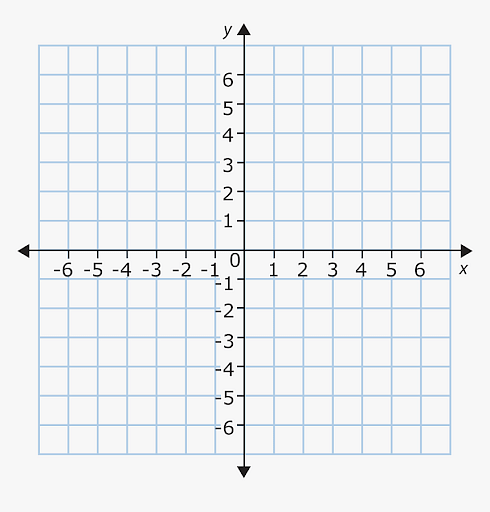
Cartesian Plane
The same principle can be applied to any point marked on the graph. If the point lies on the left side of the origin the x- coordinate will be negative. If the point lies below the origin the y coordinate will be negative.
The video below explains this:
Coordinate Geometry Detailed Video Explanation:
Read More:
Axes in Cartesian Plane
[Click Here for Sample Questions]
Axes are the two perpendicular lines that form the cartesian plane. There are two axes which are the horizontal line called the x-axis and the vertical line called the y-axis. The two axes extend infinitely in both directions which are represented in diagrams by arrows on both ends.
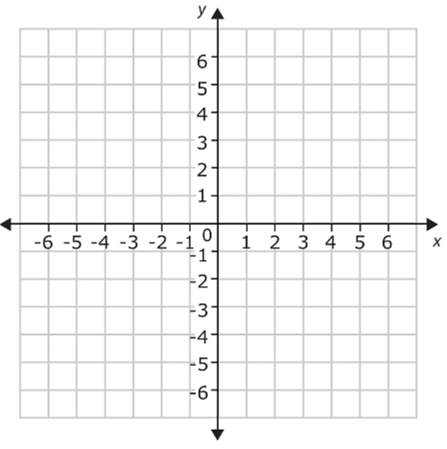
Axes in Cartesian Plane
Cartesian Plane Quadrants
[Click Here for Sample Questions]
The two perpendicular lines divide the cartesian plane into four parts called the quadrants.
- There are four quadrants in a cartesian plane formed by the x-axis and the y-axis.
- They are called Quadrant I, II, III, and IV starting from the top right and continuing anticlockwise.
- It is easy to determine the quadrant in which a point lies based on its coordinates.
- For example, the point (2, 3) would be in Quadrant I as both x and y are positive.
- On the other hand, the point (-2.-3) would be in Quadrant III as both x and y are negative.

Quadrants
Read More: Coordinate Geometry Important Questions
Abscissa and Ordinate
[Click Here for Sample Questions]
In a cartesian plane, the x-coordinate of a point is called the abscissa and the y-coordinate of a point is called the ordinate. In other words, the abscissa is the horizontal distance of the point from the origin and the ordinate is the vertical distance of the point from the origin.
For example, consider a point (25, 10). Here 25 is the abscissa and 10 is the ordinate.

Abscissa and Ordinate
Plotting a Point on Cartesian Plane
[Click Here for Sample Questions]
Consider the point (2,3 ). Given below is a detailed explanation on how to plot the points on a cartesian plane.
- First, we identify the abscissa, which is 2, and plot it on the graph.
- It is two units to the right of the origin as x is positive.
- Next, we plot the ordinate which is 3. It is 3 units up from the origin as the y-coordinate is positive.
- Since both the x-coordinate and y-coordinate are positive, we can conclude that the point lies in Quadrant I.
- Draw a line upwards from the plotted abscissa and a line towards the right from the plotted ordinate.
- The point of intersection of these lines is the point (2, 3)

Plotting a Point on Cartesian Plane
One Dimensional Cartesian Plane
[Click Here for Sample Questions]
One dimensional cartesian plane is like a regular number line. Consider a line with a point O called the origin marked in the middle. The numbers on the left of the line are negative and those to the right are positive. We denote these numbers with the ‘+’ (for right-side numbers) and the ‘-’ sign (for left-side numbers). The origin, in this case, can be defined as the point from which the distances to the right and left are marked.

One Dimensional Cartesian Plane
Read More: Coordinate Geometry MCQs
Three Dimensional Cartesian Plane
[Click Here for Sample Questions]
In a three-dimensional cartesian plane, there is one more line, the x-axis, that is perpendicular to both the y-axis and z-axis. In other words, if we take the XY-plane the line z-axis will also be perpendicular to it. Similarly, if we consider the XZ-plane, the line y-axis is perpendicular to it. Also, if we look at the YZ-plane, the line X-axis will be perpendicular to it.

Three Dimensional Cartesian Plane
A point lying on the 3D cartesian plane can be represented as (x,y,z) where x, y, and z are the distance of the point from the origin with respect to the three axes.
Check More:
Representing Complex Numbers on Cartesian Plane
[Click Here for Sample Questions]
A complex number is of the form a+bi, where i is the imaginary unit satisfying the condition i2=-1.
- It cannot be represented on a regular cartesian plane.
- A complex plane has one axis representing the real part of the complex number and the other axis is the imaginary part of the complex number.
- A complex number x+yi is plotted as (x,y) on a complex plane just like a regular point (x,y) is plotted on a regular cartesian plane
For example, 3+4i is plotted (3,4) on the complex plane.

Complex Plane
Things to Remember
- Cartesian Plane is formed from two perpendicular lines, the x-axis and the y-axis, intersecting at the origin.
- The x-axis and y-axis extend indefinitely in both directions, represented by arrows at both ends.
- A point on the cartesian plane is represented by an ordered pair (x,y) where x lies on the x-axis and y lies on the y-axis.
- A one-dimensional cartesian plane is the same as a regular number line.
- A 3D cartesian plane consists of three axes that are perpendicular to each other namely the x-axis, y-axis, and z-axis.
- A complex number x+yi can be represented on a complex plane as an ordered pair (x,y).
- A complex plane is the same as a regular cartesian plane where the y-axis represents the imaginary part of the complex number.
Sample Questions
Ques. What are the coordinates of a point whose ordinate is 5 and lying on the y-axis? (2 Marks)
Ans. Since the point is lying on the y-axis, the abscissa is zero. Hence, the point is of the form (0,y). The ordinary y, in this case, is 5. Hence, the coordinates of the point are (0,5). It lies 5 above the origin on the y axis.
Ques. In which quadrant or on which axis do each of the points (-2,4), (3,-1), (-4,0), (2,3) lie? (3 Marks)
Ans. The point (-2,4) has a negative abscissa and positive ordinate. Considering that fact, the point lies in the second quadrant.
- The point (3,-1) has a positive abscissa and a negative ordinate. Hence, the point lies in the fourth quadrant.
- The point (-4,0) has 0 as an ordinary. That means the point lies on the x-axis.
- Point (2,3) has a positive abscissa and ordinate. Hence, it lies in the first quadrant.
Ques. What is the sign of x-coordinate in Quadrant II? (1 Mark)
Ans. The second quadrant lies to the left of the first quadrant and above the third quadrant. It has a negative (-) x-coordinate and a positive (+) y-coordinate.
Ques. Plot the point (0, –2) and identify which quadrant or axis it is located. (1 Mark)
Ans. The point (0,-2) has 0 as abscissa. Hence, it lies on the y-axis. Since the ordinate is -2, the point lies two below the origin.
Ques. In a pair of coordinates, the first number represents which axis? (2 Marks)
Ans. In a pair of coordinates, the first number represents the x-axis. It is the horizontal distance of the point from the origin and is also called the abscissa. Whereas, the second number is referred to as the y-axis.
Ques. At which point do the x and y-axis intersect? (1 Mark)
Ans. In the cartesian plane, the two perpendicular lines x-axis and y-axis intersect at a point called the origin. The coordinates of the origin are (0,0).
Ques. Do the axes extend infinitely? How is it represented in a diagram? (1 Mark)
Ans. Both the x-axis and y-axis extend infinitely in both directions. It is represented in diagrams by putting arrows on both ends of the x-axis and y-axis.
Ques. Mention the quadrant the following points belong to. (3 Marks)
1. (2, 3)
2. (-3, 1)
3. (-1.5, -2.5)
4. (0,0)
Ans. The solutions are as follows:
1. The point is denoted as (2,3) in coordinate form and belongs to quadrant I because both are positive.
2. (-3,1) is in quadrant II because the x-axis is negative and the y-axis is positive.
3. (-1.5.-2.5) in quadrant III as both of them are negative.
4. The origin is the point at where the horizontal and vertical axes cross (0, 0). It does not fit into any of the quadrants.
Ques. What is the name of horizontal and the vertical lines drawn to determine the position of any point in the Cartesian plane? (3 Marks)
Ans. The horizontal line is known as the x-axis, while the vertical line is known as the y-axis. The point where these lines connect is known as Origin, and its coordinates are (0,0). The points to the right of the origin are positive, whereas the ones to the left of the origin are negative. This entire arrangement divides the plane into four equal pieces known as quadrants. They are known as the first, second, third, and fourth quadrants. These quadrants are extremely important since they are used to establish the location of any point on a plane.
So, the horizontal line is called the x-axis and the vertical line is called the y-axis.
Ques. What are Abscissa and Ordinate? (1 Mark)
Ans. In the cartesian coordinates, abscissa represents the x-coordinate and ordinate represents the y-coordinate.
Check-Out:



Comments