



Education Journalist | Study Abroad Lead
Fahrenheit to Celsius Formula is important for conversion of temperature measured in Fahrenheit scale to Celsius Scale. Temperature refers to the measure of the degree of hotness and coldness of a body. The Fahrenheit scale and Celsius Scale are two important types of scales used to measure temperature. Worldwide, the celsius scale is mostly used to measure the temperature but in the USA, the Fahrenheit scale is used. Therefore Fahrenheit to Celsius Formula is important for reporting and understanding the temperature reading.
- The symbol °F is used to represent Fahrenheit.
- The symbol °C is used to represent Celsius.
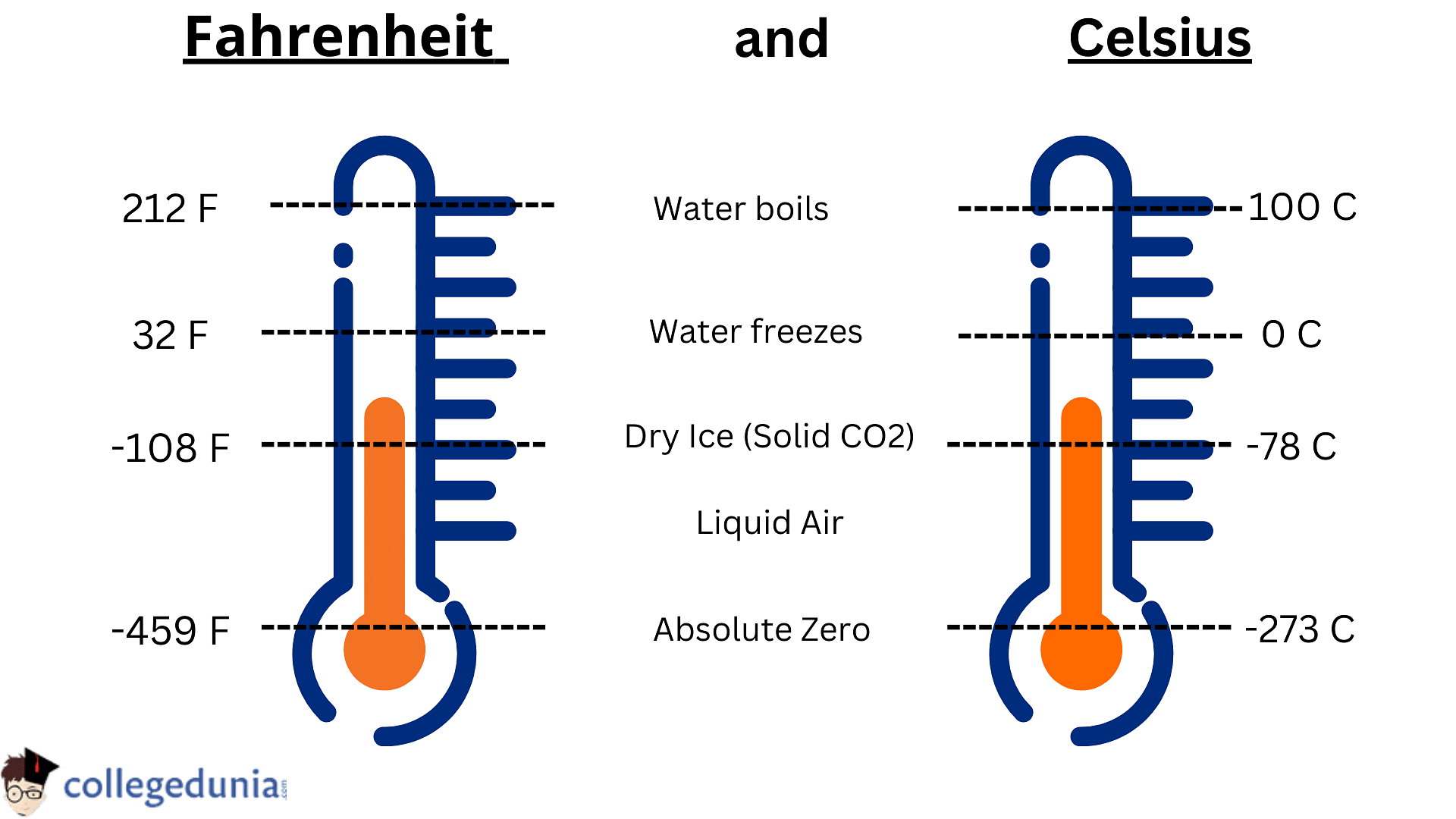
- Water freezes at 0°C and boils at 100°C on a Celsius scale.
- Water freezes at 32°F and boils at 212°F on the Fahrenheit scale.
Check Out: Thermal Properties of Matter Important Questions
Key Terms: Temperature, Fahrenheit, Celsius, Melting Point, Fahrenheit to Celsius Formula, Boiling Point, Fahrenheit Scale, Water
Fahrenheit and Celsius
[Click Here for Sample Questions]
Temperature is the measure of the degree of hotness and coldness, but these are not absolute terms. They depend on the perspective of an observer. So to define a scale, a reliable and absolute reference is required. The boiling point and melting point of ice are the two references that are sufficient to define a scale. These are the two points when water boils and freezes under standard pressure.
- The celsius scale is 0°C at the melting point of ice and 100°C at the boiling point of water.
- This scale is named after the Swedish scientist Anders Celsius.
- The Celsius scale is also called the Centigrade scale and it is the standard international unit (SI) used all over the world except the USA.
- The USA uses the Fahrenheit scale which has the symbol (°F).
- A German scientist named Daniel Fahrenheit invented the first thermometer in 1714.
- The reference for this scale is the brine solution.
- The freezing point of the brine solution is 0°F. The melting point of ice is 32°F and the boiling point of water is 212°F.
The video below explains this:
Fahrenheit to Celsius Detailed Video Explanation:
Read Also:
Fahrenheit to Celsius Formula Derivation
[Click Here for Previous Year Questions]
Often there are times when we need to convert the temperature from Fahrenheit scale to Celsius scale. We can use the Fahrenheit to Celsius formula to convert at that time. It is also called the F to C formula in short. Let us consider the temperature in the Fahrenheit scale to be F. Consider the corresponding temperature in the Celsius scale to be C. Now we have to relate F and C.
- Between the melting point of ice and the boiling point of water, there are 100 divisions in the Celsius scale.
- On the Fahrenheit scale, the melting point of ice is 32°F and the boiling point of water is 212°F, there are 120 divisions.
- We can also observe that the starting of the Fahrenheit scale has 32 degrees more than Celsius.
- So the relation between the Fahrenheit and Celsius scale is -
(F - 32) / 180 = C / 100
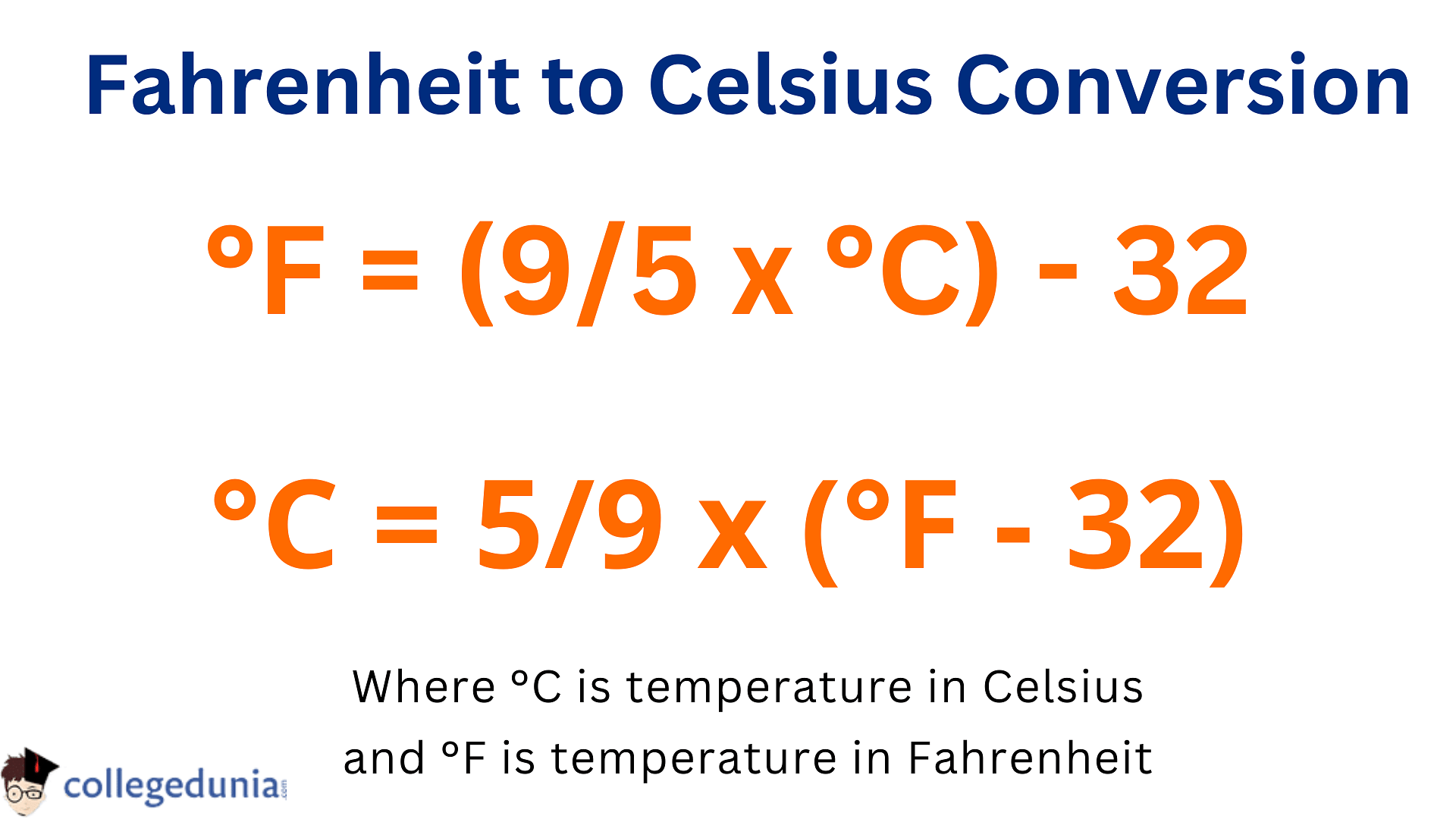
C = 5/9 x (F - 32)
Fahrenheit to Celsius Conversion
[Click Here for Sample Questions]
Let F be the temperature in Fahrenheit and C be the temperature in Celsius.
- First, subtract 32 from the Fahrenheit value.
- Multiply five to it
- At last divide the value with 9
- Now you have the same temperature in Celsius.
Solved ExampleExample: Convert 108°F to Celsius. Solution: Given – Fahrenheit temperature = 108°F. We know that the Fahrenheit to Celsius formula is °C = [(°F-32)×5]/9 Adding the values in the formula, °C = [(108-32)×5]/9 °C = (76×5)/9 °C = 42.2 Hence, 108°F = 42.2°C. |
Fahrenheit to Celsius Formula
[Click Here for Previous Year Questions]
We have derived the Fahrenheit to Celsius formula which comes out to be
C = 5/9 x (F - 32)
Example – Let us convert 68°F to Celsius.
Solution – First subtracting 32 we get,
68 - 32 = 36
- Now multiply five by it, 36 * 5 = 180
- Now dividing it by nine we get, 180 / 9 = 20°C
- Hence, the temperature on the Celsius scale is 20°C.
Celsius to Fahrenheit Conversion
[Click Here for Sample Questions]
Now we know how to convert the Fahrenheit scale temperature to the Celsius scale temperature. It might also happen that we need to convert the Celsius temperature to Fahrenheit temperature. So we can derive the Celsius to Fahrenheit equation from the existing Fahrenheit to celsius formula:
The F to C equation is C = 5/9 x (F - 32)
Take the factor 5/9 to the left side and write the equation in reverse order
F - 32 = 9/5 x C
Take 32 to the right side, F = (9/5 x C) + 32
Let us take the previous example where the temperature in celsius was 20°C
- Multiplying 9/5 to it, 9 / 5 x 20 = 36
- Now adding 32 to it, 36 + 32 = 68°F
- Thus we get 20°C is equivalent to 68°F.
Fahrenheit to Celsius Chart
[Click Here for Previous Year Questions]
Some of the Fahrenheit to Celsius formula conversion values are as follows –
| Fahrenheit – °F | Celsius – °C |
|---|---|
| - 50°F | - 45.56°C |
| 32°F | 0°C (Melting point or Freezing point of water) |
| 90°F | 32.22°C |
| 98.6°F | 37°C (Average body temperature) |
| 130°F | 54.44°C |
| 160°F | 71.11°C |
| 190°F | 87.78°C |
| 212°F | 100°C (Boiling point of water) |
Check Out:
Things to Remember
- Fahrenheit to Celsius formula is used to convert the temperature in the Fahrenheit scale to the Celsius scale.
- Temperature is the measure of the degree of hotness and coldness.
- The Celsius scale is used in almost every country but in the USA, people use the Fahrenheit scale.
- The Fahrenheit to Celsius formula is C = 5/9 x (F - 32)
- The Celsius scale is named after the Swedish scientist Anders Celsius.
- On the Fahrenheit scale, the melting point of ice is 32°F and the boiling point of water is 212°F.
- The celsius scale is 0°C at the melting point of ice and 100°C at the boiling point of water.
Sample Questions
Ques. An object has a temperature of 182°F. What is its temperature at °C? (3 Marks)
Ans. Here we have to convert from Fahrenheit to Celsius, so we will use the F to C formula - C = 5 / 9 x (F - 32)
Now putting the value of F in the equation,
C = 5/9 x (182 - 32 )
= 5/9 x (150)
= 5 x 16.66
= 83.3°C
So the temperature in celsius will be 83.3°C
Ques. An object has a temperature of 160°F. What is its temperature at °C? (3 Marks)
Ans. Here we have to convert from Fahrenheit to Celsius, so we will use the F to C formula - C = 5/9 x (F - 32)
Now putting the value of F in the equation,
C = 5/9 x (160 - 32 )
= 5/9 x (128)
= 5 x 14.22
= 71.11°C
So the temperature in celsius will be 71.11°C.
Ques. Convert 80°C to Fahrenheit. (3 Marks)
Ans. Here we have to convert from Celsius to Fahrenheit, so we will use the C to F formula -
F = (9/5 x C) + 32
Putting the value of C in the equation,
F = (9/5 x 80 ) + 32
= 144 + 32
= 176 °F
So the temperature in Fahrenheit will be 112°F.
Ques. What is the normal body temperature in both scales? (3 Marks)
Ans. The average body temperature of the human body is approximately 37.5°C.
On the Fahrenheit scale, the body temperature is 98.5°F. But the body temperature varies widely around the average temperature. When we have a body temperature of more than 36.1°C or 100°F then it is said to have a fever.
Ques. Distinguish between Celsius and Fahrenheit scales. (3 Marks)
Ans. The main points of difference are as follows:
Celsius Scale
- Defined after steam and ice point of water
- It has 100 divisions between the two fixed points
- It is the SI unit of temperature
Fahrenheit Scale
- Defined after boiling and melting point of brine
- It has 180 divisions between the two fixed points
- It is only used in the USA
Ques. Why an absolute reference is required to define a temperature scale? (5 Marks)
Ans. Temperature is the measure of the degree of hotness and coldness. But hotness and coldness are relative terms. An object is hot with respect to a cold object but is cold with respect to another object hotter than that. Many properties of matter change with a change in temperature. So in order to choose a reference, it was deduced that one should refer to natural phenomena which always occur at the same temperature.
The boiling of water and melting of ice are such phenomena. They always occur at the same temperature. The Celsius scale is made referring to the boiling and melting point of ice whereas the Fahrenheit scale is made referring to the melting and boiling point of brine.
Ques. Convert 12°F to Celsius Scale. (3 Marks)
Ans. Fahrenheit to Ccelsius formula: °C = [(°F-32)×5]/9
°C = [(12-32)×5]/9
°C = (-20 ×5)/9
°C = -100/9
°C = -11. 1
Thus, 12°F = -11.1°C.
Also Check:



Comments