



Exams Prep Master
Chromium (III) Chloride also referred to as chromic chloride describes any of several purple solid compounds with the formula CrCl3 • x H2O, where x can be 0, 5, and 6. The most common form of Chromium (III) Chloride is the dark green hexahydrate, CrCl3 · 6 H2O. It is also used as a catalyst and as a precursor to many inorganic compounds of chromium. It is produced by the direct chlorination of chromium metal. Despite CrCl3 being ionic, the solid-state structure is kinetically inert so that anhydrous chromic chloride is reluctant to dissolve in H2O. Further, we will discuss the Chromium (III) Chloride formula along with its chemical structure, preparation, properties and uses.
| Table of Content |
Key Takeaways: Chromium, Lewis acid, Cr3+, Hexahydrate, Trimethylsilyl, Chlorine, Chloride, Inorganic compounds, Catalyst, Chlorination, Solid state, Solid
Structure of Chromium (III) Chloride
[Click Here for Sample Questions]
Anhydrous Chromium (III) Chloride has the YCI3 structure along with the Cr3+ that covers one-third of the octahedral interstices inside the alternating layers of a pseudo-cubic close-packed lattice of Cl- ions. Due to the absence of cations in alternate layers, the bonding between adjacent layers weakens. Because of this, crystals of CrCl3 cleave easily along the planes between layers, which results in the flaky appearance of samples of chromium (III) chloride.
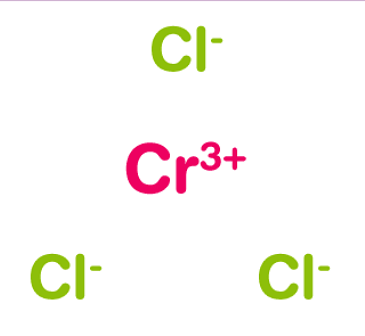
The inertness indicates that CrCl3 is generally sluggish to react without the presence of a reducing agent. However, when it does react, it undergoes ligand substitution reactions to form other complexes of chromium (III). Chromium Chloride reacts as a Lewis Acid, forming stable chloro complexes such as [CrCl6]3-.
Also Read:
| Related Articles | ||
|---|---|---|
| Saturated Solutions | Types of Solutions | Colligative Properties |
| Solvent Examples | Silver Carbonate | Camphor |
Properties of Chromium (III) Chloride
[Click Here for Sample Questions]
- Formula – CrCl3
- Appearance – Purple solid (anhydrous); Dark green (hexahydrate)
- Boiling Point – 1300 °C
- Melting Point – 1152 °C (anhydrous); 83 °C (hexahydrate)
- Density - 2.87 g/cm3 (anhydrous); 1.760 g/cm3 (hexahydrate)
- Molar Mass - 158.36 g/mol (anhydrous); 266.45 g/mol (hexahydrate)
- Solubility in water – Slightly soluble
Chromium (III) chloride is a type of Lewis Acid, categorized as "hard" according to the Hard Soft Acid Base theory. The general way of opening CrCl3 up to substitution in solution is to reduce even a trace amount to CrCl2, for example using Zn in HCL. The chromium compound undergoes substitution easily, and it can exchange electrons with CrCl3 via a chloride bridge, allowing all of the CrCl3 to react quickly.
Preparation of Chromium (III) Chloride
[Click Here for Sample Questions]
Chromium (III) chloride can be prepared from chromium metal and chlorine directly, or indirectly using Chromium (III) oxide with carbon and chlorine at 800 °C.
Cr2O3 (s) + 3 C(s) + 3 Cl2(g)→ 2 CrCl3(s)+ 3 CO(g)
It may also be prepared by chlorination of chromium metal directly, or indirectly by carbothermic chlorination of Chromium (III) oxide at 650–800 °C
Cr2O3 + 3 C + 3 Cl2 → 2 CrCl3 + 3 CO
The solvate can be derived by dehydration with trimethylsilyl chloride in THF:
CrCl3 · 6 H2O + 12 Me3SiCl → CrCl3(THF)3 + 6 (Me3Si)2O + 12 HCl
Chromium chloride can also be prepared by treating the hexahydrate with thionyl chloride:
CrCl3 · 6 H2O + 6 SOCl2 → CrCl3 + 6 SO2 + 12 HCL
Things to Remember
- The Chromium (III) Chloride formula is CrCl3.
- Despite trivalent chromium being far less poisonous than hexavalent, it should be handled carefully as it can cause an allergic skin reaction to a living being.
- CrCl3.4H2O precipitates the silver chloride when treated with silver nitrate.
- Cr2O3 + 3 C + 3 Cl2 → 2 CrCl3 + 3 CO
- CrCl3 • 6H2O + 12 Me3SiCl → CrCl3(THF)3 + 6 (Me3Si)2O + 12 HCl
- CrCl3 • 6H2O + 6 SOCl2 → CrCl3 + 6 SO2 + 12 HCl
- Chromium (III) Chloride reacts as a Lewis Acid.
- It is useful for the purpose of chrome plating in the oilfield industries.
Also Read:
Practice Questions
Ques: Find the fraction of the total number of holes occupied in chromium chloride (CrCl3), Cl− ions that have a cubic close-packed arrangement, and when Cr3+ ions are present in the octahedral holes. (3 marks)
Ans: In CrCl3 for every, 3Cl− ions, there is one Cr3+ ion is present.
So, if there are 3Cl− ions are present in CCP
Number of octahedral voids = 3, and tetrahedral voids = 6
Total voids = 3+6=9
As 1Cr3+ 1Cr3+ ion is present in the octahedral void, therefore, a fraction of holes occupied =19
Ques: What are chromium chloride hydrates? (2 marks)
Ans: Chromium chlorides show a somewhat peculiar property of existing in a number of distinct chemical forms, also called isomers, which differ in terms of the number of chloride anions that are coordinated to Cr (III) and the water of crystallization. There are different forms, both solid and aqueous solutions. The main hexahydrate can be more precisely shown as [CrCl2(H2O)4] Cl · 2 H2O.
Ques: State some properties of chromium chloride. (3 marks)
Ans:
- Boiling Point – 1300 °C
- Melting Point – 1152 °C (anhydrous); 83 °C (hexahydrate)
- Density - 2.87 g/cm3 (anhydrous); 1.760 g/cm3 (hexahydrate)
- Molar Mass - 158.36 g/mol (anhydrous); 266.45 g/mol (hexahydrate)
Ques: Silver chloride precipitates when CrCl3.4H2O is treated with silver nitrate and its solution's molar conductance corresponds to 2 ions. State the structural formula of the compound and name also name the compound. (2 marks)
Ans: When silver chloride is the result of the reaction then there is 1 free chlorine atom present outside the coordination circle. And the structural formula has to be [Cr (H2O)4Cl2] Cl.
Ques: Why do we need to keep precautions while using chromium? (2 marks)
Ans: Despite trivalent chromium being less poisonous than hexavalent, it should be handled cautiously because it can cause an allergic skin reaction to a living being.
Ques: What is the most common form of CrCl3 sold commercially? (2 marks)
Ans: Dark green hexahydrate with the structure CrCl2(H2O)4] Cl.2H2O is the most common form of CrCl3 sold commercially. It is also very inert towards substitution like the inert form.
Ques: What are dyestuffs? (2 marks)
Ans: Commercially, a number of chromium-containing dyes are used for wool. Generally, dyes are triarylmethanes consisting of ortho-hydroxyl benzoic acid derivatives.
Ques: State a few uses of Chromium (III) Chloride. (3 marks)
Ans: Uses of Chromium (III) Chloride:
- Chromium (III) Chloride is used for chrome plating in the oil-field industry.
- It is used as mordant in the dyeing and printing industry.
- It is used in food additives.
- It is used in various chromium compounds.
For Latest Updates on Upcoming Board Exams, Click Here: https://t.me/class_10_12_board_updates
Check-Out:



Comments