



Education Journalist | Study Abroad Lead
Geochemistry is that branch of science that establishes a relation between chemistry and geology and uses this relation as an investigative way to explore more about the earth and the environment. The earth has a complex chemical structure and so does the cosmos surrounding it. Geochemistry applies chemistry to study the numerous geological phenomena at the atomic and subatomic levels. This helps in determining the distribution, concentration, origin and evolution of chemical elements which form the structure of the earth and the surrounding cosmos.
| Table of Content |
Keyterms: Geochemistry, Geology, Environment, Subatomic levels, Cosmos, Evolution, Earth, Geological structure, Earth’s crust, Oceans, Solar system
What is Geochemistry?
[Click Here for Sample Questions]
Geochemistry can be defined as the branch of chemistry which studies the geological structure of the earth and the surrounding universe at atomic and subatomic levels to determine the different aspects of major geological mechanisms such as the earth’s crust, oceans, the solar system, etc. Geochemistry helps scientists in analysing the chemical composition of natural celestial bodies like meteorites and other planets of the solar system.

Geochemistry
Geochemistry provides the necessary information about the origin and composition of the earth’s crust, mantle and core. It explores several chemical and mineral transformations that occur in the rocks, for example, the metamorphosis of rocks, weathering of rocks, etc. Geochemistry has successfully contributed towards understanding some of the very important geological mechanisms like mantle convection, the origin of basalt and granite rocks, formation of the planets of the solar universe.

Rock Cycle
Also Read:
Subfields of Geochemistry
[Click Here for Sample Questions]
Some important subfields of geochemistry are :
- Aqueous Geochemistry
- Biogeochemistry
- Organic Geochemistry
- Photogeochemistry
- Isotopic Geochemistry
- Regional Geochemistry
- Cosmochemistry
Aqueous Geochemistry
Aqueous geochemistry explores the behaviour of chemical elements present in the water bodies. Elements like Copper, Sulphur and Mercury have a substantial presence in aquatic systems. Aqueous geochemistry studies the interaction between terrestrial and aquatic systems and investigates the exchange of elemental flux across terrestrial and aquatic boundaries.

Aqueous Geochemistry
Biogeochemistry
Biogeochemistry studies the elemental transaction happening between living and non-living systems. It focuses on the origin of life on earth and the subsequent changes in the chemical environment of earth.

Biogeochemistry
Organic Geochemistry
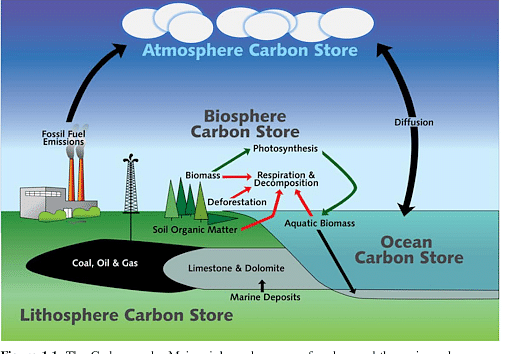
Organic geochemistry studies the behaviour of organic materials present on earth. These organic materials have been derived from living or dead organisms. It also explores the transformation of carbonaceous deposits in rocks and fossil fuels. A number of organic chemical reactions are the underlying forces behind major geological mechanisms like rock formation, rock weathering, soil formation.
Organic Geochemistry
Photogeochemistry
Photogeochemistry uses the concepts of photochemistry and geochemistry to study and analyse the chemical reactions that are induced by light energy and lead to the geological transformation of minerals. Sunlight induced chemical changes occur in the solid components like rocks and soil, aquatic components like dissolved organic matter in aquatic bodies and atmospheric components like aerosols and gases.

Photogeochemistry
These reactions are outside the realm of living things. The study of photo geochemistry is primarily focused on the chemical reactions of natural organic or synthesised inorganic materials.
Isotopic Geochemistry
Isotopic geochemistry gives a detailed analysis of relative concentrations of all the chemical elements and their isotopes and the variations in their natural abundance using mass spectrometry. Isotopic geochemistry aims to find more information about the origin of rocks, water bodies and transboundary elemental transactions between them. Stable isotopic geochemistry and radiogenic isotopic geochemistry are two fields of study under isotopic geochemistry.

Marine Isotopic Geochemistry
Regional Geochemistry
Regional geochemistry aims at mapping the geochemical resources which are present on the earth’s surface. This study involves the survey of vast areas of earth exploring soil, water, vegetation, natural bedrock, etc. On the basis of these surveys, samples are collected. Then by applying chemical analysis methods the spatial distribution of geochemical elements on earth is extracted.

Regional Geochemistry
This gives an overview of the regional abundance of minerals. Using Regional geochemistry scientists are able to determine the variation in abundance of minerals on a scale of thousands of kilometres.
Cosmochemistry
Cosmochemistry is also called chemical cosmology. Cosmochemistry studies the chemical composition of elements present in the universe and aims to explore the geochemical processes involved in their origin, development and transformation.

Cosmochemistry
Under its realm are celestial bodies, meteorites, asteroids of the solar system. On the basis of this study, researchers compile data regarding the abundance and concentration of cosmic elements in the universe. Victor Goldschmidt was one of the first proponents of this field of study.
Earth and Its Mineral Constituents
[Click Here for Sample Questions]
The earth comprises hundreds of minerals in its crust, mantle and core. The variety and abundance of minerals on earth make it a unique composition. Elements like oxygen, aluminium, silicon, calcium, sodium and potassium make up around 98 percent of the total crust. The elements mentioned above are rarely found in the elemental state and are mostly present in a combined state. The following table shows the element-wise presence in the earth’s crust :
| Element | Percentage |
|---|---|
| Oxygen | 47 % |
| Silicon | 28 % |
| Aluminium | 8 % |
| Iron | 5 % |
| Magnesium | 4 % |
| Calcium | 2 % |
| Potassium | 2 % |
| Sodium | 2 % |

Combined state of different elements: Minerals
The above-mentioned elements are mostly present in compound forms. The following table presents the abundance of major compounds in the earth’s crust :
| Compound | Percentage |
|---|---|
| SiO2 | 59.71 % |
| Al2O3 | 15.41 % |
| Fe2O3 | 2.63 % |
| FeO | 3.52 % |
| MgO | 4.36 % |
| CaO | 4.90 % |
| Na2O | 3.55 % |
| H2O | 1.52 % |
| TiO2 | 0.60 % |
| P2O5 | 0.22 % |
The earth’s crust has around 2000 types of minerals. The most abundant are feldspar, quartz, pyroxenes, mica and olivine. The magma present in the interior of the earth is the source of all these minerals. These minerals can be organic or naturally occurring and inorganic. Minerals like haematite are metallic minerals. Some of the major minerals are discussed below :
Feldspar
- The basic constituents of this mineral are silicon and oxygen. Other elements like sodium, potassium, calcium and aluminium also have a varied presence across different varieties of feldspar.
- It is light pink in colour and is majorly used in the ceramics industry.

Feldspar
Quartz
- The major constituent of quartz is silica. It is a hard mineral.
- Widely used in radios and radars.

Quartz
Pyroxene
- The basic constituents are calcium, iron, silicon, magnesium and aluminium.
- It makes up 10 % of the earth’s crust.

Pyroxene
Mica
- Elements like potassium, silicon, iron, magnesium are its basic constituents.
- Commonly present in metamorphic rocks.
- Wide application in the electronic industry.

Mica
Scope of Stable Isotope Geochemistry
[Click Here for Sample Questions]
Stable isotope geochemistry studies the isotopic variations in the geochemical elements present on the earth. The difference in mass of molecules either enriches or impoverishes certain isotopic species.
Different isotopes of the same element can be present in the same compound. For example, CaCO3. In the case of calcium carbonate, two isotopes of oxygen can be present i.e. oxygen-16 and oxygen-18. The proportion of their presence is determined by the temperature of seawater.

Stable Isotope Chemistry
Stable isotopic geochemistry also helps in the carbon-dating process by analyzing the isotopic composition of fossils. In this way, isotopic geochemistry helps in the quantification of the geological time scale. The C-14 isotope of carbon is extremely useful in analyzing the origin and transformation of biological materials of the past. The major part of stable isotope geochemistry deals in the isotopes of the elements: Hydrogen, Carbon, Oxygen, Nitrogen and Sulfur.
Applications of Geochemistry
[Click Here for Sample Questions]
- Stable isotopic geochemistry also helps in the carbon-dating process by analyzing the isotopic composition of fossils.
- Cosmochemistry studies the chemical composition of elements present in the universe and aims to explore the geochemical processes involved in their origin, development and transformation.

Carbon Dating
- Photogeochemistry uses the concepts of photochemistry and geochemistry to study and analyse the chemical reactions that are induced by light energy and lead to the geological transformation of minerals.
- Geochemistry traces metals in food chains, soil and water. For example Copper and Cobalt are a necessity in forage plants, if they are deficient, that will lead to diseases in grazing animals and can in turn affect human health.
- Geochemistry has successfully contributed towards understanding some of the very important geological mechanisms like mantle convection, the origin of basalt and granite rocks, formation of the planets of the solar universe.
- Geochemistry contributes to the exploration of mineral deposits. It aims to investigate the processes(metamorphic, hydrothermal, hydraulic, etc) that lead to the production of minerals.

Origin of Different Rocks
- Mass spectrometry methods are employed under geochemistry to analyze the identification and characterization of minerals.
- Geochemistry helps to understand environmental disasters. For example volcanic eruptions.
- Geochemistry has applications in archaeology and anthropology. It is used to investigate the concentration and consumption of metals on a regional basis. It has led to path-breaking discoveries in regions of South Africa.
Things to Remember
- Victor Goldschmidt is known as the father of Geochemistry.
- Cosmochemistry studies the chemical composition of elements present in the universe and aims to explore the geochemical processes involved in their origin, development and transformation.
- Geochemistry has successfully contributed towards understanding some of the very important geological mechanisms like mantle convection, origin of basalt and granite rocks, formation of the planets of the solar universe.
- Elements like oxygen, aluminium, silicon, calcium, sodium and potassium make up around 98 percent of the total crust.
- Geochemistry applies chemistry to study the numerous geological phenomena at the atomic and subatomic levels.
- Regional geochemistry aims at mapping the geochemical resources which are present on the earth’s surface. This study involves the survey of vast areas of earth exploring soil, water, vegetation, natural bedrock, etc.
- Aqueous geochemistry studies the interaction between terrestrial and aquatic systems and investigates the exchange of elemental flux across terrestrial and aquatic boundaries.
Also Read:
Sample Questions
Ques. Explain in detail the chemical composition of the earth. (5 Marks)
Ans. The earth comprises hundreds of minerals in its crust, mantle and core. The variety and abundance of minerals on earth make it a unique composition. Elements like oxygen, aluminium, silicon, calcium, sodium and potassium make up around 98 percent of the total crust. The elements mentioned above are rarely found in the elemental state. Mostly they are present in a combined state.
The earth’s crust has around 2000 types of minerals. The most abundant are feldspar, quartz, pyroxenes, mica and olivine. The magma present in the interior of the earth is the source of all these minerals. These minerals can be organic or naturally occurring and inorganic. Minerals like haematite are metallic minerals.
Percentage of Elements in elemental form
| Element | Percentage |
|---|---|
| Oxygen | 47 % |
| Silicon | 28 % |
| Aluminium | 8 % |
| Iron | 5 % |
| Magnesium | 4 % |
| Calcium | 2 % |
| Potassium | 2 % |
Percentage of compounds on the earth
| Compound | Percentage |
|---|---|
| SiO2 | 59.71 % |
| Al2O3 | 15.41% |
| Fe2O3 | 2.63% |
| FeO,MgO | 3.52 % , 4.36 % |
| CaO | 4.90 % |
| Na2O | 3.55 % |
| H2O | 1.52 % |
Ques. Write the applications of Geochemistry. (5 Marks)
Ans.
- Geochemistry traces metals in food chains, soil and water. For example, Copper and Cobalt which are a necessity in forage plants, if they are deficient, will lead to diseases in grazing animals and can also affect human health.
- Geochemistry has applications in archaeology and anthropology. It is used to investigate the concentration and consumption of metals on a regional basis. It has led to path-breaking discoveries in regions of South Africa.
- Geochemistry has successfully contributed towards understanding some of the very important geological mechanisms like mantle convection, the origin of basalt and granite rocks, formation of the planets of the solar universe.
- Mass spectrometry methods are employed under geochemistry to analyze the identification and characterization of minerals.
- Geochemistry helps to understand environmental disasters. For example : volcanic eruptions.
- Photogeochemistry uses the concepts of photochemistry and geochemistry to study and analyse the chemical reactions that are induced by light energy and lead to geological transformation of minerals.
Ques. Write a short note on : (1.) Photogeochemistry (2.) Regional Geochemistry (5 Marks)
Ans. Photogeochemistry:
Photogeochemistry uses the concepts of photochemistry and geochemistry to study and analyse the chemical reactions that are induced by light energy and lead to a geological transformation of minerals. Sunlight induced chemical changes occur in the solid components like rocks and soil, aquatic components like dissolved organic matter in aquatic bodies and atmospheric components like aerosols and gases. These reactions are called photo geochemical reactions. These reactions are outside the realm of living things. The study of photo geochemistry is primarily focused on the chemical reactions of natural organic or synthesised inorganic materials.
Regional Geochemistry:
Regional geochemistry aims at mapping the geochemical resources which are present on the earth’s surface. This study involves the survey of vast areas of earth exploring soil, water, vegetation, natural bedrock, etc. On the basis of these surveys, samples are collected. Then by applying chemical analysis methods the spatial distribution of geochemical elements on earth is extracted. This gives an overview of the regional abundance of minerals. Using Regional geochemistry scientists are able to determine the variation in abundance of minerals on a scale of thousands of kilometres.
Ques. Give an account of major minerals present on earth. (3 Marks)
Ans. Feldspar: The basic constituents of this mineral are silicon and oxygen. Other elements like sodium, potassium, calcium and aluminium also have a varied presence across different varieties of feldspar.
Quartz: The major constituent of quartz is silica. It is a hard mineral. Widely used in radios and radars.
Mica: Elements like potassium, silicon, iron, magnesium are its basic constituents. Commonly present in metamorphic rocks.
Pyroxene: The basic constituents are calcium, iron, silicon, magnesium and aluminium. It makes up 10 % of the earth’s crust.
Ques. What is the scope of stable isotope geochemistry? (3 Marks)
Ans. Stable isotope geochemistry studies the isotopic variations in the geochemical elements present on the earth. The difference in mass of molecules either enriches or impoverishes certain isotopic species.
Different isotopes of the same element can be present in the same compound. For example CaCO3. In the case of calcium carbonate, two isotopes of oxygen can be present i.e. oxygen-16 and oxygen-18. The proportion of their presence is determined by the temperature of seawater.
Stable isotopic geochemistry also helps in the carbon-dating process by analyzing the isotopic composition of fossils. In this way, isotopic geochemistry helps in the quantification of the geological time scale.
Ques. How can Geochemistry be applied to study celestial bodies? (3 Marks)
Ans. Cosmochemistry studies the chemical composition of elements present in the universe and aims to explore the geochemical processes involved in their origin, development and transformation. Under its realm are celestial bodies, meteorites, asteroids of the solar system. On the basis of this study, researchers compile data regarding the abundance and concentration of cosmic elements in the universe. Victor Goldschmidt was one of the first proponents of this field of study.
Ques. What is organic geochemistry? (3 Marks)
Ans. Organic geochemistry studies the behaviour of organic materials present on earth. These organic materials have been derived from living or dead organisms. It also explores the transformation of carbonaceous deposits in rocks and fossil fuels. A number of organic chemical reactions are the underlying forces behind major geological mechanisms like rock formation, rock weathering, soil formation.
Ques. What are the different subfields of geochemistry? (3 Marks)
Ans. Some important subfields of geochemistry are :
- Aqueous Geochemistry
- Biogeochemistry
- Organic Geochemistry
- Photogeochemistry
- Isotopic Geochemistry
- Regional Geochemistry
- Cosmochemistry
Ques. Write the applications of aqueous geochemistry. (3 Marks)
Ans. Aqueous geochemistry explores the behaviour of chemical elements present in the water bodies. Elements like Copper, Sulphur and Mercury have a substantial presence in aquatic systems. Aqueous geochemistry studies the interaction between terrestrial and aquatic systems and investigates the exchange of elemental flux across terrestrial and aquatic boundaries.
Aqueous geochemistry also traces the presence of metals and other inorganic elements in water which ultimately influence the food chain.
Ques. How can geochemistry be applied to archaeology? (3 Marks)
Ans.
- Geochemistry has applications in archaeology and anthropology. It is used to investigate the concentration and consumption of metals on a regional basis. It has led to path-breaking discoveries in regions of South Africa.
- Geochemical principles using carbon dating techniques and isotopic geochemistry help in the investigative analysis of prehistoric and historic era samples.
For Latest Updates on Upcoming Board Exams, Click Here: https://t.me/class_10_12_board_updates
Check-Out:



Comments