



Exams Prep Master
The circle is a planar figure in which all of its points travel through the same plane at the same time. It's a solid depiction of a sphere because it's a planar surface. Radius, diameter, arc, chord, circumference, and so on are all terms used to describe a circle. The radius is the distance between any point on the circle and the center. A straight line that passes through the center of the circle is called the diameter, half of the diameter is called radius. The circumference of a circle is the whole length of the circle's boundary and it is equal to the product of the constant \(\Pi\) and the circle's radius. Here, we will try to learn how many minimum points are sufficient to draw a unique circle? If is it possible to draw a circle passing through 3 points? Or, in how many ways can we draw a circle that passes through three points?
| Table of Content |
Keywords: Circle, Diameter of a circle, Tangents, Equation of the circle, arc of a circle, chord of a circle
Circle Passing Through A Point
[Click Here for Sample Questions]
Let us draw a circle passing through that point, considering a point.

Circle Passing Through A Point
From the figure given, we can see that through a single point P, we can draw infinite circles passing through it.
Circle Passing Through Two Points
[Click Here for Sample Questions]
Let us take two points, P and Q to draw circle passing through two points:

Circle Passing Through Two Points
Circle Passing Through 3 Points
[Click Here for Sample Questions]
One beginning point and one finishing point are required to create a straight line. To draw a line, you'll need two points. Similarly, we'll need some points if we're going to create a circle. However, unlike line segments, we can create a circle in a variety of ways. Because there are no numerous planes in a circle, it may be drawn with a single point. The starting point will also become the final point. Similarly, two points may be used to make a circle. We can draw numerous circles from two points, just as we can run several circles from a single point. The present assignment, however, is to create a circle that passes through three points.
There are two instances to consider while evaluating a circle that passes through three locations. The circle can travel across collinear points or non-collinear points since the points can be either collinear or non-collinear.
Circle Passing Through 3 Points
Check Important Formulas for Circle
Circle Passing Through 3 Collinear Points
[Click Here for Sample Questions]
Collinear means lying in the same line so collinear points are those points that actually lie on the same line. Therefore, if a circle is drawn by looking at these points on the same line, the circle touches only two points and the third point can be observed either inside or outside the circle. In this case, the circle will not touch all three points.

Circle Passing Through 3 Collinear Points
Circle Passing Through 3 Non-collinear Points
[Click Here for Sample Questions]
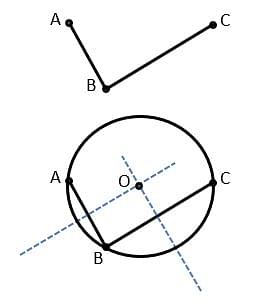
To draw a circle that passes through three points that are not on the same line, you need to find the center of the circle that passes through the three points and its radius.
Step 1: Let us take three points A, B, and C and connect these points.
Step 2:Draw a perpendicular bisector of AB and BC. The point O is called the center of the circle because the bisectors should intersect at O.
Step3:Draw a circle centered on O with a radius of OA or OB or OC. You will get a circle that passes through the three points A, B, and C.

Circle Passing Through 3 Non-collinear Points
Read More: Tangent Circle Formula
Theorem
[Click Here for Sample Questions]
It is observed that only one unique circle passes through all three points. The proof of which is explained below.
Statement: It is observed that only one unique circle passes through all three points. This can be formulated as a theorem, the proof of which is explained below.
Given:
Points A, B, and C on three non-identical lines
To prove:
You can draw only one circle through A, B, and C Structure:
Connect the AB and BC.
Draw the perpendiculars of AB and BC so that these perpendiculars intersect at O.
Proof:
| S. No | Statement | Reason |
|---|---|---|
| 1 | OA = OB | Since the point on the perpendicular bisector of the line segment is equidistant from the endpoints of the line segment as seen in the above figure. |
| 2 | OB = OC | Since the point on the perpendicular bisector of the line segment is equidistant from the endpoints of the line segment. here also |
| 3 | OA = OB = OC | From (i) and (ii) |
| 4 | O is equidistant from A, B and C | |
If you draw a circle with O as the center and OP as the radius, It also passes through Q and R.
Since the perpendicular bisector of PQ and QR is at O, the only point equidistant from P, Q, R is O.
That is, O is the center of the circle to be drawn.
OP, OQ, OR are the radii of the circle.
From the above, if the points are not on the same line, you can draw a unique circle that passes through the three points.
Equation of the Circle Passing Through 3 Points
[Click Here for Sample Questions]
Finding the equations for a circle that passes through three points is very easy and easy. To do this, you need three non-collinear points through which the circle passes.
A(x1, y1), B(x2, y2), and C(x3, y3) are the coordinates of the three non-collinear points.
Since we know that,
The general form of equation of a circle is:
x2 + y2 + 2gx + 2fy + c = 0......(1)
Now, we substitute the given points A, B and C in this equation and simplify to get the value of g, f and c.
Substituting P(x1, y1) in equ(1),
x12 + y12 + 2gx1 + 2fy1 + c = 0….....(2)
x22 + y22 + 2gx2 + 2fy2 + c = 0…....(3)
x32 + y32 + 2gx3 + 2fy3 + c = 0…....(4)
Therefore,
From (2) we get,
2gx1 = -x12 y12 – 2fy1 – c….(5)
Again from (2) we get,
c = -x12 – y12 – 2gx1 – 2fy1….(6)
From (4) we get,
2fy3 = -x32 – y32 – 2gx3 – c….(7)
Now, subtracting (3) from (2),
2g(x1 – x2) = (x22 -x12) + (y22 – y12) + 2f (y2 – y1)….(8)
Substituting (6) in (7),
2fy3 = -x32 – y32 – 2gx3 + x12 + y12 + 2gx1 + 2fy1….(9)
Now, substituting equ(8), i.e. 2g in equ(9),
2f = [(x12 – x32)(x1 – x2) + (y12 – y32 )(x1 – x2) + (x22 – x12)(x1 – x3) + (y22 – y12)(x1 – x3)] / [(y3 – y1)(x1 – x2) – (y2 – y1)(x1 – x3)]
Similarly, we can get 2g as:
2g = [(x12 – x32)(y1 – x2) + (y12 – y32)(y1 – y2) + (x22 – x12)(y1 – y3) + (y22 – y12)(y1 – y3)] / [(x3 – x1)(y1 – y2) – (x2 – x1)(y1 – y3)]
Using the values of 2g and 2f, we can get the value of c.
Thus, by substituting g, f and c in (1) we can get the equation of the circle that passes through the given three points.
Read More: Central Angle of a Circle Formula
Things to Remember
[Click Here for Sample Questions]
- Circle: A set of all points in a plane at a fixed distance from a fixed point. The fixed point is called the center, and the fixed distance is called the radius.
- Chord: A line segment whose endpoints are on a circle, therefore, dividing the circle into two segments.
- Secant line: A coplanar straight line that intersects the two points of the circle is called the secant line.
- Tangent: A line that intersects a circle at only one point.
- Diameter: The diameter is twice the radius. It is the longest line in the circle that passes through the center. All diameters are the same length.
- Circumference: The perimeter of a circle is called the circumference. It is the whole length of the circle's border. The circumference of a circle is equal to the product of the constant π and the circle's radius
- Annulus: A ring object whose area is surrounded by two concentric circles.
- Sector: A region surrounded by two radii of the same length with a common center and one of two possible arcs determined by the center and the endpoints of the radius.
Sample Questions
Ques: What will be the equation of the circle that passess through the points A(2, 0), B(-2, 0) and C(0, 2)? (4 marks)
Ans: Since we know the general equation of circle:
x2 + y2 + 2gx + 2fy + c = 0….(i)
Substituting A(2, 0) in (i),
(2)2 + (0)2 + 2g(2) + 2f(0) + c = 0
4 + 4g + c = 0….(ii)
Substituting B(-2, 0) in (i),
(-2)2 + (0)2 + 2g(-2) + 2f(0) + c = 0
4 – 4g + c = 0….(iii)
Substituting C(0, 2) in (i),
(0)2 + (2)2 + 2g(0) + 2f(2) + c = 0
4 + 4f + c = 0….(iv)
Adding (ii) and (iii),
4 + 4g + c + 4 – 4g + c = 0
2c + 8 = 0
2c = -8
c = -4
Substituting c = -4 in (ii),
4 + 4g – 4 = 0
4g = 0
g = 0
Substituting c = -4 in (iv),
4 + 4f – 4 = 0
4f = 0
f = 0
Now, we substituting the values of g, f and c in (i),
x2 + y2 + 2(0)x + 2(0)y + (-4) = 0
x2 + y2 – 4 = 0
Or
x2 + y2 = 4
This is the required equation of the circle which passess through the three points A, B and C.
Ques: Determine the equation of the circle passing through these points (1, 0), (-1, 0) and (0, 1). (4 marks)
Ans: Let the equation of the general form of the required circle be x2 + y2 + 2gx + 2fy + c = 0 ……………. (i)
So According to the problem, the above equation of the circle passes through the points (1, 0), (-1, 0) and (0, 1).
Therefore,
1 + 2g + c = 0 ……………. (ii)
1 - 2g + c = 0 ……………. (iii)
1 + 2f + c = 0 ……………. (iv)
Subtracting (iii) form (i), we get 4g = 0 ⇒ g = 0.
Putting g = 0 in (ii), we obtain c = -1. Now putting c = -1 in (iv), we get f = 0.
Substituting the values of g, f and c in (i), we obtain the equation of the required circle as
x2 + y2 = 1.
Ques: Determine the equation of the circle that passes through the points (1, - 6), (2, 1), and (5, 2). Also, find the coordinate of its center and the length of the radius. (4 marks)
Ans: Let the equation of the required circle be
x2 + y2 + 2gx + 2fy + c = 0 ……………….(i)
According to the problem, the above equation passes through the coordinate points (1, - 6), (2, 1) and (5, 2).
Therefore, substituting the coordinates of three points (1, - 6), (2, 1) and (5, 2) in the equation (i) we get,
For the point (1, - 6):
1 + 36 + 2g - 12f + c = 0
⇒ 2g - 12f + c = -37 ……………….(ii)
For the point (2, 1): 4 + 1 + 4g + 2f + c = 0
⇒ 4g + 2f + c =- 5 ……………….(iii)
For the point (5, 2): 25 + 4 + 10g + 4f + c = 0
⇒ 10g + 4f + c = -29 ……………….(iv)
Subtracting (ii) from (iii) we get,
2g + 14f = 32
⇒ g + 7f = 16 ……………….(v)
Again, Subtracting (ii) form (iv) we get,
8g + 16f = 8
⇒ g + 2f = 1 ……………….(vi)
Now, solving equations (v) and (vi) we get, g = - 5 and f = 3.
Putting the values of g and f in (iii) we get, c = 9.
Therefore, the equation of the required circle is x22 + y22 - 10x + 6y + 9 = 0
Thus, the coordinates of its center are (- g, - f) = (5, - 3) and radius = √(g2+f2−c) = √(25+9−9)
= √(25) = 5 units.
Ques:Find the equation of the circle passing through the three points (1, 2), (3, -4), (5, -6). (4 marks)
Ans: Let point (1,2) be A , (3,−4) be B and (5,−6) be C
Let the mid point of AB be D=(2,−1) and the midpoint of BC be E = (4,−5)
The equation of line passing through D and perpendicular to AB is x−3y=5
The equation of line passing through E and perpendicular to BC is x−y=9
The center of circle is the point of intersection of above two lines which is equal to (11,2)
The radius of circle is 10
Therefore the equation of circle is (x−11)2+(y−2)2=100
Ques: The equation of the circle passing through (4,6) and having centre (1,2) is: (4 marks)
A) x2 + y2 − 2x − 4y − 20 = 0
B) x2 + y2 − 2x + 4y − 20 = 0
C) x2 + y2 + 2x − 4y − 20 = 0
D) x2 + y2 + 2x + 4y − 20 = 0
Ans: The correct option is A)
Let coordinates of point A are (4,6)
As the circle is passing through point A, point A lies on the circle.
Let the center of the circle is C(1,2)
∴h=1 and k=2
Thus, AC is the radius of the circle.
By distance formula,
AC = r = [ (4−1)2+(6−2)2 ]½
∴r = [ (3)2+(4)2 ]½
∴r = [ 9+16 ]½
∴r = [ 25 ]½
∴r = 5
Thus, the equation of the circle is,
(x−h)2 + (y−k)2 = r2
(x−1)2 + (y−2)2 = (5)2
x2 − 2x + 1 + y2 − 4y + 4 = 25
∴x2 + y2 − 2x − 4y − 20 = 0
Ques: Find the equation of the circle that passes through the points (0,6),(0,0) and (8,0): (4 marks)
A) (x−4)2 + (y−3)2 = 25
B) (x+4)2 + (y+3)2 = 25
C) (x−3)2 + (y−4)2 = 25
D) (x−4)2 + (y−3)2 = 36
Ans: The correct option is A)
Let the equation of the general form of the required circle be
x2 + y2 + 2gx + 2fy + c = 0................(1)
According to the problem, the above equation of the circle passes through the points (0,6),(0,0) and (8,0). Therefore,
36 + 12f + c = 0 ………. (2)
c = 0 ……………. (3)
64 + 16g + c = 0 ……………. (4)
Putting c=0 in (2), we obtain f=−3. Similarly, put c=0 in (4), we obtain g=−4
Substituting the values of g,f, and c in (1), we obtain the equation of the required circle as:
x2 + y2 + 2(−4)x + 2(−2)y + 0 = 0 that is
x2 + y2 − 8x − 4y + 0 = 0 can be rewritten as
x2 +y2 − 8x − 4y + 16 + 9 = 0 + 16 + 9
(x−4)2 + (y−3)2 = 25
Therefore, the equation of the circle is (x−4)2 + (y−3)2 = 25.
Ques: What is the equation of a circle passing through 3 points (5,2) (2,1) (1,6)? What is the center and diameter? (5 marks)
Ans: Let center of a circle is O(h,k) and radius is r unit , its equation is:-
(x-h)2 + (y-k)2 = r2. , this circle passes through points (5,2),(2,1)and (1,6) ,therefore,
(5-h)2 + (2-k)2 = r2 …………………(1).
(2-h)2 + (1-k)2 = r2 ………………….(2)
(1-h)2 + (6-k)2 = r2 ……………………(3)
Subtracting eqn (2)from (1).
(5 – h + 2 – h).(5 – h – 2 + h)+(2 – k + 1 – k).(2 – k – 1 + k)=0
- 21 – 6h + 3 – 2k = 0.
- 2.(3h + k) = 24. Or. 3h + k - 12 = 0 . ………….(4).
Subtracting eqn. (3) from (2).
(2 – h + 1 – h).(2 – h – 1 + h) + (1 – k + 6 – k).(1 – k – 6 + k) = 0
- 3 – 2h – 35 +10k = 0. or. 2(h-5k) = -32.
- h – 5k + 16 = 0 ……………………..(5)
From eqn. (4) and (5).
h/(16–60)= k/(-12–48)= 1/(-15–1).
h/44 =k/60 = 1/16
h=44/16= 11/4.
k= 60/16 = 15/4.
Putting h=11/4 and k=15/4 in eqn. (1)
(5–11/4)2+(2–15/4)2=r2.
- 81/16+49/16=r2.
- r = 1/4√130 , therefore diameter = 2.r = 1/2.√130 = 5.7 units.
Thus, the center of the circle (11/4 , 15/4) and diameter is 5.7 units. Answer.
Ques: Find the center of a circle passing through the points (6, - 6), (3, - 7), and (3, 3). (5 marks)
Ans: The distance between the two points can be measured using the Distance formula which is given by:
Distance Formula = √[ ( x2 - x1 )2 + (y2 - y1)2 ]
Let's draw the required figure.

According to the diagram,
Let O(x,y) be the center of the circle
Let the points (6,- 6), (3, -7), and (3, 3) represent the points A, B, and C on the circumference of the circle.
Distance from center O to A, B, C are found below using the Distance formula.
Hence, OA = √ [(x - 6)2 + (y + 6)2]
OB = √ [(x - 3)2 + (y + 7)2]
OC = √ [(x - 3)2 + (y - 3)2]
From the figure ,
OA = OB (radii of the same circle)
√ [(x - 6)2 + (y + 6)2] = √ [(x - 3)^2 + (y + 7)2]
x2 + 36 - 12x + y2 + 36 + 12y = x2 + 9 - 6x + y2 + 49 + 14y (Squaring on both sides)
- 6x - 2y + 14 = 0
3x + y = 7 ..... (1)
Similarly, OA = OC (radii of the same circle)
√ [(x - 6)2 + (y + 6)2] = √ [(x - 3)2 + (y - 3)2]
x2 + 36 - 12x + y2 + 36 + 12y = x2 + 9 - 6x + y2 + 9 - 6y (Squaring on both sides)
- 6x + 18y + 54 = 0
- 3x + 9y = - 27 ..... (2)
On adding (1) and (2), we obtain
3x + y - 3x + 9y = 7 + (-27)
10y = - 20
y = - 2
From Equation (1), we obtain
3x - 2 = 7
3x = 9
x = 3
Therefore, the center of the circle is (3, - 2).



Comments