



Education Content Expert
Common Factors are the factors that can divide two or more numbers exactly without leaving any remainder. Factors are defined as the natural numbers that divide another number evenly leaving zero as the remainder. When we compare two or more numbers, we observe that some factors of the numbers are common or the same. These factors are referred to as common factors. For example, consider two numbers 6 and 8. The factors of 6 are 1, 2, 3, and 6 while the factors of 8 are 1, 2, 4, and 8. It can be seen that both 6 and 8 have two common factors which are 1 and 2. The largest factor that is common to two or more numbers is referred to as Greatest Common Factor.
| Table of Content |
Key Terms: Common Factors, Factors, Remainder, Natural Numbers, Divisors, Greatest Common Factor, Highest Common Factor
Common Factors
[Click Here for Sample Questions]
When two or more numbers are completely divided by the same number(s), then that common divisor(s) are known as common factors of the given numbers. Common factors are the numbers that divide a pair of two or more numbers exactly without leaving any remainder.
- When a number is exactly divided by a number then that number is known as the factor of that number.
- Factors of a number are always smaller or equal to the given number. They can not be greater than the given number.
- 1 is a common factor of all the numbers and every number is a factor of itself.
Example of Common Factors
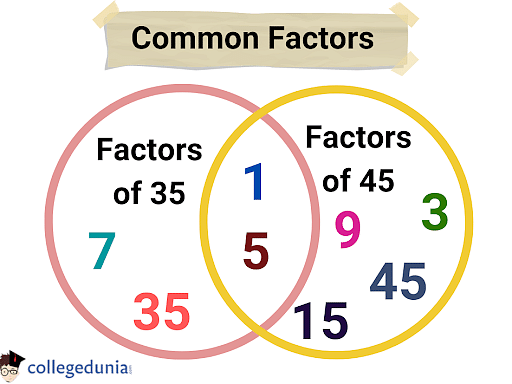
In order to find the common factors of two numbers say 35 and 45, we need to first write down all the factors of these two numbers.
- Factors of 35: 1, 5, 7, 35
- Factors of 45: 1, 3, 5, 9, 15, 45
Here, 1 and 5 are the common numbers that are exactly dividing both 35 and 45. Thus, the common factors of 35 and 45 are 1 and 5.
Common Factors
Read More:
| Relevant Concepts | ||
|---|---|---|
| Relation Between HCF and LCM | LCM Formula | Multiplication and Division of Integers |
| Properties of LCM and HCF | Dividend | Perfect Numbers |
How to Find Common Factors?
[Click Here for Sample Questions]
We know that the factors of a number are those numbers that are the exact divisors of a number. Here is a step-by-step procedure to find the common factors of a number:
- Step 1: First, write down all the factors of given numbers separately.
- Step 2: Now, find out the factors that are common in the given numbers and write down all the common factors separately.
Solved Example
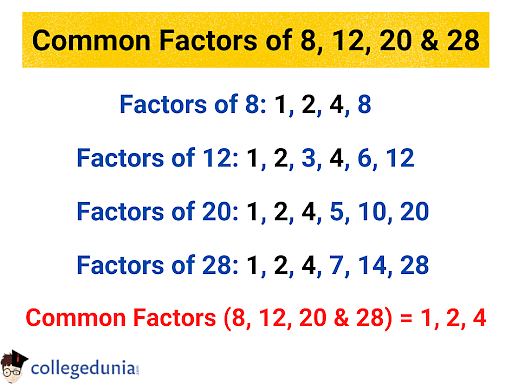
Example: Find the common factors of 8, 12, 20, and 28.
Ans. The common factors of 8, 12, 20, and 28 will be calculated as:
Step 1: We will first write down all the factors of given numbers.
- Factors of 8: 1, 2, 4, and 8.
- Factors of 12: 1, 2, 3, 4, 6, and 12.
- Factors of 20: 1, 2, 4, 5, 10, and 20.
- Factors of 28: 1, 2, 4, 7, 14, and 28.
Step 2: Now, write down the common factors of all four numbers which are 1, 2, and 4.
Common Factors of 8, 12, 20, and 28
Greatest Common Factor
[Click Here for Sample Questions]
Greatest Common Factor (GCF) is defined as the largest common factor of two or more numbers.
- Once the common factors of given numbers are found, then, the largest number that is found is referred to as the greatest common factor.
- The greatest common factor is also referred to as the Highest Common Factor (HCF) or Greatest Common Divisor (GCD).
- Consider that a and b are two natural numbers. Thus, the GCF of two natural numbers a and b is the largest possible number that divides both a and b.
Solved Example
Example: What is the greatest common factor of 68 and 88?
Solution: Writing down all the factors of 68 and 88, we get
- Factors of 68: 1, 2, 4, 17, 34, and 68.
- Factors of 88: 1, 2, 4, 8, 11, 22, 44, and 88.
It can be seen that the common factors of 68 and 88 are 1, 2, and 4. Here, 4 is the greatest factor among all the common factors. Thus, the Greatest Common Factor (GCF) of 68 and 88 is 4. It will be written as GCF (68, 88) = 4.

Greatest Common Factor of 68 and 88
Common Factors Examples
[Click Here for Sample Questions]
Given below are a few solved examples of common factors:
Example 1: Find the common factors of 12 and 18.
Solution: First, write down all the factors of 12 and 18;
- Factors of 12: 1,2,3,4,6, 12
- Factors of 18: 1,2,3,6,9, 18
1, 2, 3, and 6 are the factors that are common in both 12 and 18. Thus, the common factors of 12 and 18 are 1, 2, 3, and 6.
Example 2: What is the greatest common factor of 12, 24, and 18?
Solution: Listing all the factors of 12, 24, and 18, we get
- Factors of 12: 1, 2, 3, 4, 6, and 12
- Factors of 24: 1, 2, 3, 4, 6, 8, 12, and 24
- Factors of 18: 1, 2, 3, 6, 9, and 18
It is seen that the common factors of 12, 24, and 18 are 1, 2, 3, and 6. Thus, the greatest common factor of 12, 24, and 18 is 6.
Check More:
Things to Remember
- Common Factors are whole numbers that are factors of two or more numbers.
- A number that divides a pair of two or more numbers exactly without leaving any remainder is defined as a common factor.
- To find common factors, write all the factors of the numbers and those numbers that are common in all the given numbers are the common factors.
- Greatest Common Factor is the greatest factor that divides two or more numbers completely.
- Greatest Common Factor is also known as Highest Common Factor (HCF) and Greatest Common Divisior (GCD).
Sample Questions
Ques. What are the common factors of 8 and 24? (2 Marks)
Ans. We will write all the factors of 8 and 24,
- Factors of 8: 1,2,4,8
- Factors of 24: 1,2,3,4,6,8,12,24
Thus, the common factors of 8 and 24 are 1, 2, 4, and 8.
Ques. How to calculate common factors? (2 Marks)
Ans. In order to find the common factors of two or more numbers, follow the given steps:
- Step 1: List down all the factors of the given numbers.
- Step 2: Check and see which numbers are common in them.
The numbers thus obtained will be the common factors of the given numbers.
Ques. What are common factors? (2 Marks)
Ans. Common factors are those factors that are common to two or more numbers. In simpler terms, the numbers that divide two or more numbers completely leaving zero as the remainder are referred to as the common factors.
Ques. List the common factors of 3 and 5. (2 Marks)
Ans. The factors of 3 and 5 are
- Factors of 3: 1 and 3.
- Factors of 5: 1 and 5.
Since 3 and 5 are prime numbers, there is only one common factor of 3 and 5 which is 1.
Ques. Mention the common factors of 10 and 15. (2 Marks)
Ans. We know that the factors of 10 and 15 are
- Factors of 10: 1, 2, 5, 10
- Factors of 15: 1, 3, 5, 15
Thus, the common factors of 10 and 15 are 1, and 5.
Ques. List the common factors of 12 and 15. (2 Marks)
Ans. Writing down all the factors of 12 and 15,
- Factors of 12: 1, 2, 3, 4, 6, 12
- Factors of 15: 1, 3, 5, 15
Thus, the common factors of 12 and 15 are 1 and 3.
Ques. What are the common factors of 13 and 15? (2 Marks)
Ans. The factors of 13 and 15 are
- Factors of 13: 1, 13
- Factors of 15: 1,3, 5, 15
Therefore, the common factor of 13 and 15 is 1 which means that they are co-prime numbers.
Ques. State the common factors of 48 and 36. (2 Marks)
Ans. The factors of 48 and 36 are
- Factors of 48: 1, 2, 3, 4, 6, 8, 12, 16, 24, and 48
- Factors of 36: 1, 2, 3, 4, 6, 9, 12, 18, and 36
Therefore, the common factors of 48 and 36 are 1, 2, 3, 4, 6, and 12.
Ques. What is meant by Lowest Common Factor? (2 Marks)
Ans. The lowest common factor refers to the least number that would divide two or more numbers completely. The lowest common factor for all the numbers will always be 1 for any set of numbers, as 1 is the factor of all numbers.
Ques. What is Greatest Common Factor? (2 Marks)
Ans. Greatest common factor refers to the largest factor that is common to two or more numbers. Thus, the greatest number that divides any set of numbers is called the greatest common factor of that number. It is also known as Highest Common Factor (HCF) and Greatest Common Divisior (GCD).
Check-Out:



Comments