



Content Curator
The Schrödinger Equation is a mathematical equation that expresses how a physical quantity changes over time while accounting for quantum factors such as wave-particle duality.
- The Schrodinger wave equation describes the behavior of a particle in a field of force or the change of a physical parameter over time.
- Erwin Schrödinger developed the equation and received the Nobel Prize in 1933.
- Schrodinger's wave equation is similar to Newton’s laws of motion but not as deterministic as Newton's law of motion.
- The possible positions of the subatomic particles observed can be predicted if the initial conditions are known.
- However, Newton's equations of motion may be used to determine the position of an item after a certain period if the beginning position of the object and the number of forces acting on it are known.
- The Schrödinger Equation exists in two forms: time-dependent and time-independent.
| Table of Content |
Key Terms: Schrodinger's equation, Wave matter duality, Time-dependence, Schrodinger wave equation, Maxwell Equation, Position, Time, Electron, Atom
What Is Schrodinger Wave Equation?
[Click Here for Sample Questions]
The Schrodinger wave equation is a mathematical equation that describes the energy and position of an electron in space and time while accounting for the matter wave nature of an electron within an atom.
- The Schrodinger equation provides an in-depth explanation of the wave functions or probability waves that control the behavior of some smaller particles.
- The equation also shows how these waves are affected by external forces.
- Furthermore, the equation makes use of the energy conservation concept, which provides information on the behavior of an electron connected to the nucleus.
- Calculating the Schrödinger equation gives Ψ and Ψ2, which help in determining quantum numbers, orientations, and shapes of orbitals, where electrons lie in molecules or atoms.
There are two Schrodinger wave equation
- Time-dependent Schrödinger equation
- Time-independent Schrödinger equation
The time-dependent Schrödinger equation is given by
\(i \hbar \frac{d}{d t}|\Psi(t)\rangle=\hat{H}|\Psi(t)\rangle\)
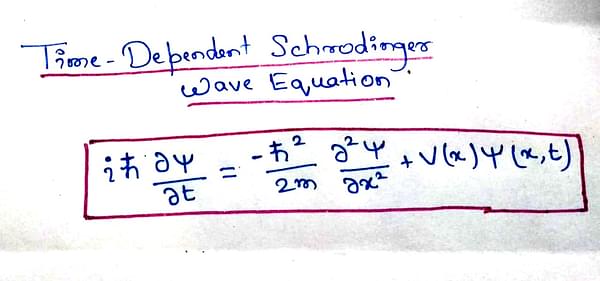
Based on position, the time-dependent Schrödinger equation is given by
\(i \hbar \frac{\partial \Psi}{\partial t}=-\frac{\hbar^{2}}{2 m} \frac{\partial^{2} \Psi}{\partial x^{2}}+V(x) \Psi(x, t) \equiv \tilde{H} \Psi(x, t)\)
Where
- i = Imaginary unit
- Ψ = Time-dependent wavefunction
- h2 is h-bar
- V(x) = potential and
- \(\hat{H}\) is Hamiltonian Operator
The time-independent Schrödinger equation in compressed form can be expressed as
\(\hat{H}\Psi = E \Psi\)
The time-independent-Schrödinger-nonrelativistic-equation is given by
\(\left[\frac{-\hbar^{2}}{2 m} \nabla^{2}+V(\mathbf{r})\right] \Psi(\mathbf{r})=E \Psi(\mathbf{r})\)
Check Out:
| Related Articles | ||
|---|---|---|
| Linear Accelerator | Moment of inertia | Unit of Moment of Inertia |
| Rotational Kinetic Energy | Relation between torque and moment of inertia | Radius of Gyration |
Derivation of Schrodinger's Wave Equation (Time-Dependent)
[Click Here for Sample Questions]
Let us consider a complex plane wave
\(\Psi ( x, t ) = Ae^{i(kx - \omega t)}\)
The Hamiltonian system is given by
\(H=T+V\)
Where
- V is the potential energy
- T is the kinetic energy
- H is the total energy
We can write the above equation as
\(E = \frac{ p^{2} }{ 2m } + V(x)\)
Now taking the derivates, we get
\(\frac{\partial \Psi }{ \partial t} = - i \omega A e^{ i(kx - \omega t)} =- i \omega \Psi (x, t)\)
Also
\(\frac{ \partial ^ { 2 } \Psi }{ \partial x^{2} } = -k^{2} Ae^{i (kx - \omega t)} = -k^{ 2 } \Psi (x, t)\)
Now, we know that
\(p = \frac{ 2 \pi \bar{h} }{ \lambda } \:and \: k = \frac{ 2 \pi }{ \lambda }\)
Where
- λ is the wavelength
- k is the wavenumber
We have, \( k = \frac{ p }{ \bar{h} }\)
Therefore, we can write
\(\frac{ \partial ^ { 2 } \Psi }{ \partial x^{2} } = - \frac{ p^{2} }{ \bar{h} ^ {2} } \Psi (x, t)\)
Now multiplying Ψ (x, t) by the Hamiltonian we get,
\(E \Psi (x, t) = \frac{ p^{2} }{2 m} \Psi (x,t) + V(x) \Psi (x, t)\)
The above equation can also be written as
\(E \Psi(x, t) = \frac{ - \bar{h} ^ {2} }{2m} \frac{\partial ^ { 2 }\Psi}{\partial x^{2}} + V(x) \Psi (x, t)\)
The equation of energy wave of a matter wave is written as
\(E = \bar{h} \omega\)
Therefore, we can write
\(E \Psi (x, t) = \frac{ \bar{h} \omega }{ - i \omega } \Psi (x, t)\)
Now, we can get the Schrodinger Wave Equation by combining the right parts
\(i \bar{h} \frac{\partial \Psi}{\partial t} = \frac{- \bar{h} ^{ 2 } }{2 m} \frac{\partial ^ {2} \Psi}{\partial x^{2}} + V(x) \Psi (x, t)\)
This is the derivation of the Schrödinger Wave Equation (time-dependent).
Also Read:
| Related Articles | ||
|---|---|---|
| Angular momentum | Linear momentum | Radial Acceleration |
| Angular Momentum of Electron | Unit of momentum | Rolling motion |
Things to Remember
- The Schrodinger wave equation describes the behavior of a particle in a field of force or the change of a physical parameter over time.
- Schrödinger Equation exists in two forms: time-dependent and time-independent.
- The Schrodinger wave equation is a mathematical equation that describes the energy and position of an electron in space and time while accounting for the matter wave nature of an electron within an atom.
- Newton's rules are deterministic because they can predict how the forces will interact and, as a result, where the object will be at a later point in time.
- The Schrodinger equation is a differential equation that uses all of the spatial coordinates and time to explain the system in question.
Sample Questions
Ques. What is a wave function? (2 Marks)
Ans. A wave function describes matter waves. Matter waves are extremely small particles in motion that have the properties of both a particle and a wave. Any variable characteristic that constitutes matter waves is a wave function of the matter wave. A wave function is represented by the symbol 'Ψ'.
Ques. What is the Hamilton operator used in the Schrodinger equation? (2 Marks)
Ans. In mathematics, an operator is a rule that converts observable properties into new ones. For example, 'A' will be an operator if it can change one property f(x) into another f(y). f(x)= f(y) The Hamiltonian operator is the sum of particles' potential and kinetic energy as measured across three coordinates and time.
Ques. What is meant by stationary state, and what is its relevance to the atom? (3 Marks)
Ans. A stationary state is one in which the probability density | Ψ2 | does not change over time. In an atom, the electron is a matter wave with quantized angular momentum, energy, and so on. The movement of electrons in their orbits causes the probability density to vary exclusively in terms of radius and angles.
The movement is similar to a stationary wave between two fixed endpoints and is time-independent. The wave function notion of matter waves is used to identify an atom's changeable characteristics through its electrons.
Ques. What is the Schrodinger wave equation's solution? (2 Marks)
Ans. The Schrödinger equation has a valid solution in the form of the wave function Ψ(x, t) = Aei(kx − ωt). Because it represents a particle with zero net force, the wave function is referred to as the free wave function (constant V ).
Ques. What is the significance of the Schrodinger equation? (2 Marks)
Ans. The use of the Schrödinger equation is to figure out where the electron might be at any given time. The significance was that electrons were exceedingly unpredictable, but scientist Erwin Schrödinger's experiment brought order to the chaos. They discovered that electrons behave similarly.
Ques. What are the Schrodinger wave equation's limitations? (3 Marks)
Ans. To summarise, the Schrodinger equations have the following flaws:
- This is not a description of spin.
- Under the motion of the observer, the transformation is not working effectively.
- Due to a lack of understanding of relativity, replies are erroneous.
Ques. For a free particle, what is the time-dependent Schrödinger equation? (2 Marks)
Ans. For a free particle, the time-dependent Schrodinger equation is given by
\(i \hbar \frac{\partial \Psi}{\partial t}=-\frac{\hbar^{2}}{2 m} \frac{\partial^{2} \Psi}{\partial x^{2}}+V(x) \Psi(x, t) \equiv \tilde{H} \Psi(x, t)\)
Ques. What are some of the Schrodinger wave equation's applications? (3 Marks)
Ans. Some of the applications are:
- In quantum mechanics, the Schrodinger equation is particularly useful for studying the motion of microscopic particles, just as Newton's laws are in classical mechanics for studying the motion of large entities.
- Underwood can solve problems involving particle motion that is confined by some form of interaction by solving the Schrodinger equation in a specific setting.
- The Schrodinger equation is solved in this case for particles interacting in a uniform potential well.
Ques. In the Schrodinger wave equation, what is the Hamilton operator used? (2 Marks)
Ans. In mathematical equations, operators are referred to as the rules that help in the conversion of an observed attribute into another attribute. The Hamilton operator is referred to as the calculation of the sum of the energies both kinetic and potential of particles over three coordinates and time.
Hamiltonian operator = \(\check{H}\) = T + V = Kinetic energy + Potential energy
\(\check{H} = - \frac{h^2}{2 m}( \bigtriangledown)^2 +V(r,t)\)
Ques. What is referred to as the stationary state and its relevance to atoms? (3 Marks)
Ans. The stationary state is referred to as the system’s state where the probability density doesn’t vary with time. An electron present within an atom is a matter wave that has a particular quantity of angular momentum, energy, etc. The electron’s momentum within its orbit can be stated as such that the probability density changes only with a change in its radius and angles. In between two stable ends, the movement is similar to a stationary wave without depending on the time. The electrons present within an atom help to understand the variable properties by applying the wave function concept of matter waves.
For Latest Updates on Upcoming Board Exams, Click Here: https://t.me/class_10_12_board_updates
Check-Out:



Comments