


.jpg?h=35&w=35&mode=stretch)
Osmosis is the spontaneous movement of solvent molecules through a semipermeable membrane from a low-solute concentration region to a high-solute concentration region. This process occurs to equalize the concentrations on both sides of the membrane. Osmosis is a passive process that does not require energy expenditure.
What is Osmosis?
[Click Here for Sample Questions]
Osmosis is the movement of solvent molecules through a semipermeable membrane, from a solution of low concentration to a solution of high concentration.
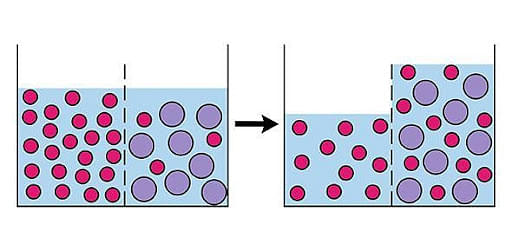
Osmosis
- Molecules move from high concentration to low concentration.
- The process ends when concentrations on both sides of the membrane become equal.
- Osmosis does not require the use of energy.
Osmotic Solutions
[Click Here for Sample Questions]

Osmotic Solutions
The three types of osmotic solutions:
- Hypotonic.
- Isotonic
- Hypertonic
A hypotonic solution is a solution with a higher solute concentration inside the cell than outside. Water moves into the cell by osmosis, causing it to swell and become turgid.
An isotonic solution is one that has the same concentration of solute both within and outside the cell. The cell membrane does not experience any net movement of water.
A hypertonic solution contains a higher amount of solutes outside the cell than inside. Water exits the cell by osmosis, causing it to shrink and become flaccid.
Types of Osmosis
[Click Here for Sample Questions]
There are two types of osmosis: Endosmosis and Exosmosis.
- Exosmosis: Exosmosis involves the use of a hypertonic solution. The substance is placed in the solution, due to which the solvent molecules start moving outside the cell. This leads to the cell going through the process of plasmolysis.
- Endosmosis: Endosmosis involves the use of a hypotonic solution. The substance is placed in the solution, due to which the solvent molecules start moving inside the cell. This leads to the cell going through the process of deplasmolysis.
Osmotic Pressure
[Click Here for Sample Questions]

Osmotic Pressure
The pressure required to stop the process of osmosis is called osmotic pressure. Osmotic pressure stops the water from diffusing through the membrane. The water travels from a region of high concentration to a region of low concentration until the concentration is equal on both sides.
Osmotic pressure is the product of temperature, molar concentration, and gas constant.
| Osmotic Pressure = M × R × T |
In the above equation,
- M denotes molar concentration.
- R denotes constant.
- T denotes the temperature.
Effect of Osmosis on Cells
[Click Here for Sample Questions]

Effects of Osmosis on Plant Cells
Osmosis has significant effects on both plant and animal cells.
Osmosis is essential for preserving turgor pressure in plant cells, which gives the plant structural support and enables it to stand upright. Turgor pressure is produced when water enters plant cells in a hypotonic solution, forcing the central vacuole to expand and press on the cell wall.
Animal cells are more susceptible to osmotic pressure fluctuations since they do not have a cell wall. They can burst from consuming too much water in a hypotonic environment, and they can shrink and possibly die in a hypertonic environment.
Significance of Osmosis
[Click Here for Sample Questions]
- Osmosis helps keep the cells turgid.
- Diffusion of water in cells is controlled through osmosis.
- Osmosis prevents drought injury in plants by building high osmotic pressure.
- Dehiscence of sporangia is controlled by osmosis.
- The transport of nutrients in plants is aided by osmosis.
- Plants release metabolic waste products through osmosis.
- Osmosis helps plants in maintaining their water content.
- Osmosis helps plants in absorbing water from the soil and transport it throughout the plants.
- Osmosis maintains the level of water and other cellular fluids in living organisms.
Things to Remember
- Osmosis refers to the process of movement of solvent molecules through a semipermeable membrane.
- The molecules move from a solution of low concentration to a solution of high concentration.
- The two types of osmosis are Endosmosis and Exosmosis.
- Endosmosis involves the use of a hypotonic solution whereas exosmosis involves the use of a hypertonic solution.
- The three types of osmotic solutions are Isotonic, Hypertonic, and Hypotonic.
- The solute concentration is equal on both sides of cells in an isotonic solution. An isotonic solution is ideal for animal cells.
- The molecules travel from high concentration to low concentration until the concentration is equal on both sides.
- Osmosis is important in living organisms.
- Osmosis helps plants in absorbing water from the soil and transport it throughout the plants.
- The diffusion of water in cells is controlled through osmosis.
Sample Questions
Ques. What is reverse osmosis? (2 Marks)
Ans. Reverse osmosis is the process of filtration that is used to filter large molecules and impurities. Only pure water can pass through the semipermeable membrane used in reverse osmosis. Reverse osmosis works by reversing the process of osmosis. In reverse osmosis, the pressure applied is higher than the osmotic pressure. Opposed to osmosis, reverse osmosis is an artificial process. It is often used in water purification systems. It removes bacteria and other impurities from water.
Ques. What are some examples of osmosis? (3 Marks)
Ans. Some examples of osmosis are:
- Fingers become pruney when they are placed in water for a long time period. This is because the water travels and flows inside the cells.
- When a fish from freshwater or saltwater is placed in water that has different concentrations of salt, the fish doesn’t survive for long. This is due to the flow of water in fish cells of fish.
- Osmosis helps plants in absorbing water from the soil. The water flows from the soil to the roots of the plants as the roots have higher concentrations.
Ques. Write a note on active transport. (2 Marks)
Ans. The process of movement of molecules from a low concentration area to a high concentration is known as active transport. This process requires energy. Molecules move using the stored energy in adenosine triphosphate, with help of protein pumps. The two types of active transport are primary active transport and secondary active transport. In primary active transport, ATP breakdown supplies energy for molecule movement to take place. In secondary active transport, electrochemical energy is used for molecule movement.
Ques. Write a note on Passive Transport. (3 Marks)
Ans. The movement of molecules and ions within the cell, without the use of any external energy, is called passive transport. The four types of passive transport are:
- Simple Diffusion: The movement from areas of high concentration to low concentration is called simple diffusion.
- Facilitated Diffusion: The passive transport of molecules and ions through the cell membrane is called facilitated diffusion.
- Filtration: The process of separating solids, liquids, and gas is called filtration.
- Osmosis: Osmosis is the process of movement of solvent molecules from a solution of low concentration to a solution of high concentration, through a semipermeable membrane.
Ques. Write a note on Plasmolysis. (3 Marks)
Ans. The process of contraction of the protoplasm of a plant cell is called plasmolysis. Loss of water in cells leads to plasmolysis. There are two types of plasmolysis, concave and convex. The cell membrane starts to detach from the cell wall during concave plasmolysis.
In convex plasmolysis, the cell membrane completely detaches from the cell wall. Concave plasmolysis can be reversed whereas convex plasmolysis cannot be reversed. The process of plasmolysis takes place in three steps: Incipient plasmolysis, Evident plasmolysis, and Final plasmolysis.
Ques. What is diffusion? What are the factors affecting diffusion? (2 Marks)
Ans. Diffusion refers to the process of movement of molecules from areas of high concentration to areas of low concentration. Diffusion occurs in all living organisms. It is a natural process that occurs in all living organisms. Diffusion is of two types: simple diffusion and facilitated diffusion. Several factors affecting diffusion are particle size, temperature, area of interaction, and concentration gradient. Diffusion can occur in solids, liquids, as well as gases.
Ques. What is the difference between Endosmosis and Exosmosis? (4 Marks)
Ans. Difference between endosmosis and exosmosis:
| Endosmosis | Exosmosis |
|---|---|
| In endosmosis, the process takes place towards the inside of the cell. | In exosmosis, the process takes place towards the outside of the cell. |
| Endosmosis leads to the swelling of cells. | Exosmosis leads to shrinkage in cells. |
| Endosmosis involves the use of a hypotonic solution. | Exosmosis involves the use of a hypertonic solution. |
Ques. What is the difference between osmosis and diffusion? (4 Marks)
Ans. The key difference between diffusion and osmosis is tabulated below:
| Osmosis | Diffusion |
|---|---|
| Osmosis only takes place in liquids. | Diffusion takes place in solids, liquids, and gases. |
| A semi-permeable membrane is essential for osmosis. | A semi-permeable membrane is not essential for diffusion. |
| During osmosis, particles flow in one direction. | During diffusion, particles flow in all directions. |
| Only solvent molecules travel from one side to another during osmosis. | All molecules travel from one side to another during diffusion. |
Check-Out:



Comments