



Content Writer
Glucose and Fructose are common examples of monosaccharides or simple sugars. They are referred to as monosaccharides because they have six carbon atoms. These sugars are the structural isomers of one another and have only one difference that Glucose contains aldehyde functional group and Fructose contains ketone functional group.
| Table of Content |
Key Terms: Glucose, Fructose, L-Glucose, D-Glucose, starch, sugar, carbohydrates, monosaccharides, aldehyde, ketone functional group, Atoms
Glucose
[Click Here for Sample Questions]
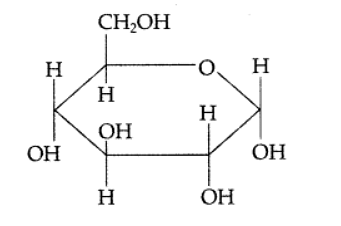
Glucose is a monosaccharide which is found in carbohydrates such as table sugar and starch. It is also known as blood sugar or grape sugar. It forms a pyranose ring structure and is represented as a ring of six members. Being aldohexose, it is the body’s primary and preferred source of energy. Glucose is mainly found in starch compounds.
Read More:
Fructose
[Click Here for Sample Questions]
Fructose is a monosaccharide which is found in substances like fruits and vegetables. Fructose has a lower glycemic index than Glucose. Fructose binds to cellular protein with a speed rate of seven times that of glucose. Fructose is also known as fruit sugar, D-Fructose. It is not found in starch and is metabolised primarily in the Liver. Ketone is its functional group.
Structure of Glucose
[Click Here for Sample Questions]
Glucose is a group of carbohydrates of a simple sugar with chemical formula C6H12O6. It is made up of an aldehyde group and 6 carbon atoms, so it’s also called aldohexose. It exists in two forms which are either Ring (cyclic) form or open-chain (acyclic) form. Glucose is a major source of energy for a lot of living organisms. It is prepared by plants and algae with the help of water, sunlight and carbon dioxide during photosynthesis. It is found naturally in honey and fruits. The glycogenolysis process is used to obtain glucose present in animals.
Steps to draw the Open Chain structure of glucose
The steps to draw an open-chain structure or acrylic structure of a glucose molecule are given below:
Step 1: Firstly, draw six carbon atoms.
Step 2: Now extend arms for all the carbon atoms but don’t extend the first one’s.
Step 3: Now draw four hydrogen bonds to carbon bonds such that four are on one side and one hydrogen bond on the other side.
Step 4: Fill the rest of the remaining spaces with an OH group. (Note – To show that oxygen is bonded to carbon you must transpose (OH) to —> (HO) for the left side.)
Step 5: Complete the ends with two single-bonded hydrogen bonds and one double-bonded carbon.
The concept of the open-chain structure of glucose was introduced by Baeyer, but then Haworth introduced the cyclic structure of glucose confirming the existence of mutarotation, alpha and beta forms of glucose, etc. The open-chain structures did not explain the process of mutarotation or why Schiff base or sodium bisulphate fails to react with glucose. The open-chain structure of glucose is as follows :
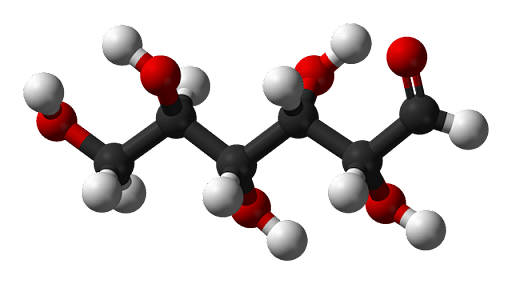
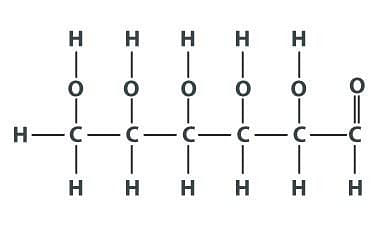
Open Chain structure of glucose
Steps to draw the Ring Structure of glucose
The steps to draw a ring structure or cyclic form of a glucose molecule is given below:
Step 1: Draw a hexagon.
Step 2: Draw five carbon atoms at consecutive edges.
Step 3: Now attach an oxygen atom to the one remaining edge.
Step 4: Attach the H and OH groups to the four carbon atoms.
Step 5: Finish the structure by attaching the one remaining carbon atom to the OH group, one carbon atom and two hydrogen atoms.
Properties of Glucose
[Click Here for Sample Questions]
| Category | Property |
|---|---|
| Glucose Formula | C6H12O6 |
| Glucose Molar mass | 180.156 g/mol |
| Glucose Chemical Formula | C6H12O6 |
| IUPAC Name | D-Glucose |
Structure of Fructose
[Click Here for Sample Questions]
A monosaccharide and a simple sugar with a chemical formula of C6H12O6 are known as Fructose. It is also known as fruit sugar and was discovered by a French chemist Augustin-Pierre Dubrunfaut in the year 1847. It is made up of 6-carbon polyhydroxy ketone.
A cyclic structure of six members fails to explain the stability of the internal hydrogen bonding and hemiketal. This form is also known as D-fructopyranose. It can be found naturally in vine fruits, honey, most root vegetables, flowers and berries. It can be commercially obtained from sugar cane, maize and sugar beets.
Ring and Open chain structure of a Fructose
The Cyclic structure of fructose is given below:
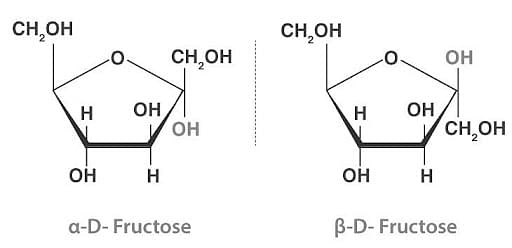
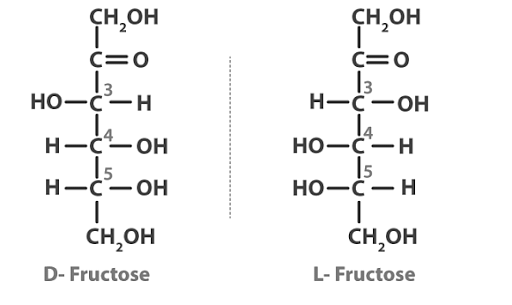
The Fischer projections or open chain structures of L-fructose and D-fructose is given below:
Properties of Fructose
[Click Here for Sample Questions]
Dry fructose is a crystalline white solid. It is odourless and sweet. It is soluble in ether, water and alcohol.
| Category | Property |
|---|---|
| Fructose Formula | C6H12O6 |
| Fructose Molar mass | 180.156 g/mol |
| Fructose Chemical Formula | C6H12O6 |
| Density | 1.694 g/cm3 |
| Melting point | 103°C |
Structural Difference Between the Fructose and Glucose Compounds
[Click Here for Sample Questions]
Fructose and Glucose have a difference in bond connectivity and are also known as constitutional isomers. Fructose is a ketone, while Glucose is an aldehyde. So, when they are cyclized by the formation of hemiacetal/hemiketal, glucose becomes a six-ring sugar while on the other hand, fructose becomes a sugar of five-rings.
Glucose can be metabolized by every cell in living organisms. Therefore, it is the most preferred form of energy by the body. Fructose can only be metabolized by the liver, that is why it should not be taken in a large quantity.
Difference between L-Glucose and D-Glucose
[Click Here for Sample Questions]
L-Glucose Chemistry
D-glucose and L-glucose are composed of similar atoms. The sole difference between these two structures is often displayed using the Fisher model. In the Fisher model, unlike D-glucose, the hydrogen and oxygen group of atoms present in L-glucose points to the left. If these two specific molecules faced one another, they might appear as if a mirrored image of one another.
D-Glucose Chemistry
In the glucose molecule, a hydrogen and oxygen atom group is bonded to the atom. On the opposite side of the glucose molecule, there exists a double-bonded oxygen atom. In the D-glucose Fisher model with the double-bonded oxygen atom, which is pointed down, the hydrogen and oxygen group present at the top of the atom points towards the right.
Things to Remember
- Glucose is a monosaccharide which is found in carbohydrates such as table sugar and starch. It is represented as a ring of six members.
- Fructose is a monosaccharide which is found in substances like fruits and vegetables. It binds to cellular protein seven times faster than that of glucose.
- Fructose is made up of 6-carbon polyhydroxy ketone.
- The hydrogen and oxygen group of atoms present in the structure of L-glucose points to the left.
- In the structure of D-glucose, the hydrogen and oxygen group present at the top of the atom points towards the right.
- The chemical formula of Fructose and Glucose is C6H12O6
- The orientation of the molecules of Glucose and Fructose is different.
Also Read:
Sample Questions
Ques: What are monosaccharides? (All India 2010, 1 Mark)
Ans: Monosaccharides are the simplest carbohydrates which cannot be hydrolysed to smaller molecules. They are commonly known as sugars. The general formula of monosaccharides is (CH2O)n. where n = 3 – 7
Example : glucose, fructose etc.
Ques: Write a reaction which shows that all the carbon atoms in glucose are linked in a straight chain. (All India 2012, 1 Mark)
Ans: Glucose forms n-hexane on heating with HI. It shows that all the six carbon atoms are linked in a straight chain:

Ques: Name the products of hydrolysis of sucrose. (Delhi 2014, 1 Mark)
Ans: Glucose and fructose are the products that are formed by the hydrolysis of sucrose.
Ques: What are biocatalysts? Give an example. (All India 2014, 1 Mark)
Ans: The catalysts which catalyse biochemical reactions are called biocatalysts.
E.g. invertase catalysed hydrolysis of cane-sugar to form glucose and fructose.
Ques: What is the difference between a-form of glucose and p-form of glucose? Explain. (Delhi 2009, 2 Mark)
Ans: In a-α-glucose, the OH group at C1 is towards right while in p-D-glucose, the OH group at C1 is towards left.

Ques: What are invert sugars and what are the products of hydrolysis of sucrose? (All India 2013, 2 Marks)
Ans: Invert sugar: A mixture of glucose and fructose are called Invert sugars. An equimolar mixture of glucose and fructose is obtained by hydrolysis of sucrose in presence of an acid such as dil. HCl or the enzyme invertase or sucrase..
Ques: Write such reactions and facts about glucose which cannot be explained by its open chain structure. (All India 2009, 2 Marks)
Ans: Limitations of the open chain structure of glucose:
- Glucose does not form a NaHSO3 addition product. It has aldehyde-ammonia group but it does not respond to 2,4-DNP test and Schiff’s reagent test.
- Glucose penta acetate does not react with NH2OH due to the absence of an aldehydic group.
Ques: Name the products of hydrolysis of (i) sucrose and (ii) lactose. (All India 2011, 2 Marks)
Ans: (i) On hydrolysis of Sucrose, the products that are obtained are: Glucose and fructose
(ii) Glucose and galactose are the products that are obtained on the hydrolysis of Lactose.
Ques: Write any three reactions of glucose which cannot be explained by the open chain structure of the glucose molecule. (Delhi 2012, 3 Marks)
Ans: Two reactions of glucose which cannot be explained by the open chain structure of the glucose are:
- Glucose does not give 2, 4-DNP test or Schiff’s test.
- It does not form the hydrogen sulphite addition product with NaHSO3.
- The pentaacetate of glucose does not react with hydroxylamine indicating the absence of the free –CHO group.
Ques: (a) What type of linkage is present in proteins? (b) Give one example of water soluble and fat soluble vitamins. (c) Draw pyranose structure of glucose. (Comptt. Delhi 2016, 3 Marks)
Ans: (a) Peptide linkage is present in proteins.
(b) Vitamin C is water soluble vitamin and Vitamin D is fat soluble vitamin.
(c) Pyranose structure of glucose:
Ques: (i) Deficiency of which vitamin causes rickets? (ii) Give an example for each fibrous protein and globular protein. (iii) Write the product formed on reaction of D-glucose with Br2 water. (Delhi 2014, 3 Marks)
Ans: (i) Rickets is caused by the deficiency of Vitamin D.
(ii) Example of Fibrous protein = α-keratin
Example of Globular protein = Insulin
(iii) The product which is formed by the reaction of D-glucose with Br2 water

For Latest Updates on Upcoming Board Exams, Click Here: https://t.me/class_10_12_board_updates
Also check:



Comments