



Exams Prep Master
Chemical reactions are constantly taking place around us at all times. The most common types of them are endothermic and exothermic reactions which have heat playing a crucial role in their process. Energy is released because of bond formation at higher levels, whereas they break at lower levels. These reactions determine a lot of activities around us like the melting of ice, gas explosions, evaporation of water, etc.
Let us take a better look at these types of reactions, their examples, and the differences between them.
| Table of Content |
Read More: Diatomic
What are Endothermic Reactions?
[Click Here for Sample Questions]
An endothermic process can be defined as a chemical reaction that is associated with absorbing energy from its outer environment in the form of heat. The term ‘endothermic’ was first used by Marcellin Berthelot, who derived it from the Greek root endo, coming from the word endon which meant within. The root ‘therm’, meaning hot, was initially used to indicate that any reaction depends on absorbing heat in order to move forward.
We can find endothermic reactions happening around us in our day-to-day lives. Melting of ice, evaporation of liquids, thermal decomposition, salt being dissolved in water, cracking of alkanes, dry ice, ammonium chloride in water, hydrolysis, sublimation, are all good examples of endothermic reactions.
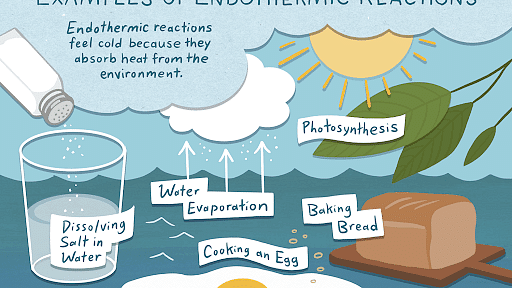
Energy is absorbed in this process. The formation of energy is possible due to reactants transforming into products. Bonds end up dissociating with the molecules, which gives rise to energy as new bonds are formed. As all the heat is absorbed here, the temperature of the surrounding drops down and becomes cooler.
Read more: Hydrogen Spectrum
What are Exothermic Reactions?
[Click Here for Sample Questions]
Exothermic reactions are a total contrast to endothermic reactions. They give out, or release energy from the system into the environment. This energy may be in the form of heat, or even light, electricity or sound. The word takes its origination from the Greek root exo, which denotes outwards, and the root thermikos, which means thermal. The name exothermic was used by Marcellin Berthelot. This concept of exothermic reactions is commonly used in Chemistry, where chemical bond energy is transformed into thermal energy or heat. Burning of a substance, reactions caused by fuels, dry ice deposition, respiration, neutralisation, dissolving of sulphuric acid into water are commonly known examples of exothermic reactions happening around us.

As these chemical reactions involve emitting a lot of energy into the atmosphere, they may get dangerous at times because of high rate reactions. These are warmer than endothermic reactions.
Read more: Uses of Carbonyl Compounds
Difference between Endothermic and Exothermic Reactions
[Click Here for Sample Questions]
Given below, are some common differences you can find between endothermic and exothermic reactions. Let us take a look at the following.

| Endothermic reaction | Exothermic reaction |
|---|---|
| Endothermic reaction is a chemical reaction which absorbs energy from the environment in the form of heat. | Exothermic reaction is opposite of endothermic reaction. It releases energy in the form of heat. |
| Energy is absorbed from the surrounding and goes into the reaction. | Here, energy flows out of the reaction and goes into the surrounding. |
| Energy can be found present in the form of heat only. | Energy can take multiple forms like heat,light, electricity, or sound. |
| Makes surroundings cooler. | Makes the environment hotter. |
| Contain more energy than exothermic reactions. | Contains lesser energy as compared to endothermic reactions. |
| Examples - Melting of ice, evaporation, photosynthesis | Examples - Nuclear explosions, nuclear fission, rusting of iron |
Things to Remember
- Exothermic reactions and endothermic reactions are an important part of Chemistry. We depend upon them on a daily basis for heat energy. For example we require hand warmers in winters as they keep us warm. They take or absorb the heat from surroundings to function. They are also helpful in investigation of fire, and explosions.
- Chemical reactions are often influenced by the laws of Thermodynamics which decide whether any reaction is exothermic or endothermic. When they are exothermic a negative heat energy is released, while the opposite happens in case of endothermic reactions.
- Endothermic reactions involve absorption of energy from the surroundings. These take place at a high temperature where the entropy increases. Cooking an egg, splitting of a gas molecule, and baking of bread are all good examples of endothermic reactions.
- Exothermic reactions have an opposite nature to that of endothermic fractions. They give out excessive energy and this heat energy may be present in forms of light, electricity or sound. A very typical example of exothermic reaction is crystallisation which gives rise to solids, from liquids or gases.
Read more:
Sample Questions
Ques. Explain rusting of iron process reaction. (2 marks)
Ans. It can be concluded that rusting of iron is an exothermic process. Air consists of a certain amount of moisture in itself. When this air comes in contact with a piece of iron, rust is formed, which gives out a lot of energy. Oxidation of iron takes place due to the presence of oxygen, which forms rust. The reaction does not happen vigorously which is why the emission of heat may go unnoticed sometimes.
Ques. Give some examples of endothermic reactions in day to day life. (2 marks)
Ans. Some common examples of endothermic reactions are,
- Dissolving of ammonium chloride - Upon taking a small quantity of ammonium chloride is put inside a test tube with water, it can be observed that the temperature of the test tube drops down and becomes very cold. This suggests that, in this reaction, heat is absorbed from the outside environment of the test tube.
- Melting of ice is also a good example of endothermic reaction. Here, an ice cube is present, absorbs heat from its surroundings, and thereby starts turning into water. This is also known as melting. Similarly, evaporation is also an endothermic reaction.
Ques. How to know if a reaction is exothermic or not? (2 marks)
Ans. We know that according to the equation for exothermic reactions,
Reactants → Products + Energy
Change in energy is denoted as ΔH. If the temperature rises when the reaction is taking place, we can infer that it's an exothermic reaction. Also, if by adding the enthalpies of the said reactants, turns out to be greater than the product itself, it will surely be an exothermic reaction.
Ques. In what way photosynthesis is an endothermic reaction? (2 marks)
Ans. We know that plants require energy from the Sun in order to carry out its process. It needs it to convert it into carbon dioxide and water into glucose and oxygen. Without energy from the sun, it won't be able to do photosynthesis. It's an endothermic reaction where light is absorbed by the green pigment called chlorophyll which is present in the leaves.
Ques. How does endothermic reaction differ from exothermic reaction? (2 marks)
Ans. Energy is present as heat in endothermic reactions, whereas it can be found present in the form of heat, sound, light, and electricity in exothermic reactions. Energy is drawn or absorbed in the former, whereas on the other hand, the same is released into the atmosphere in the latter. Enthalpy is positive in endothermic reactions, however it becomes negative in the exothermic reactions. Melting of ice, photosynthesis make for great examples of endothermic reactions, while rusting of iron, nuclear fission are examples of exothermic reactions.
Ques. What will happen with the rate of an exothermic reaction, due to an increase in temperature? (2 marks)
Ans. In an exothermic reaction, the reaction will speed up and start to occur vigorously in case the temperature is raised from the optimal temperature level.
It is because energy usually comes out of complex bonds present in the reactants. It usually requires a kickstart for the whole process. A little warmth from a matchstick is enough. So when the temperature is made to increase, it automatically starts emitting heat readily.
Ques. Name the type of reactions taking place in Chemistry. (2 marks)
Ans. There are basically four kinds of chemical reactions happening all over.
- Synthesis
- Decomposition
- Single replacement
- Double replacement
Ques. What are chemical reactions? (2 marks)
Ans. Chemical reactions can be termed as a transformation of a group of compound substances into another. They usually involve a change in the position of electrons without disturbing the nuclei. The substance which is a part of the reaction is known as reactant. These chemical reactions will continue to fluctuate back and forth, until they reach a point of equilibrium.
Ques. Why is energy required in the ecosystem? (2 marks)
Ans. Energy plays a great role in maintaining a healthy balance of the ecosystem. There are two kinds of energy, radiant, and fixed energy. Electromagnetic waves come together to form radiant kinds of energy. On the other hand, fixed energy is a kind of chemical energy and it can be broken down to retrieve it from different sources to which it is tied to.
Ques. What are the different levels in the ecosystem? (2 marks)
Ans. The levels of ecosystem are given as,
- Complete food chain - Taken up by the producers
- First trophic level - Green plants occupy this level
- Second trophic level - Herbivores can be found in this group
- Third trophic level - Taken up by carnivores
Chemistry Related links:



Comments