



Education Journalist | Study Abroad Lead
Humans and Animals are both very distinct from each other. Humans are the most intelligent living organisms known on Earth. Humans are capable of thinking and reacting to situations, whereas, animals are not. When it comes to the brain, the human brain is considered large compared to the animal brain. Human brains have a phenomenal cognitive capability, which is the greatest accomplishment of evolution, whereas animal brains have significantly less cognitive power. Furthermore, the cerebral cortex of the human brain, which is responsible for its superior cognitive capacity, is disproportionately massive, accounting for more than 80% of total brain mass, whereas the cerebral cortex of the animal brain is not particularly huge.
| Table of Content |
Key Terms: Human Brain, Animal Brain, Nervous System, Neurons, Cerebral Cortex, Spinal Cord, Skull, Forebrain, Midbrain, Vertebrate, Invertebrates, Medulla, Hindbrain, Cognitive Ability
Human Brain
[Click Here for Sample Questions]
The brain is a portion of the central nervous system that is placed in the skull of humans. The brain's major purpose is to govern the body's processes by integrating, analysing, and organising information in order to make decisions and convey them to the effector organs. It is rather huge; the average human brain weighs roughly 1.2 kg. The cerebrum, brainstem, and cerebellum are the three major components of the human brain. The cerebrum, which consists of two cerebral hemispheres, is the biggest region of the human brain. White matter is found in the cerebrum's core, whereas grey matter is found in the cerebral cortex's outer layer. Furthermore, the cerebral cortex is divided into two parts: the neocortex and the allocortex.
Read More: Difference between Cerebellum and Cerebrum
Animal Brain
[Click Here for Sample Questions]
The brain, which is located in the head area of animals, is also a component of the central nervous system. Animal brains may be classified into three groups based on their structure. The invertebrate, vertebrate, and mammalian brains are the three types. Molluscs, arthropods, worms, and tardigrades are invertebrates. Arthropods and molluscs have the most complicated brains among them. They're made up of twin nerve cords that run parallel to one other and run the length of the body. Molluscs have the biggest brains, with the supra-oesophageal ganglion serving as the arthropod brain.
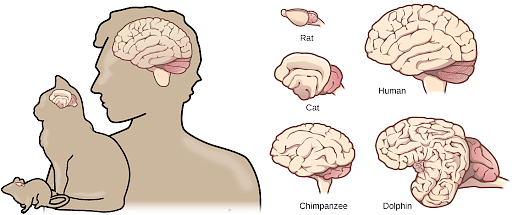
The prosencephalon (forebrain), mesencephalon (midbrain), and rhombencephalon are the three primary regions of the vertebrate brain (hindbrain). The telencephalon (brain hemispheres), diencephalon (thalamus and hypothalamus), mesencephalon (midbrain), cerebellum, pons, and medulla oblongata are the six components of the vertebrates' brain. The size of the brains of vertebrates and mammals differs significantly. Mammalian midbrains and hindbrains are also smaller than human forebrains. The cerebral cortex of humans and monkeys has expanded dramatically, enhancing their cognitive abilities.
Read More: Hypothalamus: Structure, Functions, Hormones and Its Disorder
Differences Between Human Brain and Animal Brain
[Click Here for Sample Questions]
The major distinctions between the human brain and the animal brain are as follows:
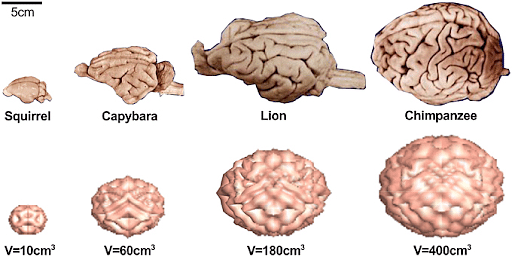
- Brain size: The majority of animals have lesser brains than humans have (1.2 kg). However, there are still a few species with greater brains than humans. Dolphins (1.5-1.7 kg), elephants and blue whales (5 kg), and killer whales are among them (6 kg).
- Cerebral Cortex: The cerebral cortex of the human brain is abnormally massive, accounting for more than 80% of total brain mass, whereas the cerebral cortex of the animal brain is comparably tiny.
- Neurons in the Cerebral Cortex: The cerebral cortex of a human brain comprises around 16 billion neurons, but the cerebral cortex of an animal brain includes a far lower number of neurons.
- Cortex Layer Thickness: Humans have a thick cortex layer, whereas animals have a thin cortex layer.
- Texture of the Cortex: Human brain cortex is totally wrinkled, whereas the cortex of other animals' brains is smooth.
- Cognitive Capacity: Human brains have a high cognitive capacity, but animal brains have a low cognitive capacity. As a result, this is the primary distinction between the brains of humans and animals.
- Glia: Glia is the neurons' support cells. The glia-to-neuron ratio is a measure of mental capacity. A Minke whale's glia to neuron ratio is 5.5 times that of humans. A few animals have lower glia to neuron ratio than others.
- Neural Connections: The brains of humans and animals have more developed neural connections, but the brains of animals have less developed neural connections.
- Intellect: Humans are more intellectual than animals because they have more neural connections in their brains, whereas animals have fewer neural connections.
- Neocortex: The neocortex in humans' brains is the biggest, while the neocortex in animals' brains is modest.
- Processing Complexity: Because of the presence of a big neocortex, human brains are capable of sophisticated processing such as conscious cognition, language, and self-awareness, but animal brains are not.
- Olfactory Bulb: Humans have a poor sense of smell due to the tiny olfactory bulb in their brains. Animals, on the other hand, have a huge olfactory bulb in their brains, giving them a superior sense of smell. For example, Capybara and agouti, two rodents, have the biggest olfactory bulbs of any animal. Bears' olfactory bulbs are five times larger than humans'.
- Navigation: Humans have a limited innate navigation skills, however other animals, such as pigeons, can navigate using the magnetic field. Specialized cells in the pigeon's brain respond to magnetic stimuli. They can figure out where they are by sensing variations in the earth's magnetic field.
- Neurogenesis: The process of neurogenesis involves the replacement of neurons that have been injured or destroyed. Neurogenesis occurs 100 times faster in teleost fish than it does in mammals. Neurogenesis takes place at a certain rate in mammals throughout development. Later on, the process is limited to the scent and memory parts of the brain.
- Photographic Memory: Due to photographic memory, children may memorise a lot of information. Chimpanzees have the same quality as humans. Young chimps have a superior capacity to recall numerical sequences as compared to humans.
Read More: Brain Tumors & Neurodegenerative Diseases
Similarities Between Human Brain and Animal Brain
[Click Here for Sample Questions]
Here are some of the similarities between the human brain and the animal brain:
- One of the two components of the central nervous system is the brain, which is found in humans and animals, and the other is the spinal cord.
- Both of these conditions occur in the head area of the body.
- Furthermore, the brain of vertebrate animals is contained within the skull, which is made up of bones.
- Both have a brain made up of neurons and neuroglia, which are supporting cells.
- The telencephalon, diencephalon, midbrain, cerebellum, pons, and medulla are also major components of the vertebrate brain.
- Furthermore, both brains' primary functions are to regulate ideas, memory, and physical movement.
Read More: Difference between Brain and Spinal Cord
Things to Remember
[Click Here for Sample Questions]
- The primary function of the human brain is to control the body's activities by integrating, analysing, and organising data in order to make decisions and communicate them to the effector organs.
- The three primary components of the human brain are the cerebrum, brainstem, and cerebellum.
- The cerebrum is the largest area of the human brain, consisting of two cerebral hemispheres. The cerebrum's core is made up of white matter, whereas the cerebral cortex's outer layer is made up of grey matter. The cerebral cortex is also split into two sections: neocortex and allocortex.
- Based on their structure, animal brains may be divided into three classes. The three types of brains are invertebrate, vertebrate, and mammalian.
- The six components of the vertebrates' brain are the telencephalon (brain hemispheres), diencephalon (thalamus and hypothalamus), mesencephalon (midbrain), cerebellum, pons, and medulla oblongata.
- The brain size, cognitive capacity, and olfactory bulb are three major differences between human and animal brains.
Sample Questions
Ques. What are the various parts of the human brain? Explain each part. (5 Marks)
Ans. The human brain is divided into three sections:
Forebrain- The forebrain is the most important region of the human brain. Emotions, appetite, sleep, body temperature, reproductive bodily parts, and functions are all controlled by the forebrain. The forebrain is made up of three primary components:
- Cerebrum
- Thalamus
- Hypothalamus
Midbrain- The midbrain is the centre portion of the brainstem, and it is smaller than the forebrain. The midbrain is divided into two sections:
- Tectum
- Tegmentum
Hindbrain- The hindbrain is the brain's middle region. It controls all vital bodily activities such as breathing, sleeping, heartbeat, motor learning, and awareness. The hindbrain is divided into three sections:
- Cerebellum
- Medulla
- Pons
Ques. List out five major differences between the human brain and the animal brain. (5 Marks)
Ans. The five major differences between the human brain and the animal brain are as follows:
- Brain Size: Animals generally have smaller brains than humans (1.2 kg). There are, however, a few creatures that have larger brains than humans. Killer whales, dolphins (1.5-1.7 kg), elephants, and blue whales (5 kg) are among them (6 kg).
- Cognitive Capacity: Human brains have a large capacity, but animal brains have a limited capacity. As a result, the major contrast between human and animal brains is this.
- Olfactory Bulb: The small olfactory bulb in humans' brains causes them to have a weak sense of smell. Animals, on the other hand, have a large olfactory bulb in their brains that allows them to have a better sense of smell. The olfactory bulbs of capybara and agouti, two rodents, are the largest of any mammal. Bears have five times the size of a human's olfactory bulb.
- Intelligence: Humans have more neuronal connections in their brains than animals, whereas animals have fewer.
- Neurogenesis: Neurogenesis is the process of replacing damaged or destroyed neurons. In teleost fish, neurogenesis is 100 times quicker than in mammals. In animals, neurogenesis occurs at a set pace during development. Later on, the process is restricted to the brain's olfactory and memory centres.
Ques. Explain what are grey matter and white matter. (3 Marks)
Ans. The distinction between white and grey matter can be stated as follows:
- White matter is found in the brain's deeper tissues. It is made up of axons, which are the extensions of neurons. Myelin covers or protects white matter which is also responsible for its colour. Inside the brain, white matter joins all of the grey matter.
- Grey matter is made up of a variety of cell types. It's mostly found in the brain's outermost layer. Grey matter surrounds the cerebrum, commonly known as the brain cortex, and is somewhat pinkish-grey in hue. Grey matter accounts for the majority of the brain and aids in the processing of information as well as the release of new information.
Ques. List out the similarities between the human brain and the animal brain. (3 Marks)
Ans. The similarities between the human brain and the animal brain are as follows:
- The brain, which is found in both humans and animals, is one of the two components of the central nervous system, together with the spinal cord.
- Both have a brain made up of neurons and supporting cells known as neuroglia.
- The vertebrate brain also contains the telencephalon, diencephalon, midbrain, cerebellum, pons, and medulla.
- In addition, the major duties of both brains are to manage thoughts, memory, and physical movement.
Ques. What is pons? Where is it located? List out its functions. (3 Marks)
Ans. The brain stem's primary component is the Pons. Between the medulla and the midbrain is this structure.
- It regulates the flow of air.
- The sleep cycle is regulated by it.
- The cerebellum sends information or impulses to the motor cortex, and vice versa.
Ques. What is the cerebellum? Where is it located? List out its functions. (5 Marks)
Ans. The cerebellum, which is located in the posterior regions of the pons and medulla, is the second-largest region of the human brain. It is the human brain's second-largest area. The cortex is the outer surface of the cerebellum, and the folia are parallel ridges. The cerebellum and cerebrum are separated apart from each other by the cerebellar tentorium and transverse fissure.
The human brain is encased in a skull made up of 22 bones, 14 of which are facial bones and 8 of which are cranial bones. The frontal, lateral, and dorsal directions are all protected by the skull. Cerebrospinal fluid surrounds the brain, which is enclosed within the skull.
The Cerebellum performs a variety of critical activities, including
- It transmits and receives data.
- It is in charge of the volunteers.
- During walking, cycling, jogging, and swimming, it keeps your body in balance.
- It helps to keep the body in equilibrium by anticipating its future position.
- It also helps to keep the eyes moving in sync.
Ques. Classify the Nervous System. (3 Marks)
Ans. Both the central and peripheral nerve systems make up the nervous system.
- The spinal cord and the brain are both parts of the central nervous system. The brain is in charge of controlling the transmission and reception of messages to and from the body. Through the spinal cord, the brain and nerves communicate.
- Peripheral nerve systems are divided into two categories: autonomic and somatic.
- The body's automatic activities are managed by the autonomic nervous system. The body's voluntary activities are governed by the somatic nervous system.
Ques. Elaborate about the various parts of the nervous system? (5 Marks)
Ans. The nervous system is frequently split into components. The nervous system as a whole is responsible for managing and looping a procedure. As a result, there are a plethora of names to choose from.
- Neuron: Of all the functional components of the nervous system, the neuron is one of the most important. Typically, a neuron is in charge of transmitting and receiving electrochemical signals. It may be divided into three sections, each of which is critical.
- The most important element of a cell is the cell body. The nucleus, endoplasmic reticulum, mitochondria, and ribosomes are all parts of the cell. Importantly, if a cell body dies, the neuron will die.
- Axon: An axon, also known as a nerve cell, is a long, cylinder-shaped structure. Nerve impulses are known to be directed away from the cell body by it.
- Dendrites are the elements that make up both sides of a neuron. Dendrites are a branch-like formation that is projected on either side of a neuron to help it connect with the neighbouring neuron.
Ques. Discuss the function of the nervous system? (3 Marks)
Ans. The most fundamental function of the nervous system is to control the movement of the body and to impact the surroundings (e.g., through pheromones). This is done by sending signals from one cell to the next, or from one bodily component to the next. Muscles contract in response to signals from muscle cells and hormones are released into the bloodstream or other internal fluids in response to signals from endocrine cells, causing the nervous system's output. Sensory cells transform physical modalities like sound and light into neuronal activity and deliver information to the nervous system. Internally, the nervous system possesses complex webs of nerve cell connections that allow it to produce patterns of activity that are only partly dependent on sensory input. The nervous system may also store information over time by dynamically modifying the strength of interconnected neurons, among other mechanisms.



Comments