



Education Journalist | Study Abroad Lead
Brain is the central and primary organ of our nervous system. It is the most complex and one of the largest organs of our body. It helps in the proper functioning of all parts of the body. The human brain is made up of over 100 billion nerves. It consists of many specialized areas that help in forming over trillions of connections to enhance communication and ensure the working of the body as a whole. It is located in the head and is the primary organ of the central nervous system or CNS. Brain is protected by the covering of the skull. In this article, we will have a look at the various brain diseases, their symptoms, and their treatment.
| Table of Content |
Key Takeaways: Brain, Neurons, Cerebrum, Cerebellum, Brainstem, brain tumor, traumatic brain injury, brain diseases, central nervous system, hormones
Brain
[Click Here for Sample Questions]
Brain is a vital organ of our body that is at the center of all our processes and actions. The three primary parts of the brain are as follows:
- Cerebrum
The largest part of the human brain is known as cerebrum. It occupies the maximum space in your skill and is mainly divided into two halves - the left and right hemispheres. Cerebrum is mainly responsible for performing vital body functions such as interpreting vision, touch, sounds, as well as speed. It helps in reasoning, dealing with emotions, controlling movements, and learning. Up to 85% of the total weight of the brain is occupied by the cerebrum.
- Cerebellum
It is a small portion of our brain that is present beneath the cerebrum, in the back of our head. It is also known as the little brain. It helps in controlling the coordination and the movements of the muscle. It also maintains the muscular activity and posture and balance of a human.
- Brain stem
Located in front of the cerebellum containing midbrain and pons and beneath the cerebrum, the brain stem acts as a relay center. It connects the cerebellum and cerebrum to the spinal cord. Brain stem is also responsible for controlling the message flow within the body, and performing multiple autonomic functions such as sneezing, breathing, digestion, pumping of the heart, swallowing, sleeping, vomiting, coughing, regulating body temperature, etc.
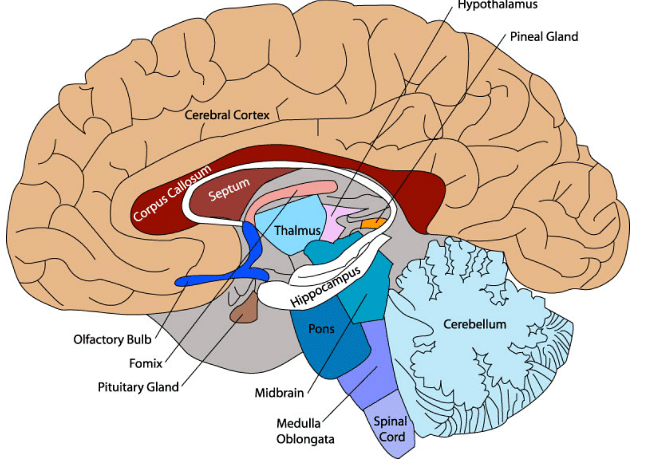
Diagram of human brain
Read More: Nervous System
Functions of brain
[Click Here for Sample Questions]
Brain is a vital component of our body that performs multiple functions. Some of the main functions of brain are as follows:
- It helps in regulating the breathing pattern, heartbeat, and blood pressure.
- It controls the various body movements and ensures proper coordination.
- Our brains help in processing the sensory information we receive from the brain around us.
- It helps us reason, remember, learn, and think.
- It synthesizes and controls the release and secretion of hormones in our bodies.
Brain Diseases
[Click Here for Sample Questions]
Brain Diseases are infections of the brain that can cause damage to it and hamper its activity. Some of the main categories into which brain diseases can be classified are trauma, tumors, seizures, inflammation, stroke, etc. The neurons present in our nervous system are highly fragile and sensitive to damage. In case the neurons suffer any energy, the signals to and fro from the brain can be either partially or permanently halted. In those particular areas, muscles will stop properly functioning, thereby causing a lack of feeling or numbness
Traumatic Brain Injury (TBT)
[Click Here for Sample Questions]
The injury to the human brain and its parts that are mostly caused as a result of the rupture of internal organs, accidents, and various injuries that include hematomas, concussions, strokes, blood clots, contusions, swelling inside the skull, etc. In traumatic brain injury, neurons, tissue, and brain nerves are damaged as a result of the trauma. This eventually results in loss of the ability of the brain to communicate with other parts of the body.
Symptoms
Some of the common symptoms of a traumatic brain injury are as given below:
- Vomiting
- Bleeding from the ear
- Headache
- Loss of consciousness
- Loss of balance
- Dizziness
- Fatigue
- Numbness
- Disorientation and confusion
- Loss of concentration
- Irritability
- Sleep disorders
- Speech difficulty
- Headache
- Depression
- Seizures
- Visual problems
- Loss of memory
- Paralysis

Identifying a Traumatic Brain Injury
Treatment
The treatment of TBT depends on the severity and type of the brain injury. Some of these treatment options are:
- Neurocritical care
- Medication
- Immediate brain surgery in order to stop bleeding or remove and repair the damaged tissues.
- Rehabilitation measures such as speech therapy, physical therapy, psychiatry, and language therapy.
Read More: Types of Joints
Brain tumors
[Click Here for Sample Questions]
The abnormal tissue growth within the human brain is referred to as the brain tumor. Depending on the severity, the brain tumor can either be cancerous (malignant) or non-cancerous (benign). It can occur at any age. While the distinct causes of brain tumors are unknown, we can classify brain tumors mainly as:
- Primary Brain Tumors
The tumors which start from the brain are known as the primary brain. They are really dangerous and can be either benign or malignant.
- Secondary Brain Tumors
The brain tumors developed in other parts of the human body which then spread to the brain are known as secondary brain tumors.
Symptoms of the brain tumor
The symptoms of the brain tumor usually depend on the size, location, and size of the brain tumor. Some of the most common symptoms of brain tumors are:
- Mood swings
- Loss of balance
- Problems pertaining to speech, hearing, and vision
- Seizures
- Headache
- Behaviour and personality change
- Tingling sensation in the arms

Brain Tumor
Treatment
The primary treatment for the brain tumor is brain surgery. This treatment is mainly prescribed to treat tumors in order to remove the tumor cells. Other tumor treatments include chemotherapy, rehabilitation, and radiation therapy.
Also Read: Difference Between Axon and Dendrite
Neurodegenerative Diseases
[Click Here for Sample Questions]
The range of conditions that mainly affects the neurons present in the human brain is referred to as a neurodegenerative disease. It is also called Degenerative Nerve Diseases. Some of the common neurodegenerative diseases are
- Amyotrophic lateral sclerosis
- Huntington’s disease
- Prion disease
- Parkinson's disease
- Alzheimer's disease
- Spinocerebellar ataxia
- Motor neuron diseases
- Spinal muscular atrophy

Alzheimer’s - a neurodegenerative disease
Symptoms
Some of the symptoms of neurodegenerative diseases are
- Abnormal sensations
- Nausea
- Vomiting
- Nausea
- Improper coordination of muscles during their movement
- Mood swings
- Loss of memory
- Rigid muscles
- Decreased automatic movements
- Abnormal sensations
- Personality change
- Paralysis
- Seizures
- Muscular tremors
- Loss of concentration
- Insomnia
- Fatigue
- Agitation
Treatment
As neurodegenerative diseases cause permanent damage to our central nervous system, there is no cure for them. However, a few treatment methods can be employed to maintain the quality of the life of a person by reducing their symptoms. The treatment to reduce the symptoms often involves using medicines, active physical life, modifications in lifestyle, and getting rest.
Also Read:
Things to Remember
[Click Here for Sample Questions]
- Human brain is made up of over 100 billion nerves, having multiple specialized areas that help in forming over trillions of connections to enhance communication and ensure the working of the body as a whole.
- Brain Diseases are infections of the brain that can cause damage to it and hamper its activity.
- Traumatic Brain Injury refers to an injury to the human brain and its parts that is mostly caused as a result of accidents, rupture of internal organs, and other infections.
- The abnormal tissue growth within the human brain is referred to as the brain tumor.
- The range of conditions that mainly affects the neurons present in the human brain is referred to as a neurodegenerative disease.
Sample Questions
Ques. Write a short note on the nervous system. (5 marks)
Ans. The nervous system is the complex set of networks made up of nerve cells that comprises fibers and neurons which further help in transmitting impulses from one body part to another. The human nervous system acts as the powerhouse that coordinates all the sensory information and actions. Brain is located in the head and is the primary organ of the central nervous system or CNS It helps in the transmission of signals and forms a complicated network. The nervous system is divided into two parts:
- Central Nervous System (CNS)
The central nervous system is made up of nerves present in the spinal cord and the brain.
- Peripheral Nervous System (PNS)
The peripheral nervous system is made up of nerves, neurons, and neuron clusters that are known as ganglia. All of them are connected to each other and also to the central nervous system.
The nervous system is also responsible for responding to the stimuli inside and outside of the human body.
Ques. Write a short note on dementia. (5 marks)
Ans. Dementia is more of a syndrome than a disease. It does not have a definite diagnosis. It is mainly considered as a club of symptoms that are related to brain diseases or disorders of the brain. This eventually results in the loss of memory, and loss of control over making decisions and emotions. With precautions, Dementia can be prevented in humans. However, certain factors such as genetics, age, family history contribute to the disorder and can not be changed. Proper diet along with proper sleep and rest can prevent the onset of dementia. Challenging the brain is another such prevention tactic. The various types of dementia are:
- Parkinson's disease dementia
- Mixed dementia
- Huntington’s disease
- Creutzfeldt-Jakob dementia
- Lewy Body dementia
- Frontotemporal dementia
- Vascular dementia
Ques. Write a short note on Alzheimer's disease. (5 marks)
Ans. Alzheimer's is a common kind of Dementia. It is a chronic disease that mainly affects some parts of the brain that deal with controlling speech, memory, thought, judgments, and cognitive functions. The symptoms of Alzheimer's can include impaired thought and speech, aggression, mood changes, and deep confusion. Alzheimer's specifically occurs when the tangles of the fibers or proteins known as plaques are present in the nerve cells and the brain. They lead to damage to the nerve cell which further blocks the signaling to and from the brain. It is a kind of neurodegenerative disease as the death of nerve cells present in the brain can cause this disease. There are three stages of Alzheimer's disease which are:
- The first stage of the disease is the preclinical stage that occurs before any symptoms are recognized.
- The second stage deals with mild impairment of cognitive functions along with other mild symptoms.
- The last stage of Alzheimer's is dementia.
Ques. Write a short note on concussions. (3 marks)
Ans. A concussion is a kind of brain injury that majorly deals with a short-term loss of the normal functioning of the brain. Usually, it is caused as a result of a hit to the body or head that leads to the brain and the head moving to and fro rapidly. This sudden movement can lead to some chemical changes in the brain and can also cause damage to the brain cells.
While concussions are not life-threatening, they are still serious. Its symptoms might not show right away, instead, they can develop even weeks after the injury. Some of the common symptoms of a concussion include neck pain and headache.
Ques. State the differences between benign and malignant tumors. (5 marks)
Ans. The main differences between benign and malignant tumors are as tabulated below:
| Benign Tumor | Malignant Tumor |
|---|---|
| Benign tumor remains restricted to the organ that is affected. | Malignant Tumor, on the other hand, spreads to all the other organs of the body. |
| There is no latent stage in a benign tumor. | There is a latent stage in a malignant tumor. |
| The rate of growth of this tumor is relatively slow. | This tumor develops in a rapid manner. |
| No metastasis is there. | There is metastasis. |
| It is a non-cancerous tumor. | It is a cancerous tumor. |
| As it is non-cancerous, this tumor causes limited damage to the human body. | The cancer cells of the tumor might migrate to other body parts, thereby, also damaging them as a result. |
Ques. What is Brain abscess? (5 marks)
Ans. A brain abscess is a brain disease or infection that is usually caused due to a bacterial infection. It generally occurs in people who have a weak immune system. As a result of the infection, the brain of the person swells as dead cells and pus is collected as the infection forms. It is usually formed when virus, bacteria, or fungi reach the brain through an infection in the body or a wound in the head. The symptoms of brain abscess include an increased rate of confusion, irritability, decreased speech and sensation, changes in vision, fever, vomiting, decreased movement as a result of the loss of muscle function, stiffness of the neck, sensitivity to light, etc.
It is a serious medical condition and can even result in permanent brain damage. In certain situations, the abscess can also be treated with just some antibiotics that treat the underlying cause of these infections. Many times, surgery is often required in some cases as pressure increases in the brain to a dangerous level. The treatment option mainly depends on the severity of the abscess amongst multiple other factors.
Ques. What is brain tumor? What are the two types of brain tumor? (5 marks)
Ans. Brain tumor refers to a mass or a collection of some abnormal cell present inside the brain. The skull enclosing our brain is very rigid. Therefore, any growth that takes place inside this restricted space can lead to multiple problems. Brain tumors can be either malignant i.e. cancerous or benign i.e. non-cancerous. When they grow in size inside the brain that is enclosed within the skull, the pressure builds up. This can cause significant damage to the brain and often at times can also be life-threatening.
Mainly brain tumors are categorized as primary tumors and secondary tumors.
- Primary brain tumors
The brain tumors that develop inside the brain only from either the internal glands, nerve cells, brain cells, or the membranes surrounding the brain, are popularly referred to as meninges. Primary brain tumors can be either benign or malignant. The most common primary brain tumors are meningiomas and gliomas
- Secondary Brain Tumors
The majority of brain cancers all over the world are developed as secondary brain tumors. They begin in a part of the brain and then spread to the other parts. They are always malignant.
Symptoms
The symptoms depend on the size and location of the tumor. A common symptom of these tumors is a headache. Along with that, the other symptoms include seizures, double or blurred vision, loss of memory, changes in the ability of a person to taste, hear, or smell, vomiting, weakness in a limb, or change in the mental functioning of a person.
Treatment
The treatment of the tumors can mainly depend on many factors that include the general health of a person, the location and size of the tumor, and most importantly the type of tumor that a person has.
For Latest Updates on Upcoming Board Exams, Click Here: https://t.me/class_10_12_board_updates
Check-Out:



Comments