



Exams Prep Master
The ecosystem has been defined as a system that consists of all the living organisms and the environment in which they interact with one another. Highly controlled by the biotic and abiotic components, they help in the breaking down of organic compounds thereby helping in the exchange of energy. The nutrient cycle and the energy flow links are major functions of an ecosystem. Species, populations, and communities are the different levels falling under an ecosystem. They maintain the cycle of minerals through the biosphere and help in homeostasis. It is because of ecosystems that there is a balance in the energy flow between different food chains. Let us study in detail the ecosystem, its function, and the different levels it is made of.
| Table of Content |
Also Read: Reproductive Health
What is an Ecosystem?
[Click Here for Sample Questions]
An ecosystem refers to all the organisms and the environment in which they exist and interact. It includes all the biotic as well as abiotic components that survive on energy by the process of photosynthesis. The term was first coined in a publication by British ecologist Arthur Tansley in 1935.
Internal and external factors are known to regulate ecosystems to a great extent. Climate, nature of the soil, and topography shape the structure of any ecosystem. They are themselves not influenced by the ecosystem. Internal factors include decomposition, shading, succession, root competition, and evolution. They control the ecosystem and are also controlled by it.
The ecosystem is responsible for the cycle of nutrients and supporting life on earth. It provides stability to the biotic and abiotic components present and also maintains a balance between the different trophic levels.
Also read:
Importance of Ecosystem
[Click Here for Sample Questions]
We are highly dependent on the ecosystem to sustain life on earth. Mentioned below are the key points defining why we need it.
- An ecosystem is necessary for controlling and monitoring the flow of energy, supporting life, and providing stability.
- It helps in the absorption of nutrients between the biotic and abiotic components.
- The ecosystem plays an important role in maintaining a balance between the different trophic levels.
- Apart from the cycle of nutrients, it also recycles minerals and produces organic compounds.
- It is the primary source of food, medicines, and water for all living organisms. It also has a considerable contribution to renewable and non-renewable sources of energy.
Also read: Difference Between Renewable and Non-Renewable Resources
Levels of Ecology
[Click Here for Sample Questions]
The ecological levels are divided into six primary stages. We are going to focus on the three main stages here below.
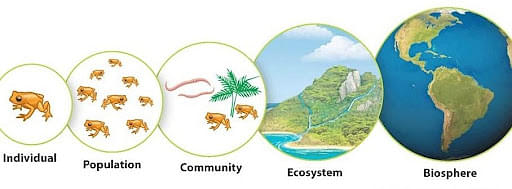
- Species/Individual
Species make up the whole level one of the processes. They are made up of populations. These are a group of individuals who are related to each other in a genetic manner. They have the ability to breed and give rise to offspring of their own kind. The best example of species is Homo Sapiens, where Sapiens happens to be our species name.
The number of populations found in a species depends on how widespread and diverse it is. The measure of the geographic area also plays an important role here. Some species are restricted to a small area whereas others are distributed over bigger areas. In the case where they are subjected to a limited area, they are vulnerable. What happens to one group, slowly starts happening to others. If not controlled, they are eventually lost and become extinct.
- Population
Population denotes the organisms belonging to the same species, in the same area, which interact with each other in a given environment. This is level two in the ecological cycle. The size of the area which they inhabit varies from place to place. For example, we humans have taken up our places in cities, states, and countries. We can also talk about special types of reefs and corals found only in the Great Barrier Reef found in Australia. There are genetic variations present in a population.
The population of a given place at a given time is affected by two things entirely. These are,
- Biotic components
- Abiotic components
- Community
Community refers to all the populations of different species in a particular area, and at a particular period of time. The different minds of organisms living in this biotic community interact with each other in the same environment. We focus on organisms in a given area because there are different individuals involved.
Every population consists of species interacting with their own species and also with individuals belonging to another species. The nature of a community can be identified by,
- Nature of every population
- Range of every population
- Type of area in which the populations reside in
- Diversity of species
- Interaction taking place between different populations in that area
The environment plays a very crucial role here. Only those organisms are able to survive who adapt themselves according to the changes in the environment they are in. The environment is determined by the climate of that place. It is the climate that decides the environment is luscious or dry.
There are manmade communities like the lawns, crops, and agricultural fields which occur due to the efforts and care of humans. They require a constant watch and are very insatiable in nature. On the other hand, naturally occurring communities like the tropical evergreen forest in the North East, thrive due to the sun’s energy and are independent of the nutrients of nearby communities.
Also read:
Difference between Species, Population, and Community
[Click Here for Sample Questions]
The main point of difference is said to be the size of the organization. For example, species refers to a smaller scale of organizations that is genetically related to each other. On the other hand, population refers to groups of similar species occurring on a much larger scale of organization
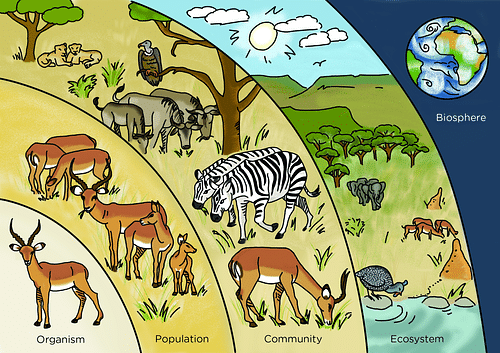
It can also be said that the organisms belonging to the same species interact with each other by forming groups. They are restricted to a particular environment and contribute to the level of the population. On the other hand, the total population in any given area forms the community. A population has groups belonging to the same species whereas a community consists of groups of different species. Community is much larger than the population in the ecological organization.
Related Links:
Things to Remember
- Ecosystem refers to all the organisms which interact with one another in a given environment, and at a particular time. They are controlled by many internal and external factors.
- We are highly dependent on the ecosystem for the energy flow which takes place between the biotic and abiotic components. It also serves a great contribution in the absorption of nutrients and minerals so as to accelerate plant life.
- There are six major levels of the ecosystem. These are named as individual, population, species, community, ecosystem, and biosphere. Each of them plays a major part in sustaining life on earth.
- Population refers to organisms that belong to the same species and interact with each other in the same environment. Species are individuals which are genetically related to each other and create offspring. Community refers to all the populations given at a particular place.
- The demographic size is said to be the major difference between species and population. Species are constricted whereas population takes up a larger space.
Sample Questions
Ques. What are the abiotic components of the ecosystem? (3 marks)
Ans. The abiotic components of an ecosystem consist of,
- Physical factors like sunlight, temperature, rainfall, humidity, and pressure.
- Inorganic substances like carbon dioxide, nitrogen, oxygen, soil, water, etc.
- Organic compounds like proteins, carbohydrates, lipids. Which constitute the building blocks of living bodies. They serve as a middle link to the biotic and abiotic components.
Ques. Why is the ecosystem important? (3 marks)
Ans. The ecosystem is important because of many factors. These are,
- The ecosystem is the place where conservation of energy flow takes place from one organism to another. It is balanced and occurs again after the matter is recycled.
- It promotes different food chains and food webs occurring simultaneously.
- It provides an environment for plants and animals where they can interact freely with each other.
Ques. What do we mean by ecology? (2 marks)
Ans. Ecology refers to the study of relationships taking place between different living organisms. These organisms may be humans interacting in their environment. It is a crucial branch of Biology and studies organisms at different levels. These levels are named as individual, population, community, ecosystems, and biosphere.
Ques. What is level 6 of the ecological organization? (3 marks)
Ans. The biosphere level is the sixth and the largest level in the ecological organization. It refers to the layer of the earth which supports life including various ecosystems together. The biosphere has been divided into the atmosphere, the lithosphere, and the hydrosphere. This narrow layer seems to be absent at the North and South poles. It is also not present when it comes to high mountains or deep oceans.
Ques. Define species. (2 marks)
Ans. Species refer to a group of organisms that reproduce with one another and give rise to offspring. They all share some common characteristics. Humans are the most common type of example of species.
Ques. Mention the biotic components of an ecosystem. (3 marks)
Ans. The biotic components of an ecosystem involve three main categories. These are the producers, consumers, and decomposers. Producers refer to the green plants which produce food for the entire ecosystem through photosynthesis and nutrients from the soil. Consumers are the ones who consume the food prepared by the producers and can be divided further into herbivores, omnivores, and carnivores. Lastly, the decomposers are those who feed on the dead matter of plants and animals. They help in the recycling of nutrients.
Ques. Name the types of ecosystems. (2 marks)
Ans. The ecosystem has been broadly classified into 2 categories. These are,
- Natural ecosystem - These ecosystems are those which occur naturally in nature and depend on solar radiation. Common examples of a natural ecosystem are lakes, oceans, forests, and deserts. We are dependent on them for giving us medicines, fuel, and food.
- Man-made - These ecosystems are known to be dependent upon solar energy and can be widely seen in agricultural fields and aquaculture ponds.
Ques. Define productivity of ecosystems. (2 marks)
Ans. The amount of biomass that is produced in an ecosystem is known as its productivity. There are two types, primary and secondary productivity respectively. Green plants are known to consume solar energy and break it down into chemical energy. They store it as it is the most important source of energy for them. The rate at which this energy accumulates in green plants can be called primary productivity.
Ques. Name the factors affecting the productivity of the ecosystem. (2 marks)
Ans. The factors affecting the productivity of an ecosystem are as follows,
- Nutrition from minerals
- Involvement of moisture (for example in soil and precipitation)
- Solar radiation
- Temperature
- Impact of human populations and the biotic activities
- Presence of nitrogen in aquatic life
Read More:



Comments