



Content Curator
Equation of a Line Formula is y = mx + c where m is the line's slope and c is the y-intercept. The equation of a straight line can also be represented through point-slope form, slope-intercept form, general form, standard form, and so on. A straight line is a geometrical entity with two dimensions that continues indefinitely on both ends.
Read More: Trapezoid Formula
| Table of Content |
Key Terms: Intercept, Slope, Gradient, Coordinate, Slope Formula, Slope of a Line Formula, Straight line, point-slope form, slope-intercept form, general form, standard form, x-intercept, y-intercept
Equation of Straight Line
[Click Here for Sample Questions]
A straight line equation is a mathematical equation that expresses the relationship between the coordinate points on a straight line.
It can be expressed in a variety of ways and indicates the line's slope, x-intercept, and y-intercept. The most popular variants of the straight line equation are y = mx + c and axe + by = c. Point-slope form, slope-intercept form, general form, standard form, and so on are some of the other forms.
Equation of Straight Line Formula
A straight line is a figure constructed by connecting two points A (x1, y1) and B (x2, y2) with the shortest distance between them and extending both ends to infinity. Given below are the forms of a linear equation with the variables x and y:
Where a, b, and c are constants and x, y are variables, ax + by = c
- Standard Form: ax + by= c
- Slope Intercept Form: y= mx + c
- Point Slope Form: y - y1= m (x-x1)
| How to Find Equation of Line? Step 1: Note down the provided data, the slope of the line as 'm' and coordinates of the given point(s) in form (xn, yn). Step 2: Apply the required formula depending upon the given parameters,
Step 3: Rearrange the terms to express the equation of the line in standard form. |
The video below explains this:
Straight Lines Detailed Video Explanation:
Forms of Equation of a Straight Line
[Click Here for Sample Questions]
Assume that line l forms an angle of the positive x-axis direction. The angle is referred to as the line's inclination, while the slope is referred to as the line's slope. It's worth noting that the x-axis has a slope of 0. The slope of all lines parallel to the x-axis is 0. In addition, the slope of all vertical lines, including the y-axis, is unknown.
Let's look at various types of straight-line equations now that we've learned the basic form of a line equation.
Normal Form
The equation for a line whose length of the perpendicular from the origin is p and whose angle with the positive x-axis is given by α is given by:
| x cos α+y sin α = p |
This is known as the normal form of the line.
In case of the general form of the line Ax + By + C = 0 can be represented in normal form as:
| A cos α = B sin α = – p |
From this we can say that cos α = -p/A and sin α = -p/B.
Also it can be inferred that,
cos2α + sin2α = (p/A)2 + (p/B)2
1 = p2 (A2 + B2/A2 .B2)
p= (AB/√ A2 + B2)
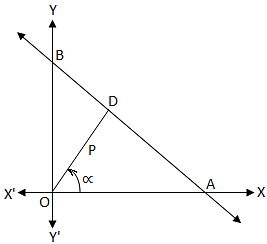
Normal Form
| Frequently Asked Questions: Ques. Which equation is converted into a normal equation? Ans. Where a and b are constants and either a≠0 or b≠0. Convert the standard equation of line ax+by+c=0 into the normal form xcosα+ysinα=p. This is the equation of the line in normal form. Here, c±√a2+b2 is the length of the normal form origin of the line. Ques. How to transform General Equation into Normal Form? Ans. Step I: Transfer the constant term to the right-hand side and make it positive. Step II: Divide both sides by \(\sqrt{(coefficient of x)^2 + (coefficient of y)^2}\) The obtained equation will be in the normal form. |
Intercept Form
The point where a line crosses the x-axis or the y-axis is called the intercept. Assume that a line intersects the x- and y-axes at (a, 0) and (0, b), respectively. The equation for a line with intercepts equal to a and b on the x- and y-axes, respectively, is as follows:
| x/a + y/b = 1 |
If C 0, then Ax + By + C = 0 can be written as; in the case of the general form of the equation of the straight line, i.e. Ax+By+C = 0, Ax + By + C = 0 can be written as:
| x/(-C/A) + y/(-C/B) = 1 |
where a = -C/A and b = – C/B

Intercept Form
Also Read:
| Related Articles | ||
|---|---|---|
| Horizontal and Vertical Lines | Straight Lines | Angle between a Line and a Plane |
Standard Form of Equation of Line
A straight line's conventional form is ax + by = c, where a, b, and c are real values. Let's look at an example of how to convert the equation y = 2x - 1 to standard form. When both sides of the equation are subtracted by 2x, we get:
| y - 2x = 2x - 1 - 2x ⇒ y - 2x = -1 ⇒ 2x - y = 1 |
As a result, the usual version of the line equation is 2x - y = 1.
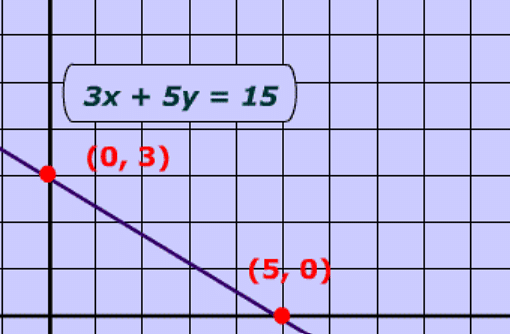
Standard Form
Point-Slope Form
The point-slope form is used to find the equation of a straight line with a slope of m that passes through a point (x1, y1). The point-slope form's equation is:
(x, y) is an arbitrary point on the line, and y - y1 = m (x - x1).
Let's look at how to calculate the point-slope form. The slope of a line equation will be used to derive this expression. Let's look at a line with a slope of m. Assume that (x1, y1) is a well-known line intersection. Let another point on the line be (x, y) with unknown coordinates. The slope of a line can be calculated using the following equation:
Slope = Difference in y-coordinates / Difference in x-coordinates
⇒ m = (y - y1)/(x - x1)
Multiplying both sides by (x - x1),
m (x - x1) = (y - y1)
This can be written as,
(y - y1) = m (x - x1)
As a result, the point-slope form of a line's equation is established.

Point-slope Form
Slope-Intercept Form
Let's say you're given a line with the slope m and the y-intercept y. Let's say a line crosses the y-axis at this location (0, c).
y - c = m (x - 0)
y = mx + c
Similarly, if d is the x-intercept, then y = m is the slope-intercept form of the line equation (x - d).

Slope-intercept Form
| Frequently Asked Questions: Ques. How do you find slope-intercept form from two points? Ans. The following steps can be followed: Step 1: Find the slope (m) The slope of the line through two points (x1,y1) and (x2,y2) can be found by using the formula below. ... Step 2: Find the y-intercept (b) ... Step 3: Write the equation in slope-intercept form (y = mx + b) ... Step 4: Check Your Equation. Ques. How do you find a slope-intercept form with two points and perpendicular? Ans. First, put the equation of the line given into slope-intercept form by solving for y. Upon obtaining y = -2x +5, it can be observed that the slope is –2. Perpendicular lines have opposite-reciprocal slopes, so the slope of the line we want to find is 1/2. Plugging in the point given into the equation y = 1/2x + b and solving for b, we get b = 6. |
The video below explains this:
Coordinate Geometry Detailed Video Explanation:
Formulas of a Straight Line
[Click Here for Sample Questions]
Formulas of a Straight Line are specified in the table below:
| Type of Line | Formula |
|---|---|
| Equation of a horizontal line | y = a or y = -a |
| Equation of a vertical line | x = b or x = -b |
| Slope m passing through a non-vertical line at x1y1 and x2y2 | m = (y2-y1)/(x2-x1), x1≠x2 |
| Equation of a line passing through x1y1and x2y2 | y-y1 = [(y2-y1)/(x2-x1)]*(x-x1) |
| Equation of line having m slope making x-intercept d | y = m(x - d) |
| Equation of line having m slope and c intercept | y = mx + c |
| Equation of line with intercept form | (x/a) + (y/b) = 1 |
| Equation of line with normal form | x cos α + y sin α = p |
Things To Remember
- A linear equation is sometimes known as a straight line equation.
- Lines are perpendicular to one other if the product of the slopes of two straight lines is -1.
- The slope of two straight lines that are parallel to each other is the same.
- Point Slope Form: (y - y1) = m (x - x1)
- Slope-Intercept Form: y = mx + c
- Standard Form = ax + by = c
Also Read:
Sample Questions
Ques. Find the equation of a straight line that passes through the points (1, 3) and (-2, 4). (3 Marks)
Ans. We'll use the formula point-slope form to figure out the line's equation.
To do so, we must first determine the line's slope.
Slope = (4-3)/(-2-1) = -1/3
Therefore, the equation of the line passing through (1, 3) and (-2, 4) is y - 4 = (-1/3) (x + 2)
⇒ y - 4 = -x/3 - 2/3
⇒ y + x/3 = 4 - 2/3
⇒ x + 3y = 10
The required equation is x + 3y = 10.
Ques. The cost of a notebook is $5 more than twice the cost of a pen. Represent the situation as an equation of a straight line. (2 Marks)
Ans. Assume the pen costs $x and the notebook costs $y. Then, in response to the query, we have
y = 2x + 5 which is the equation of a straight line.
y = 2x + 5
Ques. Find the equation of the straight line cutting of an intercept 3 in the negative direction of the y-axis and inclined at 120° to the axis of x. (2 Marks)
Ans. y = x.tan(120°) +(-3)
y +x√3 + 3 = 0.
Ques. Find the equation of the line whose slope is 8 and the coordinates of the point are (3, 5). (3 Marks)
Ans. Given, m = 8
(x1, y1) = (3, 5)
The formula for the equation of a line is,
y – y1 = m (x – x1)
y – 5 = 8 (x – 3)
y – 5 = 8x – 24
8x – y = 19
8x – y – 19 = 0
Ques. What is the equation of the line through the points (-2, 0) and (-2, 4)? (1 Mark)
Ans. The two points have the same x coordinate and are on the same vertical line whose equation is:
x = - 2
Ques. Find the equation of the line that passes through the points (-1 , 0) and (-4 , 12). (3 Marks)
Ans. The slope of the line is given by
m = (y2 - y1) / (x2 - x1) = (12 - 0) / (-4 - (-1)) = - 12 / 3 = - 4
We now write the equation of the line in point slope form: y - y1 = m (x - x1)
y - 0 = - 4(x - (-1))
Simplify and write the equation in general form
y + 4 x = - 4
Ques. What is the equation of the line through the point (-3, 2) and has x-intercept at x = -1? (2 Marks)
Ans. The x intercept is the point (-1 , 0). The slope of the line is given by:
m = (2 - 0) / (-3 - (-1)) = 2 / - 2 = -1
The point slope form of the line is
y - 0 = -1(x - (-1))
The equation can be written as
y = - x - 1
Ques. Find the equation of the line that has an x-intercept at x = - 4 and y-intercept at y = 5. (2 Marks)
Ans. The x and y intercepts are the points (-4 , 0) and (0 , 5). The slope of the line is given by:
m = (5 - 0) / (0 - (-4)) = 5 / 4
The point-slope form of the line is
y - 5 = (5 / 4)(x - 0)
Multiply all terms by 4 and simplify
4 y - 20 = 5 x
Ques. What is the Equation of a Line parallel to X-Axis? (2 Marks)
Ans. The equation of a line parallel to the x-axis is of the form y = b, which cuts the y-axis at the point (0, b).
An example is the equation of the line y = 5, which is parallel to the x-axis and cuts the y-axis at the point (0. 5).
Also, the points such as (2, 5), (-3, 5) are all the points lying on this line y = 5 has their y-coordinate as 5.
Ques. Find the slope, the x and y-intercepts of the line given by the equation: -3 x + 5 y = 8. (3 Marks)
Ans. To find the slope of the given, we first write in slope-intercept form
5y = 3x + 8
y = (3/5) x + 8 / 5
The slope is equal to 3/5. The y-intercept is found by setting x = 0 in the equation and solving for y. Hence the y-intercept is at y = 8/5. The x-intercept is found by setting y = 0 and solving for x. Hence the x-intercept is at x = -8/3
Ques. Reduce the line 4x + 3y - 19 = 0 to the normal form. (3 Marks)
Ans. The given equation is 4x + 3y - 19 = 0
First, shift the constant term (-19) on the RHS and make it positive.
4x + 3y = 19 ………….. (i)
Now determine \(\sqrt{(coefficient of x)^2 + (coefficient of y)^2}\)
= \(\sqrt{(4)^2 + (3)^2}\)
= \(\sqrt{16 + 9}\)
= \(\sqrt{25}\)
= 5
Now dividing both sides of the equation (i) by 5, we get
\(\frac{4}{5}x + \frac{3}{5}y = \frac{19}{5}\)
Which is the normal form of the given equation 4x + 3y - 19 = 0.
Ques. Using the slope-intercept form, find the equation of a straight line with a slope of 1/3 and whose y-intercept is (0, -5). (2 Marks)
Ans. Given: Slope of the line m = 1/3.
the y-intercept of the line is (0, b) = (0, -5) ⇒ b = -5.
Using the slope-intercept formula, the equation of the given line is,
y = mx + b
y = (1/3) x - 5
Ques. Find the slope-intercept form for the line given by its equation: x / 4 - y / 5 = 3. (2 Marks)
Ans. Given the equation
x / 4 - y / 5 = 3
Keep only the term in y on the left side of the equation
- y / 5 = 3 - x / 4
Multiply all terms by -5
y = (5/4) x - 15
Important Questions Based on Equation of a Line Formula
- The focus of the curve y2+4x−6y+13=0 is… [VITEEE 2018]
- (0,−1) and (0,3) are two opposite vertices of a square… [BITSAT 2006]
- Suppose P(2,y,z) lies on the line through… [KCET 2011]
- The vector equation of the straight line… [KEAM]
For Latest Updates on Upcoming Board Exams, Click Here: https://t.me/class_10_12_board_updates
Check-Out:



Comments