



Education Content Expert
Factors of 80 are the natural numbers that divide the number 80 exactly without leaving a remainder.
- The number 80 is an even composite number and has eight factors in total.
- Factors of 80 are 1, 2, 4, 8, 10, 20, 40, and 80.
- Pair factors of 80 are a set of two numbers that give 80 as the product on multiplication with each other.
- (1, 80), (2, 40), (5, 16), and (8, 10) are the factors of 120 in pairs.
Factors of 120 can be calculated through prime factorization as well as through the division method. Both methods result in the same set of factors for the number.
Key Terms: Factors of 80, Factor Pairs, Prime Factors, Prime Factorization, Remainder, Prime Numbers, Composite Numbers
What are Factors of 80?
[Click Here for Sample Questions]
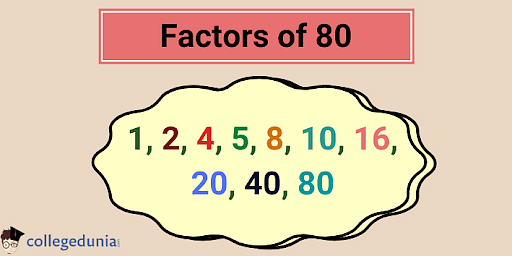
Factors of 80 are the numbers that divide it completely and leave a remainder of zero. In other words, the numbers that result in the number 80 on multiplication with each other are the factors of 80. Since 80 is an even composite number, it has various other factors other than 1 and 80 itself. 1, 2, 4, 5, 8, 10, 16, 20, 40, and 80 are the factors of 80.
Factors of 80: 1, 2, 4, 5, 8, 10, 16, 20, 40, 80
How to Calculate Factors of 80?
[Click Here for Sample Questions]
Factors of 80 can be determined using the following methods:
- Prime Factorization
- Division Method
In the division method, the numbers that divide 80 exactly and without leaving a remainder are categorized as the factors of 80. In prime factorization, 80 is represented as the product of its prime factors.
Read More:
Factors of 80 by Division Method
[Click Here for Sample Questions]
Factors of 80 can be calculated by dividing 80 by various integers from 1 to 80. An integer is a factor of 80 if it divides 80 perfectly with a remainder of 0.
- 80/1 = 80 (Remainder is 0 and Factor is 1)
- 80/2 = 40 (Remainder is 0 and Factor is 2)
- 80/4 = 20 (Remainder is 0 and Factor is 4)
- 80/5 = 16 (Remainder is 0 and Factor is 5)
- 80/8 = 10 (Remainder is 0 and Factor is 8)
- 80/10 = 8 (Remainder is 0 and Factor is 10)
- 80/16 = 5 (Remainder is 0 and Factor is 16)
- 80/20 = 4 (Remainder is 0 and Factor is 20)
- 80/40 = 2 (Remainder is 0 and Factor is 40)
- 80/80 = 1 (Remainder is 0 and Factor is 80)
Any number that divides 80, besides 1, 2, 4, 5, 8, 10, 16, 20, 40, and 80, leaves a remainder. Thus, 1, 2, 4, 5, 8, 10, 16, 20, 40, and 80 are the factors of 80.
Read More: Greatest Common Divisor
Factors of 80 by Prime Factorization
[Click Here for Sample Questions]
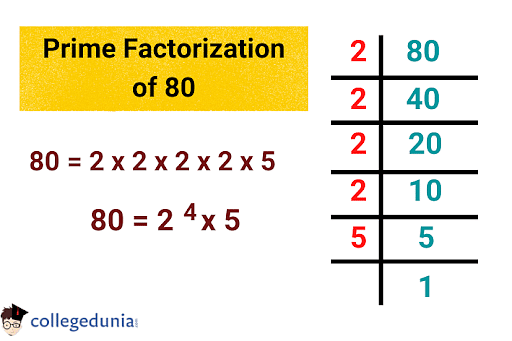
The number 80 is expressed as the product of the prime factors of 80 using the prime factorization method. The prime factors of 80 are calculated as follows:
Take a pair factor of 80, say, (1, 80).
Leave off 1 in this case because it is neither a prime number nor a composite number. The second factor 80 is an even composite number and can be expressed as
80 = 5 x 16
The numbers 5 and 16 are prime and composite, respectively. 16 is represented by the prime factors 2 × 2 × 2 × 2.
Thus, 80 = 2 × 2 × 2 × 2 × 5
Thus, 2 × 2 × 2 × 2 × 5 or 24 × 5 is the prime factorization of 80. 2 and 5 are the two prime factors of 80.
Read More: Prime Number Formula
Factors of 80 in Pairs
[Click Here for Sample Questions]
A pair of numbers that provide the original number 80 when multiplied together is known as the pair factor of 80. The pair factors of 80 can be positive or negative, but they cannot be a fraction or a decimal. Following are the positive and negative pair factors of 80:
Positive Pair Factors of 80
The positive pair factors of 80 are:
| Positive Factors of 80 | Positive Pair Factors of 80 |
|---|---|
| 1 × 80 | (1, 80) |
| 2 × 40 | (2, 40) |
| 4 × 20 | (4, 20) |
| 5 ×16 | (5, 16) |
| 8 ×10 | (8, 10) |
Thus, (1, 80), (2, 40), (4, 20), (5 16) and are the positive pair factors of 80. (8, 10).
Negative Pair Factors of 80
The negative pair factors of 80 are:
| Negative Factors of 80 | Negative Pair Factors of 80 |
|---|---|
| -1 × -80 | (-1, -80) |
| -2 × -40 | (-2, -40) |
| -4 × -20 | (-4, -20) |
| -5 × -16 | (-5, -16) |
| -8 × -10 | (-8, -10) |
The negative pair factors of 80 are (-1, -80), (-2, -40), (-4, -20), (-5, -16), and (-8, -10).
Check More:
Things to Remember
- 1, 2, 4, 5, 8, 10, 16, 20, 40, and 80 are the factors of 80.
- Two numbers are considered pair factors of 80 if they multiply with each other to produce the original number 80.
- The factors of 80 in pairs are (1, 80), (2, 40), (5, 16), and (8, 10).
- The prime factorization of 80 is 2 × 2 × 2 × 2 × 5.
- 2 and 5 are the two prime factors of 80.
- The sum of all the factors of 80 is 186.
Sample Questions
Ques. Find the common factors of 80 and 79.? (2 Marks)
Ans. The factors of 80 and 79 are:
- 1, 2, 4, 5, 8, 10, 16, 20, 40, and 80 are the factors of 80.
- 1 and 79 are the factors of 79.
Thus, there is only one common factor of 80 and 79 which is 1.
Ques. Is the number 80 a prime number or a composite number? (2 Marks)
Ans. A prime number is defined as a number that does not have any other factors other than 1 and itself. A composite number has more than two factors, i.e. factors other than 1 and itself. The factors of 80 are 1, 2, 4, 5, 8, 10, 16, 20, 40, and 80, thus it is a composite number.
Ques. List out the Prime and composite numbers under 80 and this composite number should not be divisible by 2. (2 Marks)
Ans. The prime numbers less than 80 are 2, 3, 5, 7, 11, 13, 19, 23, 29, 31, 37, 41, 43, 47, 53, 59, 61, 67, 71, 73, and 79.
The composite numbers under 80 that are not divisible by 2 are 9, 15, 21, 25, 27, 33, 35, 39, 45, 49, 51, 55, 57, 63, 65, 69, 75, and 77.
Ques. Write down the prime factorization of 80. (1 Mark)
Ans. The prime factorization of 80 is 2 × 2 × 2 × 2 × 5 or 24 × 5. This means 2 and 5 are the only prime factors of 80.
Ques. Find the greatest common factor (GCF) of 90 and 80. (2 Marks)
Ans. Listing down the factors of 80 and 90, we get
- 1, 2, 4, 5, 8, 10, 16, 20, 40, and 80 are the factors of the number 80.
- 1, 2, 3, 5, 6, 9, 10, 15, 18, 30, 45, and 90 are the factors of the number 90.
1, 2, 5, and 10 are the common factors between 80 and 90. Therefore, 10 is the greatest common factor of 80 and 90.
Ques. List out the common factors of 80 and 72. What will be the GCF? (3 Marks)
Ans. First, we will write down all the factors of 80 and 72,
- 1, 2, 4, 5, 8, 10, 16, 20, 40, and 80 are the factors of the number 80.
- 1, 2, 3, 4, 6, 8, 9, 12, 18, 24, 36, and are the factors of the number 80.
1, 2, 4, and 8 are the common factors of 80 and 72. 8 is the greatest common factor of 80 and 72.
Ques. Peter created 80 works of art. He started selling such paintings near a park. In about 5 hours, X amount of the paintings was sold out. Determine how many paintings were sold. (3 Marks)
Ans. Peter created 80 paintings in all. Assume that Peter sold X total paintings. X artworks were sold over the course of 5 hours.
80 = 5 × X
Paintings by Peter sold in 5 hours (X) by multiplying both sides by 5:
X = 80/5 = 16
Out of 80 paintings, Peter sold 16 paintings in 5 hours.
Ques. 80 images are available with Jenny. She plans to evenly distribute these images in a 20-page picture album. How many pictures will she attach to each album page? (3 Marks)
Ans. It is given that
- Total Number of Images with Jenny = 80
- Total Number of Pages in the Album= 20
Divide the whole number of photographs by the album's number of pages, or to evenly distribute them throughout the album, that is 8020 .
= 20 x 420 [(20, 4) is a pair of factors that equals 80]
= 4 [20 divided between the denominator and the numerator]
Thus, Jenny will paste 4 photos on each album page.
Ques. State whether the following statements are true or false:
1. Any number that can be divided by 3 must also be divided by 9.
2. An integer must be divisible by 3 if it is divisible by 9 else.
3. If a number can be divided by both 3 and 6, it may also be divided by 18.
4. A number must be divisible by 90 if it can be divided by 9 and 10.
5. At least one of the co-prime numbers must be a prime number.
6. Every integer that can be divided by 4 must also be divided by 8.
7. Every number that can be divided by 8 must also be divided by 4.
8. A number must precisely divide two other numbers' sums if it divides them precisely independently. (5 Marks)
Ans. The answers with detailed explanations are as follows:
1. False, the number 6 is divisible by 3 but not by 9.
2. Yes, since 9 Equals 33. Therefore, if a number can be divided by nine, it can also be divided by three.
3. False. Since 30 can be divided by both 3 and 6, but not by 18.
4. Yes, since 9 x 10 equals 90. As a result, a number is divisible by 90 if it is divisible by both 9 and 10.
5. False. Due to the fact that 15 and 32 are coprime and composite numbers.
6. False, because the number 12 can be divided by four but not by eight.
7. Yes, since 2 + 4 = 8. As a result, if a number can be divided by 8, it can also be divided by two and four.
8. It is true that 2 divides 4 and 8 as well as 12 (4 + 8 = 12).
Ques. List out the factors of 80 between 0 to 10 that can be obtained using the Divisibility Rule. (5 Marks)
Ans. The Factors of 80 between 0 to 10 that can be obtained using the Divisibility Rule are:
| Number | Is the Number a Factor of 80? | Multiplication Equation |
|---|---|---|
| 1 | Yes, since it is a factor of every number. | 1 × 80 = 80, Remainder = 0 |
| 2 | Yes, every even number is divisible by 2. | 2 × 40 = 80, Remainder = 0 |
| 3 | No, on dividing 80 by 3 the remainder is not 0. | - |
| 4 | Yes, on dividing 80 by 4 the remainder is 0. | 4 × 20 = 80, Remainder = 0 |
| 5 | Yes, if the unit number is either 0 or 5 it is divisible by 5. | 5 × 16 = 80, Remainder = 0 |
| 6 | No, it is not completely divisible by 6 also 6 is a factor of 3. | - |
| 7 | No, the remainder will not be equal to 0. | - |
| 8 | Yes, 80 is completely divisible by 8. | 8 × 10 = 80, Remainder = 0 |
| 9 | No, on dividing 80 by 9 the remainder is not 0. | - |
Check-Out:



Comments