



Content Curator
Buoyant Force is the force by which every object that is suspended in a fluid medium will be buoyed upwards. This means the object suspended in a fluid will be pushed in an upward direction. The buoyant force an object undergoes is always upwards. This is because the pressure of the liquid substance increases with the depth. The magnitude of the buoyant force is equal to the weight of the object upon which the force is acting. So, it is an upward-acting force that acts on objects placed in a fluid medium.
Buoyancy is caused by the difference in pressure above and below the object due to a change in medium. Buoyant Force is the reason why some objects float on water while others sink. This principle of buoyancy is useful in working ships, hot air balloons, submarines and is followed by fish as well.
Read More: Mechanical Properties of Fluids
| Table of Content |
Key Terms: Buoyancy, Buoyant Force, Pressure, Force, Density, Volume, Archimedes Principle, Upthrust, Relative Density, Centre of Buoyancy
What is Buoyant Force?
[Click Here for Previous Year Questions]
Buoyant Force is the upward force that is experienced by an object which is partially or wholly submerged in water (or any other fluid medium).
- The objective of this force is to not let the object sink in the water, thus causing it to float.
- Since buoyant force acts in an upward direction, it is also referred to as ‘Upthrust’.
- Due to Buoyant Force, an object appears lighter when it is partially or completely submerged in a fluid medium.
- Buoyancy is a phenomenon that is caused by Buoyant Force acting on objects.
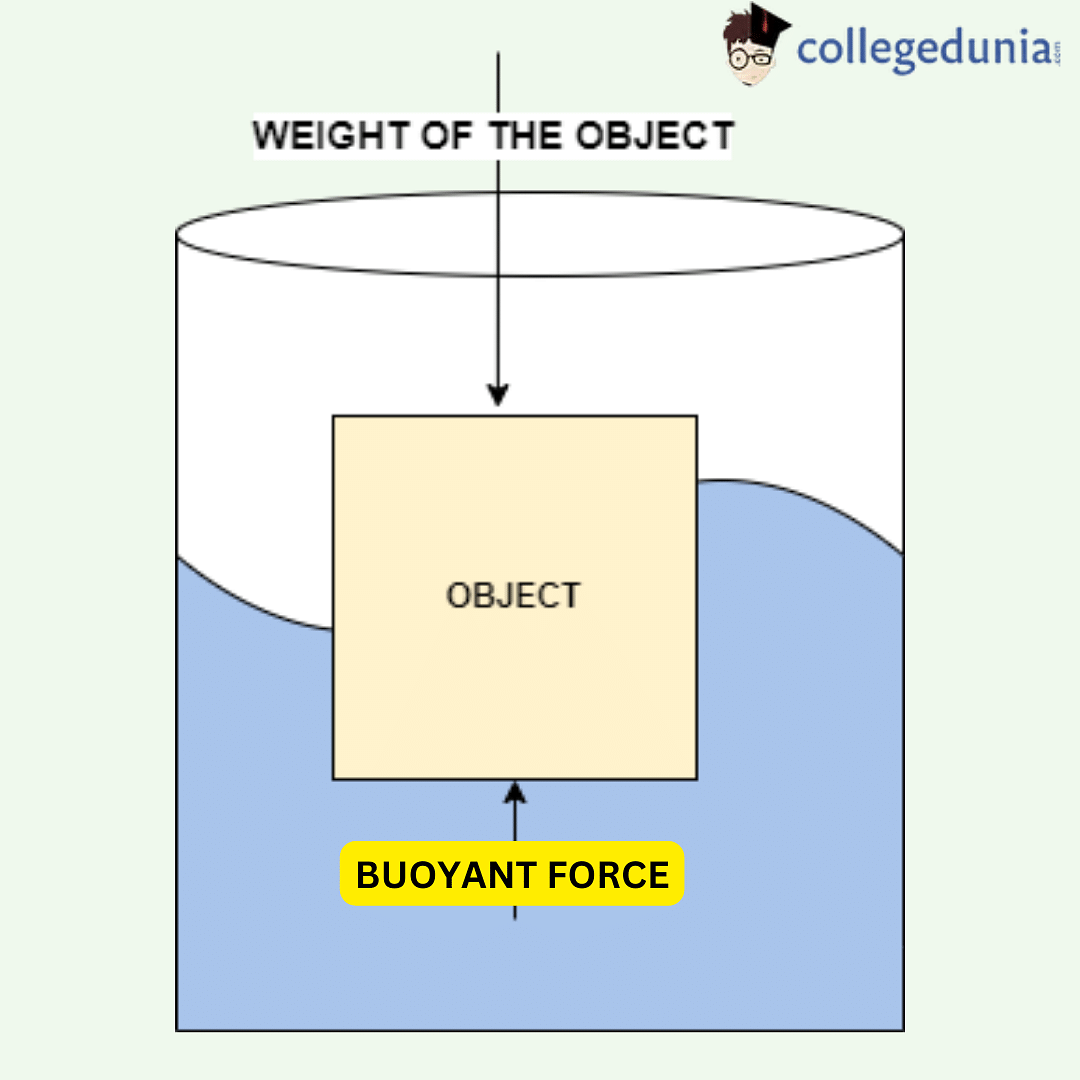
Buoyant Force Acting on the Object Immersed in Water
Buoyant Force Formula
Buoyant force can be explained in terms of Archimedes' Buoyancy. Thus, buoyancy formula is:
| Fb = PA |
Where,
- Fb = Buoyant Force
- P = Pressure
- A = Area
In case area, height and volume, the formula is:
⇒ Fb = ρ × g × h × A
- Fb = Buoyant force
- ρ = Density of liquid
- g = Acceleration due to gravity
- V = Volume of body immersed in fluid
- h = The height of immersed part
- A = Area
Demonstration of Buoyant Force
Buoyant force can be demonstrated as:
- When we immerse an object in fluid, it undergoes an upward force.
- The fluid, thus, applies a force on the object which causes it to rise.
- This force is typically known as Buoyant force or Buoyancy.
- Therefore, the magnitude of this force is equivalent to the amount of weight of the displaced liquid.
- The point where the buoyant force is applied or where the force acts is known as the “Center of Buoyancy”.
Read More: Dynamic Lift
Factors Affecting Buoyant Force
[Click Here for Sample Questions]
Buoyant Force depends on the following factors:
- The density of the fluid
- The volume of the object or displaced fluid
- The acceleration due to gravity in that particular area
Thus, buoyancy can be observed in any object whose density is greater than that of the fluid in which it is immersed in. The object sinks. The object stays afloat if it is less denser or is shaped like a boat so that force does not let it sink in the fluid. Here the concept of relative density plays an important role. Hence, if the relative density value is less than 1, the object tends to float and if the relative density is greater than 1, the object sinks.
Check Out:
| Important Concepts Related to Buoyant Force | ||
|---|---|---|
| Venturimeter | Density Vs Specific Gravity | Pressure |
| Viscosity | Barometer | Non-Contact Force |
| Reynolds Number | Interaction of Forces | Surface Tension |
| Fundamental Forces | Friction Force | Balanced Forces |
Unit of Buoyant Force
[Click Here for Sample Questions]
The unit of the buoyant force is Newton (N).
- When a body is in water, it moves some of the water inferable from its weight.
- The measure of the displaced water is further registered by the density of water that is identified as per the volume.
- For instance, the volume of a cricket ball can be equal to its weight, but its density might still vary.
- Thus, the amount of water that is displaced in the upward direction is called Buoyant force.
Density and Relative Density
Density: A material’s density can be expressed as its mass per unit volume. Density can be defined as the measurement of how tightly matter is packed together.
Thus,
| \(Density, \ \rho = \frac{Mass}{Volume} = \frac{M}{V}\) |
- SI unit of Density = kilogram per cubic metre (kg/m3).
- Note that, The density is 0.9584 grams per cubic centimetre at 100° Celsius.
Relative Density: A substance’s relative density can be defined as the ratio of the density of the substance to the density of water at C. Relative density can be otherwise also called as the specific gravity of the substance. The relative density formula is:
| \(Relative \ Density = \frac{Density \ of \ a \ Substance}{Density \ of \ water \ at \ 4^0 C}\) |
Since relative density is known as the ratio of the same quantities, it thus has no unit.
Archimedes Principle
[Click Here for Previous Year Questions]
As per Archimedes Principle, it states that the Buoyant Force on an object is equal to the weight of the fluid displaced by that object.
- Buoyancy can be understood when a block is dropped in a cup of water.
- Once the block falls into the cup, the water in the cup spills out.
- This is a classic example of the Archimedes Principle. Let us understand the fluid displacement in a little detail.
What is Displaced Fluid?
Displaced Fluid can be defined as:
- Displaced Fluid is the volume of fluid that is displaced by the object partially or wholly submerged in that fluid.
- When an object is wholly or partially submerged into a fluid it displaces some of its content to make space for itself and the fluid whose space the object now occupies is called Displaced Fluid.
Archimedes’ Principle can be written as an equation:
| Fbuoyant = Wfluid |
Where,
- Wfluid = weight of the displaced fluid.
- Fbuoyant = Buoyant Force
From this equation, the formula for calculation of Buoyant Force can be derived at.
Wfluid = (mass of the displaced fluid) X (local acceleration due to gravity) (mf)g
Where,
- m = density of the displaced fluid(ρ) X Volume of displaced Fluid (Vf)
- V= volume of the submerged object.
If the object is partially submerged, then volume of the submerged part becomes:
| Fbuoyant = Wfluid = ρVf g |
The unit of Buoyant Force is Newton(N).
The video below explains this:
Archimedes Principle Detailed Video Explanation:
Read More: Density Vs Volume
What Causes Buoyancy?
[Click Here for Sample Questions]
The mechanism of Buoyant Force can be explained by the following demonstration:
- An object is taken and submerged into a fluid (say, water).
- The force of gravity will try to sink this object in the water.
- The fluid itself exerts an upward force on the object called Buoyant Force in order to make the object float.
- The pressure in a fluid column will increase as we move deeper into it due to the weight of the above layers being added as we move downwards.
- So, as the object moves deeper into the water when it’s immersed, the pressure at the top of the object is different from the pressure at the bottom.
- This pressure difference between the top and bottom of the object results in a net upward force when the pressure at the bottom is greater, this is called Buoyancy.
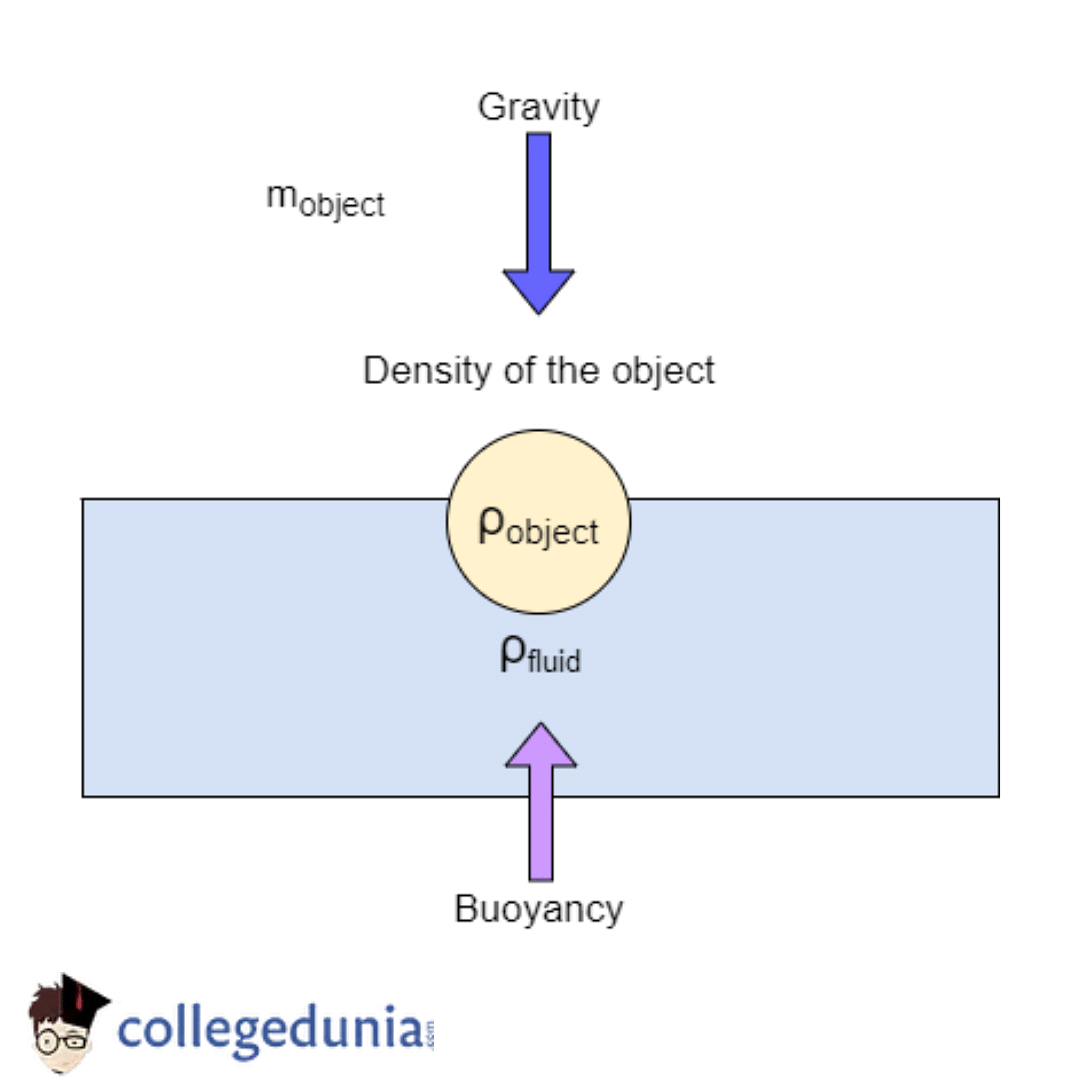
Buoyancy Experiment
Why do some Objects Float while Others Sink?
The reason why some objects float, while some sink is listed below:
- Buoyant force does not depend upon the depth of the fluid.
- So, once the object is completely submerged the pressure at the top and bottom will change at an identical rate.
- This will negate the possibility of any increase or decrease in the value of the Pressure difference recorded at the first instance of complete submergence.
- The object sinks because the weight of the sinking object is greater than Buoyant Force acting on them.
- The magnitude of Buoyant Force greatly depends upon the density of the fluid, it means that the same object can float in one medium while sink in another because the magnitude of Buoyant Force of both fluids is different.
Read More: Stoke’s Law
Applications of Buoyant Force
[Click Here for Previous Year Questions]
The principle of Buoyancy and the Buoyant Force is both natural and universal. They exist everywhere and lifeforms on earth make use of them according to their need. Some of the applications of Buoyant Force are:
Submarines
Submarines have a Ballast which fills up and lets out the water. This helps to increase and decrease its weight. In this way, the submarines will stay afloat when their weight is low and will sink deep when their weight is high.
Fishes
Fishes fill their air sacs with gases making them lighter so they can go up the surface and when they need to go down, they let all that air diffuse through their bladder making them heavier.
Hot Air Balloon
In this case, the fluid is air present in the atmosphere. So, the Hot Air Balloon experiences the Buoyant Force exerted by layers of air in the atmosphere and the lighter it is due to hot air. It descends when the buoyant force is lower than the weight of the balloon. When Buoyant Force is equal to the weight of the Balloon, it becomes stationary even in mid-air.
Ships
Ships are another example where buoyancy can be observed. The ship is able to float because the volume of water it displaces is actual to its own volume. Ships are constructed in such a way that their overall density remains lower than that of seawater. So, the buoyant force acting on it keeps it afloat as it is not overpowered by the weight of the ship.
Also Read: Difference between Weight and Mass
Things to Remember
[Click Here for Sample Questions]
- Buoyancy is caused by the upward acting force (buoyant force) exerted by the fluid on any object that is partially or wholly submerged in the fluid.
- Buoyant Force is a net upwards force.
- Buoyant Force acts from the bottom of an object and pushes it upwards. So, it is also called Upthrust.
- The formula of Buoyant Force is, Fbuoyant = ρVf g.
- If the Buoyant Force is greater than the weight of an object, it will float while the object whose weight is greater than Buoyant Force will sink.
- Buoyancy is caused by the pressure difference between the top part of an object and the bottom part of the object.
- If the relative density of an object is less than 1 it will float and if it is greater than 1 it shall sink in the fluid.
- The buoyant force depends upon the density and volume of the displaced fluid.
Check Out:
Previous Year Questions
- Water is supplied to different localities from a tank. What is the water pressure? [JIPMER 1996]
- A rain drop of radius 0.3mm has a terminal velocity of 1m/s and the viscosity of…? [BCECE 2003]
- A solid sphere falls with a terminal velocity of 20m/s in air. If it is allowed to fall in vacuum…? [AMUEEE 2015]
- A cylindrical capillary tube of 0.2mm radius is made by joining two capillaries…? [JEE 2019]
- A square wire frame of size L is dipped in a liquid. On taking out, a membrane is formed…?[DUET 2004]
- An open U-tube contains mercury. When 11.2cm of water is poured into one of the arms…? [BCECE 2006]
- A closed compartment containing gas is moving with some acceleration in horizontal direction…? [JCECE 2010]
- A sphere of radius R is gently dropped inthe to liquid of viscosity η in a vertical uniform tube…? [JKCET 2008]
- If the work done in blowing a bubble of volume V is W, then the work done in…? [BCECE 2003]
- What is the pressure exerted by 6 g of methane gas in a 0.03 m3 vessel? [NEET 2010]
- If the excess pressure inside a soap bubble is balanced by oil column of height…? [JKCET 2004]
- If two soap bubbles of different radii are connected by a tube…? [BCECE 2004]
- Two capillaries are of lengths L and 2L and of radii R and 2R are connected in series…? [JCECE 2010]
- A uniform capillary tube of inner radius r is dipped vertically into a beaker filled with water…? [JEE 2018]
- A water drop is divided into 8 equal droplets. The pressure difference between… [BHU UET 2008]
- Bernoulli’s principle is based on the law of conservation of…? [UPSEEE 2010]
- Consider a soap film on a rectangular frame of wire of area 4×4cm2. If the area of the soap…? [AMUEEE 2016]
- A tank is filled with water. There is a hole in the bottom. At the bottom total pressure…? [BCECE 2014]
- Which one of the following equationsion is Torricelli law? [JKCET 2014]
- At what speed, the velocity head of water is equal the to pressure head of 40cm of Hg…? [BCECE 2008]
- If the potential energy of a body on a planet is numerically U and the escape velocity…? [BHU UET 2008]
- Work done in increasing the size of a soap bubble from a radius of 3cm to 5cm is nearly…? [AMUEEE 2016]
- To what depth does the ball with a certain density and falling from a height sink? [BITSAT 2013]
- The cylindrical tube of a spray pump … [NEET 2015)]
- Water rises to a height h in capillary … [NEET 2015]
- A certain number of spherical drops of a liquid … [NEET 2014]
Sample Questions
Ques: What is center of Buoyancy? (2 Marks)
Ans: Tcentertre of buoyancy is that point in the body of an object where it experiences the resultant Buoyant Force. The buoyant force acts vertically on an object, so the center of buoyancy also coincides with the center of gravity of the fluid displaced by the object being immersed. So, the centre of buoyancy is the center of gravity of the displaced fluid.
Ques: Whare is Buoyant Force and Buoyancy? (CBSE 2010, 2011, 2012, 2016) (3 Marks)
Ans: Buoyant Force is the net upward force exerted by the fluid when an object is completely or partially immersed in the fluid. The ability of a fluid to exert Buoyant force and its consequences form the phenomenon of Buoyancy. The ability of some objects to be able to float in a certain fluid while others sink is explained by buoyancy wherein if the Buoyant Force is greater than the weight of the object it will float.
Ques: What Causes Buoyancy? (3 Marks)
Ans: Buoyancy is caused by Buoyant force. The mechanism for the working of Buoyant force is given below:
- As we move deeper into the fluid the pressure increases. So, there will always be a different amount of pressure on top of the object and bottom of an object.
- The difference between these top and bottom pressures creates a net upward force called buoyant force and the application of this force on an object causes Buoyancy.
Ques: What is the relationship between Buoyant Force and Density? (3 Marks)
Ans: The relationship between Buoyant Force and Density can be given as:
Fbuoyant = ρVf g
where, ρ = density of the fluid
From the above form,ula we can conclude that the Buoyant Force is directly proportional to the density of the fluid in which the given object is being immersed. It means that as the density of the fluid increases, the Buoyant force exerted by that object also increases. For example, Mercury has the highest density among fluids and its Buoyant force is so strong that even a block of iron can float on it.
Ques: State the Archimedes Principle? (CBSE 2010, 2011, 2012, 2015) (3 Marks)
Ans: When a body is immersed partially or completely in a fluid (liquid or gas), it experiences an upthrust or buoyant force which is equal to the weight of the fluid displaced by the body.
The weight of the body decreases due to the buoyant force acting on the body, when immersed in a fluid. In other words, a body loses its weight, when immersed completely or partially in a fluid. The loss of weight of a body in a fluid is equal to the upthrust or buoyant force.
The upthrust or buoyant force = weight the of fluid displaced by a body = weight the of body the in air – weight the of body a in fluid.
Ques: State the factors on which buoyancy or Buoyant Force depends on? (CBSE 2010, 2011, 2012, 2016) (5 Marks)
Ans: The formula of Buoyant Force can be given as-
Fbuoyant = ρVf g
From the above formula, it is clearly visible that the Buoyant Force and its determination is dependent upon flowing three factors:
- Density (ρ): Buoyant Force is directly proportional to the density of the fluid and not the object.
- Volume (Vf): Buoyant Force is directly proportional to the Volume of the displaced fluid and not the object.
- Acceleration due to gravity(g): Buoyant Force is directly proportional to the local acceleration due to gravity.
Ques: Calculate the buoyant force on a can of beans weighing about 0.5 kgs dropped in the lake at a depth of 20 meters. The density of lake water is 1000 kg/m3 and the Volume of that sealed can of beans is 5 X 10⁻³ m3. (5 Marks)
Ans: The formula for Buoyant force is: Fbuoyant = ρVf g
Here, ρ = 1000 kg/m3
Vf = 5 X 10⁻³ m3 (because the can is completely submerged in water)
g = 9.8 m/s2
So, Fbuoyant = [1000 kg/m3] X [5 X 10-3 m3] X [9.8 m/s2]
Fbuoyant = 49 N.
Consider a cube with a total mass of 2.5 kg. If the density of seawater is 1050 kg/m3 then what should be the side length of the cube for it to be able to float on Seawater.
We have mcube = 2.5 kg and ρ = 1050 kg/m3
For the object to float on the surface, its weight must be equal to Buoyant Force. So,
Fbuoyant = Wcube
Now, Wcube = mcube X g
And, mcube = ρ Vcube
From this we get, Vcube = mcube / ρ
Where, Vcube = (side)3 or let’s say (x3) [because the formula for cube’s volume is cube of sides]
Finally, x3 = 2.5/1050
And x = \(3\sqrt{\frac{2.5}{1050}}\)
x = 0.133 m
Ques: An object’s weight in air is 100 N. Assuming that the object is now placed in liquid, the increase in the liquid’s volume is 1.5 m3. Considering that the specific weight of the liquid is 10 N/m3, determine the weight of the object in liquid. (5 Marks)
Ans. The weight of the object in air (w) = 100 Newton
Thus, Increase in volume of liquid = volume of the object in liquid (V) = 1.5 m3
Liquid’s Specific weight = 10 N/m3
Thus,
Weight of the object in liquid = object’s weight in air – buoyant force
⇒ Weight of the object in liquid = 100 Newton – buoyant force
By using the formula of buoyant force, we get:
FA = ρgV
- FA = buoyant force = Exerted force of liquids on the object in the water
- ρ = density of liquid
- g = acceleration due to gravity
- V = object’s volume in liquid
Hence, the Specific weight of liquid = 10 N/m3
w / V = 10 N/m3
m g / V = 10 N/m3
m (10) / V = 10 N/m3
m / V = 1 kg/m3
ρ = 1 kg/m3
The density of liquid is 1 kg/m3
Thus, the magnitude of buoyant force:
FA = ρ g V = (1 kg/m3)(10 m/s2)(1.5 m3)
= 15 kg m/s2
= 15 Newton
Weight of the Object in liquid:
⇒ 100 Newton – 15 Newton
= 85 Newton
Ques: How are buoyancy and density interrelated? (1 mark)
Ans: Buoyancy is known to be directly proportional to the density of the immersed fluid. Thus, this is how buoyancy and density are related to one another.
Also Check Out:



Comments