



Education Content Expert
Molar Mass is the sum of the mass of all the atoms found in one mole of a chemical compound in grams. It can be simply defined as 'mass per mole'.
- Molar Mass is the quantity of the substance that is contained in one mole of the substance.
- One mole contains 6.023 x 10²³ molecules (Avogadro's Number).
- The SI Unit of molar mass is kg/mol, however, it is usually expressed in its standard unit g/mol.
Molar Mass Formula is the mass of a given element divided by the number of moles in that element. It is the sum of the atomic mass of all the atoms present in the molecule. Molar Mass Formula is given as:
| Molar Mass = Mass of Given Substance/Amount of Substance |
Key Terms: Molar Mass, Molar Mass Formula, Atoms, Mass, Elements, Compounds, Molecule, Mole, Atomic Mass, Avogadro's Number
What is Molar Mass?
[Click Here for Sample Questions]
Molar Mass is defined as 'Mass per Mole'. It is the total mass of all the atoms in grams that make a mole of a particular molecule. It is generally expressed in units of grams per mole (g/mol). The SI unit of molar mass is kg/mol.
- Molar mass is calculated for both elements or molecules.
- In the case of an element, the molar mass is the mass of the element expressed in atomic mass units.
- It means that the atomic mass and the molar mass of an individual atom are the same.
- In the case of a molecule, the molar mass represents the mass of all the atoms.
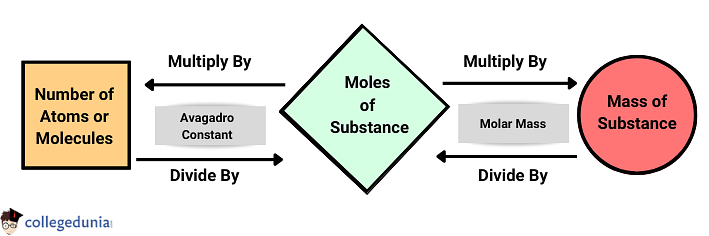
Molar Mass
Read More:
Molar Mass Formula
[Click Here for Previous Year Questions]
Molar Mass is calculated by adding the atomic masses of a given compound. Molar Mass Formula is basically defined as the mass of a given substance divided by the quantity of the substance that is being provided.
Molar Mass Formula is given as:
| M = m/n |
Where
- M refers to Molar Mass.
- m refers to the mass of the given substance.
- N refers to the amount of the substance.
Solved ExampleExample: Calculate the Molar Mass of Sodium Carbonate (Na2CO3). Solution: In Sodium Carbonate, there are 2 atoms of sodium, one atom of carbon, and three atoms of oxygen. Thus,
Now, add up all the values, 46 + 12+ 48 = 106 Thus, the molar mass of the compound is 106 g/mol. |
Calculation of Molar Mass
[Click Here for Sample Questions]
Molar Mass of a compound is usually calculated by adding the atomic masses of the constituent atoms. For example, the molar mass of titanium is 47.88 amu or 47.88 g/mol. Thus, in 47.88 grams of titanium, there is one mole or 6.022 x 10²³ titanium atoms.
In order to calculate the molar mass of a given substance using the Molar Mass Formula, one needs to follow the given steps:
- Determine the atomic mass of the elements that constitute the compound using the chemical formula.
- Now, check the number of atoms present in that element in the compound.
- Add the atomic mass of all the atoms present in the molecule or compound.
- One can also use the Molar Mass Formula also for the same.
- Lastly, assign the unit as g/mol.
Solutions Detailed Video Explanation
Molar Mass Formula Solved Examples
[Click Here for Previous Year Questions]
Given below are some solved examples on Molar Mass Formula for a better understanding of the same:
Example: Calculate the molar mass of Calcium Nitrate Ca(NO3)2.
Solution: Calcium Nitrate contains one atom of calcium, two atoms of nitrogen, and six atoms of oxygen. So,
- Ca: 1 X 40.1 = 40.1
- N: 2 X 14 = 28
- O: 6 X 16 = 96
Adding all of these masses = 40.1 + 28 + 96 = 164.1
Therefore, the molar mass of calcium nitrate will be 164.1 g/mol.
Example 2: What is the molar mass of Nitric Acid (HNO3)?
Solution: The chemical formula of Nitric Acid is HNO3.
- Hydrogen (H) = 1 g/mol
- Nitrogen (N)= 14 g/mol
- Oxygen (O3) = 3 x 16 =48 g/mol
Adding up the individual masses, we get
48 + 14 + 1 = 63 g/mol
Thus, the molar mass of HNO3 is 63 g/mol.
Check More:
Things to Remember
- Molar Mass is the amount of mass that makes up one mole of a substance.
- It is the mass of a given substance divided by the quantity of the particular substance.
- There are 6.023 x 10²³ molecules in a mole. It is commonly known as Avogadro's Number.
- Molar Mass is a physical property of an element that doesn’t depend upon the dimensions of the element.
- The SI unit of Molar Mass is kg/mol but it is usually expressed in g/mol.
- Molar Mass Formula is given as Molar Mass = Mass of Given Substance / Amount of Substance.
- It can simply be calculated by adding up the atomic masses of a given compound.
For Latest Updates on Upcoming Board Exams, Click Here: https://t.me/class_10_12_board_updates
Previous Year Questions
- How many moles of acidified K2Cr2O7 is required to liberate… (JIPMER - 2020)
- The density of 2 M aqueous solution of NaOH is 1.28… (NEET - 2019)
- The percentage of s-character in the hybrid orbitals of nitrogen… (KCET - 2020)
- The mole fraction of a solvent in aqueous solution of a solute… (JEE Main - 2019)
- The percentage composition of carbon by mole in methane is… (JEE Main - 2019)
- What is the molar mass of magnesium...
- The mass of one mole of a substance in grams is called its…
- The mass of CaCO3 is required to react with 25 mL of…
- 4 g of a hydrated crystal of formula AxH2O has 0.8 g of water… (KCET - 2013)
- The number of moles of KMnO4 that will be needed to react… (NEET - 2007)
- The mole fraction of benzene in a solution containing… (COMEDK UGET - 2012)
- One mole of NaCl contains 6.023 x 10 molecules of sodium…
- Equal moles of different substances contain the same number of…
- The density of 2 M aqueous solution of NaOH is 1.28 g… (NEET - 2019)
Sample Questions
Ques. Calculate the molar mass of Hydrogen (H2), sulfur (S8), and chlorine (Cl2). (3 Marks)
Ans. The molar mass of the given compounds is:
- Hydrogen (H2) = 2 X 1 = 2g/mol
- Sulphur (S8) = 8 X 32 = 256 g/mol
- Chlorine (Cl2) = 2 X 35 = 70 g/mol
Ques. How many moles are there in 52 gm of Helium? (3 Marks)
Ans. Molar Mass of Helium (He) = 4gm/mol
This means that the mass of 1 mole of Helium = 4 grams
4 grams = 1 mole
1 gram = 1/4 mole
52 grams = (1/4) X 52 mole
52 grams = 13 moles
Therefore, there are 13 moles of Helium in 52 gm.
Ques. Calculate the Molar Mass of the following:
(i) 4 moles of aluminum atom
(ii) 10 moles of sodium sulfite
(iii) 1 mole of nitrogen atom (3 Marks)
Ans. It is known that,
Mass of 1 Mole of Substance = Molar Mass of Substance
(i) Molar Mass of 4 moles of Aluminium atom = 4X 27g= 108 g/mol
(ii) Molar Mass of 10 moles of Sodium Sulphite (Na2SO3)= 10 (2 X 23 + 1 X32 + 3 X 16) = 1260 gm/mol
(iii) Molar Mass of 1 mole of a Nitrogen atom (N)= 14 gm/mol
Ques. Convert the given masses into moles:
(i) 22g of Carbon Dioxide (CO2)
(ii) 20g of Water (H2O)
(iii) 12g of Oxygen Gas (3 Marks)
Ans. (i) Weight of Carbon Dioxide (CO2) in grams = 12 + 2 X 16= 44 = 1 mole of Carbon Dioxide
22g of Carbon Dioxide = 1/44 x 22 = 0.5 moles.
(ii) Weight of water = 2 + 16 = 18g = 1 mole of water.
20g of water = 1/18 x 22 = 1.11 moles.
(iii) Weight of oxygen= 32g = 1 mole of oxygen
12g of oxygen= 1/32 x 12= 0.375 moles.
Ques. What is Molar Mass? (3 Marks)
Ans. Molar Mass is defined as the mass of one mole of a substance. Molar mass of any substance is calculated by multiplying its atomic mass by the element's subscript in the chemical formula. The masses of each element are then added after that.
- Molar mass is also known as molecular weight.
- It is the sum of the atomic weights of every atom in the molecule of the compound.
- g/mol is the unit that is commonly used to express molar mass.
Ques. Find out the Molar Mass of H2O. (2 Marks)
Ans. Water is represented chemically as H2O. One water molecule is composed of one oxygen atom and two hydrogen atoms. The atomic weights of oxygen and hydrogen are 16 u and 1 u, respectively.
Thus,
Molar Mass of Water = 2 (1) +16 = 18 u
Thus, the molar mass of H2O is 18 u.
Ques. What is a Mole? (3 Marks)
Ans. Mole is the amount of a substance that contains exactly 6.02214076 x 10²³ elementary entities of the given substance. The number 6.02214076 x 10²³ is commonly referred to as the Avogadro Constant and is denoted by the symbol ‘NA’. The elementary entities represented in moles can be atoms, molecules, monoatomic or polyatomic ions, and other particles such as electrons.
The number of moles in a substance are calculated as:
Number of Moles = (Mass of the Sample) / (Molar Mass)
Ques. Find out the molar mass of NaCl and C12H22O11. (2 Marks)
Ans. The molar mass of NaCl and C12H22O11 is as follows:
- NaCl = 23 + 35 = 58 g/mol
- C12H22O11 = [ (12 X 12) + (22 X 1) + (11 X 16)] = 342 g/mol
Thus, the molar mass of NaCl is 58 g/mol while the molar mass of C12H22O11 is 342 g/mol.
Ques. Explain why Gram/Mole is the standard unit of Molar Mass. (2 Marks)
Ans. The number of atoms, molecules, ions, or formula units in a chemical compound is measured in terms of "moles," which is a unit of measurement. A compound's molar mass determines the weight of one mole and the number of grams per mole of that chemical. The total mass of all the atoms that make up a mole of a specific molecule, expressed in grams, is known as the molar mass. Consequently, the molar mass is expressed in grams per mole.
Ques. Define Atomic Mass and Molecular Mass. (2 Marks)
Ans. Atomic Mass of an element is defined as the mass of one atom of the element expressed in atomic mass units (amu). It accounts for the abundance of the various isotopes of the element and assigns an average value to the mass of one atom of the element.
Molecular Mass of an element is defined as the sum of the atomic masses of all its constituent elements. It is also expressed in terms of atomic mass units.
Check-Out:



Comments