



Education Journalist | Study Abroad Lead
Heat Loss refers to the reduction of heat that is present in the space. Heat Loss usually results from the transfer of heat from walls, roofs, windows, and surfaces of buildings. Determining the value of heat loss is not so simple, as it is calculated by determining the product of the value of the surface area, the difference in temperatures indoor and outdoor, and the value of heat loss of the material. On a slightly tangential point, conduction, convection, and radiation are the methods of Heat Loss.
| Table of Content |
Key Terms: Heat Loss, Heat Conduction, Heat Convection, Thermal Radiation, Heat Transmission, Temperature, Diffusion, Kinetic Energy
Heat Loss Formula
[Click Here for Sample Questions]
There is no material present in this universe that is capable of completely preventing heat loss. It is to be kept in mind that one can only minimize heat loss.
The Heat Loss Formula is as follows:
Q = (U X A) X Δt
In this formula,
- Q stands for the amount of heat loss
- U stands for the overall coefficient of heat transmission
- A stands for Area and,
- Δt stands for the difference in temperatures of indoor and outdoor.
Heat Loss is calculated by the units called Watts.
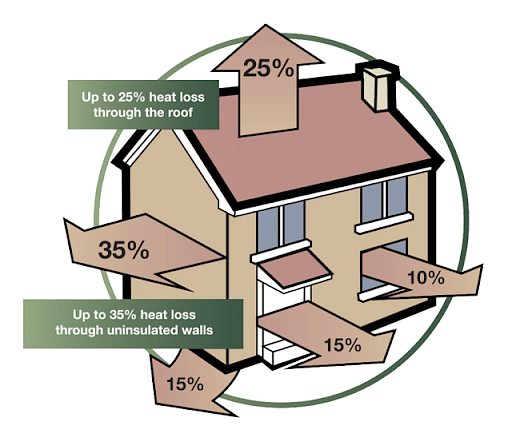
Heat Loss
Read More:
| Related Links | ||
|---|---|---|
| Heat Flux Formula | Thermal Conductivity | Difference Between Conduction, Convection and Radiation |
Three Methods of Heat Loss
[Click Here for Previous Year's Questions]
The three methods of heat loss are listed below:
Heat Conduction
Heat Conduction is also known as diffusion. It occurs within a body or amongst two bodies that are in contact. Utilizing the kinetic energy, particles are exchanged through the boundary between two systems. This Heat Conduction method of Heat Loss is followed to attain thermal equilibrium and is typically used when the temperature of an object differs from its surroundings or any other body.
The heat transfer rate is dependent on the resistance value that exists among the different temperatures of two surfaces. Thermal resistance, also denoted by R, is an ability of an object to delay heat transfer through conduction by the given thickness of the substance.
Heat Conduction can be mathematically represented as
R = L/k
Where, L stands for Insulation Thickness and,
K stands for Thermal Conductivity
Heat Convection
Heat Convection completely relies on the motion of mass from one space to another. When the bulk and heavy flow of a gas or liquid carries heat along with the flow of matter within the liquid then only Heat Convection occurs.
Thermal Radiation
Radiation can be referred to as the heat transfer through electromagnetic radiation, for instance, sunshine, with no requirement for the matter to be present in the space between bodies. For Heat loss to occur from this method, the hotter surface temperature should be above the temperature of immediate surroundings, which is much higher than considered in normal heat trace applications.

Methods of Heat Loss
Also Read:
Things to Remember
- Heat Loss is nothing but the reduction of heat in space, which can happen through heat transfer.
- No material can completely avoid Heat Loss. It can only be limited.
- Formula for Heat Loss is Q = (U X A) X Δt
- The unit of Heat Loss is Watts.
- There are three methods of Heat Loss namely, Heat Conduction, Heat Convection, and Thermal Radiation.
Sample Questions
Ques. Calculate the overall Heat Loss from the building that has a 6 sq feet area, whose coefficient of heat transfer is 0.7, and the temperature difference is 25-degree celsius. (3 Marks)
Ans. Given:
U = 0.7
A = 6.0 sq.ft
Δt = 25oC
Add these values in the given formula,
q = (U × A) ×Δt
q = 0.7 x 6.0 x 25
q = 105 watts
Ques. Calculate the overall heat loss from the building whose coefficient of heat value is 265 watts; Area is 4.30 meters and the value of ΔT is 1135 watts. (3 Marks)
Ans. Given:
U = 265 watt
A = 4.30 metres
ΔT = 1135 watts.
Add the values in the given formula,
q = (U × A) ×Δt
q = 265 x 4.30 x 1135
q = 1293332.5 watts
Ques. In which of the following devices heat loss due to conduction, convection, and radiation is minimized? Explain your answer. (3 Marks)
(1) Solar cooker
(2) Thermos flask
(3) Thermometer
(4) Electric heater
Ans. In a thermos flask heat loss is minimal due to the following reasons:
- A thin layer is present between the two walls of the flask. This layer reduces the heat loss through the process of conduction.
- The two walls in a thermos flask reduce radiation heat loss because a polished surface is a poor absorber and a poor radiation emitter.
- In the thermos flask, its cap has a strong cork stopper. It prevents heat leakage of the convection method.
Moreover, a thermos flask is protected with a plastic case to prevent any physical harm. Hence, due to the above-mentioned reasons, the thermos flask minimizes heat.
Ques. Determine the amount of heat lost given that the area, coefficient of heat transfer, and Δt are 40 sq. m, 0.5, and 50°C respectively. (3 Marks)
Ans. Provided: U = 0.5, A = 40 sq. m, Δt = 50°C
Since, q = (U × A) × Δt
⇒ q = 0.5 × 40 × 50 W
q = 1000 W
Ques. It is a generally accepted fact that air is a poor conductor of heat. Explain in detail why people do not feel comfortable without clothes? (3 Marks)
Ans. It is rightly said that air is a very poor conductor of heat. It does not allow Heat loss from our body because of conduction. However, air permits and facilitates convection to take place. Thus in the absence of clothes, generally people feel cold in the winter season on account of continuous heat loss because of convection.
Ques. Explain why cloudy nights are warmer than clear nights. (3 Marks)
Ans. During the daytime, the surface of Earth absorbs the radiation coming from the sun, and consequently the temperature of the earth increases. At night, the earth radiates heat and cools down. However, the clouds reflect the heat radiation going upwards. As heat is received back by the earth, the temperature on a particularly cloudy night does not reduce considerably. Hence, cloudy nights appear warmer.
Ques. Explain how food in a hot case remains warm for a long time. (3 Marks)
Ans. In today’s world, the hot case comes up with a double-walled vessel and the food container specially designed for a hot case comes up with crowning steel. Hence, neither the outside low-temperature air can enter the inside of the hot case nor the heat inside can escape by conduction or convection. The shining surface of the container inside the hot case assists in stopping the loss of heat due to radiation. Hence, the heat of the food is preserved for a longer period of time.
Ques. Though a woollen blanket keeps our body warm, it does not allow the ice cube to melt when it is wrapped around the same. Explain why? (3 Marks)
Ans. Wool is an extremely poor conductor of heat. Additionally, wool traps air in it which further is a bad conductor. Hence, there can be no heat loss due to convection. The woollen blanket keeps people warm by keeping the heat of the human body from going outside and further keeping our bodies warm. However in the case of ice, the outside heat is prevented to flow inside, and consequently, the ice cube stays intact.
Ques. Give reasons why heat is generated unceasingly in an electric heater. However, its temperature becomes constant after some time? (3 Marks)
Ans. When an electric heater is turned on, a stage is quickly achieved when the rate at which heat is generated becomes equal to the rate at which heat is lost through the process of conduction, convection, and radiation, and therefore a thermal equilibrium is reached. Consequently, the temperature becomes constant.
Also Read:



Comments