



Education Journalist | Study Abroad Lead
A heterotroph is an organism that is powerless to produce its own food and has to rely on other sources, specifically plant and animal matter. Each animal and non-photosynthetic plant is categorized as heterotrophs as they are incapable of preparing their own food. These organism’s recourse to further several methods of nutrition. Therefore, heterotrophs are constantly secondary or tertiary consumers in a food chain. Humans and vertebrates depend on changing organic, solid, or liquid food into energy. Organisms such as fungi are dependent on transforming the dead organic substance into nutrients. In essence, heterotrophs break down compound food into its functional components.
| Table of Content |
Keyterms: Organism, Nutrient, Energy, Food chain, Heterotroph, Nutrition, Fungi
Various Types of Heterotrophic Nutrition
[Click Here for Sample Questions]
There are various types of Heterotrophic nutrition, which are explained below in a detailed manner:
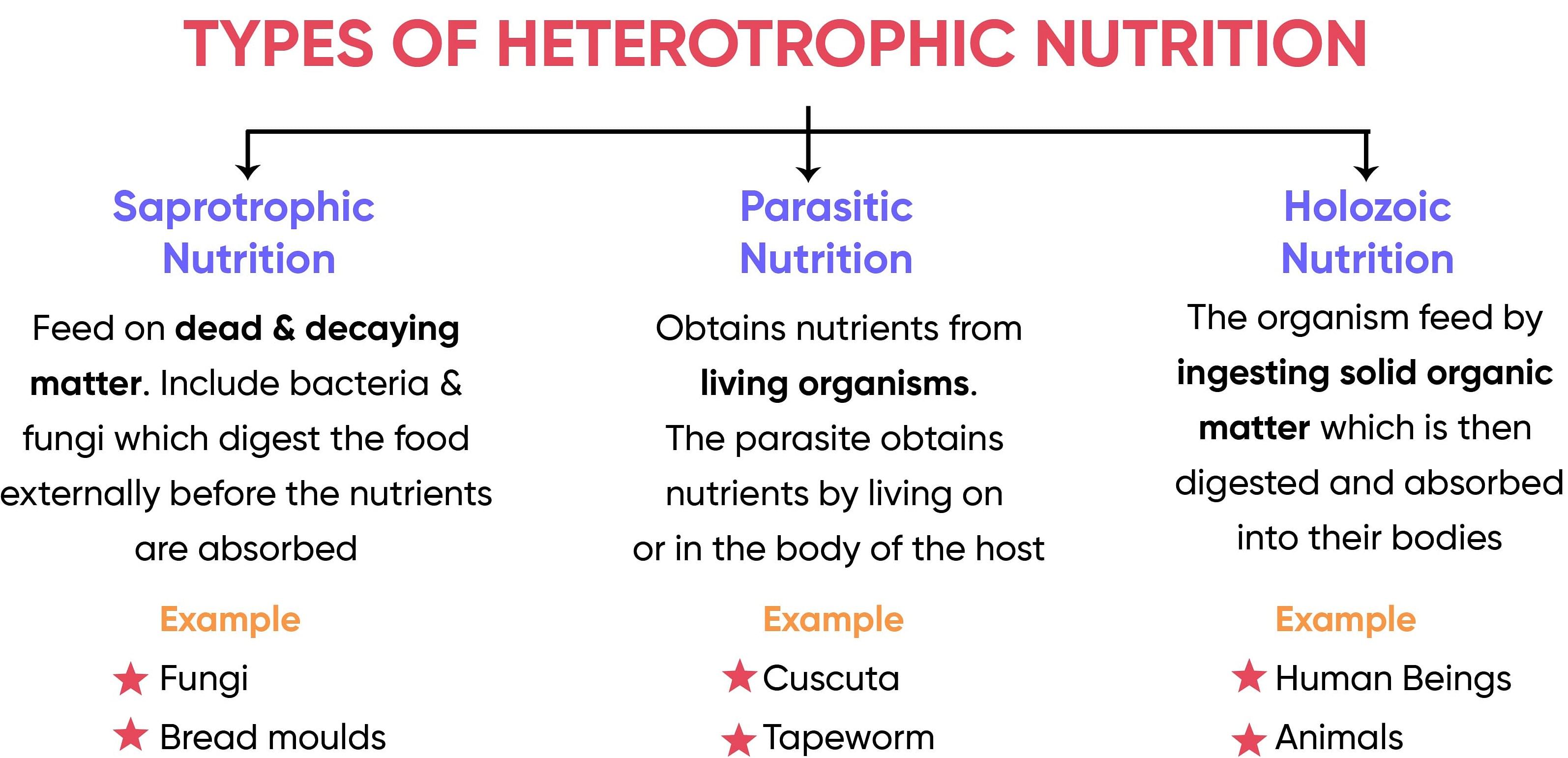
Various Types of Heterotrophic Nutrition
Holozoic Nutrition
[Click Here for Sample Questions]
This type of nutrition comprises the ingestion and internal handling of solid and liquid food in an organism. This contains the stages of ingestion, digestion, absorption, assimilation, and excretion. Ingestion is the consumption of food, which is shattered into simpler organic materials by a process called digestion. After the withdrawal of valuable components, the undesired and undigested elements are defecated out.
Examples of animals that exhibit holozoic nutrition comprise whole vertebrates. Even a few unicellular organisms like amoeba also exhibit holozoic nutrition.
Read more: Important questions on Life Processes
Holozoic Nutrition in Amoeba
Amoeba is a unicellular organism that indicates holozoic nutrition. The procedure is mentioned below in the following manner:
- The amoeba encloses the food with the help of its pseudopodia. It then consumes the food by the procedure of phagocytosis.
- The food vacuoles of amoeba have digestive enzymes which break the food into simpler materials. This procedure is well-known as digestion.
- The processed food is immersed in the cytoplasm leaving the undigested constituents behind. This absorbed food is utilized to produce energy for the development and expansion of the cells.
- The undigested food collected is excreted out by the splitting of the cell membrane.
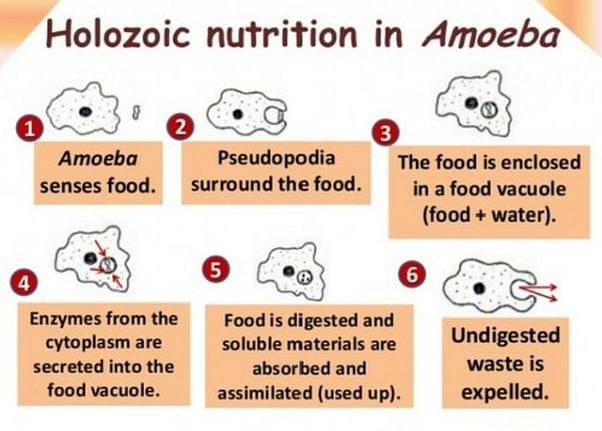
Holozoic Nutrition in Amoeba
Holozoic organisms are of three types:
- Herbivores- These organisms rely on plants for their food. Few examples of herbivores are cows, buffaloes, deer, elephants, and more.
- Carnivores- These animals feed on the rest of the animals for their diet. Few examples of carnivores are lions, tigers, leopards, and more.
- Omnivores- These animals can feed on plants or animals for their food. Few examples of omnivores are cockroaches, pigs, chimpanzees, raccoons, ants, and more.
Saprophytic Nutrition
[Click Here for Sample Questions]
The Saprophytes feed on dead and decomposed organisms for energy. These are significant to the ecosystem as they assist in keeping our environment clean and reutilize nutrients back into the ecosystem. Saprophytes release definite enzymes to take action on dead and decaying organic matter. It breaks it down into components that can be effortlessly consumed by them.
Few examples of those animals who follow saprophytic nutrition are fungi and certain kinds of bacteria like mushrooms or mould. Saprophytes are accountable for stale bread and related food products.
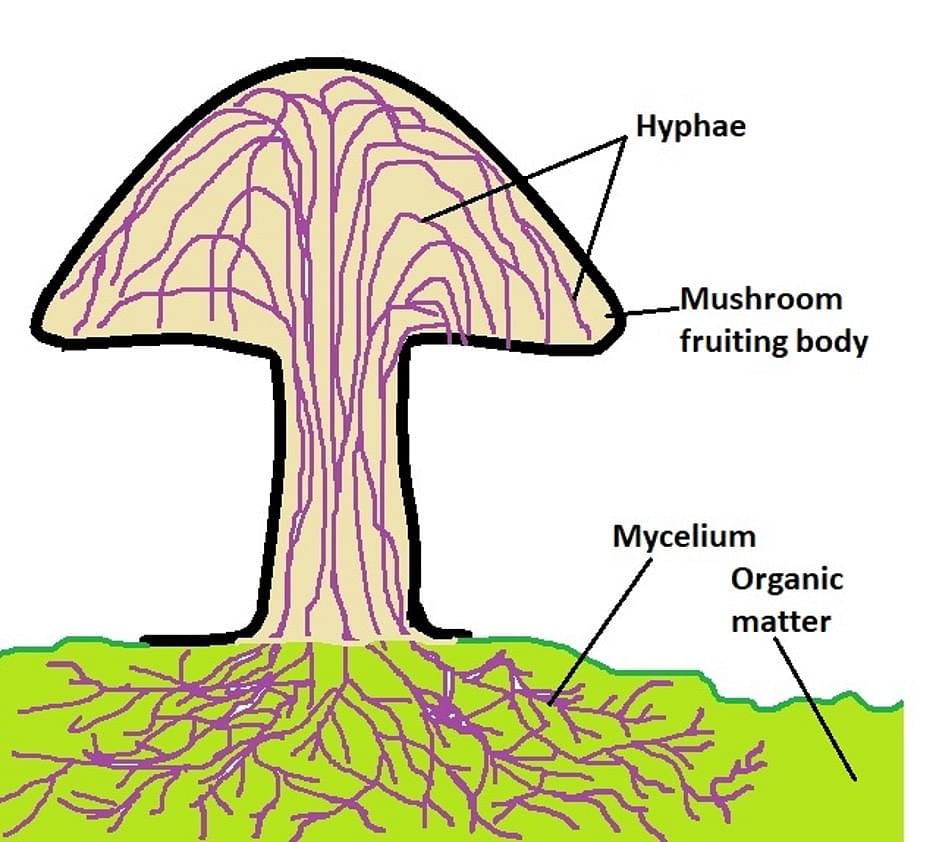
Saprophytic Nutrition
Parasitic Nutrition
[Click Here for Sample Questions]
Organisms that live inside or on other organisms and obtain food at the expense of their host are called parasites. Most parasites are injurious to health; they can even slaughter the host. Unlike commensalism, the organism causes damage to its host.
Cymothoa exigua is an uncommon parasite and is known as the tongue-eating louse. It is suitably named as it is found in the mouth of the marine fish Lithognathus. It basically breaks the fish’s tongue, cutting off the blood source causing the tongue to collapse. The louse then confers to the residues of the tongue and basically acts as the fish’s new tongue.
Read more: Excretion
Some examples of parasite organisms are louse on a human head, lice, Cuscuta plant, and tapeworms.

Parasitic Nutrition
Important Questions from Heterotrophic Nutrition
Ques. What is nutrition? (1 mark)
Ans. Nutrition is well-defined as the procedure of attaining food and utilizing it by any organism. Nutrition is a key procedure of obtaining energy from food.
Ques. Why is heterotrophic nutrition diverse from autotrophic nutrition? (1 mark)
Ans. Autotrophic nutrition organisms make their own food. This nutrition is found in plants where they make their food by the procedure of photosynthesis. Contrarily, Heterotrophic nutrition is prepared in organisms that rely on other organisms for food. This can be found in cows, dogs, tigers, elephants, and humans.
Read more : Excretion in plants
Ques. What is the main mode of nutrition in plants? (1 mark)
Ans. The main mode of nutrition in plants is the Autotrophic mode of nutrition.
Ques. Name a few examples of heterotrophs. (1 mark)
Ans. Few examples of heterotrophs are as follows:
Ques. Dogs, bacteria, fungi, yeast, cows, humans, and more. (1 mark)
Ans. They all depend on plants and animals for their diet or food.
Ques. What does the heterotrophic mode of nutrition mean? (1 mark)
Ans. Heterotrophic nutrition is the mode of nutrition where the organism is incompetent to make their food and they depend on plants or other organisms for nutrition.
Ques. What are several kinds of holozoic heterotrophs? (1 mark)
Ans. Herbivores, carnivores, and omnivores display the holozoic kind of heterotrophic nutrition.
Ques. What do you understand by the term Cymothoa exigua? (1 mark)
Ans. Cymothoa exigua is an uncommon parasite and is known as the tongue-eating louse. It is suitably named as it is found in the mouth of the marine fish Lithognathus. It basically breaks the fish’s tongue, cutting off the blood source causing the tongue to collapse. The louse then confers to the residues of the tongue and basically acts as the fish’s new tongue.
Ques. Name the steps for the Heterotrophic nutrition steps for amoeba? (1 mark)
Ans. There are five steps for heterotrophic nutrition:
- Ingestion
- Digestion
- Absorption
- Assimilation
- Egestion
Also Read:
| Related Articles | ||
|---|---|---|
| Autotrophic Nutrition | Nutrition in Human Beings | Transportation in Plants |



Comments