



Content Curator
Plasma and Serum are both components of Blood. They form part of the liquid component of the blood. So, if the cells present inside Blood like Red Blood Cells and White Blood Cells will be removed whatever remains will be a liquid-like substance containing both Plasma and Serum. They are the medium in which Blood Cells float. But that is where the common ground between Plasma and Serum ends as they are part of the same mix but are very different from one another.
| Table of Content |
Keyterms: Blood, Plasma, Serum, Blood Cells, Red Blood Cells, White Blood Cells, PH, Oxygen, Carbon Dioxide, Hormones, Enzymes
Read Also: Plasma in Blood
What is Blood?
[Click Here for Sample Questions]
Blood is a connective tissue consisting of free-floating cells and fluids. It flows in Blood Vessels and performs the job of transporting Oxygen, Carbon Dioxide, Hormones, Enzymes, and Nutrition to individual cells inside our body. Blood is also involved in the PH regulation of our body by interacting with acids and bases present inside a Human Body and it regulates the body temperature as well. Cells also release their waste in the blood which then gets extracted in the kidneys.
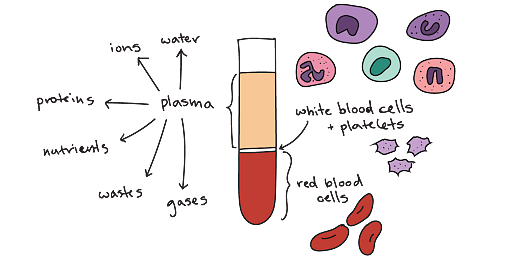
Blood: Composition
Blood is composed of Plasma, Serum, Red Blood Cells, (RBCs), White Blood Cells (WBCs), and other formed elements like erythrocytes, leukocytes and platelets.
Also Read:
What is Plasma?
[Click Here for Sample Questions]
Plasma is the core component of the Blood as it makes up to 55% of the Blood volume. It is the medium in which all types of Blood cells remain suspended and are free floating to carry on their tasks like RBCs are transporting Oxygen while WBCs are fighting foreign Bacteria.

Plasma in Blood
Plasma: Composition
Plasma is made up of 90% water and the remaining 10% contains:
- Proteins
- Antibody proteins
- Coagulation factors
- Fibrinogen
- Ions
- Nutrients
- Dissolved gases
- Waste from cells
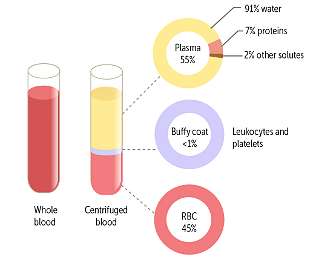
Plasma: Composition
Functions of Plasma
Plasma has two major functions:
- Regulation of body temperature
- Controlling of blood pressure
How to Obtain Plasma?
In order to separate plasma from the blood, the blood is made to undergo the process of centrifugation wherein the plasma is separated and forms the upper layer of the resulting product. separating plasma from blood increases its shelf life and makes its transportation convenient.

How to Obtain Plasma
Uses of Plasma
Clotting factors present in Plasma are used to treat coagulation disorders like hemophilia or disseminated intravascular coagulation.
Read More: Plasma Membrane
What is Serum?
[Click Here for Sample Questions]
The liquid part of the blood that lacks the clotting factors and is devoid of Blood cells is called serum. It is formed after the blood coagulation wherein the Blood loses its coagulation protein called fibrinogen as it changes another protein called Fibrin, which helps in wound healing.
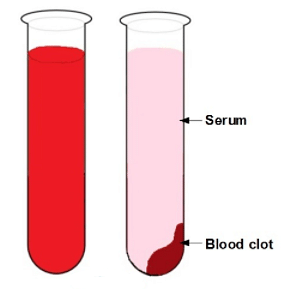
Serum
Serum contains all proteins not used in blood clotting, antibodies and antigens, enzymes, hormones, electrolytes, exogenous substances like drugs and microorganisms
Serum can be used to detect problems like Blood Sugar, Blood Pressure and Cholesterol etc.
Also Read:
Difference between Serum and Plasma
[Click Here for Sample Questions]
| Point of difference | Plasma | Serum |
| Colour | It is a yellowish liquid due to the presence of red blood cells. | It is a clear liquid. |
| PH | It is slightly alkaline in nature. | It is slightly acidic due to its proteins acting as weak acids. |
| Components | Plasma contains water, clotting factors and blood cells | Serum contains water, all proteins of plasma except clotting factors. |
| Volume | Plasma is made up of 55% of the blood volume | Serum is always less in volume than Plasma. |
| Composition | Blood Cells, Salts, Lipids, Proteins and Glucose | Electrolytes, Antigens, Antibodies, Protein and Hormones |
| Fibrinogen | It is present | It is not present as it changed into Fibrin Protein |
| Method of Separation | It is acquired after centrifuging the blood with the anti-coagulant. | It is acquired after simply centrifuging the blood after it has coagulated. |
| Shelf life | Can be preserved for more than a year after separation from blood | Can be preserved for not more than a few months after separating from the blood. |
| Density | 1.025 g/ml | 1.024 g/ml |
| Function | Helps in regulation of Body Temperature and Blood Pressure and can be used to treat Coagulation Disorders | Helps in detection of Cholesterol, Blood Sugar and Blood Pressure Etc. |
| Importance | It is the primary medium to transport excretory products through the Human Body. | It acts as an important source of electrolytes. |

Difference between Serum and Plasma
Things to Remember
- Fibrinogen is a protein found in Blood Plasma which then converts into fibrin to form Blood clots and the remaining part of Plasma is now called Serum.
- To acquire plasma, blood undergoes centrifugation before it has clotted but to obtain serum this centrifugation is done after the clotting of blood.
- Serum is essentially a component of Blood Plasma. Simply put, Blood Plasma = Serum + Clotting factors.
- Human Serum is sometimes used in the Cosmetic Industry as well.
Sample Questions
Ques. What is Plasma? (2 marks)
Ans. Plasma is yellowish fluid in the blood wherein all the blood cells are suspended. It is viscous in consistency and makes up about 55% of the total blood volume. It contains 90% water and rest of it is made up of nutrients, waste from cells, salts etc. it is known for containing Fibrinogen (clotting factor)
Ques. What is Serum? (2 marks)
Ans. Serum is a clear liquid that does not contain the clotting factor. So, serum is essentially derived from plasma once the clotting factor is removed. Serum contains enzymes, hormones, electrolytes etc.
Ques. What is Fibrinogen? (2 marks)
Ans. Fibrinogen is a blood clotting protein found in generous quantities in Blood Plasma and helps in the making of fibrin. Deficiency of fibrinogen can cause the delay in blood clotting leading to excess bleeding.
Ques. What is Fibrin? (2 marks)
Ans. Fibrin is a protein formed from fibrinogen when the latter comes under the influence of thrombin enzyme, together with platelets this protein forms haemostatic blood clot. So, this protein is literally found inside a blood clot and not in the blood itself and is crucial for wound healing.
Ques. What is the difference between serum and plasma? (2 marks)
Ans. The fluid part of the blood that contains fibrinogen is called plasma but when the same fibrinogen is removed from the blood as it changes into fibrin the remaining liquid is now known as the serum.
Ques. What is the difference between fibrin and fibrinogen? (2 marks)
Ans. Fibrinogen is a clotting factor found in plasma but during blood clotting it converts into fibrin and this fibrin is a non-globular protein that actually forms the blood clot.
Ques. What is centrifugation? (2 marks)
Ans. Centrifugation is a technique wherein mixtures are separated by application of centrifugal force i.e.; a mixture is put in a device called centrifuge where it’s rotated at extremely high speeds to separate the components of the mixture.
Ques. What is blood coagulation? (2 marks)
Ans. Blood coagulation is a process whereby all the floating and fluid components of blood turn into an insoluble gel which then leaks out of the blood vessel and covers the wound making it impenetrable and thus preventing any foreign objects from entering the body.
Check-Out:



Comments