



Education Journalist | Study Abroad Lead
Putrefaction is the process of rotting or decay in any organic matter. A sequence of changes occurs in the organic matter after death. Putrefaction is the fifth stage of death usually known as decomposition. Though putrefaction is a biologically natural phenomenon, some external factors can fasten or slow the pace of the putrefaction process. There are various external and internal factors affecting the process of putrefaction such as temperature, moisture, age, clothing, etc.
| Table of Content |
Key Terms: Putrefaction, Life Processes, Putrefying Bacteria, Stages of Death, Factors Affecting Putrefaction, Decomposition, Fungi, Microorganisms, Temperature
Concept of Putrefaction
[Click Here for Sample Questions]
Putrefaction is the decay or rotting of a body or an organic matter due to the consistent action of micro-organisms. Putrefaction is seen as the fifth stage of death. That being said, Putrefaction is usually observed between 10 to 20 days after the death of a living being or an organism. However, the time taken for putrefaction can vary as it depends upon numerous factors, for example, temperature, moisture, age, light, cause of death, etc. It is important to note there that the process of putrefaction, in which plenty of microorganisms are working together, also results in the production of an unbearable foul smell.
The decomposition of proteins, breakdown of the tissues, and liquefaction of the organs are the events that occur during the process of Putrefaction. Decomposition of the body happens due to the action of putrefying bacteria and fungi. Both of these microorganisms release certain gases to infiltrate and deteriorate the body tissues and organs which is certainly the breakdown of the tissues. It would be significant to note that Putrefying bacteria play a vital role in recycling nitrogen from the organism which is dead.

Putrefaction
Process of Putrefaction
[Click Here for Sample Questions]
Regular biochemical maintenance is required in order to utilize the chemical energy of the body. But this biochemical maintenance stops happening during the death of an organism. When the maintenance is not happening, the hydrolysis process starts in the body.
As mentioned, there are many processes involved in the process of Putrefaction. So, hydrolysis is a spontaneous process which is increased by various bacteria such as anaerobic bacteria, already present in the human gut. Hydrolysis of proteins to amino acids and water weakens and breaks down all the tissues of the body. Moreover, with the breakdown of proteins, bacteria excrete certain organic compounds and gases which emit a foul smell like the rotten flesh from the dead organism.
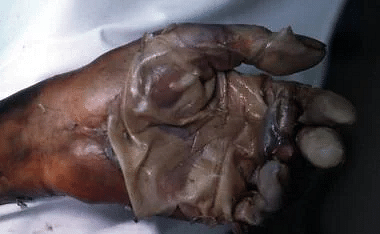
The skin tissues of the body rupture releasing the bacterial gas throughout this process. When this process of putrefaction continues, the body ultimately reaches a stage which is known as skeletonization. At this final stage, only the skeleton is left.
Read More: Difference Between Aerobic And Anaerobic Bacteria
Microorganisms Involved in the Process of Putrefaction
[Click Here for Sample Questions]
The aerobic Bacteria Bacillus and Pseudomonas are the prominent ones among the various putrefactive microorganisms. The mold fungi are also involved in the process of putrefaction but they do not play a major role in the whole process.
Stages of Decomposition
Factors Affecting Process of Putrefaction
[Click Here for Sample Questions]
There are various factors which affect the process of Putrefaction. These affecting factors can be divided into two categories. The first category is external factors and the second category is internal factors.
External Factors Affecting Putrefaction
Those factors which affect the process of putrefaction from outside or externally are known as the external factors.
- Temperature: Temperature affects the process of Putrefaction as a major external factor. An increased temperature can simply increase the level of putrefaction. 21°C to 38°C is the optimum temperature for the process of putrefaction. On the other hand, if the temperature is below 0°C or above 48°C then the putrefaction process hinders.
- Moisture: The process of Putrefaction slows down if there is a Lack of air/ moisture or if the body is immersed in water. The degradation of the organism starts when the moisture and air are present which helps in the formation of microbes.
- Clothing: Clothing is also an external factor that can affect Putrefaction. Tightly fitted clothes can reduce the blood flow to the body, making it complicated for the bacteria to be consistent with putrefaction. On the other hand, loose-fitted clothes allow uninterrupted blood and moisture flow making the process of Putrefaction easy.
- Light: Light inhibits the putrefaction process. Meanwhile, darkness makes the microorganisms active to carry on the process of Putrefaction.
Internal Factors Affecting Putrefaction
Those factors which affect the process of putrefaction from inside or internally are known as the internal factors.
- Age: In comparison to the body of an old person a young one's body undergoes the putrefaction process at a rapid speed. On the other hand, the bodies of infants and fetuses undergo putrefaction way far slowly as these bodies are still sterile.
- Condition of the Body: Because more heat and fluids are present in the tissues, fat body putrefaction much more quickly than a lean body.
- Reason behind Death: Putrefaction happens at a fast pace in the dead bodies of those people who die from infectious diseases in comparison to those who died due to accidents.
- External Injuries: Due to bacterial invasions, bodies with external injuries are much more easily putrefaction. Moreover, putrefaction happens at a rapid pace in air as compared to soil, earth and water.
Read More: Human Diseases
Things to Remember
- The decay or rotting of a body or an organic matter due to the consistent action of micro-organisms is known as Putrefaction.
- The putrefaction process starts between 10 to 20 days after the death of the organism.
- Putrefaction is the fifth stage of death involving many other processes within it.
- The aerobic Bacteria Bacillus and Pseudomonas are the Putrefative bacteria.
- Both external, as well as internal factors, can affect the process of putrefaction.
Sample Questions
Ques. What among the following is the decay of the organic matter by the action of microorganisms resulting in the production of a foul smell? (3 Marks)
a.Putrefaction
b.Purification
c.Acidification
d.None of these
Ans. a) Putrefaction is the correct answer.
The decay of the organic matter of microorganisms resulting in the production of a foul smell is known as putrefaction. That said other options purification and acidification are incorrect there.
Ques. Putrefaction involves (3 Marks)
a.breakdown of the tissues
b.decomposition of proteins
c.liquefaction of the organs
d.all of these
Ans. d) All of these is the correct answer.
The process of putrefaction involves the breakdown of the tissues, decomposition of proteins and liquefication of the organs so the answer would be all of these.
Ques. Which among these factors affects putrefaction? (3 Marks)
a.Moisture
b.Clothing
c.Light
d.all of these
Ans. d) All of these is the correct answer.
Moisture, clothing and light are all of these factors that affect putrefaction by slowing down the process. Hence, all of these would be the answer.
Ques. Pick the odd one out (3 Marks)
a.Body Condition
b.Cause of Death
c.External Injuries
d.Clothing
Ans. d) Clothing is the correct answer.
Body condition, cause of death and external injuries are the internal factors affecting putrefaction. Meanwhile, clothing is an external factor. Hans clothing is the odd one out there and it would be the answer.
Ques. Choose the incorrect statement: (3 Marks)
a.Loose-fitting clothes retain body heat and speed up the putrefaction process.
b.The rate of putrefaction decreases with the increase in temperature.
c.Light inhibits the putrefaction process
d.A fat body putrefies more quickly than a lean body
Ans. b) The rate of putrefaction decreases with the increase in temperature is the correct answer.
The increased temperature increases the rate of putrefaction. hence, the statement that the rate of putrefaction decreases with the increase in temperature would be incorrect.
Ques. Which of the two microbes are involved in the process of decomposition? (3 Marks)
a.Virus and fungi
b.Bacteria and virus
c.Bacteria and fungi
d.None of these
Ans. c) Bacteria and fungi is the correct answer.
Virus and fungi alone cannot make the process of putrefaction or decomposition occur. Moreover, the virus can be the cause of death but it is not majorly involved in the process of decomposition. Hence option c) bacteria and fungi is the correct answer.
Ques. Name the microorganisms involved in the process of putrefaction. (1 Mark)
Ans. The aerobic Bacteria Bacillus and Pseudomonas. Mold fungi also play a role in the process of putrefaction.
Ques. What is Putrefaction? Explain in detail. (5 Marks)
Ans. A sequence of changes occurs in the organic matter after death. Putrefaction is the process of decay or rotting of a body or an organic matter due to the action of microbes. Putrefaction is usually observed within 10 to 20 days of the death of a living being or an organism matter.
However, the time for putrefaction can differ as it is depended upon numerous factors, for example, temperature, moisture, age, light, cause of death, etc. It is important to note there that the process of putrefaction, in which plenty of microorganisms are working together, also results in the production of a foul smell.
Ques. What kind of a factor is clothing? How can it affect the Putrefaction process? (3 Marks)
Ans. Clothing is an external factor that affects the putrefaction process externally.
Body fitted clothes can reduce the blood flow to the organic matter, which directly makes putrefaction difficult for the bacteria. On the opposite side, blood and air can easily flow in loose-fitted clothes which consequently helps the putrefaction process to continue at a rapid pace.
Ques. What are the internal and external factors affecting the process of putrefaction? (5 Marks)
Ans. Temperature, moisture, age, light, cause of death, and clothing are some factors affecting the process of putrefaction. These factors can be classified into two categories. These categories are internal and external factors. External factors are those that affect the process externally. Whereas, internal processes are those which affect the process internally.
Temperature, moisture, clothing and light are some factors that affect the Putrefaction process externally. Age, condition of the body, the reason behind death and external injuries are some factors that affect the process internally. All of these factors can fasten or slow down the process of putrefaction.
Check-Out:



Comments