



Content Curator
Apoptosis is a type of cell death in which a predetermined number of cells die without releasing hazardous compounds into the environment. It's also known as cellular suicide or planned cell death. The most well-understood type of programmed cell death is this. It necessitates the death of a cell yet benefits the entire organism.
This is a systematic procedure in which the contents of the cell are packaged into little membrane packets for collection by immune cells. By removing cells throughout development and eliminating possibly malignant and virus-infected cells, it aids in the maintenance of body equilibrium.
| Table of Content |
Keyterms: Apoptosis, Cell, organism, environment, cell death, equilibrium, cell membrane, cancer cells
Apoptosis: Definition
[Click Here for Sample Questions]
Apoptosis is defined as “A normal biological process in which cells self-destruct in order to keep the body running smoothly.”

Apoptosis
In other words, apoptosis is a type of cell death in which a cell dies as a result of a succession of molecular events. This is one of the mechanisms by which the body eliminates undesired or abnormal cells. In cancer cells, the apoptotic process may be inhibited. Also referred to as "planned cell death".
Also Read:
| Related Articles | ||
|---|---|---|
| Tuberculosis | Dengue Fever | Hepatitis |
| Infectious Diseases | Human Health and Diseases | Human Diseases |
| Thalassemia | Hemophilia | Jaundice |
Apoptosis: Process
[Click Here for Sample Questions]
Apoptosis is a biological process that happens in all multicellular organisms, including plants and animals. It eliminates cells from organisms that should no longer be a part of them. This process is critical for human development as well as the formation and maintenance of a healthy immune system. The word apoptosis comes from the Greek word apoktosis, which means "falling off." Kerr, Wyllie, and Currie were the first to introduce it. Apoptosis kills between 50 and 80 billion cells every day in an adult individual. Infected cells, pre-cancerous cells, and other cancer cells are successfully destroyed during this biological process, which maintains the equilibrium of cells in the human body. As a result, it is a critical process that is responsible for the normal development of cells, cell cycle maturation, and the maintenance of cell functions and activities.

Apoptosis Process
Apoptosis occurs in all vertebrates with digits, such as fingers and toes. Fused toes or fingers are the result of a minor apoptotic error. Another example of apoptosis is the loss of a tadpole's tail as it develops into a frog.
Classification of Apoptosis Pathways
[Click Here for Sample Questions]
Apoptosis pathways can be divided into two categories.
- The mitochondrial pathway is also known as the intrinsic pathway. Due to the identification of DNA damage, the cell receives a signal to destroy itself from one of its own genes or proteins.
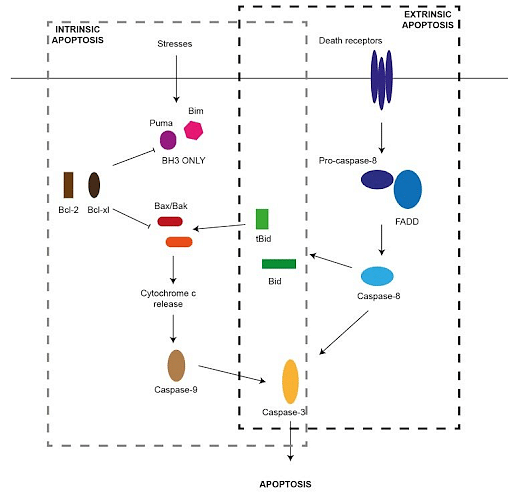
Classification of Apoptosis Pathways
- The death receptor pathway is also known as the extrinsic pathway. A cell receives a signal from other cells in the organism to initiate apoptosis. When a cell has outlived its usefulness or is no longer a good investment for the organism to support, this is triggered.
Steps in Apoptosis
[Click Here for Sample Questions]
- Shrinkage of Cell- The reduction of cell volume is a universal hallmark of programmed cell death, as shown in all occurrences of apoptosis.
- Cell Fragmentation- The DNA in the cell's nucleus condenses and breaks into uniformly sized fragments in this step.
- Collapse of Cytoskeleton- The cytoskeleton of the immature organism collapses at this stage.
- Disassembly of the Nuclear Envelope- At this point, the nuclear envelope is disassembled.
- Release of Apoptotic Bodies by Cells- At this stage, cells go through morphological changes such as membrane blebbing, the development of thin membrane protrusions, and the generation of discrete apoptotic bodies.

Steps in Apoptosis
Also Read:
| Related Articles | ||
|---|---|---|
| Acquired Immunodeficiency Syndrome | Arthritis | insulin |
| Symptoms of Heart Attack | Heart Diseases | Cancer |
| Typhoid | Thyroid | Leprosy |
Importance of Apoptosis
[Click Here for Sample Questions]
- Apoptosis contributes to the sculpting of numerous organs and tissues throughout the development of overproduced cells that eventually die of natural causes.
- Every second, almost one lakh cells in the human body die by apoptosis, while a similar amount are generated by mitosis.
- In a day, roughly 29 to 30 billion cells die in youngsters aged 8 to 14.
- Apoptosis causes the epithelial lining of our bodies to alter every 23 days.
Apoptosis and Its Function
[Click Here for Sample Questions]
- Cardiac remodelling, also known as systolic and diastolic dysfunction, is a process in which heart chamber dilatation and wall weakening occur in conjunction with systolic and diastolic malfunction.
- Pancreatic cancer pathology - pancreatic cancers resist apoptosis, which could lead to new molecular treatments for pancreatic cancer.

Apoptosis and Its Function
- Thisapoptosis behaves like a stone sculptor, removing the substance and revealing a new shape.
- Apoptosis is a quick and irreversible process that develops in cancer cells to rapidly destroy defective cells.
- Bone-Related Diseases Pathogenesis and Treatment - Apoptosis dysfunction may play a role in malignant transformation as a cell dysregulation. The death mechanism plays a role in the progression of osteoporosis.
Examples of Apoptosis
[Click Here for Sample Questions]
- Mouse Feet - During embryonic development, mice's feet begin as flat, spade-shaped objects. The process of apoptosis causes the feet to divide into five different toes as they develop. The cells are joined in order to generate different gaps between them.

Examples of Apoptosis
- Developmental Stages of Tadpole to Frog - The best and most spectacular example of apoptosis is found in frog tadpoles, which destroy and reabsorb all of their body structures as they develop into frogs. As the tadpole matures, apoptotic signals cause cells in the gills, fins, and tail to die. The raw material of the dead cells becomes a key material for new growing limbs and also serves as a supplement as needed.
Apoptosis and Cancer: Is there a Link?
[Click Here for Sample Questions]
Cancer is defined as the uncontrolled division of cells that results in the formation of a tumour. These undesirable cells can be removed from the body if apoptotic signalling works properly. The ability of cancer cells to avoid apoptosis and hence grow uncontrollably is the primary cause of cancer.

Apoptosis and Cancer
Also Read:
Things to Remember
- Apoptosis is a type of cell death in which a predetermined number of cells die without releasing hazardous compounds into the environment.
- It's also known as cellular suicide or planned cell death.
- Apoptosis is a biological process that happens in all multicellular organisms. It eliminates cells from organisms that should no longer be a part of them.
- Apoptosis is divided into two pathways: The mitochondrial pathway is also known as the intrinsic pathway while the death receptor pathway is known as the extrinsic pathway.
- Apoptosis contributes to the sculpting of numerous organs and tissues throughout the development of overproduced cells that eventually die of natural causes.
- The best and most spectacular example of apoptosis is found in frog tadpoles, which destroy and reabsorb all of their body structures as they develop into frogs.
Sample Questions
Ques. What is the significance of apoptosis? (2 marks)
Ans: Precancerous and virus-infected cells are killed via apoptosis. As a result, it keeps the human body's cells in balance and boosts the immune system.
Ques. What Causes Apoptosis in Cells? (3 marks)
Ans: Caspases are proteolytic enzymes that trigger cell death by removing particular proteins from the cytoplasm and nucleus, causing apoptosis. These caspases exist as an inactive process in all types of cells, and are normally activated by cleavage by other caspases, resulting in a proteolytic caspase cascade.
In general, the adaptor protein causes activation by bringing many copies of particular activities known as initiator processes. Cells can also destroy themselves when they are damaged or stressed, causing procaspase aggregation and activation from within the cell.
Ques. What does apoptosis serve? (2 marks)
Ans: One of the functions of apoptosis is to destroy cells with potentially harmful mutations. If a cell's apoptosis mechanism fails, the cell will expand and divide uncontrollably, eventually forming a tumour.
Ques. Why Do Cells Go Through Apoptosis? (3 marks)
Ans: Apoptosis is a process in which many cells in the human body die. Apoptosis is a widespread and practical method of removing cells that are no longer regarded to be a part of the live organism. Nevertheless, certain cells are aberrant and, if they survive, could harm the organism. Viral infections or DNA damage are examples of cells that need to be eradicated.
To preserve equilibrium and make room for the growth or production of new cells, the majority of cells in an adult organism may be eliminated.
Ques. What factors have an impact on apoptosis? (3 marks)
Ans: In some circumstances, whether cells die through apoptosis or necrosis is determined by the type of stimuli and/or the intensity of the stimuli. A variety of harmful stimuli, including heat, radiation, hypoxia, and cytotoxic anticancer medications, can trigger apoptosis at low doses, but at higher concentrations, these same stimuli can cause necrosis.
For Latest Updates on Upcoming Board Exams, Click Here:https://t.me/class_10_12_board_updates
Do Check Out:



Comments