



Content Curator
An inelastic collision is a particular case of collision in which there is a dissipation of energy in the form of heat, light, and sound takes place when the two bodies interact with each other.
- In an inelastic collision, the kinetic energy of the objects before and after the collision is not conserved.
- When the two colliding objects stick together and move as one body then the collision is said to be a perfectly inelastic collision.
- In case of perfectly inelastic collision, the linear momentum of the system remains conserved but the kinetic energy is not conserved.
- The value of the coefficient of restitution in case of perfectly inelastic collision is zero.
An elastic collision is a type of collision in which there is no dissipation of energy takes place during the collision.
- In an elastic collision, the kinetic energy of the colliding bodies before and after the collision is conserved.
- An elastic collision is said to be a perfectly elastic collision if both linear momentum and kinetic energy of the system are conserved.
- The value of the coefficient of restitution in case of perfectly inelastic collision is one.
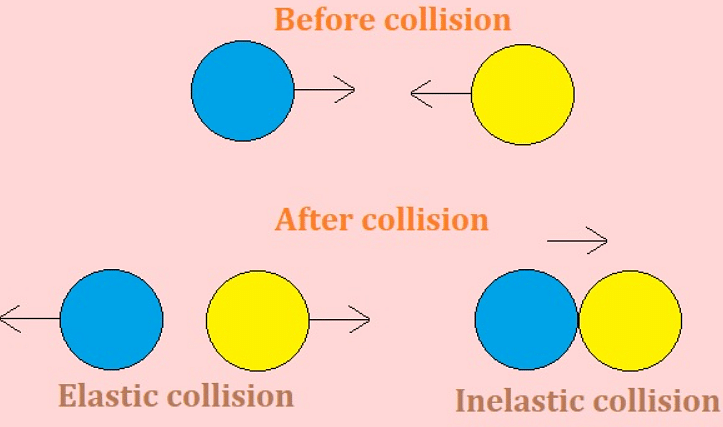
Elastic and inelastic collision
Very Short Answers Questions [1 Mark Questions]
Ques. Define inelastic collision.
Ans. In a particular collision, if there is dissipation of energy i.e. the total kinetic energy of the objects before and after the collision is not conserved, then the collision is known as the inelastic collision.
Ques. In an inelastic collision,
- Momentum is not conserved but kinetic energy is conserved
- Momentum is conserved but kinetic energy is not conserved
- Both momentum and kinetic energy is conserved
- Neither momentum nor kinetic energy is conserved
Ans. The correct option is b. Momentum is conserved but kinetic energy is not conserved.
Explanation: In an inelastic collision, due to the loss in energy, the total kinetic energy of the objects before and after the collision is not conserved.
Since no external force supported the collision, therefore momentum is conserved.
Ques. A bullet strikes a wooden block resting on a frictionless horizontal surface and stops in it. Later the combined system moves. In this case
- Only kinetic energy is conserved
- Only momentum is conserved
- Both kinetic energy and momentum are conserved
- Neither kinetic energy nor momentum is conserved
Ans. The correct option is b. Only momentum is conserved.
Explanation: Kinetic energy is not conserved because this is the case of perfectly inelastic collision.
Momentum is conserved because there is no external force acting on the system.
Ques. When two bodies collide, there is no loss in the overall kinetic energy. Which type of collision is this?
- Elastic collision
- Inelastic collision
- Perfectly elastic collision
- None of the options
Ans. The correct option is c. Perfectly elastic collision
Explanation: In a perfectly elastic collision, both linear momentum and kinetic energy are conserved. Therefore, after the collision, there is no loss in the overall kinetic energy.
Ques. In which type of collision does no conversion of energy take place?
- Inelastic collision
- Perfectly inelastic collision
- Elastic collision
- None of the options
Ans. The correct option is c. Elastic collision
Explanation: In an elastic collision there is no loss of energy i.e. the total kinetic energy before and after the collision is the same. Hence, no conversion of energy takes place.
Short Answers Questions [2 Marks Questions]
Ques. Give three examples of inelastic collision.
Ans. Examples of inelastic collisions are
- A ball dropped from a certain height unable to rise to its original height.
- The accident of two vehicles.
- When a soft mudball is thrown against the wall, it will stick to the wall.
Ques. Define perfectly inelastic collision.
Ans. A collision is said to be a perfectly inelastic collision if two bodies after collision stick together and move as one body.
In this collision, the linear momentum of the system remains conserved but the kinetic energy is not conserved.
Ques. Define Collision. How it occurs?
Ans. The interaction between two bodies due to which the direction and magnitude of the velocity of the colliding bodies change is called Collision.
A collision occurs when two bodies come in direct contact with each other. It is a situation in which two or more bodies exert forces on each other in about a relatively short time.
Ques. Define elastic collision. What is the value of the coefficient of restitution in case of a perfectly elastic collision?
Ans. In a particular collision, if there is no dissipation of energy, the total kinetic energy of the object before the collision is equal to the total kinetic energy of the objects after the collision, then the collision is said to be an elastic collision.
An elastic collision is said to be perfectly elastic if both the linear momentum and kinetic energy of the system remain conserved.
In this situation, the value of the coefficient of restitution is e = 1.
Read More:
| Concept Related Topics | ||
|---|---|---|
| Physical Nature of Matter | Buoyant Force | Maxwell Boltzmann Distribution Formula |
| Diffusion Formula | Water | Pressure |
| Stefan Boltzmann Constant | Gay Lussac’s law | Mean Free Path |
Long Answers Questions [3 Marks Questions]
Ques. A bullet weighing 10 g and moving with a velocity of 800 ms-1 strikes a 10 kg block resting on a frictionless surface. What is the speed of the block after the perfectly inelastic collision?
Ans. In a perfectly inelastic collision, the two colliding bodies stick together and move as one body with velocity
v = (m1u1 + m2u2) / (m1 + m2)
Given
- Mass of the bullet, m1 = 10 g = 10 x 10-3 kg = 10-2 kg
- Mass of the block, m2 = 10 kg
- The initial velocity of the bullet, u1 = 800 m/s
- The initial velocity of the block, u2 = 0
Therefore, the final velocity after the collision is given by
v = (10-2 x 800 + 10 x 0) / (10-2 + 10)
⇒ v = 8/10.01 = 0.799 m/s ≅ 8 m/s
Ques. Define the coefficient of restitution.
Ans. The coefficient of restitution is an experimental quantity used to represent the nature of collision between two bodies.
The formula of the coefficient of restitution is given by the ratio of the velocity of separation to the velocity of the approach. i.e.
Coefficient of restitution, e = vseparation/vapproach = |(v2 - v1) / (u2 - u1)|
Where u1 and v1 are the initial and final velocity of the first body respectively and, u2 and v2 are the initial and final velocity of the second body respectively.
Ques. What is the value of the coefficient of restitution in case of a perfectly inelastic collision? Write the expression for the final velocity of the two colliding objects undergoing a perfectly inelastic collision.
Ans. The coefficient of restitution in the case of a perfectly inelastic collision is zero. i.e. e = 0.
Let a body of mass m1 moving with velocity v1 collides with a body of mass m2 moving velocity v2. If the collision is perfectly inelastic, then after the collision both the body will stick together and move as one body with velocity
v = (m1u1 + m2u2) / (m1 + m2)
Ques. What are the differences between elastic and inelastic collisions?
Ans. The difference between elastic and inelastic collisions are as follows
| Elastic Collision | Inelastic collision |
|---|---|
| In an elastic collision, total kinetic energy is conserved. | In an inelastic collision, total kinetic energy is not conserved. |
| There is no loss of energy. | There is a loss of energy in the form of sound, light, and heat. |
| Total momentum before and after the collision is conserved. | Total momentum before and after the collision is conserved. |
| The nature of the forces involved during the interaction is conservative. | The nature of the forces involved during the interaction is non-conservative. |
Very Long Answers Questions [5 Marks Questions]
Ques. Two particles of mass 1 kg and 2 kg are moving with speeds of 2 m/s and 5 m/s respectively. They collide perfectly inelastically. Find
- Their final velocities
- Loss in kinetic energy
Ans. In a perfectly inelastic collision, the two colliding bodies will stick together and move as one body with velocity
v = (m1u1 + m2u2) / (m1 + m2)
Given
- m1 = 1 kg
- m2 = 2 kg
- u1 = 2 m/s
- u2 = - 5 m/s
- Let the body of mass m1 is moving towards the positive X-axis and the body of mass m2 is moving towards the negative X-axis. After the collision, both the body will stick together and moves as one body, therefore the velocity of both bodies will be
v = (1 x 2 - 2 x 5) / (1 + 2) = - 8/3 m/s towards negative X-axis
- Loss in kinetic energy is given by
ΔK.E. = 1/2 (m1m2 / m1 + m2) (u1 - u2)2
ΔK.E. = 1/2 (1 x 2 / 1 + 2) (2 + 5)2 = 49/3 J
Ques. A small ball is dropped from rest from a height of 10 m on a horizontal floor. If the coefficient of restitution between the ground and the body is 0.5, then find the maximum height it can rise after the collision.
Ans. Coefficient of restitution, e = vseparation/vapproach
Where
- vseparation = velocity of the ball just leaving the ground
- vapproach = velocity of the ball just before hitting the ground
But vapproach = √(2gh1)
Where h1 is the height from where the ball is dropped.
Also vseparation = √(2gh2)
Where h2 is the maximum height of the ball after collision from the ground.
Therefore, the coefficient of restitution, e = √(2gh2) / √(2gh1)
⇒ e = √(h2 / h1)
⇒ h2 = e2h1
Given
- e = 0.5
- h1 = 10 m
Therefore, the maximum height the ball can rise after collision
h2 = 0.52 x 10 = 2.5 m
Ques. A moving particle of mass m makes a head-on perfectly inelastic collision with a particle of mass 2m which is initially at rest. Find the fractional loss in energy of the colliding particle after the collision.
Ans. After the head-on perfectly inelastic collision, the two bodies will stick together and moves as one body with velocity
v = (m1u1 + m2u2) / (m1 + m2)
Given
- m1 = m
- m2 = 2m
Let the particle of mass m is moving with a velocity u and the particle of mass 2m is at rest, therefore,
- u1 = u
- u2 = 0
On substituting the values, the final velocity of the bodies will be
v = (mu + 0) / (m + 2m) = u/3
Now, initial kinetic energy, Ki = 1/2 m1u12 + 1/2 m2u22
⇒ Ki = mu2/2
Final kinetic energy, Kf = 1/2 (m1 + m2)v2
⇒ Kf = 1/2 (m + 2m)(u/3)2
⇒ Kf = 1/2 (3m)(u2/9) = mu2/6
Loss in kinetic energy, ΔK = Kf - Ki = mu2/6 - mu2/2 = - mu2/3
Fractional loss in kinetic energy = (Kf - Ki )/Ki = (- mu2/3) / (mu2/2) = -2/6 = - 1/3
Therefore, after collision fractional loss in kinetic energy is 1/3 of its initial kinetic energy.
For Latest Updates on Upcoming Board Exams, Click Here: https://t.me/class_10_12_board_updates
Check-Out:



Comments