



Content Curator
Inverse Square Law Formula claims that, for a point source of waves, the intensity of radiation will be inversely proportional to the square of the distance. In other words, the intensity of light at various distances from a light source is described by the inverse square law. This indicates that when the distance between a light source and the observer grows, the intensity of the light rises by a factor of 1/d2. It means that the closer the light source is, the brighter it is.
Also Check: Gravitation
| Table of Contents |
Key Terms: Inverse Square Law Formula, Light, Intensity, Radiations, Candelas, Astronomy, X-Ray, Law of Gravity
What is Inverse Square Law?
[Click Here for Sample Questions]
Inverse square law claims that, for a point source of waves, the intensity of radiation will be inversely proportional to the square of the distance. Each light source is unique, but the intensity varies in the same way.
Thus, we can say that the light intensity is inversely proportional to the square of the distance. Hence, when the distance between a light source and observer grows, the intensity of light increases by a factor of 1/d2.
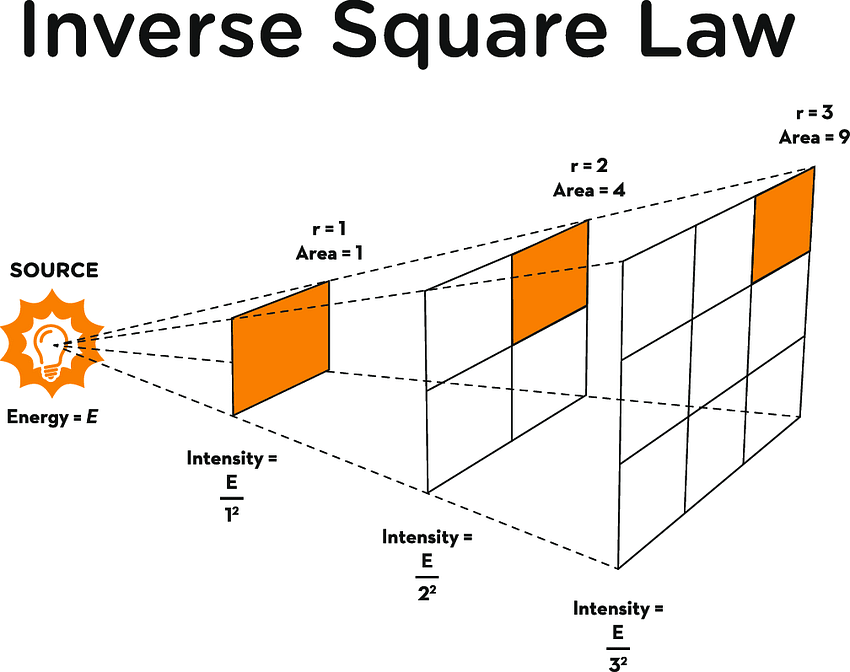
Inverse Square Law
The proportional sign is used to demonstrate how they are related. This is evident when at night a car approaches from a distance, it appears dark but as soon as it comes near the light, the headlights make it brighter in appearance as the distance between the observer and the car has been decreased.
Also Check:
What is Inverse Square Law Formula?
[Click Here for Previous Year's Questions]
According to the Inverse Square law formula, the intensity of light from a particular source varies inversely with the square of the source's distance. In brief, as the distance between the source and the observer rises, so does the intensity of the light from the source.
According to the Inverse Square Law Formula, light loses its brightness or luminosity as it moves away from the source. For instance, when we switch on the light in a corner of a room and then when we move away from the corner, the light seems to be dim or less bright because of an increase in the distance.

Inverse Square Law Diagram
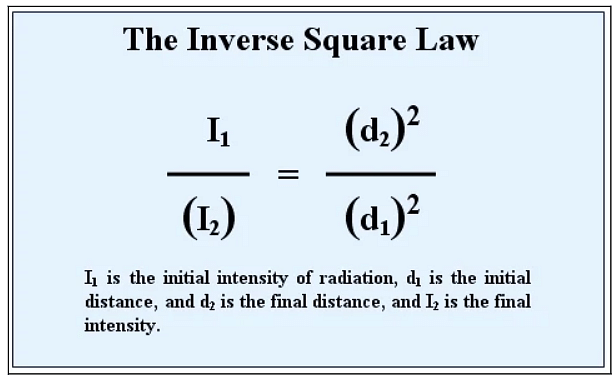
Inverse Square Law Formula can be stated mathematically as:
| I ∝ (1/d2) |
Where,
- d (metres) = Distance
- I (candela) = Radiation Intensity
If the distances are d1 and d2 and the intensities are I1 and I2, Then, according to Inverse-square Law,
⇒ I1/I2∝ d22/d12
The inverse square law formula is used to calculate the distance or intensity of a particular radiation. The intensity is measured in Lumens or Candelas, while the distance is measured in metres. It has a wide range of applications in light-related problems.
Inverse Square Law Formula
Also Read: Difference Between Centre of Gravity and Centroid
Applications of Inverse Square Law Formula
[Click Here for Sample Questions]
This rule is applied to determine the intensity of any given radiation or distance. Some applications of Inverse Square Law include:
- In X-ray methods, the inverse-square law is used to compute source-to-film distances.
- It also aids in determining the duration of x-ray exposure as well as the intensity of the x-ray tube used in the procedure.
- When the brightness of the source is known, the traditional candle method may be used to compute the distance from the Earth.
- The inverse-square law is used to calculate astronomical distances.
Inverse Square Law
Previous Year Questions
- At what height from the surface of earth the gravitation potential … [NEET 2016]
- Light year is used to measure … [DUET 2007]
- Sparkling of diamond is because of … [DUET 2008]
- The critical angle for total internal reflection in diamond … [DUET 2009]
- The angle of minimum deviation for a prism … [DUET 2008]
- Two parallel infinite line charges with linear charge densities … [NEET 2019]
- At the corners of an equilateral triangle of side …
- The electric field due to an infinitely long straight uniformly charged … [KEAM]
- If the gravitational force between two objects were proportional … [NEET 1994]
- If the mass of the Sun were ten times smaller and the universal … [NEET 2018]
- If ve is escape velocity and vo is the orbital velocity of a satellite for orbit … [NEET 2012]
- Infinite number of bodies, each of mass 2 kg are situated on x-axis … [NEET 2013]
- The earth (mass = 6 ×1024 kg) revolves around the sun … [NEET 1995]
- For the angle of minimum deviation of a prism to be equal to its …
- Polarising angle for water is …
- The electric field in a certain region is acting radially outward … [NEET 2015]
Things to Remember
- Light lose brightness or luminosity as it goes away from the source, according to this rule. For example, if you turn on a light in one corner of the room and then move away from the source, the light seems dull or less brilliant owing to the increase in distance (away from the source).
- The Inverse Square Law Formula can be stated mathematically as I ∝ (1/d2).
- When a force, energy, or other conserved quantity is equally radiated outward from a point source in three-dimensional space, the inverse-square law often applies.
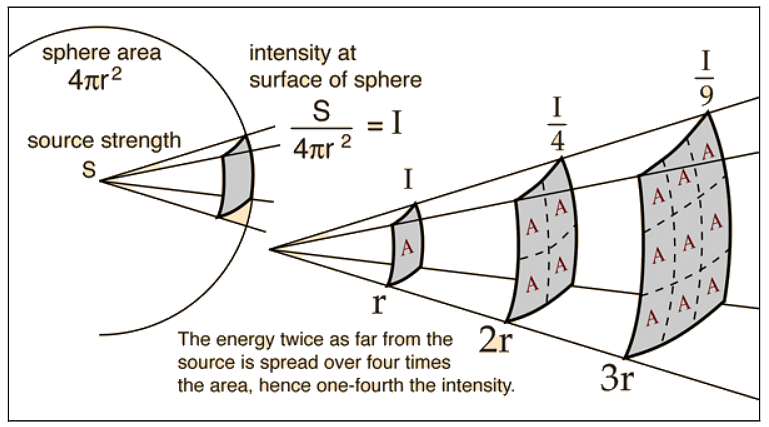
- Because the surface area of a sphere (which is 4r2) is proportionate to the square of the radius, the emitted radiation spreads out across an area that grows in proportion to the square of the distance from the given source.
- As a result, the intensity of radiation travelling through any unit area (directly confronting the point source) is inversely proportional to the square of the distance. Gauss' law for gravity is also applicable in the same case, and it may be applied to any physical variable that behaves in an inverse-square relationship.
Read Also:
Solved Questions
Ques. If the light intensity of a strong flashlight is 15.0 candela at a distance of 1.00 m from the lens, what is the intensity of the flashlight at a distance of 100.0 m from the lens? (3 Marks)
Ans. The intensity at a greater distance may be calculated using the inverse square formula, which is as follows:
If d1 = 1.00 m from the lens and d2= 100.0 m from the lens, then I1 = 15.0 candela and we must find I2.
When we solve for I2, we obtain
I2 equals 0.0015 candelas.
Ques. The radio signal strength is provided as 0.120 W/m2 at a distance of 16.0 m from the transmitter. What is the signal strength at a distance of 4.00 m from the same transmitter? (5 Marks)
Ans. The intensity at a close range may be calculated using the inverse square formula, which is as follows:
I1/I2=d2/d1
If d1 is 4.00 m away from the transmitter and d2 is 16.0 m away from the transmitter, then
I2 = 0.120 W/m2, and we must find I1 This necessitates a re-arrangement of the equation:
I1/I2=d2/d1 → I1= d2/d1 i2
Substituting the values
I1= (16.0m)2/(4.00m)2 x 0.120W/m2)
I1= 256.0 m2/16.0m2 (0.120W/m2)
I1 = (16)(0.120 W/m2)
I1 is equal to 1.92/m2.
The radio signal strength from the transmitter is 1.92 W/m2.
Inverse-square law computations are often easy, and so they are employed as part of much bigger calculations.
Ques. Give any three applications of the inverse square law formula.? (3 Marks)
Ans. Here are the three applications of the inverse square law formula:
- The inverse-square law is used to compute source-to-film distances in the X-Rays.
- Determines the duration of x-ray exposure as well as the intensity of the x-ray tube used in the procedure.
- Used in the calculation of the astronomical distances.
Ques. What is the electrostatics in the inverse square law formula?? (3 Marks)
Ans. The force of attraction or repulsion between two electrically charged particles is inversely proportional to the square of the distance between them, in addition to being directly proportional to the product of the electric charges; this is known as Coulomb's law. The exponent's departure from 2 is less than one part in 1015.
Ques. The intensity of monochromatic light has a 16:1 ratio. What is the second distance if the first is 6 m?? (3 Marks)
Ans. We are given that
I1:I2 = 16:1.
d1 = 6 m, and
d2 equals?
d2 =24 m
Ques. How is the inverse square law applied in audio production? (3 Marks)
Ans. In the case of audio production, the inverse square law defines the reduction of a sound’s intensity over distance. Basically, the inverse square law states that with every doubling of distance away from the sound source, the sound will be four times less intense.
Ques. What is radiation density in inverse square law? (3 Marks)
Ans. The intensity of radiation is inversely related to the square of the distance. One must notice that when the distance doubles, the area quadruples, and therefore the original radiation amount is spread across the full area and is thus proportionally reduced.
Ques. Mention some examples of the Inverse Square Law Formula? (3 Marks)
Ans. Some of the most common examples of the inverse square law are:
- The Universal Law of Gravity
- Electric Fields and Forces
- Intensity of Light
- Radiation From a Source
- The Intensity of Sound
Ques. At what speed does the light fall? (3 Marks)
Ans. In general, if the size of the light source is minimal in comparison to the distance d to the light source, the light will fall off as 1/d2. If, on the other hand, the light source is much bigger than the distance d to the light source, the light will fall off as 1/d – that is, slower than predicted by the Inverse Square Law.
Ques. How is Inverse Square Law Formula used in Photography? (3 Marks)
Ans. The inverse square law basically states that an object that is twice the distance from a point source of light will receive a quarter of the illumination. Thus, for the photographers, it means that if one moves the subject from three meters away to six meters away, one will need four times the amount of light for the same exposure.
Read Also:



Comments