




Preparing for the IPU CET 2027 requires a clear, strategic approach aligned with the specific syllabus and pattern of your target course under Guru Gobind Singh Indraprastha University. Because the university conducts separate entrance exams for undergraduate and postgraduate programs, covering sections like Reasoning, Aptitude, English, and core subject knowledge, success depends on structured planning.
- For core science and quantitative subjects like Physics, Chemistry, and Mathematics, focus on mastering fundamental NCERT concepts, memorizing formulas, and practicing time-bound problem-solving daily.
- For Logical Reasoning and Computer Awareness, dedicate regular time to solving coding-decoding, analytical puzzles, and basic computing concepts to build speed.
- Finally, boost your English Language and General Awareness performance by reading daily news editorials, expanding vocabulary, and attempting topic-specific section tests to ensure balanced coverage.
- Additionally, keeping track of negative marking schemes and maintaining regular revision will ensure you remain confident and well-prepared on exam day.
A winning strategy begins with mastering foundational concepts, followed by consistent practice with previous years' question papers and time-bound mock tests to build speed and accuracy.
Related Links:
- IPU CET Question Paper (Available): Check Previous Year Question Paper with Solution PDF
- IPU CET Mock Test 2027: Attempt Online Free Mock Test, Chapter-wise
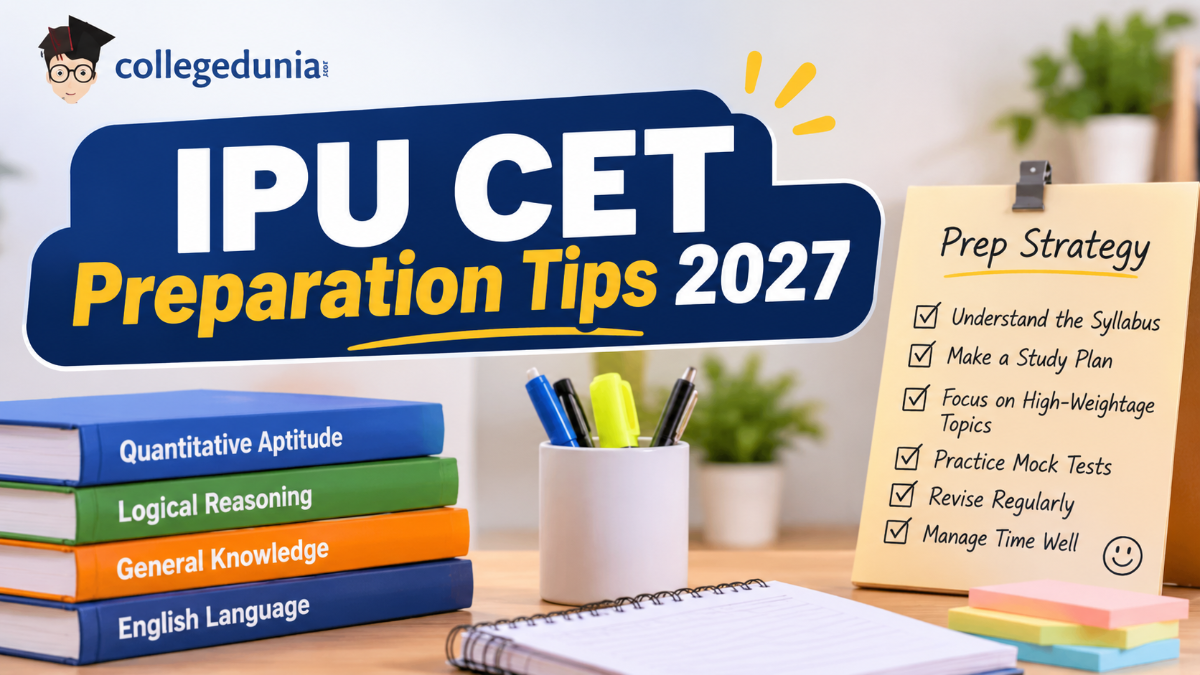
IPU CET Preparation Tips 2027 for Beginners
Starting your IPU CET 2027 preparation from scratch can feel overwhelming, but breaking the journey into clear, manageable phases ensures steady progress and high confidence.
Step-by-Step Preparation Roadmap for Beginners
Phase 1: Understand the Exam Pattern & Syllabus
- Know the Marking Scheme: IPU CET typically consists of 100 Multiple Choice Questions (400 total marks). You earn +4 marks for each correct answer, but -1 mark is deducted for every incorrect choice. Eliminating random guesswork early is crucial.
- Deconstruct Your Course Syllabus: The subject weightage varies depending on whether you are targeting BBA, BCA, B.Ed, B.Tech, or PG programs. Identify the 3–4 core subjects specified for your program.
Phase 2: Build Strong Fundamentals
- Start with Basic Textbooks: For science and technical subjects, build your core concepts directly from Class 11 and 12 NCERTs. For general aptitude, use standard entry-level reference books (e.g., RS Aggarwal for Logical Reasoning, Word Power Made Easy for English).
- Maintain Subject Balance: Allocate daily preparation time into two halves—one half for your core theoretical/technical subjects and the other half for Reasoning, English, or General Awareness.
- Make Short Revision Notes: Create handwritten formula sheets, shortcuts, and key definitions right from day one. These prove essential during final revisions.
Phase 3: Practice & Time Management
- Topic-wise Practice: Don't wait until the entire syllabus is finished to start solving questions. Solve 30–50 topic-specific questions right after completing a chapter.
- Master Logical Reasoning Shortcuts: Learn shortcut techniques for seating arrangements, coding-decoding, and series to save crucial time during the exam.
- Daily Current Affairs: Spend 20–30 minutes daily reading newspapers or monthly current affairs magazines to build up your General Awareness section effortlessly.
Phase 4: Mock Tests & Final Revision
- Solve Previous Years' Papers (PYQs): Practice past IPU CET papers to understand question trends, difficulty levels, and repeating patterns.
- Take Timed Full-Length Mocks: Take 1–2 full-length mock tests per week under strict exam conditions (150 minutes).
- Analyze Your Weak Spots: Dedicate time after every mock exam to analyze incorrect answers and review weak chapters.
How to crack IPU CET 2027 on the first attempt?
Clearing the IPU CET 2027 on your first attempt comes down to eliminating negative marking penalties, mastering time management, and building speed on core concepts.
| Strategy Phase | Objective | Execution Plan | First-Attempt Mastery Metric |
|---|---|---|---|
| 1. Syllabus Alignment & Pattern Mastery | Map your preparation directly to your target program's syllabus. | • Analyze section weightage for your specific course (e.g., BCA vs. BBA vs. B.Ed). | 0% blind guessing on mock exams. |
| • Understand score dynamics: +4 for correct, -1 for wrong. | |||
| 2. Core Fundamentals (First 50% Time) | Build conceptual clarity using standard textbooks. | • Study NCERTs (Class 11 & 12) for core science/math streams. | Completion of all foundational topics 60 days before the exam. |
| • Use RS Aggarwal & Wren & Martin for aptitude, logic, and English. | |||
| • Create 1-page formula and shortcut cheat sheets per chapter. | |||
| 3. Section-Wise Tactics | Maximize accuracy in high-scoring sections. | • Reasoning: Learn shortcut tricks for puzzles, coding-decoding, and series. | Speed threshold of under 45 seconds per aptitude/English question. |
| • English: Practice 2 Reading Comprehension passages daily. | |||
| • General Awareness: Track daily news & major events of the last 8–9 months. | |||
| 4. PYQs & High-Yield Mocks | Train under real exam pressure and identify pattern trends. | • Solve past 5–8 years of IPU CET Previous Year Question papers (PYQs). | Achieving 85%+ accuracy on mock tests. |
| • Take 1–2 full-length, 150-minute timed mock tests weekly. | |||
| • Conduct a 1-hour post-mock review to log weak areas. | |||
| 5. Exam-Day Time Allocation | Execute a 3-round exam attempt method. | • Round 1 (0–40 min): Solve easy/direct GK and English questions first. | Leave risky questions unattempted to avoid negative marks. |
| • Round 2 (40–110 min): Attempt Logical Reasoning & formula-based problems. | |||
| • Round 3 (110–150 min): Solve complex calculations; skip remaining doubtful questions. |
Also Read:
IPU CET Preparation 2027: Subject-wise Prep Tips
A well-planned IPU CET Preparation 2027 strategy requires candidates to focus on each subject according to its syllabus, difficulty level, and weightage. Effective IPU CET Preparation should include regular practice of Mathematics, Computer Awareness, English Language, and General Knowledge, depending on the chosen course.
Bachelor of Business Administration (BBA)
| Subject / Section | Weightage | Focused Topics & Preparation Strategy | Standard Recommended Books |
|---|---|---|---|
| English Language & Comprehension | 25% | Focus on reading comprehension, synonyms/antonyms, idioms, and sentence correction. Solve 2 RC passages daily. | • Word Power Made Easy by Norman Lewis • Objective General English by S.P. Bakshi |
| Logical & Analytical Ability | 25% | Practice coding-decoding, blood relations, series, venn diagrams, and syllogisms daily. Focus on speed tricks. | • A Modern Approach to Verbal & Non-Verbal Reasoning by R.S. Aggarwal |
| General Awareness | 25% | Cover static GK (Indian Polity, Geography, History) and business news. Read monthly current affairs digests. | • Lucent’s General Knowledge • Manorama Yearbook |
| Management Aptitude & Business Studies | 25% | Study Class 11/12 Business Studies (Management principles, leadership, marketing, business environment). | • NCERT Class 12 Business Studies • GGSIPU BBA Entrance Guide by Arihant Experts |
| Recommended Overall Guide | — | Comprehensive coverage of all 4 sections with past papers. | • GGSIPU BBA Common Entrance Test Guide by Arihant Experts / RPH Editorial |
Also Read: IPU CET BBA Question Papers (2018–2026): Download PDF with Solutions
Bachelor of Computer Applications (BCA)
| Subject / Section | Weightage | Focused Topics & Preparation Strategy | Standard Recommended Books |
|---|---|---|---|
| Mathematics | 30% | Focus on Class 11 & 12 topics: Calculus, Matrices, Vectors, Probability, Integration, and Algebra. Practicing numerical speed is vital. | • NCERT Mathematics (Class 11 & 12) • Mathematics for Class 12 by R.D. Sharma |
| Computer Awareness | 30% | Cover computer fundamentals, MS Office, binary conversions, networking, C language basics, and operating systems. | • Computer Fundamentals by P.K. Sinha • Objective Computer Awareness by Arihant Experts |
| General Knowledge (IT & Science) | 25% | Focus on technology trends, IT sector developments, basic general science, and computer history. | • Lucent’s General Knowledge (Science Section) • Monthly Tech Magazines & Current Affairs |
| English Language & Comprehension | 15% | Basic grammar rules, spotting errors, reading comprehension, and vocabulary builder. | • High School English Grammar & Composition by Wren & Martin |
| Recommended Overall Guide | — | Practice full-length test papers and subject-wise MCQs. | • GGSIPU BCA CET Guide by Arihant Experts / RPH Editorial Board |

Source: Quora
On Quora, a student has raised the question, “Can I crack the IPU CET BCA without preparation?”
Ans. While it is technically possible to pass the IPU CET BCA without dedicated preparation if you have an exceptionally strong 10+2 foundation in Mathematics and basic computing, cracking it with a good rank to secure a top college is highly unlikely.
Ans. For IPU CET BCA preparation, the General Knowledge section covering IT and Science includes basic computer knowledge, information technology, and important scientific developments.
B.Tech (Biotechnology)
| Subject / Section | Weightage | Focused Topics & Preparation Strategy | Standard Recommended Books |
|---|---|---|---|
| Biology / Biotechnology | 40% | Core focus area. Study Cell Biology, Genetics, Plant & Animal Physiology, Biotechnology Principles, and Ecology line-by-line. | • NCERT Biology (Class 11 & 12) • Trueman’s Elementary Biology (Vol 1 & 2) |
| Physics | 20% | Memorize formulas and solve numerical problems in Mechanics, Electromagnetics, Optics, and Modern Physics. | • NCERT Physics (Class 11 & 12) • Concepts of Physics (Vol 1 & 2) by H.C. Verma |
| Chemistry | 20% | Equal emphasis on Organic reactions, Physical Chemistry numericals, and Inorganic periodic table properties. | • NCERT Chemistry (Class 11 & 12) • OP Tandon Physical & Organic Chemistry |
| Mathematics | 20% | Cover core 10+2 calculus, coordinate geometry, probability, and algebra fundamentals. | • NCERT Mathematics (Class 11 & 12) |
| Recommended Overall Guide | — | Focus on NCERT exemplar questions and IPU CET sample papers. | • GGSIPU Engineering Entrance Exam Guide by Arihant / RPH |
Also Read: IPU CET B.Tech Question Papers: Download PDF with Solutions
BA Journalism & Mass Communication (BA JMC)
| Subject / Section | Weightage | Focused Topics & Preparation Strategy | Standard Recommended Books |
|---|---|---|---|
| Media Aptitude | 25% | Study print media, radio, television history, digital advertising, cinema, and notable journalists/media houses. | • Mass Communication in India by Keval J. Kumar • Media Aptitude Guide by RPH Editorial |
| General Awareness & Current Affairs | 25% | Track daily news, international affairs, government policies, awards, national events, and media news. | • Daily Newspapers (The Hindu / The Indian Express) • Lucent’s GK |
| English Language & Comprehension | 25% | Strong focus on vocabulary, idiom usage, reading passages, and editorial writing tone recognition. | • Word Power Made Easy by Norman Lewis • Objective English by Edgar Thorpe |
| Reasoning Ability | 25% | Analytical reasoning, series, analogies, statements & assumptions, and logical deduction. | • A Modern Approach to Logical Reasoning by R.S. Aggarwal |
| Recommended Overall Guide | — | Integrated master guide for mass comm entrance exams. | • GGSIPU BJMC Entrance Exam Guide by Arihant Experts |
Also Read: IPU CET 2026 Bachelor of Arts (Journalism & Mass Communication) Question Paper with Solutions
Bachelor of Commerce (B.Com Hons)
| Section | Weightage | Focused Topics & Preparation Strategy | Standard Recommended Books |
|---|---|---|---|
| Data Interpretation | 25% | Practice reading pie charts, line graphs, bar diagrams, tables, and calculating averages/percentages quickly. | • Data Interpretation & Data Sufficiency by Ananta Ashisha (Arihant) |
| Logical Reasoning | 25% | Practice puzzles, seating arrangements, directions, coding-decoding, and critical reasoning. | • Verbal and Non-Verbal Reasoning by R.S. Aggarwal |
| General English | 25% | Focus on grammar rules, error detection, synonyms, antonyms, and passage comprehension. | • Objective General English by S.P. Bakshi |
| General Awareness | 25% | Focus on financial news, Indian economy, banking terms, business updates, and static GK. | • Lucent’s General Knowledge • Financial & Economic daily news papers |
| Recommended Overall Guide | — | Comprehensive study material for B.Com entrance. | • GGSIPU B.Com (Hons) Entrance Guide by Arihant Experts |
Bachelor of Education (B.Ed)
| Subject / Section | Weightage | Focused Topics & Preparation Strategy | Standard Recommended Books |
|---|---|---|---|
| Mental Ability & Reasoning | 40% | Primary scoring section. Solve puzzle sets, series completion, ranking tests, and spatial reasoning. | • A Modern Approach to Logical Reasoning by R.S. Aggarwal |
| Teaching Aptitude | 25% | Study learning psychology, classroom management, student handling techniques, and educational communication. | • Teaching Aptitude & Attitude Test by Abha Malik • R. Gupta’s Teaching Aptitude |
| General Awareness (Education Focus) | 20% | National Education Policies (NEP), educational schemes, Indian history, polity, and social issues. | • Lucent’s GK • Educational policy updates & current affairs |
| General English | 15% | Fundamentals of English grammar, vocabulary, reading comprehension, and sentence structuring. | • High School English Grammar by Wren & Martin |
| Recommended Overall Guide | — | Full guide dedicated to the GGSIPU B.Ed pattern. | • GGSIPU B.Ed. Entrance Exam Guide by Arihant Experts / RPH |
- The exam allocates 60% of its total weightage directly to Mathematics (30%) and Computer Awareness (30%), alongside negative marking (-1 mark for wrong answers) that severely penalizes uncalculated guessing.
- Without targeted practice, managing the 150-minute time constraint and navigating complex Class 11/12 calculus, algebra, and coding fundamentals becomes extremely difficult.
- If time is short, focus on reviewing core NCERT Math formulas, basic computer concepts (hardware, OS, C language), and previous years' question papers (PYQs) to maximize your score.

Source: Quora
A student on Quora has asked, “What topics come under General Knowledge–IT and Science related for the preparation of IPU CET for BCA?”
- IT: Computer fundamentals, hardware and software, operating systems, internet, networking, databases, and basic programming concepts.
- Science: Basic Physics, Chemistry, Biology, scientific discoveries, inventions, and everyday science.
- Candidates should also cover recent developments in technology, artificial intelligence, cybersecurity, and space research.
- Regularly revise important facts and practise GK questions to improve accuracy and confidence in the exam.
IPU CET Preparation 2027: Section-wise
Prioritise Mathematics and Computer Awareness, which together account for 60% of the paper under the previous pattern.
- Practise mock tests and revise regularly to improve speed and accuracy.
| Section | Preparation Strategy |
|---|---|
| English Language and Comprehension | Practise reading comprehension, vocabulary, synonyms, antonyms, grammar, sentence correction, and rearrangement. |
| Mathematics | Focus on algebra, trigonometry, calculus, matrices, probability, statistics, coordinate geometry, and arithmetic. |
| Computer Awareness | Study computer fundamentals, operating systems, networking, databases, number systems, programming basics, and data structures. |
| General Knowledge (IT and Science Related) | Cover basic science, scientific discoveries, IT developments, computer technology, space research, and current affairs related to science. |
IPU CET Preparation 2027: Previous Year Papers
Solving previous year question papers is an essential part of IPU CET Preparation 2027, as it helps candidates understand the exam pattern, question difficulty, and frequently tested topics. Including PYQs in your IPU CET Preparation strategy also helps improve time management, accuracy, and confidence before the actual examination.
| Year | Download PDF | Solution |
|---|---|---|
| 2025 | Download PDF | Check Solution |
| 2024 | Download PDF | Check Solution |
| 2023 BBA | Download PDF | Check Solution |
| 2023 BCA | Download PDF | Check Solution |
| 2018 | Download PDF | Check Solution |
| 2017 | Download PDF | Check Solution |
IPU CET Preparation 2027: Mock Test
Practising mock tests is an important part of IPU CET Preparation 2027, as it helps candidates evaluate their preparation level and identify areas that need improvement. Attempting regular mock tests based on the IPU CET 2027 exam pattern also improves speed, accuracy, and time management.
| Subject | Mock tests | |
|---|---|---|
| BBA English Mock Test | IPU CET BBA English Mock Test 1 | IPU CET BBA English Mock Test 2 |
| BBA General Awareness Mock Test | IPU CET BBA General Awareness Mock Test 1 | IPU CET BBA General Awareness Mock Test 2 |
| Physics | IPU CET Physics Mock Test 1 | IPU CET Physics Mock Test 2 |
| Chemistry | IPU CET Chemistry Mock Test 1 | IPU CET Chemistry Mock Test 2 |
| Mathematics | IPU CET Mathematics Mock Test 1 | IPU CET Mathematics Mock Test 2 |
Can I Prepare for IPU CET 2027 in last 1 month?
Yes, you can prepare for IPU CET 2027 in the last 1 month, provided you have a clear execution plan. Because IPU CET focuses primarily on core Class 11 and 12 fundamentals alongside standard aptitude topics, a 30-day intensive study strategy is sufficient to achieve a competitive rank.
| Phase | Days | Strategy & Daily Goal | Daily Hours Target |
|---|---|---|---|
| Phase 1: High-Yield Core | Days 1–10 | • Focus exclusively on high-weightage topics (e.g., NCERT Math/Science for BCA/B.Tech BT, Reasoning & RC for BBA/BA JMC). • Create 1-page formula & rule cheat-sheets. | 6–8 Hours |
| Phase 2: Question Practice | Days 11–20 | • Solve 50–70 topic-wise MCQs daily. • Learn speed shortcuts for Logical Reasoning and Quantitative Aptitude. • Dedicate 30 mins daily to high-frequency Current Affairs (past 6 months). | 6–8 Hours |
| Phase 3: Mocks & PYQs | Days 21–27 | • Solve past 5 years' IPU CET Previous Year Questions (PYQs). • Take 1 full-length, 150-minute timed mock test every alternate day. • Analyze every error to eliminate repeated conceptual mistakes. | 7–8 Hours |
| Phase 4: Final Revision | Days 28–30 | • Zero new topics. • Revise formula sheets, shortcuts, and key definitions. • Practice strict negative marking control (+4 / -1 rules). | 4–5 Hours |
IPU CET Preparation 2027: Last Minute Preparation Tips
During the final 7–10 days of IPU CET Preparation 2027, candidates should focus on revising important topics, practising mock tests, and improving speed and accuracy.
- As the IPU CET 2027 exam approaches, avoid starting new topics and concentrate on strengthening concepts, analysing mistakes, managing exam-day pressure, and maintaining a healthy routine.
| Last-Minute Focus Area | Actionable Execution Strategy | Impact on Final Score |
|---|---|---|
| Zero New Concepts | Stop starting new chapters or unstudied topics. Focus exclusively on consolidating concepts you have already covered to build absolute confidence. | Prevents anxiety and avoids confusion right before the exam. |
| High-Yield Revision Sheets | Revise short notes, core NCERT formulas, vocabulary lists, and mental shortcuts for reasoning puzzles for 2–3 hours daily. | Speeds up recall time during the 150-minute exam. |
| The 3-Pass Exam Attempt Strategy | • Pass 1 (0–35 min): Solve direct GK, media/business awareness, and straightforward English MCQs. | Ensures you lock in easy points early without getting stuck on complex questions. |
| • Pass 2 (35–100 min): Attempt standard Reasoning, Computer Awareness, and numerical problems. | ||
| • Pass 3 (100–130 min): Review marked-for-review questions. Spend the final 20 mins wrapping up. | ||
| Strict Negative Marking Control | With the +4 / -1 marking scheme, avoid uncalculated guesswork. Only attempt a doubtful question if you can confidently eliminate at least 2 options. | Prevents unnecessary mark deductions that degrade rank position. |
| Exam Slot Simulation | Take 2 full-length mock tests strictly in your assigned exam shift timing. | Aligns your brain's peak focus window with the actual exam schedule. |
| Logistics & Hall Ticket Readiness | Print your IPU CET admit card, prepare a valid photo ID, ensure clear photos, and map your exam center location 24 hours prior. | Eliminates last-minute panic on exam day. |
Common mistakes to avoid during IPU CET Preparation 2027
Avoiding common mistakes during IPU CET Preparation 2027 is essential for improving accuracy and achieving a better score.
- Candidates should focus on course-specific section weightage, manage negative marking, practise timed mock tests, and analyse their performance regularly.
| Category | Common Mistake | Why It Reduces Your Score | Corrective Strategy |
|---|---|---|---|
| Negative Marking Management | Indiscriminate Guesswork | IPU CET follows a +4 / -1 marking scheme. Blindly guessing on 10 uncertain questions can easily wipe out 10 hard-earned marks. | Never attempt a question purely on intuition. Only answer if you can logically eliminate at least 2 options. |
| Preparation Strategy | Ignoring Stream Weightage | Studying general aptitude without checking section allocation for your specific course (e.g., preparing heavy Math for BBA when BCA requires 30% Math). | Align your study hours strictly to your course code's weightage matrix from Day 1. |
| Practice Habits | Practicing Without Timers | IPU CET tests both speed and accuracy (100 MCQs in 150 minutes). Solving questions comfortably without a clock creates a severe time crunch on exam day. | Solve topic-wise practice sets using a stopwatch target (Aim for under 45–60 seconds per question). |
| Mock Analysis | Taking Mocks Without Analysis | Simply attempting full-length tests without identifying error trends causes repeated mistakes on the same topics. | Spend 45–60 minutes after every mock classifying errors into Conceptual Gaps, Calculation Errors, or Over-speeding. |
| General Awareness | Relying Only on Static GK | Over-emphasizing historical static facts while completely ignoring business/domain updates and current events of the last 8–9 months. | Maintain a dedicated daily log for national/international updates, brand/tech news, and current events. |
| Exam Execution | Getting Stuck on Tough Questions | Spending 3–4 minutes on a complex puzzle or math numerical in the first pass depletes time for easy questions at the end. | Follow the 3-Pass Strategy: attempt easy/direct questions first, mark moderate ones for review, and skip lengthy ones. |
IPU CET Preparation 2027 FAQs
Ques. Is IPU CET difficult to crack?
Ans. No, IPU CET is not considered difficult to crack compared to major national-level exams like JEE Main or CUET; its overall difficulty level is easy to moderate. The exam primarily tests standard Class 11 and 12 NCERT fundamentals alongside basic aptitude and speed. With consistent practice, strong time management, and careful control over negative marking (+4/-1), securing a top rank is easily achievable.
Ques. How many months are required for IPU CET preparation?
Ans. Generally, 3 to 4 months of dedicated preparation is ideal for clearing the IPU CET with a top rank, as it provides ample time to cover the syllabus, practice mock tests, and master time management. However, students with a strong foundation in Class 11 and 12 basics can comfortably prepare in 1 to 2 months with focused, daily practice.
Ques. Can I crack IPU CET without coaching?
Ans. Yes, you can absolutely crack the IPU CET without coaching through self-study. Since the exam primarily assesses basic Class 11/12 concepts, general aptitude, and speed, commercial coaching is not mandatory to achieve a top rank. With a clear understanding of your course syllabus, standard self-study books (like NCERTs and standard aptitude guides), and regular practice with previous year question papers (PYQs) under timed conditions, you can prepare effectively on your own. Consistent daily preparation combined with strict control over negative marking is more than enough to secure admission.
Ques. Are previous year papers enough for IPU CET preparation?
Ans. Previous year question papers are an important resource for IPU CET Preparation 2027, as they help candidates understand the exam pattern, question types, and difficulty level. However, they are not sufficient on their own. Students should also study the complete syllabus, revise important concepts, practise mock tests, and solve topic-wise questions to improve their overall performance.
Ques. What are the best resources for IPU CET mock tests?
Ans. Candidates can use IPU CET previous year question papers, online mock tests, and subject-wise practice books for effective preparation. For Mathematics, refer to R.S. Aggarwal's Quantitative Aptitude; for English, use Objective General English by S.P. Bakshi; and for Computer Awareness, consider Computer Awareness by Arihant Experts. Additionally, practise full-length mock tests and sample papers to improve speed, accuracy, and time management.



Comments