



Content Curator
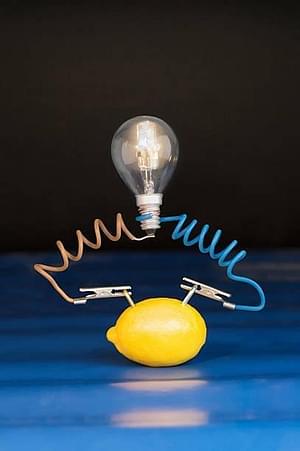
A lemon battery is a voltaic battery and can generate electricity for educational purposes. The lemon battery is made by placing a galvanized nail and a penny inside a lemon and connecting them with wire. Small devices like LEDs are powered by the energy generated by the reaction of the metals.
- Batteries are chemical energy storage containers that can be converted to electrical energy or electricity.
- This is accomplished through an electrochemical process.
- The reaction usually takes place between two metal objects known as electrodes and a liquid known as an electrolyte.
- The negative terminal of a battery is the anode, and the positive terminal is the cathode when it is supplying electric power.
- In 1800, Alessandro Volta was known for creating the first electrochemical cell battery, which consisted of stacking alternating copper and zinc discs with a cloth soaked in salt water between each disc.
| Table of Content |
Key Terms: Lemon Battery, Electricity, Battery, Cell, Electrolysis, Electrodes, Electrolytes, Conductors, Electrons, Light Bulb, LED, Citric acid, Phosphoric acid.
Read Also: Electric Charges and Fields
What is a Lemon Battery?
A lemon battery is a simple battery made using zinc metal, such as a galvanized nail, and a copper item, such as a penny. These are wired together and inserted into a lemon.
- The zinc and copper are called electrodes and lemon juice is an electrolyte.
- This battery illustrates the type of chemical reaction (oxidation-reduction) that occurs in batteries.
- Many citrus fruits can be used for the acidic electrolyte because fruits like lemons, oranges, grapefruits, etc. contained citric acid and provide both the electrolyte and support the electrodes.
- This type of battery is also known as a citrus battery.
- Similarly, potatoes also contain phosphoric acid and are used to make potato batteries.
Check Important Notes for Potentiometer
Lemon Battery Experiment
It is a fun experiment for students and can be done easily under adult supervision.
Materials Needed
The materials required for the lemon battery experiment are:
- A lemon
- Copper penny or copper wire
- Paper clips
- Wire-cutter or stripper
- Voltmeter
- A plate and paper towels
- Scissors, ruler, knife
- Aluminum foil.
Also Read:
Preparation
The following is the preparation made before the experiment:
- Squeeze the lemon and roll it on a surface, so that there’s plenty of juice inside.
- To remove any dirt sticking to the copper pennies, wash them in soap water and dry them with paper towels.
- Carefully cut aluminum foil to make aluminum strips.
Procedure
The procedure of the experiment is given below:
- Place the lemon on the plate and cut a small slit near the middle.
- Make a second cut parallel to the first, but further away from it.
- Push the copper penny into the initial cut until it comes into touch with the juice. The penny will act as the first electrode.
- Slide one of the aluminum strips in the second cut deep enough that it touches the lemon juice. This is the second electrode. The electrodes should never come into close contact with one another.
- It is now a battery with two electrodes constructed of different metals separated by an electrolyte.
- To construct a connection, use a paperclip to link the second aluminum strip to the part of the penny sticking out of the lemon.
- When the aluminum strips come into contact with each other, electricity should be generated in the battery and travel through the strips, from one electrode to the next.
- Keep the two pieces apart and touch them together with your fingertip.
Check More: Combination of Resistors-Series and Parallel
Results
The results obtained from the lemon battery experiment are:
- When you touch the fingertips, you can feel a slight tingling sensation.
- A small amount of electricity produced in the lemon creates it.
- You can measure it by attaching a voltmeter to the battery. The typical voltage is 0.906 Volt in a lemon battery.
- Unfortunately, the current produced by this battery is insufficient to light a lamp.
- To do so, we can make more lemon batteries and connect the positive and negative terminals with a metal wire.
- Each cell will gain voltage because of this. To light an LED, we'll need at least four lemon batteries.

Check Also: Ohm’s Law and Its Limitations
Breakdown of the experiment
Every battery has positive and negative terminals, and this is a single-cell battery. The battery is all about the electrochemical connection between the two metals. Some metals will give electrons away, while others will accept them as electrodes.
- The electrons will flow from the "-" electrode to the "+" electrode of the battery via the wire.
- Aluminum would be reduced at the cathode, whereas copper would be oxidized at the anode in this scenario.
- The electrolyte in lemon juice is sour Citric Acid. Electricity will now be generated.
- Batteries will not work if there is insufficient electrolyte to react with the metal, or if there is insufficient metal to react with the electrolyte.
Cathode: 3[Cu2+(aq) + 2e- → Cu(s)]
Anode: 2[Al(s) → Al3+(aq) + 3e-]
Balanced Equation: 3Cu2+(aq) + 2Al3+(s) → 2Al3+(s) + 3Cu(s)
Physics Related Links
Things to Remember
- A battery is an electrochemical cell, where chemical energy transforms into electrical energy.
- The cathode is the positive terminal of the battery, where reduction occurs, and the anode is the negative terminal, where oxidation occurs.
- Electrons run from the negative terminal to the positive terminal. This flow of electrons creates the current of electricity.
- There should be enough lemon juice (electrolyte) in the lemon for the metals to react.
- A lemon contained citric acid which acts as an electrolyte in a lemon battery.
- The electrodes, copper pennies, and aluminum strips should never come in contact with each other.
- A lemon battery experiment is also commonly known as a lemon light experiment, lemon bulb experiment, and lemon science project.
Sample Questions
Ques. What is Lemon Battery? (2 Marks)
Ans. A Lemon Battery is a single-cell battery that was created for educational purposes. It's essentially an electrochemical cell with two separate metal electrodes and an electrolyte. Galvanized nails and copper pennies are commonly used as electrodes, with lemon juice acting as the electrolyte. Other acidic fruits can also be used instead of to make a fruit battery.
Ques. Who invented the Lemon Battery? (1 Marks)
Ans. Alessandro Volta invented the first electrochemical cell in 1800, using brine or saltwater and alternatively stacking copper and zinc discs. The idea for the lemon battery came from here.
Ques. What are electrodes, electrolytes, and conductors? (3 Marks)
Ans. Electrodes are terminals through which the electricity passes into the liquid.
An electrolyte is a liquid or gel which contains ions and can be decomposed by electrolysis, e.g., that is present in a battery.
Materials that allow electric current or electrons to flow through them are called conductors.
Ques. What are Electrolysis and Electrolytic Cells? (2 Marks)
Ans. An electrolytic cell is an electrochemical cell that drives a non-spontaneous redox reaction utilizing electrical energy. It is often used to break down chemical compounds, in a process called electrolysis.
Ques. Explain the conductivity of lemon juice? (2 Marks)
Ans. Citric acid is found in lemon juice. When acids are dissolved in water, they break down into charged anions and cations. Because charged particles may circulate within the acid, they conduct electricity.
Ques. Why are zinc and copper used in batteries? (2 Marks)
Ans. Because zinc loses electrons more rapidly than copper, putting zinc and copper metals in salt solutions can allow electrons to flow through an external wire connecting the zinc and copper.
Ques. How does lemon battery works? (3 Marks)
Ans. The electrochemical reactions that occur between the zinc and copper metals in the lemon juice power the lemon battery. Oxidation and reduction take place, and electrons are transferred from one metal to another. The current or electricity inside the lemon battery is created by electrons flowing from one electrode to another through the electrolyte.
Ques. How much electricity does a lemon battery produce? Can it light a bulb or LED? (3 Marks)
Ans. When a single lemon battery is connected to a voltmeter, it reads 0.906 V. As a result; it does not generate enough electricity to light a bulb. The total voltage produced by connecting at least 3-4 batteries in series, however, suffices to light a light bulb or an LED.
Ques. What is Voltmeter? (2 Marks)
Ans. A voltmeter, often known as a voltage meter, is a device that measures the voltage differential between two points in an electrical or electronic circuit. The unit of electric current, Volt was named in honor of Alessandro Volta.
Also Read:



Comments