



Content Curator
Lice are parasites that attach themselves to human hair and feed on human blood. The order Phthiraptera, which comprises the chewing louse (Amblycera) and the sucking louse, is responsible for lice (Anoplura). The chewing louse lives on some mammals, including cattle and birds. The sucking louse lives on people who have poor hygiene. The Pediculus humanus, often known as the sucking louse, infests the human head. Louse comes in a variety of colors, including white, brown, yellow, and black, and can be up to 11 mm long.
| Table of Content |
What Causes Head Lice?
[Click Here for Sample Questions]
The only hosts that head lice can survive on our people. Adult lice must consume human blood several times each day to survive. The lice's life cycle exclusively occurs on the scalps of humans because they cannot survive on pets or other animals.
Also Check: Difference Between Pathogens and Parasites
Life Cycle of Lice
[Click Here for Previous years Questions]
The complete life cycle of lice is described here. There are several stages that lice go through. Those stages are as follows:
Stage 1: The Egg
Nits, commonly referred to as lice eggs, are incredibly little particles that are found on human scalps. It might be mistaken for dandruff or other types of scalp debris due to its size. It is oval-shaped, up to 0.8 mm long, and yellow or white in color. These eggs hatch into nymphs after about a week.
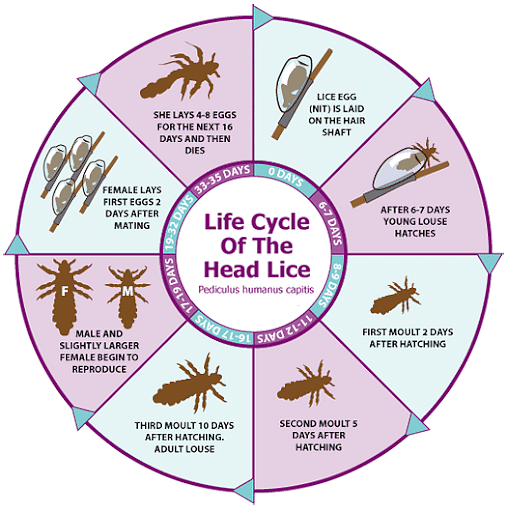
Life Cycle of the Head Lice
Stage 2: The Nymph
The second stage of the nymph is when lice are reduced in size. The nymph initially has a yellow to white color, but it passes through three stages of molting. The nymph changes into adult lice with each stage of the molting process. It takes this nymph a week to transition into adulthood.Stage 3: The Adult
The adult louse has reached full development and can reach a length of 2 mm. Adult lice, which are about the size of a sesame seed, can live up to 30 days if given multiple blood meals throughout the day. If the adult lice have left the host, they will expire in one or two days.
Check Out: Lizard And Moth Life Cycle
What Do Adult Head Lice, Nymphs, and Nits Look Like?
[Click Here for Sample Questions]
The life cycle of head lice contains several stages, each with its own appearance. The three primary phases of lice development can be distinguished using the following:
Nits: The size of head lice eggs and nits is comparable to a pinhead. They are fixed to the hair quite tightly and won't budge. One method to distinguish them from dirt, dandruff, sand, and other debris, all of which might resemble nits, is by their lack of movement. When they're living, they have a deeper coloring and will "pop" under your fingernails. When they hatch, they turn pale and practically transparent. After death, their sides appear shriveled.
Nymphs: The middle stage of the lice life cycle is the nymph stage, which affects humans. The shape is primarily that of an adult, with six legs extending from the middle of the body. Nymphs are considerably smaller than adults. Every time they molt or lose their skin, they grow bigger from their starting size to the size of a pinhead.
Adults: They resemble sesame seeds in size. They are brown and come in a variety of tones, from dark to light. Males and females typically have slightly different body sizes. Adult louse lacks the ability to jump due to the lack of wings and legs. Only crawling is a lice's only means of transportation.
Also Read: Haplontic Life Cycle
How Are Head Lice Found?
[Click Here for Previous years Questions]
Since nits don't migrate, they are simpler to find than adult lice. You can find them following the given process:
Wet the hair: Soak your entire head with water or comb conditioner through your dry hair. After a few strokes, you should take out the comb and wipe it with a paper towel to check for lice or nits. Cover the entire scalp.
Begin the Treatment: If you discover lice, start with the treatment and regularly do a thorough check to make sure there aren’t any left.
Spreading of Lice
The main method of head lice transmission is direct hair-to-hair contact. Children who are playing together or who are in such close quarters with people may experience this. Contrary to popular belief, they are neither disseminated nor brought on by poor hygiene. Less frequently, you can also get head lice from something that touched a person with an infected head, like:- Hairbrushes
- Earmuffs, scarves, and hats
- Pillows, Blankets, and Upholstery
However, lice that aren't attached to human scalps don't survive very long in pillows, blankets, or upholstery. They require your body heat in order to stay warm and live.
Also Check: Difference Between moths and Butterfly
Removal of Head Lice
Prescription medications are available to treat head lice. These are typically administered to all of the hair in the form of a cream or other treatment. After your initial treatment, check for lice one more. If there are many living ones left, they might be immune to the medication you administered. You should try a different over-the-counter or prescription medicine in this situation.
Treating any items that have come into touch with the head with lice will help stop the spread of the infestation. The following steps can be taken to prevent the spread:
Clean every linen: All pillowcases, blankets, sheets, and quilts that have come into touch with hair should be washed. The temperature in your dryer should be high enough to kill the lice.
Clean plastic objects: To kill lice, place hair brushes, combs, and similar items in a kettle of boiling water for ten minutes.
Seal Items: Put everything in a sealed plastic bag that cannot be cleaned or boiled. The lice will die if you leave them alone for two weeks.
Also Read:
| Chapter Related Concepts | ||
|---|---|---|
| Termite Life Cycle | Bed Bug Life Cycle | Grasshopper Life Cycle |
| Dragonfly Life Cycle | Ant Life Cycle | Vermiculture |
Previous Year Questions
- An epithelial tissue which has thin flat cells arranged edge… [NEET 1994]
- Histamine secreting cells are found in… [NEET 1989]
- A protein present in cartilage is… [NEET 1997]
- An epithelial tissue which has thin flat cells, arranged edge to edge so as to appear like closely packed tiles, is found to be present at… [NEET 1994]
- Haversian canals occur in… [NEET 1989]
- Areolar connective tissue joins… [NEET 2006]
- Cuboidal epithelium with brush border of microvilli is found in… [NEET 2020]
- Characteristics of smooth muscle fibers are.... [NEET 1992]
Things To Remember
- Lice go by the scientific name Pediculus humanus capitis. They have a maximum 35-day life cycle from egg to death.
- The lice that emerge from the eggs, known as nits, are little insect forms known as nymphs.
- Two days after lice hatch, they go through their first molt or shedding of their outer covering and three days later, they undergo their second molt, which results in an increase in size.
- Lice are wingless, blood-sucking insects that can spread from one person's head to another and cause an infestation.
- Lice and some nits may be removed by combing damp or oily hair with a fine-toothed nit comb.
Sample Questions
Ques. How are lice spread? (2 marks)
Ans. Head lice live only on human beings and can be transmitted by direct contact with people who have head lice or by using their combs, hats, clothing, or bedding. Lice do not hop or jump. The spread of lice does not have to do with cleanliness or hygiene, and any child who is exposed can get head lice.
Ques. Which order and family do the lice belong to? (2 marks)
Ans. Phthiraptera lice are members of Psocodea, the order that contains booklice, barklice, and bark flies. Within Psocodea, lice are within the suborder Troctomorpha and are most closely related to the family Liposcelididae.
Ques. What is a louse? (4 marks)
Ans. The common name for any member of the group Phthiraptera, which includes almost 5,000 species of wingless parasitic insects, is louse (plural: lice). Due to advancements in evolutionary studies, Phthiraptera has alternately been recognized as an order, infraorder, or a parvorder. All species of birds and mammals, with the exception of monotremes, pangolins, and bats, are warm-blooded hosts for lice, which are obligatory parasites that live externally on their hosts. Diseases like typhus are spread by lice.
Ques. What kinds of human lice are there? (2 marks)
Ans. Head louse refers to the type of lice that live on the scalp of a human being. Body lice and pubic lice are the other types of human lice. Due to its shape like a crab, the pubic louse is sometimes known as the "crab" louse.
Ques. Are there any diseases that come from having head lice? (3 marks)
Ans. They do not spread or cause any diseases, hence they are not disease carriers. However, if the infestation continues for a long time, it may result in severe skin irritants. There is no evidence that head lice spread illness. Because they may cause itching and insomnia, head lice can be a nuisance. Sometimes excessive scratching brought on by the itching increases the risk of developing a subsequent skin infection.
Ques. What appearance does a head louse have? (2 marks)
Ans. The size of a sesame kernel, the lice have six claws, are wingless, and are typically yellow, white (for nymphs), brown, or black (for adults). They can be mistaken for dandruff or other dirt particles because of their tiny size. Typically, lice will build their nests on the scalp's surface or 6 mm from the root.
Ques. What exactly are nits, and how do they appear? (5 marks)
Ans. Lice eggs are referred to as nits. They have an oval shape, one pointy side, and two antennas on the other. They have a brown color and are joined to hair strands. Before they hatch, these appear as little yellow, tan, or brown spots. Near the scalp, where the temperature is ideal for keeping warm until they hatch, lice lay their nits on hair shafts. While nits resemble dandruff in appearance, they cannot be removed by brushing or shaking.
Ques. What precautions can be taken to avoid getting lice in hair? (2 marks)
Ans. A few steps taken to avoid lice are to clean all pillowcases, blankets, sheets, and quilts that have come into touch with hair, place hair brushes, combs, and similar items in a kettle of boiling water for ten minutes. Also, put everything in a sealed plastic bag that cannot be cleaned or boiled. The lice will die if you leave it alone for two weeks.
Ques. What are the chemicals used in head lice treatment? (3marks)
Ans. Head lice pesticide products contain both “active” and “inert” ingredients. An active ingredient is one that prevents, destroys or repels a pest. An inert ingredient is any ingredient in the product that is not intended to affect a target pest. For example, isopropyl alcohol may be an active ingredient in some products.
Ques. Do lice jump? (2 marks)
Ans. Head lice do not have hind legs to hop or jump. They also do not have wings and cannot fly. Only crawling is a lice's only means of transportation.
Check Out:



Comments