



Exams Prep Master
A Lindlar catalyst is referred to as a heterogeneous catalyst that comprises palladium deposited on calcium carbonate or barium sulphate which is after that poisoned with several forms of lead or sulphur like lead acetate or quinoline. It is also used for the reduction of alkyne to cis-alkenes. Here we will discuss the concept in detail including its structure, properties, preparation along with important questions.
| Table of Content |
Keyterms: Lindlar catalyst, calcium carbonate, barium sulphate, sulphur, quinoline, lead acetate, alkyne, cis-alkenes, heterogeneous catalyst, Hydrocarbons
What is Lindlar Catalyst?
[Click Here for Sample Questions]
The term “Lindlar” was named after the British-Swiss chemist and inventor Herbert Lindlar Wilson. Lindlar catalyst is studied under the topic Hydrocarbons and used to obtain an alkene from an alkyne and is composed of palladium, calcium carbonate, and lead (or quinoline as a poisonous catalyst). Such catalyst is used as a substance to accelerate or change the pace of a chemical reaction. On the surface of the metal (palladium, also known as lindlar catalyst), the small pores on this surface act as the catalyst; more pores, faster the reaction.

It is prepared by reducing palladium(II) chloride in semi-liquid calcium carbonate and poisoning the resulting mixture with a suitable substance, usually lead salts as the last step to deactivate the reduction process.
The formula of Lindlar catalyst is H2/Pd/CaCo3.
Read More: Organic Solvents
Composition of Lindlar Catalyst
[Click Here for Sample Questions]
The lindlar catalyst can be divided into three primary components:
- Palladium, a soft-silver white metal from the platinum group of metals. (5% of the total weight in the Lindlar catalyst)
- Calcium Carbonate is a chemical compound commonly found in rocks. Palladium gets deposited on it)
- Poisonous substances, the common options are lead acetate, lead (II) oxide, and quinoline.
Also Read:
| Related Articles | ||
|---|---|---|
| Vapour Pressure | Melting and Boiling Point | Dispersion Forces |
| Critical Pressure | Green Chemistry | Benzene |
Structure of Lindlar Catalyst
[Click Here for Sample Questions]

Properties of Lindlar Catalyst
[Click Here for Sample Questions]
- Its specific surface area 150/260 m2/g
- The impurities in it are less than 0.5%
- Its water content is less than 5%
- Its pH is 8
Read More: Unsaturated Hydrocarbons
Preparation of Lindlar Catalyst
[Click Here for Sample Questions]
Lindlar catalysts can be prepared in laboratories or can be bought commercially. For preparing it in the laboratories, the three composition substances are used in specific ratios. The catalyst reduces alkynes to an alkene, also introducing quinoline prevents any further reduction into alkenes, it acts as a deactivator.
Read More: Huckle Rule
Reaction Mechanism of Lindlar Catalyst
[Click Here for Sample Questions]
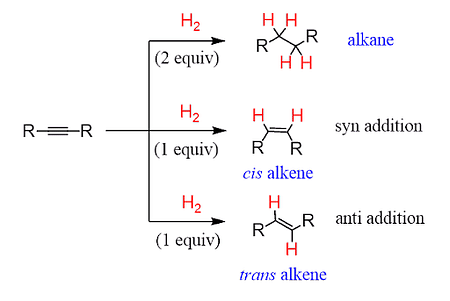
- The palladium-catalyzed hydrogenation of alkynes to alkenes happens in the presence of Hydrogen (H2). The work of hydrogen is to get added to the alkyne to afford the corresponding alkene. It lowers the alkyne to an alkene.
- The introduction of a Hydrogen atom is to reduce the triple bond of alkyne to a double-bonded alkene. In this addition process of hydrogenation always proceeds via syn addition (addition to the substituent on the same side of the bond).
- Therefore, the final product that is received is always a pure cis-isomer of the alkene. This means that the hydrogen atom is transferred to the same side(cis) of the alkyne.
Why Lindlar Catalyst ‘Poisoned’ with Lead Salts?
The surface area of the palladium metal that is used as a catalyst for the reaction, has small pores, if more in number, the faster the reaction. The catalytic activities are fast enough to reduce even further than the double bonds. The purpose of using this catalyst is to obtain alkenes, if not deactivated, the hydrocarbons will further undergo reduction and form alkanes. In order to achieve the purpose, a substance, ‘poison’, has to be added to reduce its activity.
Using the lead salts or quinoline as a poison for the catalyst causes disruption in its ability to further reduce the double bonds. Also, the quinoline controls the formation of unwanted by-products.
Read More: Saturated Hydro carbons
Uses of Lindlar Catalyst
[Click Here for Sample Questions]
Lindlar catalyst has two main reactions,
- Partial reaction (hydrogenation of alkyne to form alkene)
- Rosenmund reaction (acid chloride is converted to aldehyde)
Partial Reaction

Partial Reaction
It is the first use of the lindlar catalyst. It works as follows;
- After taking 2-Butyne which is an alkyne, mix poisoned palladium (or lindlar catalyst). In this reaction, one bond breaks, and the valencies of two carbon atoms will change.
- One hydrogen atom gets attached to each carbon atom.
- The carbon atoms now make a double bond instead of a triple bond.
- In this particular reaction, an alkyne is reduced to an alkene.
- The catalyst is used in a very limited quantity. In this case, it does not react with an alkene, because alkyne is more reactive than alkene.
- The configuration of the bond is cis.
- Concludingly, its first use is to convert an alkyne into a cis alkene.
Rosenmund Reaction

- In this reaction, we have an acid chloride in which lindlar catalyst is added, in which the weak bond of carbon and chlorine is broken. Due to which the free valency of the carbon atom is satisfied by the hydrogen atom.
- Which results in the formation of an aldehyde from an acid chloride.
- It is also a reduction reaction.
Examples of Lindlar Catalyst
- The action of lindlar catalyst in the hydrogenation of butyne-dioic acid (acetylene dicarboxylic acid), which only yields maleic acid and does not yield any fumaric acid.
- To reduce 1-phenylpropyne to an alkene, the lindlar catalyst is used and the hydrogenation of phenyl propyne reaction takes place. At the later stage, the poison substance is added to deactivate the reactions, if not added, the alkyne will keep reducing further and into an alkane. So to stop it at the alkene result, it is needed.
Read More: Conformational isomers
Things to Remember
- The formula of lindlar catalyst is H2/Pd/CaCO3
- The Lindlar catalyst is also known as palladium.
- It is a metal that resembles the metal platinum.
- It is a heterogeneous reaction.
- It is used to reduce alkyne to alkene through the process of syn addition.
- The resultant alkene is called a cis-isomerism.
- The reaction is called exothermic.
- The deactivator or ‘poison’ is added to the resultant alkene, usually a lead salt or quinoline.
- It has two uses; 1) Partial reaction, and 2) Rosenmund reaction
- The reduction of alkyne to an alkene is called the hydrogenation of alkyne.
Sample Questions
Ques 1: Can lindlar catalyst be classified as a homogeneous catalyst? (1 mark)
Ans: No, the lindlar catalyst is a heterogeneous catalyst which means the physical phase of the catalyst is not similar to the physical phase of the reacting entities.
Ques 2: What are lindlar catalysts made up of? (1 mark)
Ans: The Lindlar catalyst is the heterogeneous catalyst that comprises palladium deposited on calcium carbonate or barium sulphate which is poisoned with several forms of lead or sulphur like lead acetate or quinoline.
Ques 3: State the uses of lindlar catalyst. (2 marks)
Ans: The lindlar catalysts are used to synthesize Vitamin A on a commercial scale. Moreover, they are also used to synthesize dihydro vitamin K1. With the help of a lindlar catalyst, phenylacetylene can be reduced to styrene.
Ques 4: How can lindlar catalyst be prepared? (2 marks)
Ans: Lindlar catalysts can be prepared in laboratories or can be bought commercially. For preparing it in the laboratories, the three composition substances are used in specific ratios. The catalyst reduces alkynes to an alkene, also introducing quinoline prevents any further reduction into alkenes, it acts as a deactivator.
Ques 5: Who invented the lindlar catalyst? (2 marks)
Ans: The lindlar catalyst was named after the British-Swiss chemist and inventor Herbert Lindlar Wilson. The primary application of this catalyst is in the hydrogenation of alkynes into alkenes.
Ques 6: What is the lindlar catalyst formula? (2 marks)
Ans: Lindlar catalyst (H2/ Pd/ CaCO3) is used for alkyne hydrogenetion in order to mould cis alkene as hydrogenetion by using H2/ Pd will create alkanes and thus CaCO3 are to be used as a pesticide to avoid further hydrogenetion and thus form an alkene.
Ques 7: Which of the following is lindlar catalyst: (1 mark)
(a) Zinc chloride and HCL
(b) A cold dilute solution of KMnO4
(c) Sodium and liquid NH3
(d) Partially deactivated palladised charcoal
Ans: The correct option is d. Partially deactivated palladised charcoal
Ques 8: Alkynes undergoes reduction using lindlar’s catalyst to produce ____? (1 mark)
Ans: Alkynes undergoes reduction using lindlar’s catalyst to produce cis-alkenes.
Ques 9: What is Pd/ BaSO4? (2 marks)
Ans: Pd/ BaSO4 is the lindlar catalyst along with quinolone, which is used again to convert alkynes to alkenes. This reagent gives the accompanying beginning alkynes cis alkene. The reduction of terminal alkynes is not limited, while terminal alkenes are produced. In the case of Benzene, there occurs no interaction with Benzene.
Ques 10: Write two examples of Lindlar catalysts. (2 marks)
Ans: The two examples are:
- The action of lindlar catalyst in the hydrogenation of butyne-dioic acid (acetylene dicarboxylic acid), which only yields maleic acid and does not yield any fumaric acid.
- To reduce 1-phenylpropyne to an alkene, the lindlar catalyst is used and the hydrogenation of phenyl propyne reaction takes place. At the later stage, the poison substance is added to deactivate the reactions, if not added, the alkyne will keep reducing further and into an alkane. So to stop it at the alkene result, it is needed.
Ques 11: How does particle reaction function? (3 marks)
Ans: After taking 2-Butyne which is an alkyne, mix poisoned palladium (or lindlar catalyst). In this reaction, one bond breaks, and the valencies of two carbon atoms will change. One hydrogen atom gets attached to each carbon atom. The carbon atoms now make a double bond instead of a triple bond. In this particular reaction, an alkyne is reduced to an alkene. The catalyst is used in a very limited quantity. In this case, it does not react with an alkene, because alkyne is more reactive than alkene. The configuration of the bond is cis. Concludingly, its first use is to convert an alkyne into a cis alkene.
For Latest Updates on Upcoming Board Exams, Click Here: https://t.me/class_10_12_board_updates
Check-Out:



Comments