



Education Journalist | Study Abroad Lead
Conformation is referred to as the spatial arrangements of Hydrogen and Carbon atoms which can be transformed in one another by rotation around a single bond of C-C. This is because, in alkanes, electron distribution in sigma molecular orbital is symmetrical around the C-C bond’s internuclear axis. In this article, we will explore the concept of conformation and its representation.
What is conformation?
Conformation is the different arrangements of atoms in space that result from the free rotation of groups about the C-C bond axis.
The organic compounds having the same molecular formula but different chemical or physical properties or both are known as isomers and this phenomenon is called isomerism. The difference in properties in an isomer is due to the relative arrangement of various atoms or groups present.

Conformational Isomerism
Check out pdf-notes for Hydrocarbons. (Hydrocarbon.pdf)
Conformational Isomerism
The two main types of isomerism seen are Structural or Constitutional Isomerism and Space or Stereoisomerism. Space or stereoisomerism is further divided into two groups known as Configurational and Conformational Isomerism. The stereoisomerism arises due to the difference in the relative arrangement of atoms or groups in space.
The concept of conformation can be very well explained using the example of an ethane molecule where the sigma bonds that join the two carbon atoms are cylindrically symmetrical about the nuclear axis. This symmetry permits the free rotation of the two carbon atoms along with the bond axis with respect to each other but without breaking the bond.
Ethane Conformations

In this case, one CH3 group needs to be kept stationary and the other one is allowed to rotate through the C – C axis. In this position, an infinite number of atomic arrangements are possible. These different arrangements of atoms of ethane in space that result from the free rotation of groups about the C - C bond axis are called Conformations or Conformational Isomers or rotational Isomers, and this phenomenon is known as Conformational Isomerism.
In all these conformations there is no change in the basic structure of a molecule and bond lengths and bond angles.
Among the all-possible arrangements of the ethane, the two conformations that represent the extremes are
-
Eclipsed Conformation
In Eclipsed conformation, the hydrogens of one carbon are just behind the other, making the repulsion the maximum, hence resulting in an angle of zero degrees (θ = 0°)
-
Staggered Conformation
Staggered conformation is represented by the staggering hydrogens of two carbons which results in the maximum distance and maximum repulsion and an angle of 60°. (θ= 60°).
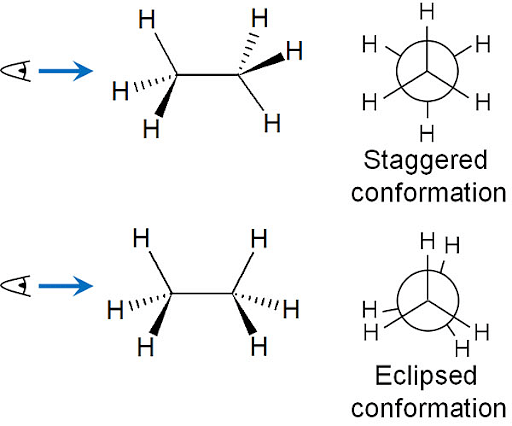
The one more arrangement that is possible between these two extremes is known as Gauche or Skew Form.
Representation of Eclipsed and Staggered Conformation
Sawhorse Projection
In the Sawhorse projection, the bond is shown as a long straight line between the carbon atoms. The front carbon atom is represented by the lower end while the rear carbon atom is represented by the upper end.
In the case of eclipsed conformation, the hydrogens are just behind another. This results in the maximum repulsion in these atoms. In the case of staggered conformation, the hydrogens of two carbons are staggered with respect to one another. This results in the minimum repulsion between them.

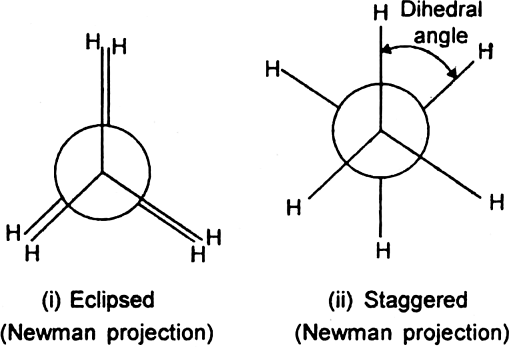
Newman Projection
Newman projection is another way of representing the eclipsed and staggered conformations. In Newman’s projections, the two carbon atoms with a sigma bond are represented by two circles, one behind the other. In this case, only the front carbon is seen. The hydrogen atoms attached to the first carbon are represented by C – H bonds from the center of the circle. The C-H bonds of the carbon at the back are drawn from the circle’s circumference.
A 60° rotation converts a staggered conformation into eclipsed conformation and eclipsed conformation into staggered conformation. Again, these rotations from 0° to 60° generate many arrangements in between which are called Gauche or Skew Forms.
Torsional Barriers
The small difference in the energy content of the two extreme conformations upon rotations is referred to as torsional strain or barrier. The potential energy of the staggered form is minimum, and of the eclipsed form is maximum. The difference in the energy of the two extreme conformations is 3 K.cal/mol or 12.5 KJ/mol. This energy is very small so that it can not prevent rotations.
The eclipsed conformation is the least stable and less abundant while staggered conformation is the most stable and most abundant.
Things to Remember
- Conformation is the different arrangements of atoms in space that result from the free rotation of groups about the C-C bond axis.
- The organic compounds having the same molecular formula but different chemical or physical properties or both are known as isomers.
- These different arrangements of atoms that result from the free rotation of groups about the C - C bond axis are called Conformational Isomers or rotational Isomers.
- The two conformations that represent the extremes are Eclipsed Conformation and Staggered Conformation.
- Two ways of representing the eclipsed and staggered conformations are through Sawhorse Projections and Newman Projection.
- The small difference in the energy content of the two extreme conformations upon rotations is referred to as torsional strain or barrier.
Sample Questions
Ques. Are conformational isomers stereoisomers? 1 marks
Ans. Conformational isomers are a type of stereoisomers.
Ques. How many Conformations does ethane have? 1 mark
Ans. Ethane has many possible conformations. Among its many conformations, two extremes are Eclipsed and Staggered conformations.
Ques. Which is the most stable conformation of ethane? 1 mark
Ans. The most stable conformation of ethane is staggered conformation.
Ques. Which Newman projection has the lowest energy? 1 mark
Ans. The staggered conformation of the Newman projection has the lowest energy.
Ques. What are Stereoisomers? 2 marks
Ans. Stereoisomerism is also called space isomerism. Stereoisomers are seen in compounds having the same molecular and structural formula but different spatial arrangements of atoms or groups. This spatial arrangement is also referred to as the configuration of the molecule.
Ques. What is Newman’s projection? 2 marks
Ans. The representation of a molecule by looking through its C-C single bond or sigma bond is known as Newman’s projection.
Ques. What are the three types of isomers? 3 marks
Ans. The three main types of isomers are:
- Chain isomers
- Functional isomers
- Positional isomers



Comments