



Education Journalist | Study Abroad Lead
Line of symmetry is a line that divides a shape or figure into two halves. These two halves are the reflection of each other. A line of Symmetry is an imaginary line or axis that always passes through the center of a shape or a figure. Since one-half reflects the other half, it is also known as reflection or mirror symmetry. The line of symmetry of shapes like circles, squares, equilateral triangles, and other polygons can be drawn in vertical, horizontal, slanting, etc. directions.
Also Read: Rotational Symmetry
Key Terms: Symmetry, Line Symmetry, Horizontal Line Symmetry, Vertical Line Symmetry, Axis, figures, shapes.
Line of Symmetry
[Click Here for Sample Questions]
Line of symmetry is an imaginary axis or line that passes through the center of a body. It divides the body or shape into two halves. These two halves reflect each other. The line of symmetry is also known as the axis of symmetry. As the two halves reflect each other, it is also termed as reflection or mirror symmetry. A figure may have:
- No Line of Symmetry (for the asymmetrical figure)
- One Line of Symmetry
- Two Line of Symmetry
- Multiple (more than 2) Line of Symmetry
- Infinite Line of Symmetry,
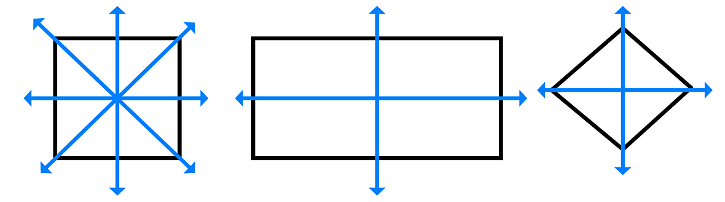
Lines of Symmetry
For example, cut an apple into two pieces, the one piece is symmetric with another piece or a mirror image of another piece. Similarly, an equilateral triangle can be divided into halves. The two triangles formed are the right-angled triangles. Asymmetrical Figures are defined as irregular figures that cannot be divided into two equal parts. Hence, the concept of line of symmetrical is not applicable for such figures.
Read More:
Types of Line of Symmetry
[Click Here for Sample Questions]
Line of Symmetry can be a combination of horizontal, vertical, and diagonal. In actuality, there are three types of axis or lines of symmetry.
- Horizontal Line of Symmetry
- Vertical Line of Symmetry
- Diagonal Line of Symmetry
Horizontal Line of Symmetry
Any horizontal line or axis that passes through the center of a figure and divides it into two halves, that line is known as the Horizontal Line of Symmetry. In English alphabets, B, C, D, E, H, K shows horizontal symmetry.
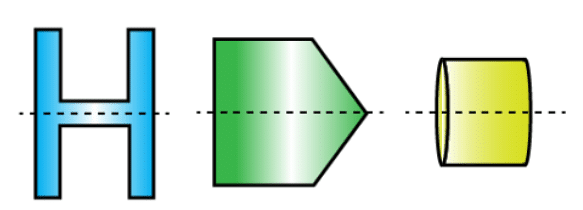
Horizontal Line of Symmetry
Vertical Line of Symmetry
A vertical axis that passes through the center of a figure and divides it into two halves, that line is known as the Vertical Line of Symmetry. Alphabets like A, H, I, M, O, U, V, W, T, Y are examples of the vertical lines of symmetry.

Vertical line of symmetry
Note: Alphabets such as ‘H’, ‘I’, ‘O’, ‘X’ show both horizontal and vertical symmetry. This means, a shape or a figure may have either one or both lines of symmetry. Also, alphabets such as ‘F’, ‘G’, ‘L’, ‘P’, ‘Q’, ‘R’, ‘S’, ‘Z’ do not show any symmetry.

Line of symmetry in Alphabets
Diagonal Line of Symmetry
In a diagonal line of symmetry, the line (or axis) passes through the diagonal of a figure. In this symmetry, the figure is split across its corner and forms two halves.

Diagonal Line of Symmetry
Two Lines of Symmetry
Shapes like rectangle, rhombus, and alphabets like ‘H’, ‘I’, ‘O’, ‘X’ are examples of two lines of symmetry. These two lines pass through the center of a shape intersecting each other.

Two Lines of Symmetry
Three Lines of Symmetry
An equilateral triangle shows three lines of symmetry. All three lines (axis) pass through its median that intersect at the center of a triangle.

Three Lines of Symmetry
Four Lines of Symmetry
A square shows four lines of symmetry. Out of 4, two lines (or axis) pass through the opposite vertices and the other two through the midpoints of opposite sides.

Four Lines of Symmetry
Infinite Lines of Symmetry
Only a circle has infinite lines of symmetry. A circle is symmetric along all of its diameters. We can also say that a circle can either have infinite or no line (zero) symmetry.

Infinite Lines of Symmetry
No Line Symmetry
Shapes such as trapezoid, scalene triangle, parallelogram do not have any line of symmetry that is zero line of symmetry. Alphabets such as ‘F’, ‘G’, ‘L’, ‘P’, ‘Q’, ‘R’, ‘S’, ‘Z’ are examples of no line symmetry.
Also Read: Median of Triangle
Symmetry in Coordinate Plane
[Click Here for Sample Questions]
In the coordinate system, the graph may have symmetry about the x-axis, y-axis, origin, or about any given line.
- A graph is said to be symmetric about the x-axis only when the point (x, y) is on the graph then (x, -y) must be on the graph.

Symmetry along x-axis
- A graph is said to be symmetric about the y-axis only when the point (x, y) is on the graph then (-x, y) must be on the graph.

Symmetry along y-axis
Read More:
Things to Remember
- Line of symmetry is an imaginary line that divides a shape of figure into two equal parts where one is a mirror image to the other.
- Horizontal line of symmetry is where the shape is divided into two equal parts horizontally.
- Vertical line of symmetry is where the shape is divided into two equal parts vertically.
- Depending on the number of lines of symmetry, it can be divided into two line symmetry (rectangle) , three line symmetry (equilateral triangle), four line symmetry (square) and infinite line symmetry (circle).
- Symmetry in Coordinate planes can be divided into symmetry along x-axis and symmetry along y-axis.
Sample Questions
Ques 1. How many English alphabets have horizontal lines of symmetry?. Name them with representation. (2 marks)
Ans. English Alphabets such as A, H, I, M, O, T, U, V, W, X, Y have horizontal lines of symmetry.

We can see when we divide these alphabets with horizontal lines (along the x-axis) the alphabet is divided into two identical parts. These 2 parts are mirror images of each other.
Ques 2. Name all the English alphabets that show both horizontal and vertical symmetry. Prove by making a diagram. (5 marks)
Ans. In English alphabets, only H, I, O, and X show both horizontal and vertical symmetry. This means these alphabets are symmetric about both x and y axes.
- Horizontal Line of Symmetry

- Vertical Line of Symmetry

- Combine Line of Symmetry

Ques 3. Which of the following figures has a vertical line of symmetry? (2 marks)
Ans. First, divide all the figures by a vertical line (along the y-axis). We have,

As observed, in figures a, b, c the two halves are identical to each other. These two halves are the vertical reflection of each other. But the figure (d) does not have a vertical line of symmetry but has a horizontal line of symmetry instead.
Ques 4. Complete the figure. The dashed line represents a line of symmetry (reflection). (2 marks)
Hence the complete figure will be –

Ques 5. Draw all possible lines of symmetry to the given figure. Also, write which line of symmetry is present. (2 marks)
Ans. The figure shown here is symmetric about the y-axis. Thus, draw a vertical line such that it divides the figure into two identical parts.


Both horizontal and verticle line of symmetry is present.
Ques 6. Draw and name the type of line of symmetry the following figures have. (2 marks)
Ans. Look at each figure one by one we have
Fig. a - Equilateral Triangle
Fig. b - Hexagon
Fig. c - Circle
- For Fig. a
Three lines will pass through the center that is along the median of an equilateral triangle. Each line (axis) intersects at the center of the triangle.

As the figure suggests, there are 3 lines dividing an equilateral triangle into identical parts. Hence, the equilateral triangle has three-line symmetry.
- For Fig. b
The figure is a hexagon. Draw a horizontal line passing through the center, the hexagon is symmetric. So a horizontal line of symmetry is present. Similarly, draw a vertical line passing through the center. It reflects that the hexagon also has a vertical line of symmetry. Hence, the hexagon has two lines of symmetry.

- For Fig.
The figure given is a circle. Since a circle is symmetric along all of its diameters. Therefore, all the lines passing through diameter are a line of symmetry that is infinite.
Hence, the circle has infinite lines of symmetry.

Ques 7. Does the figure given below have symmetry?. Calculate a number of symmetric lines. (2 marks)
Ans. At first draw two lines along x and y axes that must pass through the center of a body. We have,


Ques 8. Find the total number of lines of symmetry in the figure given below. (2 marks)

Ans.

As shown above, the figure has 4 lines of symmetry. All these four lines pass through its center.
For Latest Updates on Upcoming Board Exams, Click Here: https://t.me/class_10_12_board_updates
check Out:



Comments