



Content Curator
Lithium Chloride is an ionic compound which is hygroscopic in nature. This means that Lithium Chloride is soluble in water, ether, and alcohol. The chemical formula of Lithium Chloride is LiCl.
- It can be produced by the reaction of Hydrochloric Acid with Lithium Hydroxide.
- It has a density of 2.07 g/cm3.
- Typically, Lithium chloride can be found in form of a white solid hygroscopic substance.
- Lithium chloride, in the form of a solid, can absorb water in order to form a Hydrate, LiCl.H2O
Key Terms: Ionization enthalpy, Atomic Radii, Ionic radii, Oxoacids, Diagonal Relationship, Alcohol, The S-Block Elements, Periodic Table
What is Lithium Chloride?
[Click Here for Sample Questions]
Lithium Chloride is an ionic compound and hygroscopic in nature, meaning that is soluble in water, ether, and alcohol.
The chemical formula of Lithium Chloride is LiCl. Since the size of Li+ ion gives rise to certain properties unique from the rest of the alkali metal chlorides, the molecular weight of it is 42.394 g/mol.
It was during the 1950s that people produced it to replace it with common table salt (NaCl). The common process to produce Lithium Chloride is made by the action of hydrochloric acid on lithium hydroxide.
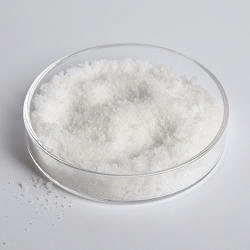
Lithium Chloride
Some common details about Lithium Chloride are:
| Type | Classification |
|---|---|
| Density of Lithium Chloride | 2.07 g/cm³ |
| Molecular Weight or Molar Mass | 42.394 g/mol |
| Boiling Point of Lithium Chloride | 1,382 °C |
| Melting Point of Lithium Chloride | 605 °C |
| Chemical Formula of Lithium Chloride | LiCl |
Properties of Lithium Chloride
[Click Here for Sample Questions]
The various Lithium Chloride properties include:
Physical Properties of Lithium Chloride
- It is a white solid hygroscopic substance.
- Appearance is like cubic crystals, or granules.
- It has a sharp saline taste.
- The boiling point of the compound is 2485 oF at 760 mm of Hg.
- The density of the compound is 2.068 at 77 oF
- It is odourless while being soluble in water, methanol, ethanol, isopropanol, butanol, formic acid, and hydrazine.
- It is insoluble in dichloromethane.
Also Read: Oxoacids of Halogen
Chemical Properties of Lithium Chloride
Like other metals, it also forms crystalline hydrates its anhydrous salts can be regenerated by heating the hydrates
Lithium chloride reaction with Sulfuric acid
The reaction between lithium chloride and sulfuric acid forms lithium sulphate and hydrogen chloride:
2LiCl + H2SO4 \(\to\) 2HCl + Li2SO4
Lithium chloride reaction with Base
When lithium chloride reacts with sodium hydroxide the products formed are lithium hydroxide and sodium chloride:
LiCl + NaOH \(\to\) LiOH +NaCl
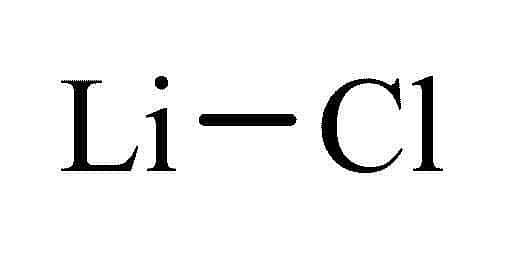
Lithium Chloride Molecular Structure
Also Read: Covalent bond
Explanation of Lewis structure of Lithium ChlorideLithium Chloride is an ionic compound, in which lithium-ion is a metal compound and chloride is a non-metal where electrons are transferred from metal ion to non-metal ion. Steps:
|
Check More:
Preparation of Lithium Chloride
[Click Here for Sample Questions]
Lithium chloride can be produced by treating the lithium carbonate with hydrochloric acid.
Also, it can be produced by the highly exothermic reaction of lithium metal with ether chlorine or anhydrous hydrogen chloride gas when the heating of hydrate is along with the steam of hydrogen chloride.
Also Read: Sodium carbonate
Lithium Chloride Uses
[Click Here for Sample Questions]
There are an infinite number of uses of lithium chloride:
- It is used to produce lithium metal by electrolysis of LiCl/KCl whose melting point is 450 oC in industries.
- It is used as a brazing flux for aluminium in automobile parts.
- It is also used as a desiccant for drying air streams.
- It has certain specialized applications in organic synthesis such as an additive in the Stille reaction where we use it to precipitate RNA from cellular extracts.
- We use it in flame colourant to produce dark red flames in the calibration of hygrometers.
- In industries, the molten form of it is used to prepare carbon nanotubes, lithium niobate, and grapheme.
Also Read: P-block elements
Health Hazards of Lithium Chloride
[Click Here for Sample Questions]
Some of the major health hazards caused by Lithium Chloride include:
- The salts of lithium chloride directly affect the central nervous system in many ways.
- It may also cause tremors and convulsions.
- There has been significant evidence that it can cause severe irritation of the upper respiratory tract with pain, burns and inflammation.
Also read: Oxygen Cycle
Things to Remember
- Lithium chloride is a chemical compound that has a chemical structure LiCl.
- The molecular weight or molar mass of Lithium Chloride is 42.4 g/mol.
- The reaction of Lithium chloride with Sulphuric Acid is 2LiCl + H2SO4 \(\to\) 2HCl + Li2SO4.
- The reaction of Lithium chloride with a Base is LiCl + NaOH \(\to\) LiOH +NaCl.
- Lithium Chloride has a density of 2.07 g/cm3.
Also Check:
Sample Questions
Ques. What is the chemical formula for lithium chloride? (1 mark)
Ans. The chemical formula for lithium chloride is LiCl. It is salt like other metal chlorides, forms crystalline hydrates.
Ques. What are the uses of lithium chloride? (2 marks)
Ans. i. Lithium chloride is used for the manufacture of lithium metal by electrolysis of a molten LiCl / KCl
- LiCl is also used in automotive parts as a brazing flux for aluminium
Ques. What is molar mass of LiCl? (2 marks)
Ans. The molar mass of LiCl is 42.394 g/mol. We can multiply the element’s atomic mass by the number of atoms in the compound to get the molar mass of the compound.
Ques. What is lithium Lewis’s dot structure? (2 marks)
Ans. A valence electron is an electron that exists within an atom’s outer shell. Valence electrons, also known as bonding electrons, can engage in chemical bonding. The presence of valence electrons as bonding or non-bonding pairs has an impact on the molecular geometry of molecule.
Ques. What are the solvents used to dissolve lithium chloride? (2 marks)
Ans. The lithium chloride is soluble in hydrazine, methyl formamide, butanol, selenium, oxychloride, and propanol solvents.
Ques. What is the boiling point of lithium chloride? (1 mark)
Ans. The boiling point of lithium chloride is 1380 oC.
Ques. How can lithium chloride serve as a source of chloride ion? (2 marks)
Ans. It can be served as a source of chloride ions by forming a precipitate upon treatment with silver nitrate as we can see in the following reaction
LiCl + AgNO3 \(\to\) AgCl + LiNO3
Ques. What is the reason for the pink colour lithium chloride crystal? (2 marks)
Ans. The reason for this is metal excess defect due to anionic vacancies.
- The negative ions (Cl) are missing from their lattice sites, leaving the holes in which electrons are trapped so that electrical neutrality is maintained.
- When we heat the crystal, Li atoms get deposited on the surface of the crystal.
Ques. Why lithium chloride is a predominantly covalent bond? (2 marks)
Ans. The reason why lithium chloride is primarily a covalent bond is due to the fact that there is an electronegative difference between Li and Cl. The electronegative difference between the both of them are small and according to the Fajan rule, the smaller the cation in the polarising power, the more the polarization, leading to more covalent character.
Ques. What are the physical properties of lithium chloride? (2 marks)
Ans. The density of the compound is 2.068 g/cm3 and it is white crystalline solid in colour
For Latest Updates on Upcoming Board Exams, Click Here: https://t.me/class_10_12_board_updates
Also Read:



Comments