



Content Curator
The logarithm is an important topic for mathematics and is used in various formulas. Logarithms to the base e are called natural logarithms which is a mathematical constant and its value is 2.718. The natural logarithm of x is written as ln x, loge x, or sometimes, if the base e is known, simply log x. There are a total of 4 natural log formulas, used widely in mathematics.
Key Terms: Log, Logarithmic Function, Exponent, Number, Exponential Equation, Quotient, Natural Log, Log Formula
What is Log?
[Click Here for Sample Questions]
In mathematics, a log or logarithm is an alternate method of representing an exponential equation. The logarithm is the inverse of exponentiation. It is defined as the exponent or power to which a base is raised in order to yield a number. When this logarithmic has a base e, the mathematical constant, it is known as the natural log.
Hence, a natural log is written as loge x or simply log x where the base is e.
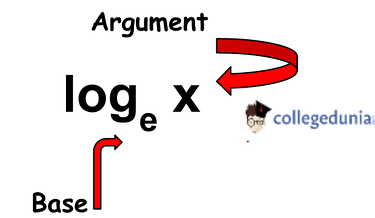
Natural Logarithmic Function
Natural Log Formula
[Click Here for Previous Years’ Questions]
There are four natural log formulas that are widely used in several other formulas in mathematics. All four formulas are discussed below.
Product Rule
The logarithm of the multiplication of two values namely x and y is the sum of the logarithm of x and the logarithm of y.
loge(x ∙ y) = loge(x)+ loge(y)
Quotient Rule
The logarithm of the division of the two values x and y, is found as the difference between the logarithm of x and logarithm of y. Hence, the quotient rule is given as
loge(x / y) = loge(x)- loge(y)
Power Rule
The logarithm of x raised to the power of y is calculated as y times the logarithm of x.
loge(xy) = y ∙ loge(x)
Base Change Rule
The logarithm of x to the base y is equal to the logarithm of x to the base z divided by the logarithm of y to the base z.
logy(x) = logz(x) / logz(y)
Also Read:
Solved Examples
[Click Here for Sample Questions]
A few examples are illustrated below to understand better the concept of natural log formulas.
| Example 1: Find loge(4 ∙ 8). Solution: Using the natural log product formula loge(4 ∙ 8) = loge(4) + loge(8) Example 2: Find the value of x if loge (15x – 3) = 2. Solution: loge(15x – 3) = 2 ⇒ 15x - 3 = e2 ⇒ 15x - 3 = 7.389 ⇒ 15x = 10.389 ⇒ x = 10.389/15 ⇒ x = 0.6926 |
Natural Logarithms Table
[Click Here for Previous Years’ Questions]
For quick calculations and better understanding a table is given below with natural logarithms and their respective values.
| x | loge x |
|---|---|
| 0 | undefined |
| 0+ | – ∞ |
| 0.0001 | -9.210340 |
| 0.0010 | -6.907755 |
| 0.0100 | -4.605170 |
| 0.1000 | -2.302585 |
| 1.0000 | 0.000000 |
| 2.0000 | 0.693147 |
| e ≈ 2.7183 | 1.000000 |
| 3.0000 | 1.098612 |
| 4.0000 | 1.386294 |
| 5.0000 | 1.609438 |
| 6.0000 | 1.791759 |
| 7.0000 | 1.945910 |
| 8.0000 | 2.079442 |
| 9.0000 | 2.197225 |
| 10.0000 | 2.302585 |
| 20.0000 | 2.995732 |
| 30.0000 | 3.401197 |
| 40.0000 | 3.688879 |
| 50.0000 | 3.912023 |
| 60.0000 | 4.094345 |
| 70.0000 | 4.248495 |
| 80.0000 | 4.382027 |
| 90.0000 | 4.499810 |
| 100.0000 | 4.605170 |
| 200.0000 | 5.298317 |
| 300.0000 | 5.703782 |
| 400.0000 | 5.991465 |
| 500.0000 | 6.214608 |
| 600.0000 | 6.396930 |
| 700.0000 | 6.551080 |
| 800.0000 | 6.684612 |
| 900.0000 | 6.802395 |
| 1000.0000 | 6.907755 |
| 10000.0000 | 9.210340 |
Previous Years’ Questions
- The value of… [JKCET 2013]
- If a=log23,b=log25,c=log72, then… [BITSAT 2007]
- The sum of the divisors of 24…
- The value of d/dx...
Things to Remember
- The logarithm is an alternate method of representing an exponential equation.
- Logarithm of 0 to the base e is undefined.
- All logarithmic expressions with a base e are called natural logarithmic.
- Logarithm of 1 to the base e is 0.
Sample Questions
Ques: Find the integer value of x using natural log formulas: e3x = 9. [2 marks]
Ans: Given that e3x = 9
Thus,loge (e3x) = loge(9)
3x = loge(9)
x = loge(9)/3
Ques: Solve 5e4x + 3 = 13 [2 marks]
Ans: 5e4x + 3 = 13
⇒ 5e4x = 13 – 3 ⇒ 5e4x = 10
⇒ e4x = 10/5 ⇒ e4x = 2 [Applying ln both the sides]
⇒ ln(e4x) = ln 2
⇒ 4x = ln 2 ⇒ 4x = 0.693 ⇒ x = 0.693/4
⇒ x = 0.173
Ques: Evaluate: p = log35 – log36 + log310 [3 marks]
Ans: p = (ln 5/ ln 3) – (ln 6/ ln 3) + (ln 10/ ln 3)
= [ln 5 -(ln 6 + ln 10)] / ln 3
= [ln 5 – ln (6 × 10)]/ ln 3
= [ln 5 – ln 60]/ ln 3
= [ln(5/60)] / ln 3
= [ln(1/12)] / ln 3
= [ln (12)-1] / ln 3
= [-1×ln 12] / ln 3
= -ln 12 / ln 3
p = -2.262
Ques: If ln 6 = a , ln 8 = b , ln 16 = c , ln 12 = d then write d in terms of a, b and c. [2 marks]
Ans: (a + c) – b = (ln 6 + ln 16) – ln 8 [ln a + ln b = ln (ab)]
⇒ a + c – b = ln 96 – ln 8 [ln a – ln b = ln (a/b)]
⇒ a + c – b = ln 96/8
⇒ a + c – b = ln 12
⇒ a + c – b = d
d = a + c – b
Ques: If 8exy + 2 = 98 and 2ez + 3 = 79, then find the value of x + y, where z = x2 + y2 [4 marks]
Ans: 8exy + 2 = 98
⇒ 8exy = 98 - 2 = 96
⇒ exy = 96/8 = 12 [Applying ln on both sides]
⇒ ln(exy) = ln 12 [Since ln(ex )= x]
⇒ xy = 2.4849 ⇢ Equation 1
2ez+ 3 = 79
⇒ 2ez = 79-3 = 76
⇒ ez = 76/2 = 38 [Applying ln on both sides]
⇒ ln(ez) = ln 38
⇒ z = x2 + y2 = 3.6375 ⇢ Equation 2
Now, (x + y)2 = x2 + y2 + 2xy [Putting value of Equation 1 and Equation 2]
(x + y)2 = 3.6375 + 2 × 2.4849
(x + y)2 = 3.6375 + 4.9698
(x + y)2 = 8.6073
(x + y) = √8.6073 = 2.933
Ques: What are logarithmic functions? [1 mark]
Ans: Logarithmic functions are simply the inverse of exponential functions. The logarithmic function, y = logax is a representation of the exponential equation, x = ay.
Ques: What is the product rule of natural logarithmic? [1 mark]
Ans: The product rule of two natural logarithmic functions of x and y is the sum of the logarithmic function of x and the logarithmic function of y.
[loge(x ∙ y) = loge(x)+ loge(y)]
Ques: Find x if log5(x-7)=1. [2 marks]
Ans: Given,
log5(x-7)=1
Using logarithm rules, we can write;
51 = x-7
5 = x-7
x = 5+7
x = 12
Ques: Express log101 = 0 in exponential form. [2 marks]
Ans: Given, log101 = 0
By the rule, we know;
logac=b ⇒ ab = c
Hence,
100 = 1
Check-Out:



Comments