



Content Writer
Mathematical Reasoning is a tool which is used to know the truth values of any given statement and thus helps in determining the validity of it. Questions related to Reasoning Statements are usually asked in several competitive exams including JEE to assess the conceptual thinking of the examinee. The difficulty of such questions is easy to moderate. Mathematical Reasoning is taught to improvise an individual’s ability of rational thinking and logic.
The principle of mathematical reasoning is the most important requisite in framing mathematically acceptable statements.
Read more: Mathematical operations
KeyTerms: Mathematical Reasoning, Inductive Reasoning, Deductive Reasoning, Mathematical Statements, Open statement, Simple Statement, Compound Statement, If – then (conditional) Statement , Negation method
Mathematical Reasoning
[Click Here for Sample Questions]
Mathematical reasoning is used to apply logic and rationality in mathematical statements. A Mathematical Statement is one which is either true or false and is not ambiguous in its sense. A mathematical statement in which the information conveyed can be true and false at the same time cannot be considered as a mathematically acceptable statement.
There are certain other criteria that a sentence should fulfill in order to become a mathematical statement, these are:
- Should not be in exclamatory form.
- Should not be in the form of a request or order.
- Should not be an interrogative sentence
- Should not include timings such as yesterday, today, tomorrow, etc.
- Should not have variable places like here, there, etc.
- Should not have pronouns such as her, him, them, etc.
Read more: Tautology
Mathematically Acceptable Statement
[Click Here for Sample Questions]
The basic entity required for mathematical statements is reasoning.
To assess and determine whether a given statement or set of statements is mathematically acceptable or not, we need to find out if the statement is ambiguous or not.
How to find out if a statement is ambiguous or not?
A mathematical statement is always “Either true or false, but cannot be both simultaneously.”
A statement which has the possibility of being true and false at the same time is ambiguous and such a statement is not mathematically acceptable.
For example:
- “The sum of two prime numbers is odd.”
Let's assess – Given that the sum of two prime numbers can be odd or it can be even also. Thus, the statement is true and false at the same time. It is an example of an ambiguous statement; hence it is not mathematically acceptable.
- “Parallel lines never intersect each other.”
Let’s assess – Given that parallel lines never intersect each other. So, the statement is “true” with clear cut information. Hence, it is a Mathematically Acceptable Statement.
Open Statement
[Click Here for Sample Questions]
There are certain statements in mathematical reasoning which are open – ended in nature. Such statements are called Open Statements.
For example:
- Mina has to walk 1km to reach her school.
From this statement, it’s known only about the distance but nothing about the direction and from where she starts. Hence, it is an incomplete and an open – ended statement.
- Y is a whole multiple of 3.
Here Y could be any number as the value of Y is not specified. So, in this sense it is an Open – ended Statement.
Read more:
| Relevant Concepts | ||
|---|---|---|
| Principles of Mathematical induction | Alternate angles | Consecutive integers |
| Mathematical Logic | Permutation and Combinations | Boolean Expression |
Types of Mathematical Reasoning
[Click Here for Sample Questions]
The human brain is wired to employ the 7 different types of reasoning to make a decision. Each type of reasoning holds value in a different arena of life and all are equally important. These are:-
- Inductive Reasoning
- Deductive Reasoning
- Intuition
- Counterfactual thinking
- Critical Thinking
- Backwards induction
- Abductive induction
Among all these, the first two are mostly used in Mathematical Reasoning. These two are discussed below:-
Inductive Reasoning
The concept of Inductive Reasoning is used in the Principle of Mathematical Induction. This reasoning uses a “not so” logical approach in interpreting a situation, event or statement. It is based on generalized statements and is a non- rigorous method. In this method the validity of a statement is checked against a set of generalized principles.

Inductive Reasoning
For Example:
Statement: The cost of chocolate is Rs 20 and the cost of labor to manufacture the chocolate is Rs. 10. The sales price of the item is Rs. 50.
Reasoning: From the above statement, it can be said that the chocolate will provide a good profit for the stores selling it.
Deductive Reasoning
Deductive Reasoning is the opposite of Inductive Reasoning. Here, specific conclusions are made from generalized assumptions or information. It is also called ‘top – down ‘reasoning, that is, if something is assumed to be accurate then the other relates to the first assumption, the original truth must also hold true for the second. Deductive reasoning is a more logical and rigorous method of reasoning. It, therefore, is used more in mathematical reasoning.
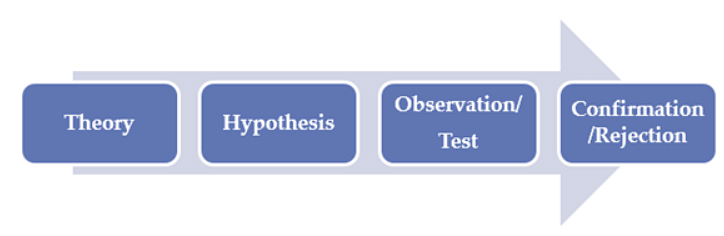
Deductive Reasoning
For example:
Statement 1: Tangents are always perpendicular to the radius of the circle.
Reasoning: If a given figure is a circle, then its tangent and its radius will be perpendicular to each other.
Statement 2: Compound Interest offers higher returns than Simple Interest.
Reasoning: If I invest in Compound Interest I will benefit more.
Statement 3: A man reads a lot about politics and daily affairs.When he meets someone he tries to discuss politics and daily affairs with them.
Reasoning: The man is interested in politics and daily affairs.
Types of Statements
[Click Here for Sample Questions]
In mathematical reasoning, there are three main types of reasoning statements:-
- Simple Statement
- Compound Statement
- If – then (conditional) Statement
Simple Statements
Simple Statements are those which convey a piece of logical information without the need of any modifiers or connectives. A Simple Statement cannot be broken into further parts.
For example: The sun is a Star.
This sentence is scientific and logical and does not have any modifiers and cannot be broken further. So, it is a Simple Statement.
Compound Statement
Usually a compound statement contains two (sometimes more than two) pieces of information in a single sentence. These include connectives such as ‘and’ and ‘or’. Mathematically a Compound Statement is made up of two Simple Statements clubbed together with the help of connectives.
‘If –then’ or Conditional Statements
Conditional Statement are those statements which are based on conditions. It is the form of compound statement in which the true value of a part of a statement depends upon the true value of the other part of the statement.
For example – ‘If a number is divisible by 10, then it is also divisible by 5.’
Break the statement into two parts –
1st statement – If a number is divisible by 10.
2nd statement –The number is divisible by 5.
Here, it implies that the validity of the 2nd statement depends upon the validity of the 1st statement. So, if the first statement is true then the 2nd statement is also true.
A conditional statement made up of two simple statements ‘w’ and ‘z’ can be represented by ‘w → z’.
Connectives used in Compound Statements
[Click Here for Sample Questions]
Connectives are the words that are used as a bridge to form a compound sentence by two more compound statements. There are three types of connectives that are used to combine simple statements to form a compound statement. Connectives are simple English words used to connect the statements.
The three types of connectives are as follows:
Conjunction
The compound statement created by joining two basic statements together with the conjunction "and" is known as a conjunctive statement. The words "p and q" or "p Λ q" are used to join the two propositions "p" and "q."

Conjunction
Example: "Time is money and money is time" is the combination of "time is money" and "money is time."
Disjunction
A compound statement called a disjunctive statement is created by putting two or more sentences together with the word "or." When two statements p and q are disjunction, they are expressed as "p or q" or “p ∨ q”.
Example: "A natural number is an odd number or an even number" is the disjunction of the two statements "A natural number is an odd number" and "A natural number is an even number."
Negation
Negation of a statement is the altering of a given statement in such a way as to deny the original statement. It involves a change of meaning of the original statement and uses the word ‘not’.
For Example: 12 is a positive integer.
Its negation would be “12 is not a positive integer.” The negation of a statement ‘Y’ is symbolized as ‘~ Y’.
Mathematical Reasoning Formula used in Compound Statements:
[Click Here for Sample Questions]
If ‘x’ and ‘y’ are two mathematical statements, then their different mathematical reasoning formulae can be represented by the following:-
- x ∧ y –represents the conjunction of two statements indicating ‘x and y’.
- x ∨ y - represents disjunction of two statements indicating ‘x or y’.
- ~ x – represents negation of the statement ‘x’.
- The negation of the conjunction statements is given as the conjunction negation of the two statements.
~ (x ∧ y) = ~ x ∧ ~ y
- The negation of the disjunction of the given statements is given as the disjunction of negation of both the statements.
~ (x ∨ y) = ~ x ∨ ~ y
Method used to frame Mathematical Reasoning Statements:-
[Click Here for Sample Questions]
To frame new statements or for making important deductions from the given statements, the technique generally used is - Negation of the given statement,
Negation method
In this method the validity of the statement is denied by modifying the given statement. The resulting statement is completely opposite of the given statement. The sentence is changed into a negative sentence. This method is also used to check whether a statement is mathematically acceptable or not and also to deduce a new statement.

Negation method
For example:
Statement 1: Sum of two negative integers is always negative.
Negation statement: Sum of two negative integers is not negative.
In this example, the given statement by using ‘not’ can be denied and the new statement means that the sum of two integers cannot be negative. This is inferred as ‘false’. So, it becomes a new mathematical statement,
From this example one can infer that the negation of a mathematical statement is equally acceptable as a mathematical statement.
Read more:
| Relevant Concepts | ||
|---|---|---|
| Linear equation | Digits | Analytical function |
| Set theory | Metric system | Polynomials |
Methods used to check the validity of a Mathematical Reasoning Statements
[Click Here for Sample Questions]
In order to show that a statement is mathematically acceptable or not, validity must be tested. This can be done by the use of the following methods:
- Contradiction method
- Counter method
These methods are discussed below
Contradiction method
It is a simple method, in which the given statement is assumed to be false and then tries to prove that the assumption is wrong by using mathematical operations.
For example:
“The unit of speed is m/s.”
Here, it is assumed that the unit of speed is ≠m/s. Now, the validity of the assumption is checked.
Speed=d/ t =ms
So the unit of speed is m/s.
Hence, the assumption is wrong, the given statement is ‘true’ and thus a valid one.
Counter Method
It is used to check the validity of a given statement by looking for a statement or an example where the given statement is not generalized or valid.
‘The product of two prime numbers is odd.’
Here, one can show that two prime numbers 2 and 17 and their product 34 is an even number. This is how we bring out the contradiction of the given statement and prove it to be ‘false’.
Things to remember
- A mathematical statement is a statement which “Either true or false, but cannot be both simultaneously.”
- An ambiguous statement which holds the possibility of either becoming true or false at the same time cannot be accepted as a mathematical statement.
- Inductive and Deductive reasoning is used in Mathematical Reasoning and Statement.
- Most mathematical statements are based Deductive reasoning.
- There are three types of statements in Mathematical Reasoning: Simple statement,Compound statement and If - then statements.
- Usually there are three different ways with which a new mathematical statement can be formed from a given statement. These are: Negation method, Contradiction method,Counter statement method
Sample Questions
Ques. What is a mathematical statement? (1 mark)
Ans. A mathematical statement is one which fulfills all the criteria to be mathematically acceptable as a statement. It should be either a true or false statement and should not be true and false at the same time.
Ques. What is mathematical reasoning? (1 mark)
Ans. Mathematical reasoning is the application of logic, rationality and mathematical skill in assessing the validity of a given statement and also to find out whether a given statement is mathematically acceptable or not.
Ques. What are the types of reasoning used in math? (1 mark)
Ans. Usually both Inductive and deductive reasoning are used in math, but mostly deductive reasoning is applied in Mathematical reasoning and statements.
Ques. Consider the following statements, state whether each one is mathematically acceptable statement or not: (3 marks)
(a) Hyderabad is situated in Andhra Pradesh.
Ans. Yes.The given statement is a straightforward sentence without any ambiguity. It is a true fact hence a mathematically acceptable statement.
(b) Jay loves to play games.
Ans. No. In this sentence there is a lot of ambiguity as it is not clear which games Jay loves to play. So, it cannot be a mathematically acceptable statement.
(c) 0 is an integer.
Ans. Yes. This statement is a clear and true fact. So, it is a mathematically acceptable statement.
Ques. Check whether the given two statements are true with respect to each other. (2 marks)
(i) Sphere A and a circle B have the same radius.
(ii) A sphere A and a circle B have the same circumference.
Ans. To show the relation between the two statements we first need to analyze each statement in the light of mathematical reasoning. The first statement is true as there is a possibility of a circle and a sphere to have the same radius. Hence, it is true and mathematically acceptable. The second statement is also true so both the statements are true with respect to each other.
Ques. “The product of squares of two positive numbers is always negative.” Is the statement mathematically acceptable? (2 marks)
Ans. Yes. Firstly everything is clearly stated in the statement, there is no ambiguity. The statement argues that if one calculates the product of squares of two positive numbers the result is always negative, which in practice is not true. So, it is a mathematically acceptable statement.
Ques. Frame a new statement for each of the following statements given below by using the negation method: (1 mark)
(a) The multiple of three positive integers X, Y and Z is always greater than 0.
Ans. The multiple of three positive integers X, Y and Z not greater than 0.
(b) All Prime Numbers are divisible by 1.
Ans. All Prime Numbers are not divisible by 1.
Ques. What are the two methods used to check the validity of reasoning statements? (2 marks)
Ans. The two methods used are:
- Contradiction method
- Counter method
Ques. Mention two types of statements (2 marks)
Ans. The two types of statements used in mathematics are:
- Simple statements
- Compound statements
Ques. What are the connectives? Mention the types. (2 marks)
Ans. Connectives are the words that are used as a bridge to form a compound sentence by two more compound statements. The three types of connectives are:
- Conjunction
- Disjunction
- Negation
Check out:



Comments