



Education Journalist | Study Abroad Lead
Millikan’s oil drop experiment was used to determine the charge of an electron. The product of the charge and the electric field equals the force on any electric charge in an electric field. Millikan was able to determine the magnitude of the charge by measuring both the quantity of electric force and the magnitude of the electric field on the minuscule charge of an isolated oil droplet.
| Table of Content |
Keyterms: Electron, Electric force, Electric field, Magnetic field, Electrodes, Gravity, Coulombs, Microscope
What is Millikan’s Oil Drop Experiment?
[Click Here for Sample Questions]
Millikan’s oil drop experiment was performed in 1909 by Robert Millikan and Harvey Fletcher to discover the charge of an electron. By balancing downward gravity with upward drag and electric forces, they were able to hang tiny charged droplets of oil between two metal electrodes.

Millikan’s Oil Drop Experiment
As the density of the oil was known, Millikan and Fletcher were able to calculate the masses of the droplets based on their observed radii (since from the radii they could calculate the volume and mass). Millikan and Fletcher calculated the charge on oil droplets in mechanical equilibrium using the known electric field and the values for gravity and mass.
They proved that the charges were all multiples of a basic value by repeating the experiment. They calculated 1.5924 × 10⁻¹⁹ Coulombs (C), which is within 1% of the currently recognized value of 1.602176487 × 10⁻¹⁹ C. This was thought to be the charge of a single electron, according to them.
Also Read:
Apparatus Required
[Click Here for Sample Questions]
Milliken and Fletcher designed and built the experiment's apparatus. It consisted of two metal plates separated by an insulated rod. There were four holes in the plate, three of which allowed light to flow through and one of which allowed viewing through the microscope.
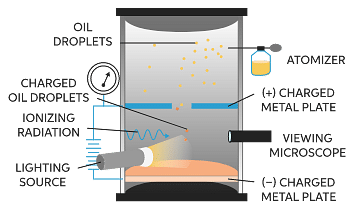
Millikan Oil Drop Apparatus
Ordinary oil was not used in the experiment because it would evaporate due to the heat of the light, perhaps resulting in a Millikan's Oil Drop Experiment mistake. As a result, the oil was employed that is commonly used in vacuum apparatuses and has a low vapour pressure.
Procedure of Millikan’s Oil Drop Experiment
[Click Here for Sample Questions]
- Oil goes through the atomizer in tiny droplets, as it did before. The same droplets travel through the apparatus's upper plate's holes.
- The terminal velocity of the oil droplets is measured after the droplet's downward movements are examined using a microscope and the mass of the oil droplets is determined.
- By passing through the X-ray beam, the air inside the chamber is ionized. Collisions with gaseous ions created by air ionization produce the electrical charge on these oil droplets.

Procedure of Millikan oil-drop experiment
- The electric field is then established between the two plates, causing the charged oil droplets' motion to be impacted by the same electric field.
- The oil is now being drawn downward by gravity, while the charge is being pushed upward by the electric field. The electric field strength is also controlled so that all of the oil droplets reach a gravity-balanced state.
- At equilibrium, the charge on the droplet is computed, which is based on the mass of the droplet and the strength of the electric field.
Formula of Millikan’s Oil Drop Experiment
[Click Here for Sample Questions]
In the absence of an electric field, the experiment allows the oil drops to fall between the plates. They accelerate initially because of gravity, but due to air resistance, the oil droplets progressively slow down.
The following is the Millikan oil-drop experiment formula.
Fup = Q ⋅ E
Fdown = mg
Where,
Q → Charge of an electron
m → Mass of a droplet
E → Electric field
g → gravity
Q ⋅ E = m ⋅ g
Q = m.gE
This allows one to figure out how Millikan measures an electron charge. Millikan also discovered that all the drops had charges in the range of 1.6x 10⁻¹⁹C.
Importance of Oil Drop Experiment
[Click Here for Sample Questions]
Millikan was able to calculate the sum of electric force and the size of the electric field using the minuscule charge of an isolated oil droplet, and then use the data to determine the amount of the charge itself. Between 1909 and 1910, physicist Robert Millikan conducted a series of oil-drop experiments.

Importance of Oil Drop Experiment
Because the plates were charged, the droplets entered the distance between them and could be made to rise and fall by varying the voltage applied to them. The vapour pressure of paraffin oil is 0.5 kPa as a standard.
Principles of Oil Drop Experiment
[Click Here for Sample Questions]
There are only a few of these principles:
- Under its weight, an oil drop can fall. An electric field can be used to suspend a drop that has been given a charge. The weight of each drop is balanced at this point by the electrostatic force. The electrostatic force's size is then totally determined by the decrease. So, as soon as Millikan learned the weight, he should have figured out the charge.
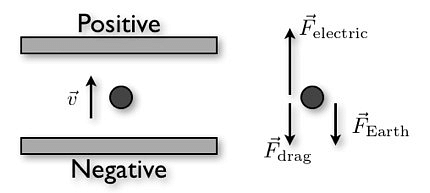
Oil drop experiment principle
- To determine the weight of the drop, Millikan let it fall into the air. It quickly accelerates to its maximum speed. The air's viscous drag balances the weight at this point. The Stokes' Law, which Millikan used to figure out the weight, may be used to compute drag.
- Millikan carried out the same experiment over 150 times and chose 58 of the findings to discover the highest common factor. It's the one unit of charge that could be multiplied to get the total charge he measured across all of his oil drips.
Things to Remember
- The oil drop experiment was performed in 1909 by Robert Millikan and Harvey Fletcher to discover the charge of an electron.
- By balancing downward gravity with upward drag and electric forces, they were able to hang tiny charged droplets of oil between two metal electrodes.
- Because the density of the oil was known, Millikan and Fletcher were able to calculate the masses of the droplets based on their observed radii (since from the radii they could calculate the volume and mass).
- Millikan carried out the same experiment over 150 times and chose 58 of the findings to discover the highest common factor. It's the one unit of charge that could be multiplied to get the total charge he measured across all of his oil drips.
Also Read:
Sample Questions
Ques. Explain the basic principle of Millikan’s Oil Drop Experiment? (5 marks)
Ans: The experiment's basic principle is quite straightforward. The experiment's purpose was to see tiny charged oil droplets between two horizontal metal electrodes. In the absence of an electric field, the oil drops are permitted to fall between the plates at first. They accelerate at first because of gravity, but due to air resistance, they progressively slow down. The oil drop's final velocity is then calculated. Because the oil drop is not accelerating at terminal velocity, the total force exerted on it must be zero. As a result, the gravitational force must be equal to the resistance of the air (drag).
With the supply voltage, a field is now created in the chamber. By changing the voltage, a likely-looking drop is picked and retained in the centre of the field of view. The drop suspends in the air if the electric forces balance the gravitational pull. Some of the drops (the charged ones) will begin to rise if the applied electric force is larger than the downward forces. Gravity and viscous forces will now act downwards, while the electric force will act upwards. The total force acting on it must also be zero in this situation.
Ques. Is it possible to create or destroy a charge? (2 marks)
Ans: The Charge Conservation Law does not imply that generating or removing electrical charges is difficult. It also means that whenever a negative electrical charge is generated, an equal quantity of positive electrical charge must be generated at the same time to ensure that the total charge of the system does not fluctuate.
Ques. A charged particle of mass m is in equilibrium in an applied electric field E in Millikan's Oil Drop experiment. If the direction of the electric field is reversed, what is the particle's acceleration? (4 marks)
Ans: We'll assume the oil droplet has a positive charge q and that the field E is directed up to keep the charge from falling due to gravity. For a negative electron charge, the actual experiment had E pointing down, but this doesn't matter for our reasoning since if q is inverted and E is inverted, the force has the same direction.
The oil droplet begins in a suspended state with the following net force:
\(f = qE - mg\) = 0 as a result, qE = mg
The initial acceleration before friction with the air becomes a limiting factor if E is suddenly inverted is:
f = qEm
\(f = qE - mg\) = −2mg
Hence the initial acceleration is 2g.
Ques. When an electron behaves like a wave, how did they compute its mass? (3 marks)
Ans: Its "wave-like" behaviour is irrelevant. The mass of an electron can be measured in a variety of methods. For example, the ratio of electron charge-to-mass (e/m) may be measured by measuring the radius of revolution of electrons in a magnetic field, and its charge can be measured by the Millikan Oil Drop Experiment, and the mass of the electron can be estimated from these two easy experiments. [Also, as of now, the electron charge has been a determined constant, exactly 1.602 x 10⁻¹⁹ C, so the Oil Drop experiment is no longer necessary.]
Ques. What is vapour pressure? (2 marks)
Ans: Equilibrium or vapour pressure at a given temperature in a closed system, vapour pressure is defined as the pressure exerted by a vapour in thermodynamic equilibrium with its condensed phases (solid or liquid). The evaporation rate of a liquid can be calculated using the equilibrium vapour pressure. It has to do with particles trying to get out of a liquid (or a solid). The term "volatile" refers to a chemical that has a high vapour pressure at room temperature. Vapour pressure refers to the pressure exerted by vapour above a liquid surface.
Ques. What exactly is a vacuum? (3 marks)
Ans: A vacuum is a space that is completely devoid of matter. The word comes from the Latin adjective vacuus, which means "void" or "empty." A zone with a gaseous pressure significantly lower than atmospheric pressure is an approximation to such a vacuum. Physicists frequently discuss ideal test findings that would occur in a perfect vacuum, which they sometimes simply refer to as "vacuum" or "free space," and use the phrase partial vacuum to refer to a real imperfect vacuum, such as one found in a laboratory or space.
Vacuum, on the other hand, is a term used in engineering and applied physics to describe any space with a pressure that is significantly lower than atmospheric pressure. An object that is surrounded by a vacuum is referred to as vacuo in Latin.
Ques. Why are charges quantized? (2 marks)
Ans: Charges are quantized because the charge of each thing is different (ion, atom, etc.) As a result of charge quantization, no random values can be extracted from the charge, only integral multiples of the basic charge (proton/electron charge).
Ques. In Millikan's Oil Drop Experiment, Why Was the Negative Plate Earthed? (3 marks)
Ans: There are three plausible options for clearing it.
The first reason is for our protection. Grounding (or "earthing," as the case may be) the equipment is critical, especially when working with high voltages. The same precautions would be used to protect the equipment as well as personal safety.
The second reason is to obtain a suitable, steady voltage measuring reference point. A larger and more solidly linked grounding cable might do a better job.
Finally, the two plates employed in Millikan's experiment form a capacitor from an electrical standpoint. This capacitor, on the other hand, is being charged to a very high voltage. In such instances, it is recommended that a discharge path be installed on one of the terminals or plates to prevent damage to humans or equipment. As a result, the negative plate is grounded.
Ques. In the Millikan Oil-drop Experiment, why do we use oil instead of other liquids? (3 marks)
Ans: For Millikan's oil drop experiment, oil is one of the best liquids. It keeps its bulk for a long time and can withstand greater temperatures. We also use an atomizer to create ultra-fine droplets. Because water cannot live at such high temperatures, less dense liquids such as water and oils are recommended.
The use of an atomizer is another major rationale for employing oil in this experiment. It is also worth noting that oil would keep its identical volume, quantity, and weight. This would allow for a precise charge measurement. Other liquids would separate, evaporate, or dissipate.
Ques. What is the definition of an electron? (2 marks)
Ans: An electron is a negatively charged component of an atom that is stable. Electrons exist outside and around the nucleus of the atom. In comparison to a neutron or proton, each electron has a modest mass and carries one unit of negative charge (1.602 x 10⁻¹⁹ coulomb). Protons and neutrons have substantially more mass than electrons. An electron has a mass of 9.10938 x 10⁻³¹ kg. This is around 1/1836 of a proton's mass.
For Latest Updates on Upcoming Board Exams, Click Here: https://t.me/class_10_12_board_updates
Check-Out:



Comments