



Education Journalist | Study Abroad Lead
De Broglie Wavelength Formula is a formula that defines the nature of a wave to that of a particle. Many experiments show that light can behave both as a wave and as a particle. The particles of light are known as photons. A French physicist named Louis de Broglie created a formula in 1924 to define the dual nature of light as a wave and as a particle. This formula is also used for electrons as well as protons.
| Table of Content |
Key Takeaways: De Broglie wavelength, Photons, Planck’s constant, Electron, Proton, Light, Particle, Wave, Wavelength, Speeds, momentum
De Brogile Wavelength
[Click Here for Sample Questions]
Louis de Broglie stated that any particle that moves will behave like a wave. This experiment was later demonstrated by Clinton Davisson and Lester Germer in 1927. The waves that are related to matter are called matter waves. They are also known as De Broglie waves.
Particles like electrons and protons except photons have a different de Broglie wavelength formula. At non-relativistic speeds, the momentum of a particle would be equal to its rest mass m multiplied by the velocity v.
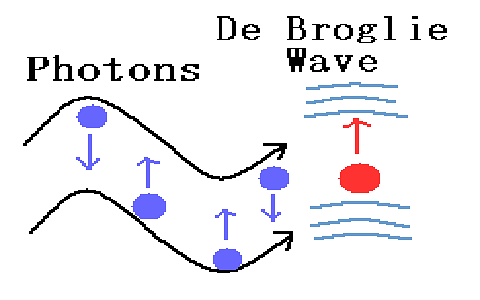
De Broglie Wave
Also Read:
| Related Articles | ||
|---|---|---|
| Dual Nature of Radiation and Matter | Relativity | Chapter 11 Dual Nature of Radiation and Matter |
| Electron Emission | Electromagnetic Radiation | Davisson and Germer Experiment |
De Brogile Wavelength Formula
[Click Here for Previous Year Questions]
According to De Broglie, the wavelength which is represented by (λ) of any moving object is given by
| λ = \(\frac{h}{p}\) |
Or
| λ = \(\frac{h}{mv}\) |
Where
λ is the de Broglie wavelength in metres
h is the Planck’s constant that is 6.63 × 10⁻³⁴ Js
p is the momentum of a particle in kg m s-¹
m is the mass of the particle in kg
v is the velocity of a particle ms-¹
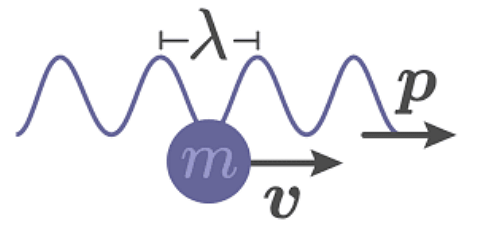
De Broglie Wave
De Broglie Equation Derivation
[Click Here for Sample Questions]
From Einstein’s theory of relativity, we get that
E = mc² → Equation (1)
Where
E is the energy of the particle
m is the mass of the particle
c is the speed of the light
According to Planck’s theory, every quantum of a wave has a separate amount of energy associated with it, the following equation was given
E = hf → Equation (2)
Where
E is the energy of the particle
h is the Planck’s constant = 6.62607×10⁻³⁴ Js
f is the frequency
De Broglie’s Wavelength Equation suggests that particles and waves have similar behaviour. Thus, he equated the relation of energy for both the particle and the wave; by simplifying equations (1) and (2)
mc² = hf → Equation (3)
If λ is the wavelength of the wave, then the frequency will be f = v / λ
Substituting this in equation (3), we get
mv² = hv / λ
λ = h / mv
Or
λ = h / p → Equation (4)
where p is the momentum of the particle.
De Brogile Wavelength of an Electron
[Click Here for Previous Year Questions]
Matter waves that are related to real objects are very small and are useless to us. But for subatomic particles with negligible masses, the value of de Broglie is significant. To find the de-Broglie wavelength related to a microscopic particle.
Let us take the mass of the electron as
m = 9.1×10-³¹kg,
moving with the speed of light, i.e.,
c = 3 × 10⁸m/s
Then the De Broglie wavelength associated with it can be given as:
λ = h / mc
λ = 6.62607×10⁻³⁴ Js / 9.1×10-³¹kg x 3 × 10⁸m/s
= 0.7318×10-¹¹ m
Or
0.073 Ao
Thus, the de-Broglie wavelength associated has a significant value, and it can be found out.
Things to Remember
- Matter can have a dual nature i.e. it can behave both as a wave and as a particle.
- De Broglie Wavelength Formula defines the nature of a wave to that of a particle.
- De Broglie Wavelength Formula: λ = h / p Or λ = h / mv
- De Broglie Wavelength is a part of quantum mechanics.
- De Broglie Wavelength states the probable density of finding the object at a given configuration space point.
Also Read:
Sample Questions
Ques 1. A certain photon has a momentum of 1.50 × 10⁻²⁷ kgms-¹. What will be the photon’s de Broglie wavelength? (3 marks)
Ans. Given
p = 1.50 × 10⁻²⁷ kgms-¹
h = 6.63 × 10⁻³⁴ Js (Planck’s constant from De Broglie formula)
De Broglie Wavelength formula
λ = h / p
λ = 6.63 × 10⁻³⁴Js / 1.50 × 10⁻²⁷ kgms?¹
= 4.42 × 10-7
= 442 × 10-9
= 442 nanometer
Therefore, the de Broglie wavelength of the photon will be 442 nm. This wavelength will be in the blue-violet part of the visible light spectrum.
Ques 2. The De Broglie wavelength of the electron is 0.26 nm. Electron particle has a mass of 9.109 × 10-³¹ kg. Calculate the magnitude of the velocity of this electron. (3 marks)
Ans. Given
λ = 0.26 nm
m = 9.109 × 10-³¹ kg
h = 6.63 × 10⁻³⁴ Js (Planck’s constant from De Broglie formula)
The magnitude of the velocity of this electron can be found by using the De Broglie Formula.
λ = h / mv
The formula becomes
V = h /mλ
= 6.63 × 10⁻³⁴Js / 9.109 × 10-³¹ kg x 0.26 nm
= 2.80 × 10⁶ ms-¹
Thus, the electron with de Broglie wavelength of 2.60 Armstrong will have the velocity of 2.80 × 10⁶ ms-¹
Ques 3. Find the wavelength of an electron moving with a speed of 2 x 10⁶ ms-¹. (3 marks)
Ans. Given
v = 2 x 10⁶ ms-¹ (velocity of electron)
h = 6.63 × 10⁻³⁴ Js (Planck’s constant from De Broglie formula)
m = 9.109 × 10-³¹ kg (mass of an electron)
De Broglie Formula
λ = h / mv
λ = 6.63 × 10⁻³⁴Js / 9.109 × 10-³¹ kg x 2 x 10⁶ ms-¹
λ = 0.364 × 10⁶ m
Ques 4. What is the de Broglie wavelength associated with (a) an electron moving with a speed of 5.4×10⁶ m/s, and (b) a ball of mass 150 g travelling at 30.0 m/s? (5 marks)
Ans. a) For the electron:
Given
m = 9.11×10-³¹ kg (mass of an electron)
v = 5.4×10⁶ m/s. (speed of electron)
Then, p = m v
= 9.11×10-³¹ kg × 5.4 × 10⁶ m/s
p = 4.92 × 10⁻²⁴ kg m/s
de Broglie wavelength,
λ = h/p
h = 6.63 × 10⁻³⁴ Js
(Planck’s constant from De Broglie formula)
λ = 6.63 × 10⁻³⁴ Js / 4.92 × 10⁻²⁴ kg m/s
λ = 0.135 nm
b) For the ball:
m1 = 0.150 kg (mass of the ball)
v1 = 30.0 m/s (speed of the ball)
Then, p1 = m1 v1
p1 = 0.150 kg x 30.0 m/s
de Broglie wavelength
λ1 = h/p1
λ1 = 6.63 × 10⁻³⁴ Js / 0.150 kg x 30.0 m/s
λ1 = 1.47 ×10⁻³⁴ m
The de Broglie wavelength of an electron is comparable with X-ray wavelengths. However, for the ball, it is about 10-19 times the size of the proton, quite beyond experimental measurement.
Ques 5. An electron, an α-particle, and a proton have the same kinetic energy. Which of these particles has the shortest de Broglie wavelength? (2 marks)
Ans. For a particle, de Broglie wavelength
λ = h/p
Kinetic energy, K = p² /2m
Then, λ =h / √2mK
For the same kinetic energy K, the de Broglie wavelength associated with the particle is inversely proportional to the square root of their masses.
A proton is 1836 times more massive than an electron and an α-particle four times that of a proton. Hence, α – particle has the shortest de Broglie wavelength.
Ques 6. A particle is moving three times as fast as an electron. The ratio of the de Broglie wavelength of the particle to that of the electron is 1.813 × 10⁻⁴. Calculate the particle’s mass and identify the particle. (3 marks)
Ans. De Broglie wavelength of a moving particle, having mass m and velocity v
λ = h / p = h / mv
Mass, m = h / λv
For an electron, mass me = h / λe ve
Now, we have v/ve = 3 and
λ/λe = 1.813 × 10⁻⁴
Then, the mass of the particle, m = me λ
m = 9.11×10-³¹ kg × 1/3 × 1 /1.813 × 10-4
m = 1.675 × 10⁻²⁷ kg
Thus, the particle with this mass could be a proton or a neutron.
Ques 7. What is the de Broglie wavelength associated with an electron, accelerated through a potential difference of 100 volts? (2 marks)
Ans. Accelerating potential V = 100 V.
The de Broglie wavelength λ is
λ = h /p
= 1. 227 / √V = nm
= 0.123 nm
The de Broglie wavelength associated with an electron in this case is of the order of X-ray wavelengths.
Ques 8. Calculate the wavelength of an electron that is moving at the speed of light. (3 marks)
Ans. The De Broglie wavelength equation is as follows
λ = h / mv
where λ is the wavelength
h = 6.63 × 10⁻³⁴ Js
v = 3 × 10⁸m/s
m = 9.11×10-³¹ kg
λ = 6.63 × 10⁻³⁴ Js / 9.11×10-³¹ kg x 3 × 10⁸m/s
λ = 0.2424 x 10-¹¹m
λ = 2.424 nm
Previous Year Questions
- A beam of cathode rays is subjected to crossed electric (E) and magnetic fields (B).….. [NEET 2010]
- A beam of electron passes undeflected through mutually perpendicular electric and magnetic fields….[NEET 2007]
- When light of wavelength 300 nm (nanometer) falls on a photoelectric emitter, photoelectrons are liberated….. [NEET 1999]
- The de-Broglie wavelength of a neutron in thermal equilibrium with heavy water at….. [NEET 2017]
For Latest Updates on Upcoming Board Exams, Click Here: https://t.me/class_10_12_board_updates
Check-Out:



Comments