



Education Journalist | Study Abroad Lead
De Broglie relationship determines that similar to light, matter also exhibits wave-like and particle-like properties. This nature has been described as dual behaviour of matter. Based on his observations, de Broglie derived a relationship between momentum of matter and wavelength. This relationship is termed as the De Broglie Relationship.
| Table of Content |
Keyterms: Matter, Momentum, Wavelength, Atoms, Spectrum, Magnetic fields, Electric fields, Bohr’s model, Atomic model
What is the De Broglie Relationship?
[Click Here for Sample Questions]
Many concepts related to the spectrum of various atoms and the splitting of spectral lines under magnetic and electric fields were not explained by Bohr's model. To address the flaws in Bohr's atomic model, efforts were undertaken to build a more comprehensive atomic model.
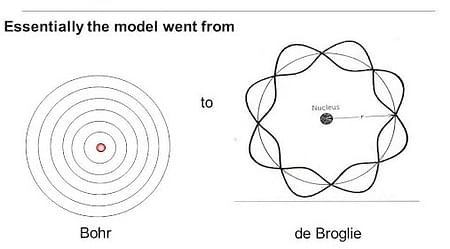
The examination of dual behaviour of matter was one of those developments that had a profound impact on the formulation. Considering the particle nature, Einstein equation is shown as,
E= mc2 …...(1)
Where,
E = energy
m = mass
c = speed of light
Considering the wave nature, the Plank’s equation is given as,
E = hν …... (2)
Where,
E = energy
h = Plank’s constant
ν = frequency
From (1) and (2),
mc2 = hν …... (3)
Frequency, ν can be expressed in terms of wavelength, λ as,
ν = c/λ
For a general particle, c can be replaced with the velocity of object, v. Hence, equation (3) can be given as,
mv2 = hv/λ ⇒ λ = h/mv
The above equation is known as de Broglie relationship and the wavelength, λ is known as de Broglie wavelength.
Every object in motion has a wavelike character. The wavelengths associated with ordinary objects are short due to a large mass. Due to this, their wave properties cannot be detected. On the contrary, the wavelengths connected with electrons and other subatomic particles can be experimentally detected.
Also Read:
Significance of De Broglie Equation
[Click Here for Sample Questions]
de Broglie explained that all the objects in motion have a particle nature. Yet, if we look at a moving car or a moving ball, they don’t seem to have particle nature. To explain this further, de Broglie derived the wavelengths of a cricket ball’s electrons.
De Broglie Wavelength
1. De Broglie Wavelength for a Cricket Ball
Let’s assume,
Mass of the ball = 150 g (150 x 10-³ kg),
Velocity = 35 m/s, and
h = 6.626 x 10⁻³⁴ Js
Now, putting these values in the equation λ = hmv
λ = 6.626×10⁻³⁴/150×10−3×35
On solving, we get,
λBALL = 1.2621 x 10⁻³⁴
m = 1.2621 x 10⁻²⁴ Å
Å is a very small unit, and thus, the value is in the power of 10−24. Here onwards, we see that the moving cricket ball is a particle.
Now, the question arises whether this ball has a wave nature or not. Answer will be a big no because the value of λBALL is immeasurable.
Hence, de Broglie’s theory of wave-particle duality is valid for the moving objects ‘up to’ the size (not equal to the size) of the electrons.
2. De Broglie Wavelength for an Electron
We know that me = 9.1 x 10⁻³¹ kg, and ve = 218 x 106 m/s
Now, putting these values in the equation λ = h/mv = 9.1×10⁻³¹/218×106
λ = 3.2 Å
This value is measurable. Thus, we can say that electrons have wave-particle duality. Also, all the big objects have a wave nature and microscopic objects like electrons have wave-particle nature.

De Broglie Hypothesis: Conclusion
From de Broglie equation for a material particle, i.e., λ = h/p = h/mv, we conclude that:
If v = 0, then λ = ∞, and,
If v = ∞, then λ = 0
This denotes that waves are associated with the moving material particles only. Therefore, these waves are independent of their charge.
De Broglie Wavelength of an Electron Derivation
[Click Here for Sample Questions]
Let’s say an electron accelerated from resting position through a voltage difference of V volts.
Then,
Gain in KE = ½ mv2
Work done on the electron = eV
So, ½ mv2 = eV or v = √2eV/m
We know that λ = h/mv = h/√2meV
On substituting the values:
h = 6.626 x 10⁻³⁴ J/s
m = 9.1 x 10⁻³¹kg
e = 1.6 x 10⁻¹⁹ C

On solving, we get
λ = 12.27/√VÅ
De Broglie Equation Derivation and de Broglie Wavelength
[Click Here for Sample Questions]
Particles of very low mass travelling at less than the speed of light act like a particle and a wave. de Broglie devised an equation that associates the mass of such smaller particles to their wavelength.
Plank’s quantum theory explains the connection between energy of an electromagnetic wave and its wavelength or frequency.
E = hν = hc/λ……(1)
Einstein associated the energy of particle matter to its mass and velocity, as E = mc2……..(2)
As the smaller particle has a dual nature, and energy is the same, de Broglie equated both these relations for the particle moving with velocity ‘v’ as,

Here, ‘h’ is the Plank’s constant.
This equation connecting a particle's momentum to its wavelength is known as the de Broglie equation, and the wavelength determined using this connection is known as the de Broglie wavelength.
Things to Remember
- De Broglie wave, also known as matter wave, is any element of a material object's behaviour or characteristics that varies in time or space in accordance with the mathematical equations that describe waves.
- The wavelength of any moving object may be calculated using the de Broglie wave equations.
- The wavelength of an electron increases with reduction in its speed.
- De Broglie established the following relationship between a material particle's wavelength () and momentum (p). λ=h/mv=h/p. Here is the wavelength, and p is the momentum.
- Every moving item has a wave nature. Because of their large masses, the wavelengths associated with common objects are so short that their wave characteristics cannot be determined.
Also Read:
Sample Questions
Ques. Derive the relation between de Broglie Wavelength and Temperature. (3 Marks)
Ans. We know that the average KE of a particle is:
K = 3/2 kbT
Where kb is Boltzmann's constant, and T = temperature in Kelvin
The kinetic energy of a particle is ½ m2
The momentum of a particle, p = mv = √2mK = √2m(3/2)KbT= √2mKbt
de Broglie wavelength, A = h/p = h √2mKbT
Ques. If the KE of an Electron Increases By 21%, Find the Percentage Change in its de Broglie Wavelength. (3 Marks)
Ans. We know that λ = h/√2mK
So, λi(2m x 100), and λf= h/√2m121
% change in λ is:
Change in wavelength/Original x 100 =(λfi-λf)/i= ((h/√2m)(1/10-1/21))/(h/√2m)(1/10)
On solving, we get % change in λ = 5.238 %
Ques. Does, de Broglie hypothesis have any relevance to macroscopic matter? (3 Marks)
Ans. de Broglie relation can be applied to both microscopic and macroscopic. Taking for example a macro-sized 100Kg car moving at a speed of 100m/s, will have a-

High-energy γ-radiations have wavelengths of only 10-12 m.
Very small wavelength corresponds to high frequencies. Waves below a certain wavelength or beyond certain frequencies undergo particle-antiparticle annihilation to create mass. So, wave nature or de Broglie wavelength is not observable in the macroscopic matter.
Ques. The De-Broglie wavelength for an electron in 10th Bohr's orbit H-atom is [h=6.625×10⁻³⁴ j/s, me=9.110−31 kg, and ao =0.529 angstrom]. (3 Marks)
(a) 33.2 angstrom
(b) 16.6 angstrom
(c) 66.4 angstrom
(d) 332.4 angstrom
Ans. Given,
Ao=0.529Å
de-Broglie's wavelength of e¯ present in
1st Bohr orbit = 2∏0.529Å
10th Bohr orbit = 2∏0.529Å10
=2∏5.29A°
As angular momentum is quantized,
Here, mvao=h/2∏
2∏ao=h/mv= λ
Here, 2∏ao = 2∏5.29Å
∴= 2∏5.29A°
= 33.2A°
Option (A) is correct.
Ques. The de Broglie wavelength relates to applied voltage as: (5 Marks)
(a) λ=12.3/√hA°
(b) λ=12.3/√VA°
(c) λ=12.3/√EA°
(d) None of these
Ans. According to de Broglie, every moving particle can act as either wave or particle at different times. The wave associated with moving particles is called de Broglie wave, having de Broglie wavelength. For an electron, the de Broglie wavelength equation is written as:
λ=h/mv
Where, λ is the wavelength of an electron, h is Planck’s constant, m and v are mass and velocity of an electron respectively and together it is momentum.
This states that all the moving particles have wave-particle dual nature which is true for all the particles. de Broglie wavelength of an electron can be derived in following way:
Let us suppose an electron is accelerated from rest position through a voltage difference of V volts, then the gain in kinetic energy is 1/2mv2 and work done on the electron or potential energy can be described as eV.
So, we can say that gain in kinetic energy is equal to work done on the electron or potential energy of an electron just before colliding with the target atom.

We can substitute the values in the above formula like
h = 6.626×10⁻³⁴J/s
m = 9.1×10⁻³¹kg
e = 1.6×10⁻¹⁹C
This gives,

On solving it completely, we get
=12.3/√¯V*Å
Hence, the correct option is (B).
For Latest Updates on Upcoming Board Exams, Click Here: https://t.me/class_10_12_board_updates
Check-Out:



Comments